





Home
|



Refund if not satisfied

Support Available

Privacy Confidentiality
© 2024 GuruCool.life. All rights reserved
Dr balkrisna | Hindu God and Goddess
2023-12-22
“Vakratunda Maha-Kaaya Surya-Kotti Smaprabha
Nirvighnam KuruMe Deva Sarva-Karyeshu Sarvada II"
Introduction:
Lord Ganesha, the beloved elephant-headed deity, is revered across the Hindu world as the remover of obstacles and the patron of new beginnings. While his popular tales of wisdom and bravery are widely known, his rich mythology holds many hidden gems waiting to be discovered. Let's delve into some fascinating lesser-known stories that showcase different facets of Ganesha's character.
These are just a few glimpses into the lesser-known world of Ganesha. Each story adds a new layer to his personality, revealing him as not just a remover of obstacles, but also a wise son, a dedicated scribe, a compassionate deity, and a powerful protector. As you explore these hidden narratives, you may discover a deeper connection with Lord Ganesha and gain valuable insights into his enduring significance.
Remember, these are just a starting point. There are many other fascinating stories about Ganesha waiting to be discovered. So, keep exploring and let yourself be enchanted by the rich tapestry of his mythology!
There are myriad mythological testimonies and anecdotes of Lord Ganesha acquiring his elephant head. According to the Shiva Purana, in the absence of Nandi, a trusted accomplice of Lord Shiva, Parvati fashioned a boy out of the turmeric paste from her frame and infused existence into it to shield the door until she completed her ablution.
However, when Lord Shiva, a stranger to the boy, expressed his desire to meet Parvati, an undesirable problem arose. Much to Shiva’s dismay, the boy was determined to follow his mother’s command and impeded his meeting Parvati. A fierce battle ensued between Lord Shiva and the boy. At the end, Lord Shiva, along with his Trisul (trident), decapitated the boy.
Being livid past the limit, goddess Parvati threatened to annihilate all creations. Then Lord Brahma manifested to placate the inconsolable mother Parvati on the condition that the boy be revived and worshiped earlier than the puja of all the other gods. Lord Shiva also repented for his misdeed. According to the path of Lord Shiva, His aides fetched the top of a sturdy and powerful elephant, Gajasura. Lord Brahma set the elephant head onto the boy’s frame, and Lord Ganesha was, as a result, created.
However, the want of Gajasura changed and was additionally fulfilled. Once Lord Shiva changed into happiness by using the austerity exhibited during penance by Gajasura, a demon with the traits of an elephant. The demon expressed his desire that Lord Shiva inhabit his stomach. Lord Shiva granted his desire. Finding no trace of Lord Shiva, His consort Parvati entreated Lord Vishnu to find out her husband.
Then Lord Vishnu arranged a cosmic dance executed by Nandi (the bull of Shiva) in cadence with the melodious notes of the flute performed with the aid of Him. Gajasura became so enraptured with the performance of the duo that he wished to fulfill any choice of the flutists who became none aside from Lord Vishnu. In step with Vishnu’s choice, Gajasura liberated Lord Shiva from his stomach. Then Lord Shiva blessed Gajasura so that his head could be embellished by means of each person.
Brahma Vaivarta Purana tells another legend at the back of the elephant head of Lord Ganesha. After Parvati gave birth to a refulgent baby, all of the gods and goddesses, together with Shani (Saturn), were invited to bless the brand new-born baby. But no sooner had Shani, who is notorious for his cataclysmic gaze, beheld the toddler than his head became decapitated from his torso. Then Lord Vishnu, mounting on His divine vehicle, Garuda, fetched the head of a younger elephant from the Pushpa Bhadra River and fixed it on the child’s torso.
Lord Shiva, in another mythological tale, via mistake decapitated Aditya, the son of Kashyapa, one of the first-rate seven Rishis (sages). Later, Shiva repented his misdeed and substituted Aditya’s head with the head of Devraj Indra’s elephant, Airavata. The enraged Rishi cursed Lord Shiva to stand the identical awkward quandary.
According to Padma Purana, Goddess Ganga is taken into consideration as the foster mother of Lord Ganesha. Goddess Parvati, out of the fragrant oily paste implemented in her frame, molded the parent of a boy with an elephant head. The advent of an odd figure out of her caprice changed her into being later immersed within the river Ganga. The determined springing to lifestyles in contact with sacred water of the river become recognized as Lord Ganesha.
In another legend, the sacred water spilling from the frame of Goddess Parvati while bathing mingled with the river Ganga. The elephant-headed goddess Malini drank the sacred water and gave birth to a baby with five elephant heads. Lord Shiva bestowed upon the child the title of Goddess Parvati's son. Lord Shiva decreased the five elephant heads into
There are numerous testimonies on the damaged tusk of Lord Ganesha. In line with Brahmanda Purana, Parashuram, the 6th avatar of Lord Vishnu, changed into a crush with gratitude to Lord Shiva, who empowered him to win the fight with Kartavirya Arjuna. He got here to pay his obeisance to Lord Shiva at Mount Kailash. However, Ganesha avoided meeting his father, who changed into a sound asleep. Then Parashuram hurled his awl. However, Ganesha restricted himself as the awl changed into something bestowed on Parashurama by using his father, Lord Shiva. He embraced the blow with his left tusk. The chopped tusk fell to the floor.
According to any other popular legend, Ganesha lost his tusk while writing the manuscript of the Mahabharata. recommended by means of Lord Brahma, the Maharshi Veda Vyas urged Ganesha to jot down the manuscript of the amazing scripture. While writing the manuscript of the epic, the feather of his pen broke. Then Ganesha pulled out his left tusk to finish the undertaking he had been entrusted with.
There is also a funny tale about Ganesha dropping his challenge. One full moon night, while Ganesha changed into returning after relishing a luxurious dinner from Kubera’s palace, he stumbled down on the floor. All of the meals he had eaten popped out of his stomach. Noticing this, the god Moon could not restrain himself and burst out laughing. Ganesha, being angry, hurled his tusk, broke the god Moon into pieces, and also cursed him to be invisible. He cursed the moon, saying that if one sees the god Moon on the day of Ganesha Chaturthi, one will fail to reap'moksha' (emancipation from the cycle of dying and delivery). Consequently, viewing the moon on Ganesha Chaturthi is considered inauspicious.
In line with Ganesha Purana, a celestial musician god named Krauncha, a divine mouse, prayed to Ganesha to lessen his weight so that he might want to support him. Lord Ganesha granted his prayer, allowing the divine mouse to be his vehicle. Consequentially, the mouse or rodent is popularly considered the ‘vahana’ (divine vehicle) of Lord Ganesha. except that Lord Ganesha used special ‘vahanas’ like the lion, divine peacock, and Sheshnag at some stage in His incarnations of Vakratunda, Vikata, and Vighnaraja, respectively.
There are numerous exciting known concerning Lord Ganesha’s love and marital lifestyles. Goddess Tulsi, enamored by means of Ganesha’s resplendent apparel of yellow garments and sandal paste smearing all over His body in His ascetic shape, sought Him as her consort. But Ganesha, with politeness, grew to reject her marriage proposal. This humiliated Tulsi to the point of disappointment. She cursed Ganesha, saying that He would be destined to just accept a forceful marriage against His will. Ganesha also cursed her to be condemned to marry a demon. Consequently, Tulsi leaves are not supplied to Ganesha due to their entanglement in mutual curses. In this tale, Ganesha is diagnosed as a ‘Brahmachari’ (celibate) without a consort.
In some other mythological tales, Siddhi (the power of spirituality) and Riddhi (the strength of prosperity), the daughters of Prajapati Vishwaroopa, are the two consorts of Lord Ganesha. They're blessed with two beautiful sons, Khema (safety) and Labh (earnings). The wives and sons of Lord Ganesha are the divine incarnations of the characteristics that are attained by worshiping the elephant-confronted god.
Prasadam:
Modak is popularly served as the prasadam of Lord Ganesha. The main elements of modak are flour, grated coconut, and jaggery. There are a variety of modaks, specifically Mava Modak, Kesari Modak, Moong Dal Modak, and so forth. On the other hand, chocolate modak and paneer modak are the contemporary versions of the dessert. Twenty-one Modaks are offered to Lord Ganesha as prasadam.
Symbolism:
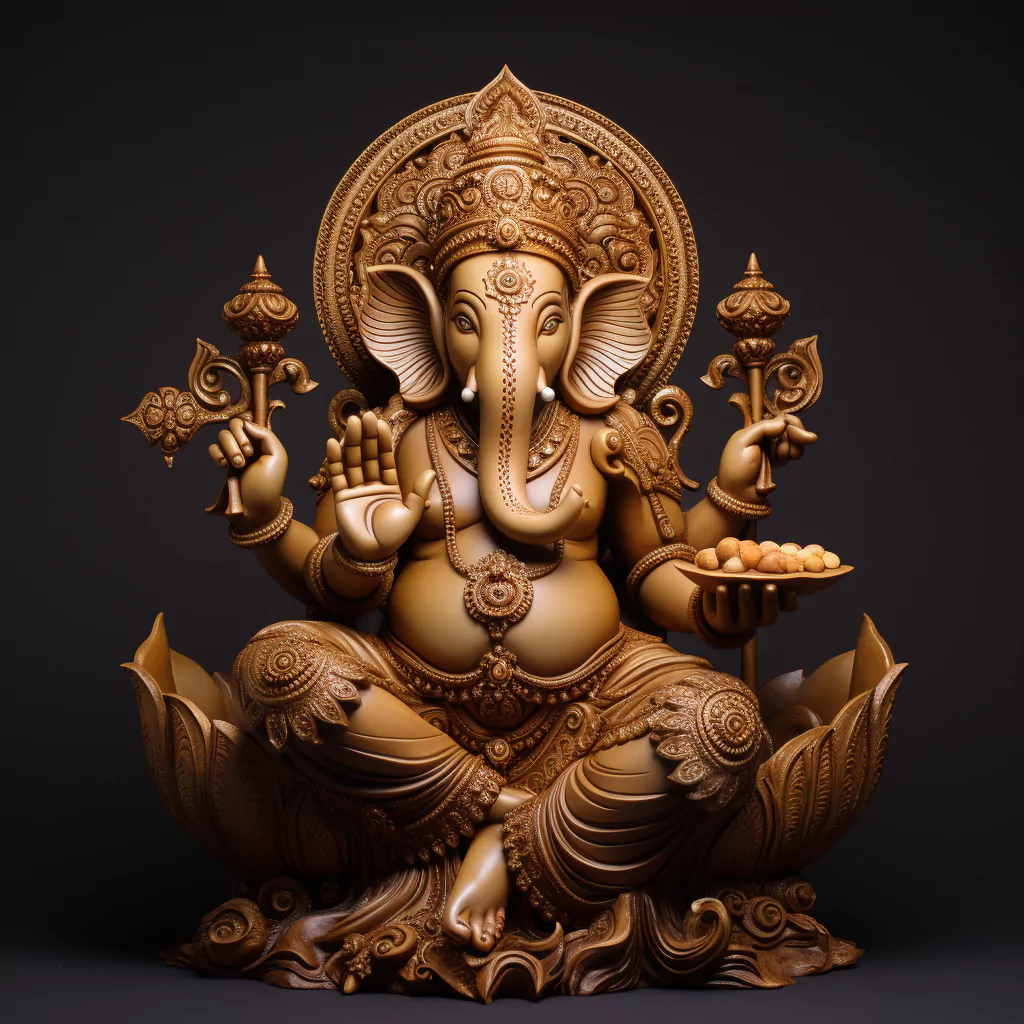
The idol of Lord Ganesha includes plenty of symbolism. Exclusive people interpret in another way. A trunk like that of the elephant symbolizes strength and a strong experience of discrimination to differ properly from evil. Huge ears advise the strength of listening and attention that one wishes to accumulate know-how. The pot stomach is the symbol of a big box that can soak up everything gracefully. His single tusk indicates the weariness of the mundane world and authentic know-how past the dichotomy. The sitting posture of Lord Ganesha, with one leg resting on the floor and the other folded up, symbolizes the dilemma between material and divine internationalism except that the hands of Lord Ganesha are embellished with some not unusual things. In one hand, he holds a lotus, the symbol of enlightenment. The laddu in one of his palms stands for the sweet result of spiritual elevation attained after penance. The noose or hatchet symbolizes the myth of the cloth internationally. One will get away with the noose handiest while one attains actual salvation, i.e., Moksha. On the other hand, the blessing posture indicates the assurance bestowed on the devotees by Lord Ganesha.
In different religions and countries, Lord Gonesha, like different famous Hindu deities, is worshiped in special names in nations transcending the boundary of India. In Burma, Ganesha is popular as Maha Peinne, whereas in Thailand, the elephant-headed god is worshiped at the call of Phra Pikanet. In Sri Lanka, he is worshiped as Gana Deviyo.
The Buddhists and Janists worship Lord Ganesha with exquisite devotion. In Japanese Buddhism, Kangiten, representing a couple of elephants of opposite sexes in mating posture, is considered Lord Ganesha. In Indonesia, Ganesha is worshipped as the ‘Indonesian God of Understanding'. Ganesha dancing posture is worshipped as the destroyer of obstacles, whereas Ganapati, or Maha Rakta, is the Tantric Buddhist form of Ganesha. but, in China, Lord Ganesha is very often revered sented as the obstacle as opposed to the remover of it.
Get Insights from Our Expert Astrologer
Get Insights from Our Expert Astrologer
Download Barsane Wali Radha ringtone for mobile and enjoy a beautiful Radha Krishna bhakti ringtone filled with devotion, love, and spiritual positivity.
Shiva Rudra Mantra
316 Downloads
Jai Ambe Gauri
356 Downloads
Khatu Wala Shyam
341 Downloads
Gayatri Mantra Of Hanuman
354 Downloads
Jai Bhole Jai Bhole Ringtone | Mahadev Devotional Ringtone
391 Downloads
Barsane Wali Radha
381 Downloads
Shiva Nirguna Stotra
325 Downloads
Hanuman Lalla Ki Aarti
355 Downloads
Maa Durga Devotional Ringtone
358 Downloads
Kui Bhekawe
360 Downloads
Hanuman Chalisa
334 Downloads
Har Har Mahadev Ringtone | Powerful Shiv Devotional Ringtone 🔱
372 Downloads
Narayanaya Namo Namah
384 Downloads
Haare Ka Sahara
334 Downloads
Shiva Kirtan Ringtone | Powerful Shiv Devotional Ringtone
336 Downloads