





Support

Consult about
Horoscope
Wallpapers
Ringtones
Services
Company
Help
Payments


Refund if not satisfied

Support Available

Privacy Confidentiality
© 2024 GuruCool.life. All rights reserved
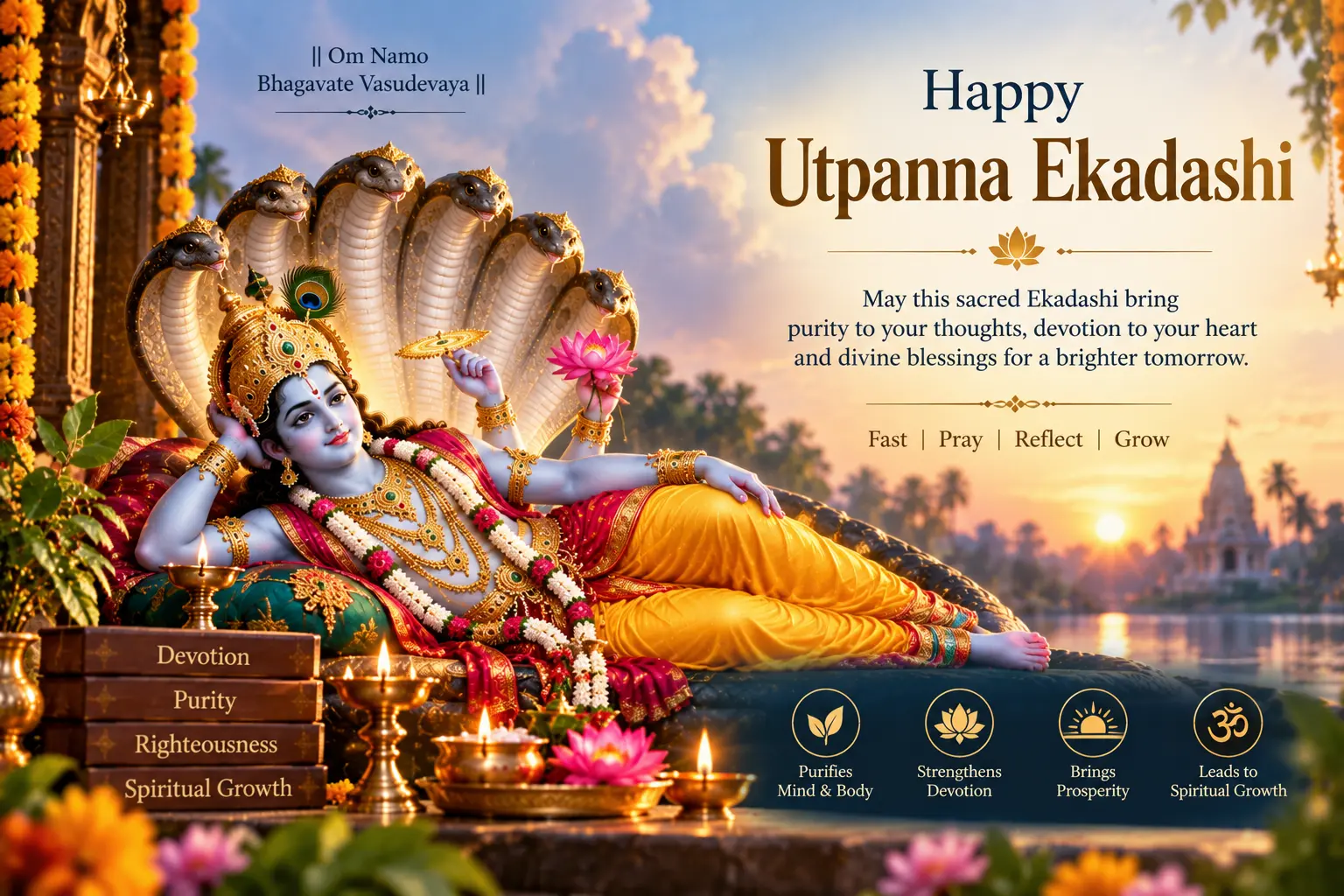
Utpanna Ekadashi occurs during Margashirsha Krishna Paksha.
It is primarily dedicated to Lord Vishnu.
The tradition associates the festival with the manifestation of Goddess Ekadashi.
Grains and beans are commonly avoided during Ekadashi fasting.
Utpanna Ekadashi falls on December 4, 2026 across the major Indian calendars checked.
Utpanna Ekadashi is an important Hindu fasting festival dedicated primarily to Lord Vishnu. It is observed on the Ekadashi, or eleventh lunar day, of Krishna Paksha during the Hindu month of Margashirsha. The festival has a special place in Vaishnava traditions because Hindu religious literature associates it with the origin and spiritual significance of Ekadashi itself. \n\nEkadashi occurs twice in each lunar month, once during Krishna Paksha and once during Shukla Paksha.
Devotees traditionally observe these days through fasting, prayer, meditation, self-control, charity, and devotional activities. Utpanna Ekadashi is especially significant because it is associated with Goddess Ekadashi, who is regarded as the divine personification of the Ekadashi vrata. \n\nAccording to traditional stories, a powerful demon named Mura was creating difficulties for the gods and divine beings. Lord Vishnu fought against Mura and eventually rested in a cave.
When Mura attempted to attack Vishnu, a divine feminine energy emerged from Vishnu and defeated the demon. This manifestation became known as Ekadashi. \n\nThe story is interpreted symbolically as the victory of spiritual strength over destructive tendencies. The demon can represent uncontrolled desires, laziness, anger, attachment, and other forces that disturb spiritual discipline.
Ekadashi represents the awakening of consciousness capable of overcoming those tendencies. \n\nDevotees generally begin Utpanna Ekadashi with an early morning bath and a religious resolve, or sankalpa. Lord Vishnu may be worshipped with flowers, lamps, incense, fruits, Tulsi leaves, and devotional prayers. Some devotees visit Vishnu temples or participate in bhajans and kirtans.
\n\nFasting is the central practice. However, Hindu traditions allow different levels of fasting. Some devotees observe Nirjala fasting without food or water, while others consume fruits, milk, nuts, or foods specifically permitted during vrat. Grains and beans are commonly avoided.
\n\nThe purpose of fasting is not merely physical deprivation. Ekadashi is intended to encourage control of the senses and reduce unnecessary distractions. Devotees may use the day to reduce entertainment, avoid harmful speech, control anger, meditate, read scripture, and spend additional time in prayer. \n\nVishnu-related scriptures, the Bhagavad Gita, Vishnu Sahasranama, and other devotional texts may be read.
Charity is also encouraged. Donating food, clothing, money, or other necessities provides a practical expression of compassion. \n\nThe fast is traditionally concluded on Dwadashi during the prescribed Parana period. The exact Parana time is location-dependent because it depends on local sunrise and the relationship between the tithi and sunrise.
Therefore, an India-wide application should calculate Parana separately rather than storing one fixed national time. \n\nUtpanna Ekadashi in 2026 falls on December 4. Indian Hindu calendars across multiple regions consistently list December 4 as the festival date. \n\nThe festival can also be viewed as a spiritual reset.
People often accumulate habits and distractions without noticing them. Ekadashi creates a recurring opportunity to stop, examine those habits, and consciously redirect attention toward spiritual goals. \n\nThe deeper meaning of Utpanna Ekadashi is therefore self-control, spiritual awakening, devotion, purification, and protection from negative tendencies. \n\nFor modern families, the festival can be observed through a suitable fast, Vishnu worship, scripture reading, meditation, charity, and mindful behavior.
People who cannot safely fast can participate through prayer and devotional activities without undertaking a physically harmful fast. \n\nUtpanna Ekadashi ultimately teaches that spiritual strength develops through repeated discipline. The story of Ekadashi's manifestation represents the awakening of inner strength when destructive forces appear overwhelming. \n\nThe festival therefore combines mythology, fasting, devotion, ethical discipline, charity, and spiritual reflection into one of the important Ekadashi observances of the Hindu calendar.
What is Utpanna Ekadashi?
Utpanna Ekadashi is a sacred Hindu festival observed with devotion and religious rituals. It holds deep spiritual significance in the Hindu lunar calendar.
When is Utpanna Ekadashi observed?
The exact date changes every year based on the Hindu lunar calendar. Check the Daily Panchang on GuruCool for accurate tithi and muhurat timings.
What are the main rituals of Utpanna Ekadashi?
Devotees observe fasts, perform puja, chant mantras, and engage in charitable activities during Utpanna Ekadashi. Specific rituals vary by region and family tradition.
What is the spiritual significance of Utpanna Ekadashi?
Utpanna Ekadashi holds great religious importance in Hinduism. Observing it with full devotion is believed to bring blessings, ancestral merit, and spiritual liberation.
How can I get guidance for Utpanna Ekadashi rituals?
You can consult expert Vedic astrologers on GuruCool for personalized guidance on performing rituals correctly as per your birth chart and family tradition.