





Support

Consult about
Horoscope
Wallpapers
Ringtones
Services
Company
Help
Payments


Refund if not satisfied

Support Available

Privacy Confidentiality
© 2024 GuruCool.life. All rights reserved
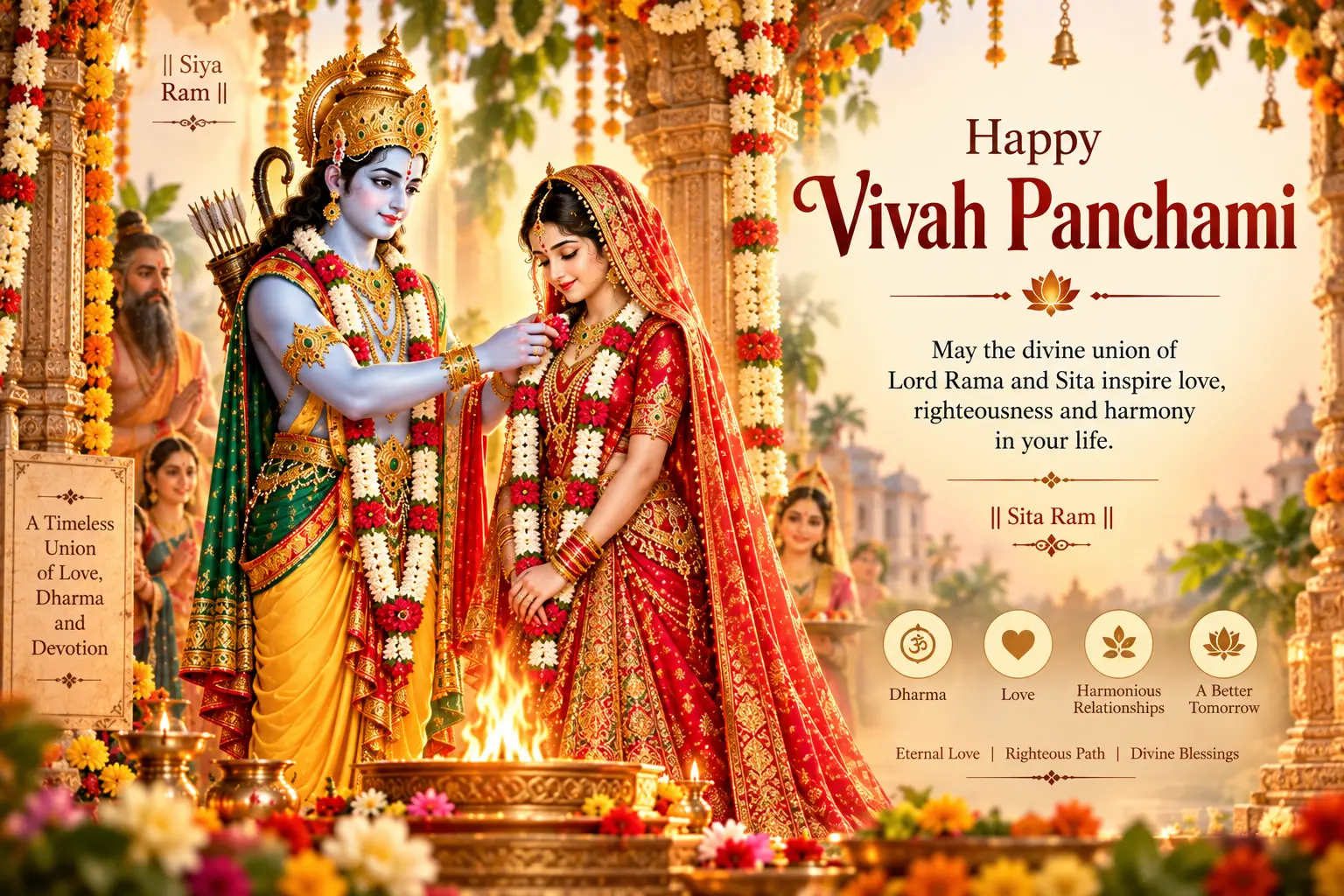
Vivah Panchami commemorates the marriage of Lord Rama and Goddess Sita.
It is observed on Margashirsha Shukla Panchami.
The festival is strongly connected with the Ramayana.
Janakpur and Ayodhya are major centers of Vivah Panchami traditions.
Vivah Panchami is a significant Hindu festival commemorating the divine marriage of Lord Rama and Goddess Sita. It is observed on Margashirsha Shukla Panchami, the fifth lunar day of the bright fortnight of Margashirsha. The festival is particularly important in Ayodhya, Janakpur, and other places associated with the Ramayana tradition. \n\nLord Rama is revered as an incarnation of Lord Vishnu and is traditionally regarded as an ideal embodiment of dharma, righteousness, responsibility, courage, and moral conduct.
Sita is revered as an incarnation of Goddess Lakshmi and represents devotion, strength, dignity, loyalty, and spiritual resilience. \n\nThe marriage of Rama and Sita is one of the major events described in the Ramayana. According to the traditional story, King Janaka of Mithila arranged a swayamvara for his daughter Sita. A great challenge was established: the suitor had to lift and string the powerful bow associated with Lord Shiva.
\n\nMany kings attempted to complete the challenge but failed. Rama eventually lifted the bow and broke it while attempting to string it. Having demonstrated his strength and worthiness, Rama became the chosen bridegroom of Sita. \n\nThe marriage was celebrated with great joy, and the event became a central example of an ideal marriage in Hindu tradition.
\n\nVivah Panchami therefore has significance beyond the historical or mythological event. It represents the union of two individuals committed to dharma and responsibility. Rama and Sita's relationship is traditionally presented as a model of devotion, loyalty, sacrifice, and mutual responsibility. \n\nOn Vivah Panchami, devotees perform special Rama-Sita Puja and may organize a symbolic wedding ceremony.
Temples decorate the images of Rama and Sita with wedding clothing, jewelry, flowers, and ornaments. Priests may perform traditional marriage rituals, mantras, aarti, and offerings. \n\nDevotees may also read or listen to the Ramayana, particularly sections describing the marriage of Rama and Sita. Bhajans, kirtans, processions, and cultural programs may accompany the religious ceremonies.
\n\nJanakpur in Nepal is especially famous for Vivah Panchami because of its association with Sita and the ancient kingdom of Mithila. Ayodhya is also a major center of celebration because of its connection with Lord Rama. \n\nIn India, celebrations are especially visible in Uttar Pradesh and other regions where Rama traditions are prominent. However, devotees throughout the country can observe the festival through home puja and scripture reading.
\n\nThe festival can also have significance for married couples and families. Some devotees pray for harmony, mutual respect, stability, and happiness in marriage. \n\nAn important lesson from the festival is that Hindu marriage traditions are often understood as a dharmic partnership. Marriage is not merely a personal relationship but can involve shared responsibilities toward family, society, and spiritual development.
\n\nRama's commitment to dharma and Sita's strength in difficult circumstances are repeatedly emphasized in traditional interpretations of the Ramayana. \n\nVivah Panchami also helps preserve the Ramayana as a living cultural tradition. Children and younger generations encounter the story through temple ceremonies, dramatic performances, devotional songs, storytelling, and family discussions. \n\nIn 2026, Vivah Panchami falls on December 14.
The major Indian Hindu calendars checked for Rajasthan, Haryana, Uttar Pradesh, Bihar, Karnataka, Kerala, and other regions list December 14 for this observance. \n\nThe festival's deeper message is therefore about sacred partnership, devotion, responsibility, and dharma. \n\nFor devotees, the day can be observed through Rama-Sita worship, reading the Ramayana, visiting a temple, participating in a symbolic wedding ceremony, or simply reflecting on the values represented by Rama and Sita. \n\nVivah Panchami ultimately combines mythology, devotion, marriage symbolism, cultural heritage, and spiritual education.
\n\nIt reminds devotees that relationships become meaningful when they are supported by responsibility, loyalty, respect, patience, and shared commitment to righteous living.
What is Vivah Panchami?
Vivah Panchami is a sacred Hindu festival observed with devotion and religious rituals. It holds deep spiritual significance in the Hindu lunar calendar.
When is Vivah Panchami observed?
The exact date changes every year based on the Hindu lunar calendar. Check the Daily Panchang on GuruCool for accurate tithi and muhurat timings.
What are the main rituals of Vivah Panchami?
Devotees observe fasts, perform puja, chant mantras, and engage in charitable activities during Vivah Panchami. Specific rituals vary by region and family tradition.
What is the spiritual significance of Vivah Panchami?
Vivah Panchami holds great religious importance in Hinduism. Observing it with full devotion is believed to bring blessings, ancestral merit, and spiritual liberation.
How can I get guidance for Vivah Panchami rituals?
You can consult expert Vedic astrologers on GuruCool for personalized guidance on performing rituals correctly as per your birth chart and family tradition.