




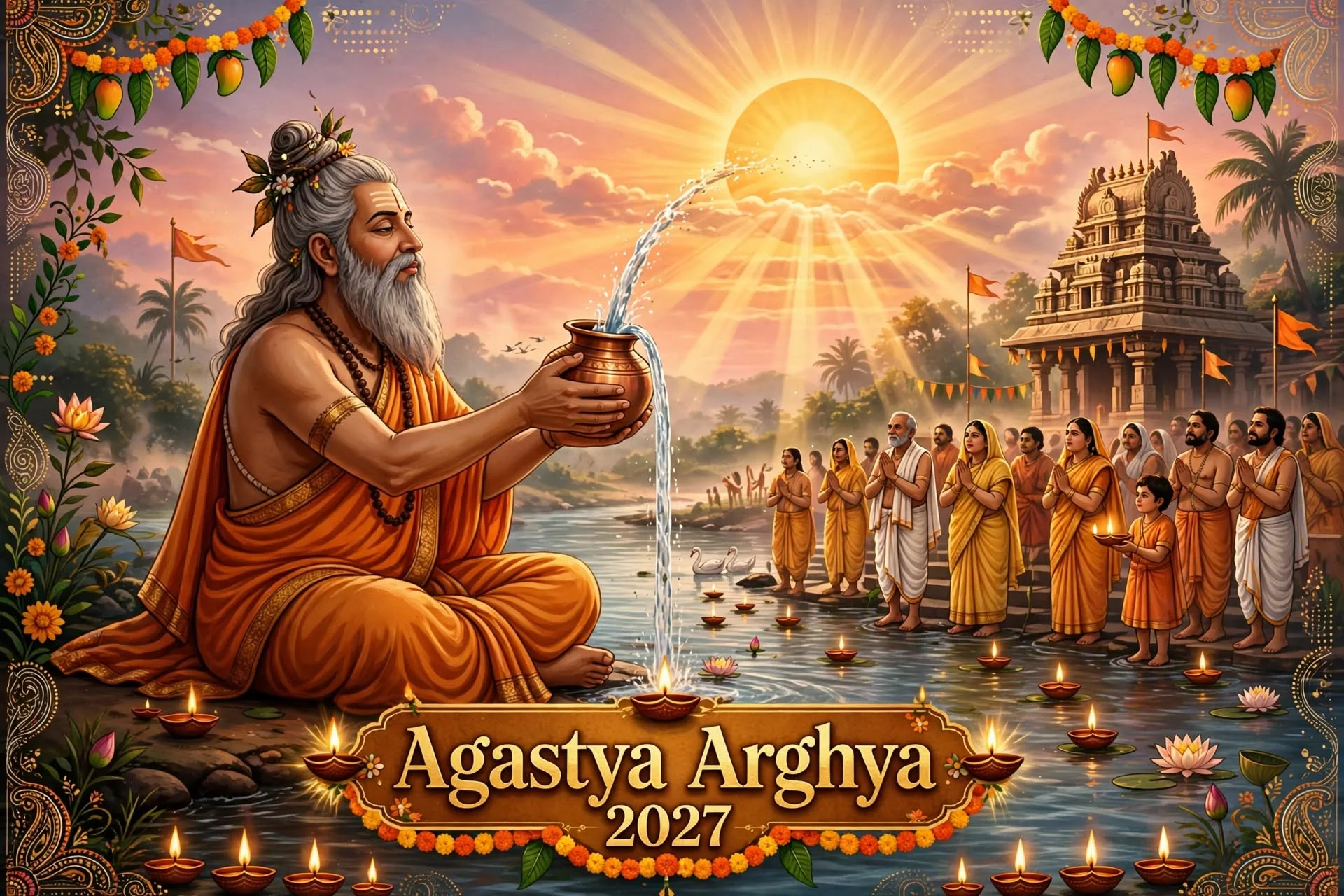
Agastya Arghya, also known as Agastya Udaya Arghya, is a profound astronomical and Vedic ritual observed during the transition of late monsoon into early autumn (Sharad Ritu), when the celestial star Canopus (known in Sanskrit as the Agastya Nakshatra) first rises above the southern horizon at dawn. In ancient Indian astronomy (Surya Siddhanta) and Puranic literature, the dawn rising of Agastya is celebrated as an extraordinary cosmic event marking the physical and energetic purification of all terrestrial waters, the calming of turbulent monsoon rivers, and the pacification of atmospheric toxins.
Agastya Arghya 2027: Date, Puja Timings, Rituals & Stories
Agastya Arghya Timings & Panchang
Important festival dates and auspicious timings
Usha Arghya (Sunrise)
05:59 am
Sandhya Arghya (Sunset)
06:44 pm
Start Date
Tuesday, 31 Aug 2027
Puja Muhurat
06:12 am – 11:11 pm
Agastya Arghya
Dedicated to the venerable Maharishi Agastya—one of the exalted Saptarshis (Seven Sages) and the revered father of traditional Tamil language, Siddha medicine, and Vastu Shastra—this sacred observance commemorates the sage's boundless spiritual prowess. Puranas recount how Sage Agastya drank the entire cosmic ocean in three sips to reveal the subterranean demons Kalakeyas hiding beneath the seabed, commanded the towering Vindhya mountain range to bow and remain humble, and revealed the invincible Aditya Hridaya Stotram to Lord Sri Rama on the battlefield of Lanka.
According to scriptural mandates in the Matsya Purana, Agni Purana, and Bhavishya Purana, offering sacred water libations (Arghya) in a pure copper, brass, or silver vessel to Sage Agastya during the initial days of His celestial rising purifies the devotee of severe physical diseases, removes planetary afflictions, and cleanses sins accumulated across seven lifetimes. Seekers rise before dawn, offer water mixed with white flowers, sandalwood, and sweet fruits, and donate copper vessels, gold, and medicines to learned healers and Brahmins.
Why is Agastya Arghya Celebrated?
Agastya Arghya is celebrated to honor the cosmic dawn rising of the star Canopus (Agastya Nakshatra) and to pay profound homage to Maharishi Agastya, the sovereign master of Vedic knowledge, medicine, and spiritual mastery.
In Vedic meteorology and Ayurveda, the heliacal rising of Agastya cleanses the earth's waters of monsoon mud, bacteria, and seasonal impurities, turning natural springs into pure, sweet, and curative nectar (known as 'Hamsodaka').
The festival honors the ancient sage who maintained cosmic balance by subduing the pride of the Vindhya mountains, liberating the gods from demonic terror, and teaching humanity the sciences of healing and solar devotion.
- Offering dawn water libations (Arghya) to the rising star Canopus (Agastya Nakshatra).
- Celebrating the natural purification and detoxification of terrestrial waters (Hamsodaka).
- Paying homage to Maharishi Agastya for composing the Aditya Hridaya Stotram and Siddha sciences.
- Seeking divine protection from seasonal fevers, abdominal ailments, and planetary doshas.
- Donating copper vessels, grains, gold, and Ayurvedic medicines to physicians and the needy.
Scriptural Origins in the Matsya Purana, Agni Purana, and Ramayana
The Drinking of the Cosmic Ocean in the Mahabharata
In the Vana Parva of the Mahabharata and the Matsya Purana, Sage Lomasha narrates the epic leela of Agastya to King Yudhishthira. During a cosmic conflict between gods and Asuras, the terrifying demon clan Kalakeyas waged guerrilla warfare from beneath the unfathomable depths of the ocean, emerging at night to slaughter pious sages and retreating into the waters by day.
Helpless, the gods approached Sage Agastya for deliverance. Accompanied by the Devas, the illustrious sage stood upon the shore, gathered the entire surging cosmic ocean into the palm of His right hand (Achamana), and drank it dry in three continuous sips. The ocean floor lay exposed, enabling the Devas to vanquish the demonic hordes. At the gods' request, the ocean was subsequently replenished by the descent of the holy river Ganga.
Subduing the Pride of the Vindhya Mountains
The Skanda Purana records that when the Vindhya mountain range grew filled with pride, swelling its peaks into the heavens to block the path of Surya Deva (the Sun), the universe was plunged into chaos and perpetual twilight. The gods pleaded with Sage Agastya, who was the preceptor of the mountains.
As Agastya approached the Vindhyas, the mountain range bowed prostrate in humble reverence before its guru. Agastya smiled and commanded: 'Remain bowed until I return from the south.' The sage journeyed south into Tamil Nadu, settling permanently in the Podhigai hills to establish Tamil culture and Siddha medicine, while the Vindhya mountains remain modestly lowered to this day.
Bestowing the Aditya Hridaya Stotram upon Lord Rama
In the Yuddha Kanda of the Valmiki Ramayana, Lord Sri Rama stood weary and contemplative on the battlefield of Lanka, preparing for the final confrontation with the demon king Ravana. Sage Agastya appeared on the battlefield among the gods and imparted the sacred Aditya Hridaya Stotram—the secret Vedic hymn of the Sun God that destroys all enemies and grants perpetual victory.
Astronomical Purification, Hamsodaka, and Spiritual Mastery
The Phenomenon of Hamsodaka (Purified Autumn Water)
The Charaka Samhita and Sushruta Samhita note that during the humid monsoon season, terrestrial waters are turbid, acidic, and laden with biological toxins. With the dawn rising of Agastya, the unique electro-magnetic rays of Canopus purify the waters.
Warmed by autumn sun rays by day and cooled by clear moonbeams by night, this water becomes 'Hamsodaka'—stainless, sweet, digestive, and therapeutic for drinking and bathing.
Sage Agastya as the Master of Kundalini Fire
In yogic metaphysics, Sage Agastya's ability to drink the ocean and digest the demon Vatapi represents mastery over the internal fire of digestion and spiritual awakening (Agni Tattva).
Offering Arghya to Agastya awakens the solar plexus (Manipura Chakra), burns past karmic toxins, and bestows longevity, sharp intellect, and radiant health.
Dawn Arghya Procedure, Altar Arrangement, and Healer Charity
Dawn Astronomical Timing and Vessel Preparation
Devotees verify the exact date and dawn timing of Agastya Udaya through local astronomical Panchangs. Rising before sunrise, they bathe in clean running waters and prepare a clean copper, silver, or brass vessel.
The vessel is filled with pure water, fragrant white sandalwood paste, white flowers, unbroken rice (akshata), sweet fruits, and five medicinal gems or silver coins.
The Offering of Arghya and Dana to Healers
Standing facing South at dawn, the water is poured in three continuous streams toward the rising Agastya star while reciting the ancient Puranic verse ('Kashyapasya Atmajo Devah...').
Following the libation, devotees donate copper utensils, Ayurvedic medicines, grains, clothes, and financial dakshina to physicians, herbalists, and learned Brahmins.
Agastya Arghya Puja Vidhi (Step by Step)
- 1
Arunodaya Snana & Sankalpa
Wake early before dawn during the Arunodaya period, bathe in clean running water, wear fresh white or yellow traditional garments, and resolve to offer Agastya Arghya for health and karmic purification.
- 2
Copper Vessel (Arghya Patra) Cleansing
Thoroughly cleanse a pure copper or silver vessel, anointing its outer rim with sacred white sandalwood paste and vermilion swastikas.
- 3
Preparation of the Consecrated Arghya
Fill the copper vessel with clean spring or Ganga water, adding white sandalwood paste, white lotus or jasmine flowers, unbroken rice (akshata), curd, and sweet fruits.
- 4
Dhyana of Maharishi Agastya
Stand facing South, meditating upon the golden-hued Sage Agastya, crowned with matted ascetics' locks, holding a water pitcher (Kamandalu), and radiating solar effulgence.
- 5
Agastya Arghya Samarpan (The Water Libation)
Raise the copper vessel above head level and pour the sanctified water in three steady, unbroken streams toward the rising star, chanting the ancient Puranic Arghya mantra.
Agastya Arghya Puja Samagri List
Arghya Vessels and Celestial Offerings
- Pure copper, brass, or silver vessel (Tamra Patra) for pouring Arghya
- Malayagiri white sandalwood paste and rolli (kumkum)
- Fresh white fragrant flowers: white lotus, jasmine, and white oleander
- Unbroken white raw rice grains mixed with turmeric (Akshata)
- Clean river, spring, or Ganga water infused with rosewater
Medicinal, Fruit, and Altar Articles
- Fresh seasonal sweet fruits: pomegranate, sweet lime, and bananas
- Wild raw honey, pure curd, and desi cow ghee
- Pure cow-ghee lamp, cotton wicks, and natural camphor tablets
- Aditya Hridaya Stotra or Matsya Purana scripture text
- Sandalwood incense sticks (agarbatti) and brass bell
Charity and Dana Essentials
- New copper utensils (plates, lotas, or jugs) for donation
- Ayurvedic medicinal herbs (like Triphala, Ashwagandha, and Tulsi seeds)
- Food grains (wheat, rice), jaggery, and white unstitched clothes
- Gold or silver coins and financial dakshina for Ayurvedic physicians
Mantras and Prayers for Agastya Arghya
Agastya Arghya Vrat Rules and Fasting Guidelines
Astronomical Timing and Fasting Rules
Devotees observe a partial fast until dawn Arghya and solar worship are completed. The offering must be poured precisely at dawn when the Agastya star emerges on the southern horizon.
- Offer Arghya precisely at dawn facing South toward the constellation of Canopus.
- Use pure copper, silver, or brass vessels; never use plastic or iron.
- The offered water must fall into a clean basin or clean earth, never stepped upon.
- Donate copper, grains, or medicines to physicians and learned Brahmins.
Ecological and Dietary Consciousness
Honor the natural purification of autumn waters (Hamsodaka). Refrain from polluting natural water sources, and consume light, easily digestible sattvic foods.
Dos and Don'ts of Agastya Arghya
Good Practices (Do's)
- Wake up before dawn and check the exact astronomical time of Agastya's rising.
- Offer Arghya facing South in a clean copper or silver vessel with white flowers.
- Recite the Aditya Hridaya Stotram and the Matsya Purana Agastya prayer.
- Donate copper utensils, Ayurvedic medicines, and grains to healers and the poor.
- Drink clean water energized by the autumn sun and moonbeams (Hamsodaka).
Agastya Arghya Across Regions
| Region | Local Name |
|---|---|
| South India (Tamil Nadu, Kerala, Karnataka) | Agastya Natchathiram Udhayam |
| North India (Varanasi, Haridwar, Prayagraj) | Agastya Arghya |
| Maharashtra & Gujarat | Agastya Arghyadan |
Agastya Arghya FAQs
What is the star Agastya in modern astronomy?
In modern astronomy, the star Agastya is Canopus (Alpha Carinae), the second brightest star in the night sky after Sirius, located in the southern celestial hemisphere.
Why are terrestrial waters believed to become pure when Agastya rises?
Ancient Ayurvedic treatises (like Charaka Samhita) state that the rising of Canopus signals the end of the muddy monsoon season, when cosmic rays purify waters into 'Hamsodaka', making them sweet and therapeutic.
Why is Arghya offered facing South?
Arghya is offered facing South because the star Canopus (Agastya Nakshatra) ascends above the southern horizon in the early morning sky in the northern hemisphere.
Upcoming Festivals
View All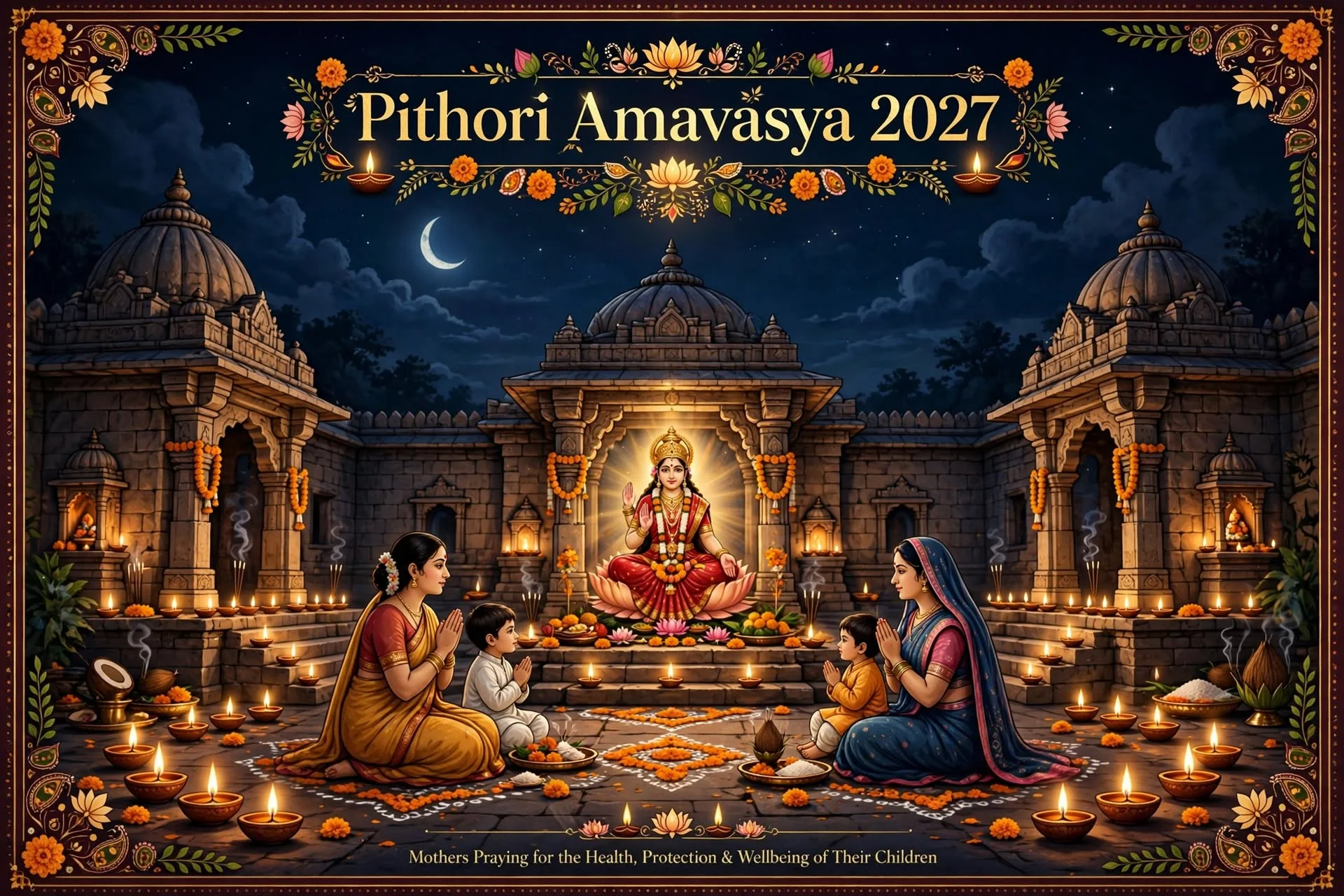
Tuesday, Aug 31, 2027
Pithori Amavasya
Pithori Amavasya, also reverently celebrated across India as Kushagrahani Amavasya, Pola Amavasya, or Pithori Vrat, is the sacred New Moon day concluding the holy monsoon month of Shravana (or Bhadrapada in the Purnimanta calendar scheme). Dedicated to Goddess Durga, Goddess Parvati, and the Sixty-Four Yoginis (Chausath Yogini), this ancient festival is celebrated with profound devotion by mothers for the longevity, health, moral strength, and spiritual protection of their children, as well as the pacification of ancestral souls (Pitrus).
View Festival Guide

Tuesday, Aug 31, 2027
Anvadhan
Anvadhan (अन्वाधान) is an ancient, highly revered Vedic ritual and spiritual observance in Sanatana Dharma performed on the day immediately preceding the New Moon (Amavasya) or Full Moon (Purnima). Rooted in the pristine traditions of the Shrauta and Grihya Sutras, Anvadhan literally translates to 'the solemn placing and replenishment of sacred fuel wood into the consecrated Vedic fires'. In traditional Vedic ritualism, householders (Grihasthas) and priests who maintain the sacred Agnihotra fires perform Anvadhan to prepare the sacrificial altars for the grand Darsha Yajna (New Moon sacrifice) or Paurnamasa Yajna (Full Moon sacrifice) scheduled for the following day.
View Festival Guide

Tuesday, Aug 31, 2027
Shravana Amavasya
Shravana Amavasya, also known as Darsha Amavasya, Hariyali Amavasya, or Pola Amavasya, is the dark New Moon night marking the grand conclusion of the sacred, rejuvenating monsoon month of Shravana. Positioned at the pivotal threshold between the height of the rainy season and the onset of early autumn, this sanctified tithi holds monumental spiritual, ancestral, and ecological significance across the Indian subcontinent.
View Festival Guide

Tuesday, Aug 31, 2027
Darsha Amavasya
Darsha Amavasya is a significant new moon observance in the Hindu calendar designating the specific night when the Moon is completely invisible to the human eye, having fully merged into the conjunction of the Sun.
View Festival Guide