





Support

Consult about
Horoscope
Wallpapers
Ringtones
Services
Company
Help
Payments


Refund if not satisfied

Support Available

Privacy Confidentiality
© 2024 GuruCool.life. All rights reserved
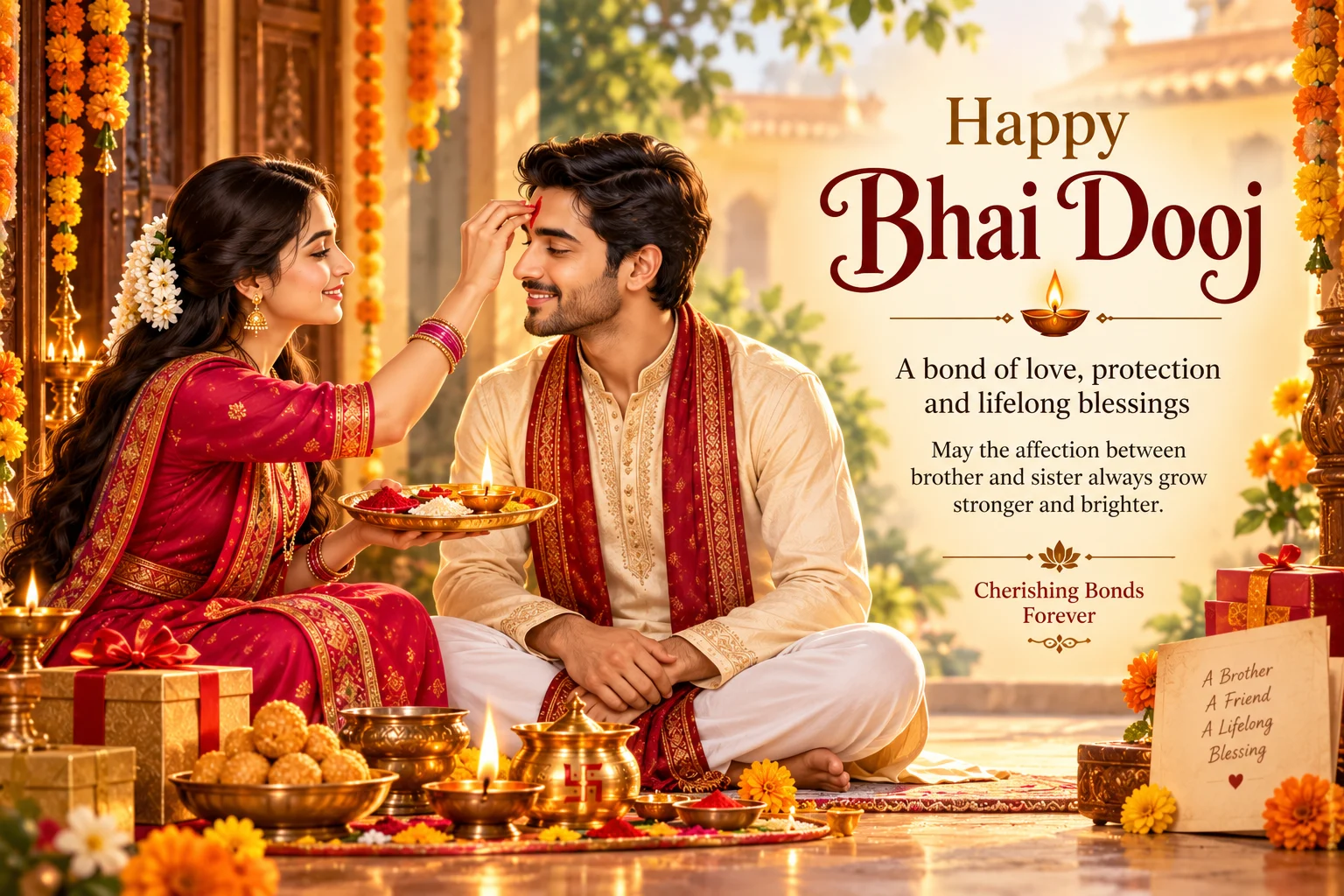
Bhai Dooj is observed on Kartika Shukla Dwitiya.
The festival celebrates the relationship between brothers and sisters.
It is also known as Yama Dwitiya in many traditions.
The sister traditionally applies tilak and performs aarti for her brother.
Bhai Dooj, also known as Bhaiya Dooj, Yama Dwitiya, or Bhau Beej in different regions, is a Hindu festival celebrating the bond between brothers and sisters. It is observed on Dwitiya, the second lunar day of Shukla Paksha in the month of Kartika. The festival occurs shortly after Diwali and forms an important part of the traditional Diwali celebration. \n\nThe central ritual involves a sister applying a tilak to her brother's forehead and praying for his health, happiness, prosperity, and long life.
The brother traditionally gives his sister a gift and promises affection and protection. Modern celebrations often interpret this relationship more mutually, with brothers and sisters expressing care and gratitude toward one another. \n\nOne traditional legend connects Bhai Dooj with Yama, the deity associated with death, and his sister Yamuna. According to the story, Yamuna invited Yama to her home and welcomed him with affection and hospitality.
She performed a ceremonial tilak and offered him food. Pleased by her devotion, Yama granted her a blessing. This story is the reason the festival is also called Yama Dwitiya. \n\nAnother traditional interpretation associates the festival with the relationship between Krishna and his sister Subhadra.
After Krishna's victory over Narakasura, Subhadra welcomed him and performed an auspicious ceremony. This story contributes to the festival's broader association with sibling affection. \n\nBhai Dooj typically begins with family members preparing for the ceremony. Sisters may decorate a puja area, prepare sweets, and arrange the materials needed for tilak.
The brother sits before the sister, who applies the tilak and performs aarti or prayer according to family tradition. \n\nFood is an important part of the celebration. Sisters may prepare or serve their brothers favorite dishes and sweets. Brothers traditionally bring gifts for their sisters, although contemporary families often exchange gifts mutually.
\n\nThe festival is significant because Hindu traditions place considerable importance on family relationships. While Raksha Bandhan also celebrates the brother-sister relationship, Bhai Dooj has a different ritual setting and occurs during the Diwali period. \n\nBhai Dooj is also a time for relatives to visit one another. In families where siblings live in different cities, the festival provides an opportunity to reconnect.
\n\nThe spiritual meaning of the festival is based on affection, responsibility, gratitude, and family solidarity. The rituals are symbolic expressions of a bond that extends beyond material exchange. \n\nIn modern society, Bhai Dooj is increasingly celebrated as a festival of mutual support rather than a one-sided promise of protection. Sisters and brothers may both pray for each other's well-being and success.
\n\nIn 2026, Bhai Dooj falls on Wednesday, November 11. The Dwitiya tithi begins at approximately 2:00 PM on November 10 and ends at approximately 3:53 PM on November 11. The Aparahna period for the ceremony is approximately 1:17 PM to 3:31 PM in the referenced Panchang. \n\nThe festival therefore provides a meaningful conclusion to the major Diwali family celebrations.
After Dhanteras, Diwali, and Govardhan Puja, Bhai Dooj turns the focus toward personal relationships. \n\nIts enduring importance comes from a simple idea: prosperity and celebration are incomplete without strong relationships. Bhai Dooj reminds siblings to maintain affection, respect, communication, and mutual support throughout their lives.
What is Bhai Dooj?
Bhai Dooj is a sacred Hindu festival observed with devotion and religious rituals. It holds deep spiritual significance in the Hindu lunar calendar.
When is Bhai Dooj observed?
The exact date changes every year based on the Hindu lunar calendar. Check the Daily Panchang on GuruCool for accurate tithi and muhurat timings.
What are the main rituals of Bhai Dooj?
Devotees observe fasts, perform puja, chant mantras, and engage in charitable activities during Bhai Dooj. Specific rituals vary by region and family tradition.
What is the spiritual significance of Bhai Dooj?
Bhai Dooj holds great religious importance in Hinduism. Observing it with full devotion is believed to bring blessings, ancestral merit, and spiritual liberation.
How can I get guidance for Bhai Dooj rituals?
You can consult expert Vedic astrologers on GuruCool for personalized guidance on performing rituals correctly as per your birth chart and family tradition.