





Support

Consult about
Horoscope
Wallpapers
Ringtones
Services
Company
Help
Payments


Refund if not satisfied

Support Available

Privacy Confidentiality
© 2024 GuruCool.life. All rights reserved
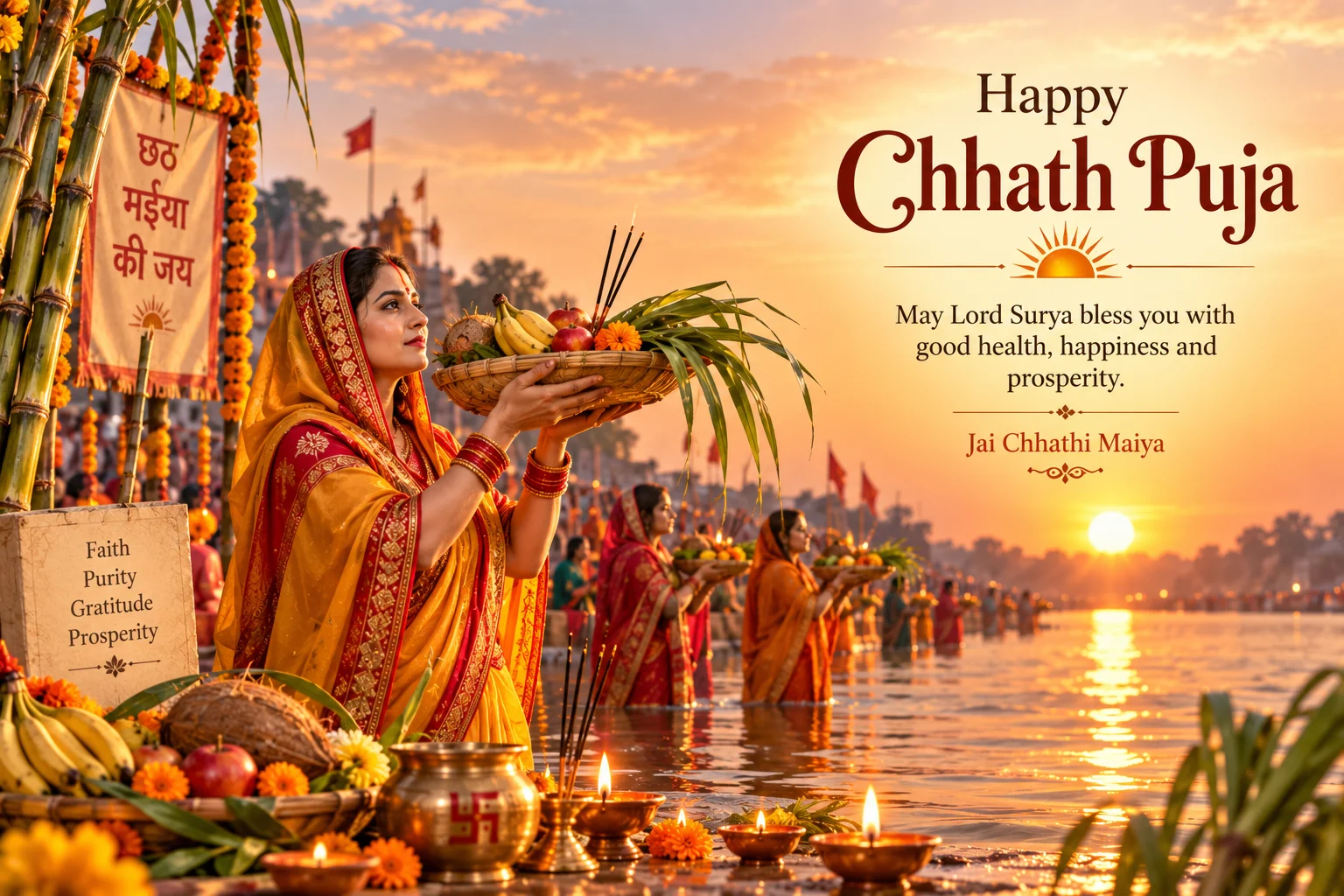
Chhath Puja is primarily dedicated to Surya, the Sun God, and Chhathi Maiya.
The festival traditionally spans four days.
Devotees offer Arghya to both the setting and rising Sun.
Thekua and sugarcane are among the traditional offerings.
Chhath Puja, also known as Chhath, Chhath Parv, Surya Shashti, or Dala Chhath, is a major Hindu festival dedicated primarily to the Sun God, Surya, and Chhathi Maiya. It is particularly prominent in Bihar, Jharkhand, eastern Uttar Pradesh, and parts of Nepal, but its popularity has spread to many parts of India. \n\nThe festival is traditionally associated with gratitude toward the Sun, which is regarded as the source of energy, light, life, and vitality. Devotees pray for health, prosperity, family welfare, and the well-being of children.
\n\nChhath is distinctive because of its disciplined fasting and elaborate water-side rituals. Devotees commonly prepare for several days through purification, dietary restrictions, fasting, and devotional activities. \n\nThe four-day observance usually includes Nahay Khay, Kharna, Sandhya Arghya, and Usha Arghya. Each stage has a specific religious significance.
\n\nNahay Khay begins the observance with ritual bathing and purification. The devotee prepares simple, pure food and establishes a disciplined environment. \n\nKharna follows, during which the devotee observes a fast and later prepares a simple offering, commonly including jaggery-based rice pudding or kheer and roti. After the evening offering, the devotee begins the long fast associated with the central Chhath rituals.
\n\nThe third day is the main evening worship, when devotees gather at rivers, ponds, lakes, ghats, or other clean water bodies. They stand in the water and offer Arghya to the setting Sun. Baskets filled with fruits, sugarcane, sweets, thekua, and other traditional offerings are presented. \n\nThe fourth day begins before sunrise.
Devotees return to the water body and offer Arghya to the rising Sun. This is the concluding ritual, after which the fast is broken. \n\nChhath is remarkable because devotees worship both the setting and rising Sun. The evening offering recognizes the Sun as it descends, while the morning offering welcomes the rising Sun.
This creates a symbolic cycle of gratitude, humility, renewal, and hope. \n\nThe festival also has a strong environmental dimension. Clean water bodies and natural surroundings are central to traditional Chhath. The emphasis on cleanliness before worship has encouraged communities to clean rivers, ponds, roads, and public spaces.
\n\nFamilies prepare traditional foods such as thekua, fruits, sugarcane, rice preparations, and other offerings. Many of these foods are prepared without onion, garlic, or certain ingredients considered unsuitable for ritual offerings. \n\nThe fast can be physically demanding, especially because traditional observance may involve extended periods without food and water. Devotees should consider their health and follow appropriate guidance rather than undertaking unsafe fasting.
\n\nIn 2026, Chhath Puja falls on November 15. The Shashthi tithi begins at approximately 11:23 PM on November 14 and continues beyond November 15. The exact sunrise and sunset times depend on the location. Sunset is around the early evening.
\n\nThe deeper significance of Chhath is gratitude. The Sun provides energy necessary for life, agriculture, seasons, and human activity. Worshipping Surya represents recognition of humanity's dependence on natural forces. \n\nChhath also emphasizes discipline, purity, family devotion, sacrifice, environmental awareness, and community participation.
\n\nThe festival has become especially important for migrant communities because it allows families living far from their ancestral regions to preserve their cultural traditions. \n\nChhath Puja therefore combines spirituality, nature worship, family prayer, rigorous discipline, environmental cleanliness, and community identity into one of the most distinctive Hindu festivals of the year.
What is Chhath Puja?
Chhath Puja is a sacred Hindu festival observed with devotion and religious rituals. It holds deep spiritual significance in the Hindu lunar calendar.
When is Chhath Puja observed?
The exact date changes every year based on the Hindu lunar calendar. Check the Daily Panchang on GuruCool for accurate tithi and muhurat timings.
What are the main rituals of Chhath Puja?
Devotees observe fasts, perform puja, chant mantras, and engage in charitable activities during Chhath Puja. Specific rituals vary by region and family tradition.
What is the spiritual significance of Chhath Puja?
Chhath Puja holds great religious importance in Hinduism. Observing it with full devotion is believed to bring blessings, ancestral merit, and spiritual liberation.
How can I get guidance for Chhath Puja rituals?
You can consult expert Vedic astrologers on GuruCool for personalized guidance on performing rituals correctly as per your birth chart and family tradition.