





Support

Consult about
Horoscope
Wallpapers
Ringtones
Services
Company
Help
Payments


Refund if not satisfied

Support Available

Privacy Confidentiality
© 2024 GuruCool.life. All rights reserved
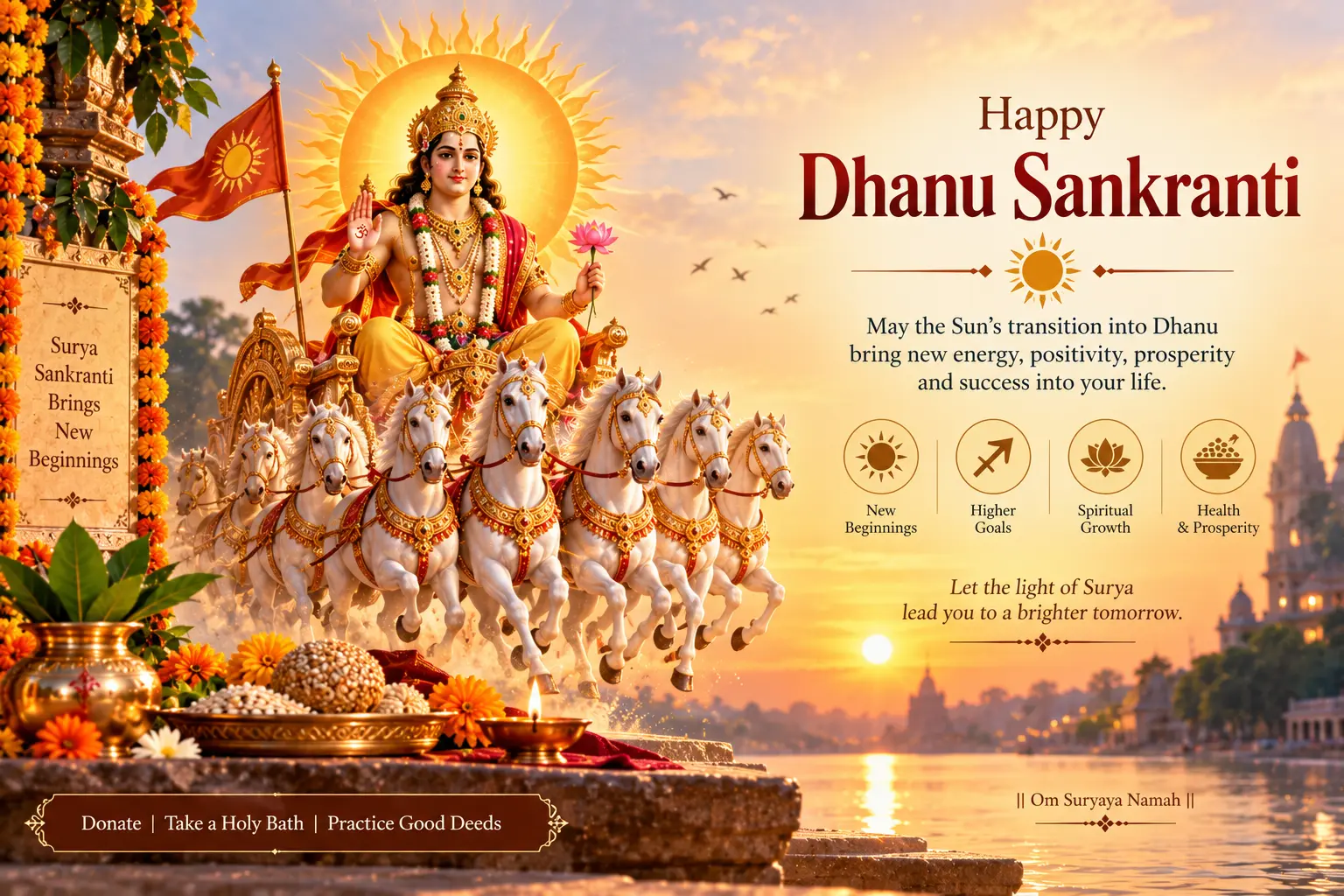
Dhanu Sankranti marks the Sun's entry into Sagittarius.
Sankranti festivals are based on solar transitions rather than lunar tithis.
Surya worship and charity are common Sankranti practices.
The observance connects Hindu religious traditions with solar and seasonal cycles.
Dhanu Sankranti is the Hindu solar observance marking the Sun's transition into Dhanu, or Sagittarius. Unlike festivals such as Ekadashi and Purnima, which are primarily determined by lunar tithis, Sankranti festivals are based on the Sun's movement from one zodiac sign to another. \n\nThe Sanskrit word Sankranti refers to a solar transition. There are twelve major Sankrantis during the solar year, corresponding to the Sun's movement through the twelve zodiac signs.
Dhanu Sankranti occurs when the Sun enters Sagittarius. \n\nThe Sun has a highly significant place in Hindu religious thought. Surya is traditionally regarded as the source of light, energy, vitality, health, and life. Solar transitions therefore provide natural occasions for prayer, gratitude, charity, and reflection.
\n\nDevotees observing Dhanu Sankranti may wake early, bathe, offer water to the Sun, perform Surya Namaskar, visit temples, and make charitable donations. Food, clothing, grains, and other useful necessities may be donated to people in need. \n\nThe festival is also connected with seasonal change. December occurs during winter in much of northern India, and the solar transition marks another stage in the annual cycle.
Traditional societies closely connected agriculture, seasons, sunlight, and religious observances. \n\nSankranti traditions demonstrate how Hindu calendars combine astronomical observation with religious life. Lunar tithis determine many major festivals, while solar transitions provide another framework for measuring sacred time. \n\nDhanu Sankranti has especially distinctive traditions in Odisha and several other regions.
Local festivals and customs may be associated with the Dhanu period, including food traditions and cultural celebrations. Such regional practices should be understood as local expressions rather than universal rituals. \n\nThe central religious values remain similar: gratitude to Surya, charity, purification, discipline, and awareness of the natural cycle. \n\nSun worship itself is an ancient Hindu practice.
Devotees may stand facing the rising Sun and offer water from a vessel while reciting prayers. Surya Namaskar combines physical movement with traditional solar devotion. \n\nCharity is another important component of Sankranti observances. Hindu traditions frequently associate auspicious transitions with generosity.
Giving food or useful necessities allows an individual to transform a personal religious occasion into an opportunity for social welfare. \n\nDhanu Sankranti can also be understood as a reminder that time is cyclical. Seasons change, the Sun moves through the zodiac, and human life progresses through different stages. Religious observances provide moments to recognize those transitions consciously.
\n\nIn 2026, Dhanu Sankranti falls on December 16. Major Indian Hindu calendars list December 16 as the Sun's transition from Vrishchika to Dhanu. \n\nThe festival is different from a location-specific Muhurat. The astronomical transition occurs at a precise time, but traditional observance practices such as bathing, charity, and puja can have local timing conventions.
\n\nFor a general India-wide festival database, December 16 is therefore the appropriate canonical date. \n\nThe deeper purpose of Dhanu Sankranti is to cultivate gratitude for the Sun and nature, practice generosity, maintain discipline, and recognize the passage of time. \n\nFor modern devotees, the festival can be observed simply by offering water to Surya, performing prayer or Surya Namaskar, donating food or clothing, and reflecting on personal goals for the next stage of life. \n\nDhanu Sankranti ultimately connects Hindu spirituality with astronomy, seasons, nature, charity, and disciplined living.
\n\nIt demonstrates that Hindu festivals are not only religious anniversaries but also ways of recognizing the natural cycles that sustain human life.
What is Dhanu Sankranti?
Dhanu Sankranti is a sacred Hindu festival observed with devotion and religious rituals. It holds deep spiritual significance in the Hindu lunar calendar.
When is Dhanu Sankranti observed?
The exact date changes every year based on the Hindu lunar calendar. Check the Daily Panchang on GuruCool for accurate tithi and muhurat timings.
What are the main rituals of Dhanu Sankranti?
Devotees observe fasts, perform puja, chant mantras, and engage in charitable activities during Dhanu Sankranti. Specific rituals vary by region and family tradition.
What is the spiritual significance of Dhanu Sankranti?
Dhanu Sankranti holds great religious importance in Hinduism. Observing it with full devotion is believed to bring blessings, ancestral merit, and spiritual liberation.
How can I get guidance for Dhanu Sankranti rituals?
You can consult expert Vedic astrologers on GuruCool for personalized guidance on performing rituals correctly as per your birth chart and family tradition.