





Support

Consult about
Horoscope
Wallpapers
Ringtones
Services
Company
Help
Payments


Refund if not satisfied

Support Available

Privacy Confidentiality
© 2024 GuruCool.life. All rights reserved
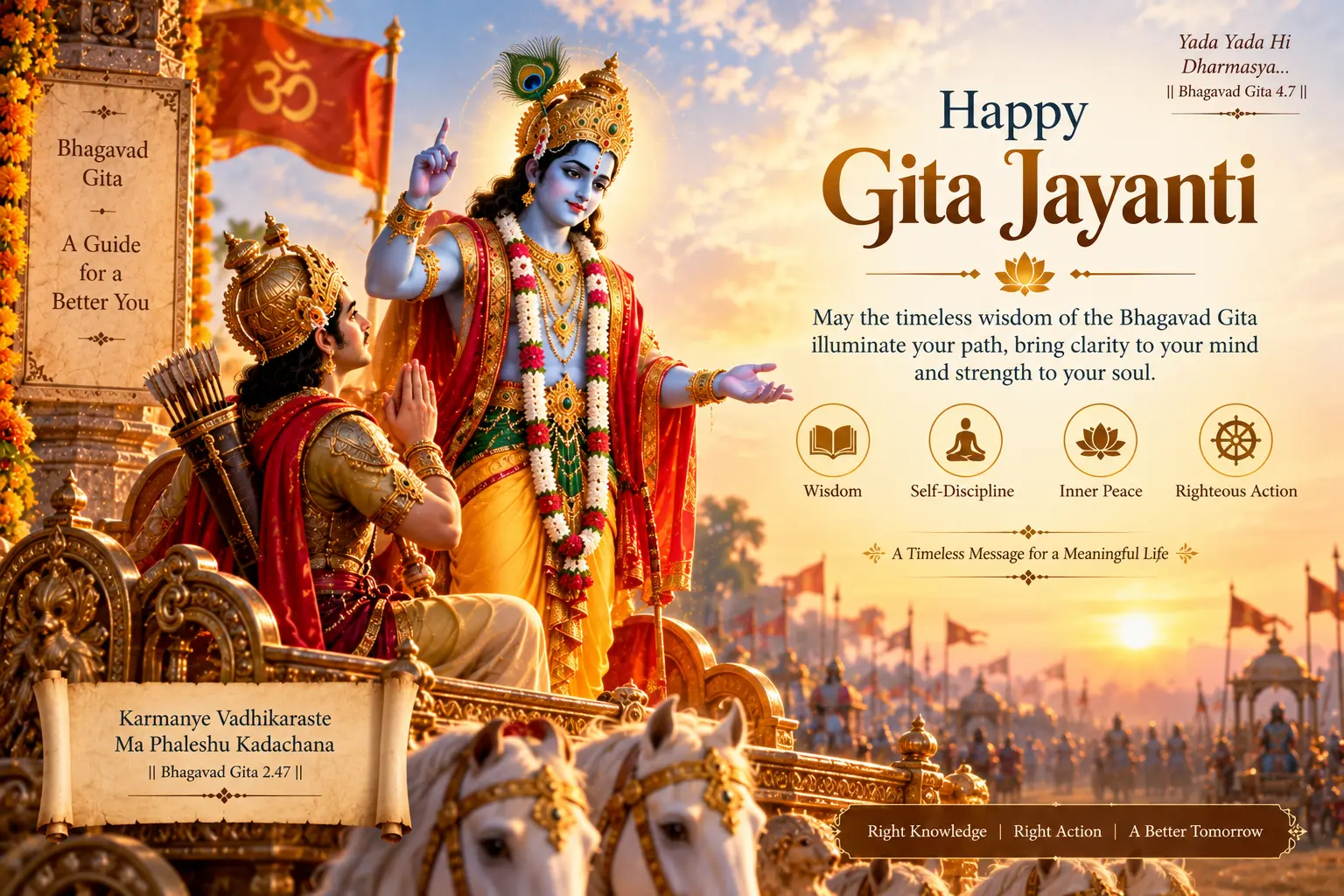
Gita Jayanti commemorates Krishna's teaching of the Bhagavad Gita to Arjuna.
It is observed on Margashirsha Shukla Ekadashi.
The Bhagavad Gita contains 18 chapters.
The dialogue occurs in the Mahabharata before the Kurukshetra war.
Gita Jayanti is the Hindu observance commemorating the day on which Lord Krishna delivered the teachings of the Bhagavad Gita to Arjuna on the battlefield of Kurukshetra. It is observed on Margashirsha Shukla Ekadashi and is one of the most important occasions for devotees who study and follow the Bhagavad Gita. \n\nThe Bhagavad Gita forms part of the Mahabharata and consists of a dialogue between Krishna and Arjuna. The conversation takes place immediately before the Kurukshetra war, when Arjuna becomes overwhelmed by grief, fear, and moral confusion.
\n\nArjuna sees teachers, relatives, friends, and respected elders among the opposing armies. He questions whether fighting the war is morally justified and becomes unable to decide what action he should take. \n\nKrishna responds by teaching him about dharma, karma, the nature of the self, devotion, meditation, knowledge, and liberation. \n\nOne of the central teachings is Karma Yoga, the discipline of performing one's duty without excessive attachment to the results.
Krishna encourages Arjuna to perform righteous action while surrendering attachment to personal outcomes. \n\nThe Gita also explains Jnana Yoga, the path of knowledge, Bhakti Yoga, the path of devotion, and Dhyana Yoga, the path of meditation. Different Hindu philosophical traditions interpret these teachings in different ways, but all recognize the text as a major source of spiritual and ethical guidance. \n\nGita Jayanti is therefore more than a historical anniversary.
It is a day for studying the text and reflecting on how its teachings apply to everyday life. \n\nTemples may organize recitations of the Bhagavad Gita. Devotees may read all eighteen chapters, participate in group chanting, listen to discourses, or study selected verses. \n\nKurukshetra is especially important because the battlefield is traditionally identified as the setting of Krishna's dialogue with Arjuna.
Large religious gatherings and Gita-related programs are associated with the observance. \n\nThe festival is also closely connected with Mokshada Ekadashi because both are observed on the same Ekadashi in 2026. \n\nThis connection makes the day particularly suitable for fasting and spiritual study. Devotees may observe an Ekadashi fast while spending additional time reading or listening to the Gita.
\n\nThe Bhagavad Gita remains relevant because its questions are universal. People frequently face difficult decisions involving family, career, responsibility, ethics, fear, ambition, and personal values. \n\nArjuna's crisis can therefore be understood symbolically as the uncertainty experienced by human beings when responsibilities conflict with emotions. \n\nKrishna's response emphasizes clarity, discipline, knowledge, devotion, and righteous action.
\n\nIn 2026, Gita Jayanti falls on December 20. Indian Hindu calendars consistently identify December 20 as Gita Jayanti and associate it with Margashirsha Shukla Ekadashi. \n\nThe festival can be observed without elaborate rituals. Reading a chapter of the Gita, listening to a discourse, discussing its teachings with family, or applying one of its principles to daily life can all be meaningful.
\n\nThe deeper message is that spiritual knowledge should influence practical action. The Gita does not simply provide abstract philosophy; it addresses how a person should act while facing uncertainty. \n\nGita Jayanti therefore encourages self-knowledge, responsibility, ethical action, devotion, and mental balance. \n\nFor modern devotees, it can become an annual opportunity to revisit personal values and ask whether daily decisions reflect dharma rather than only short-term desires.
\n\nThe festival ultimately celebrates one of Hinduism's most influential philosophical teachings and its continuing relevance to human life.
What is Gita Jayanti?
Gita Jayanti is a sacred Hindu festival observed with devotion and religious rituals. It holds deep spiritual significance in the Hindu lunar calendar.
When is Gita Jayanti observed?
The exact date changes every year based on the Hindu lunar calendar. Check the Daily Panchang on GuruCool for accurate tithi and muhurat timings.
What are the main rituals of Gita Jayanti?
Devotees observe fasts, perform puja, chant mantras, and engage in charitable activities during Gita Jayanti. Specific rituals vary by region and family tradition.
What is the spiritual significance of Gita Jayanti?
Gita Jayanti holds great religious importance in Hinduism. Observing it with full devotion is believed to bring blessings, ancestral merit, and spiritual liberation.
How can I get guidance for Gita Jayanti rituals?
You can consult expert Vedic astrologers on GuruCool for personalized guidance on performing rituals correctly as per your birth chart and family tradition.