





Support

Consult about
Horoscope
Wallpapers
Ringtones
Services
Company
Help
Payments


Refund if not satisfied

Support Available

Privacy Confidentiality
© 2024 GuruCool.life. All rights reserved
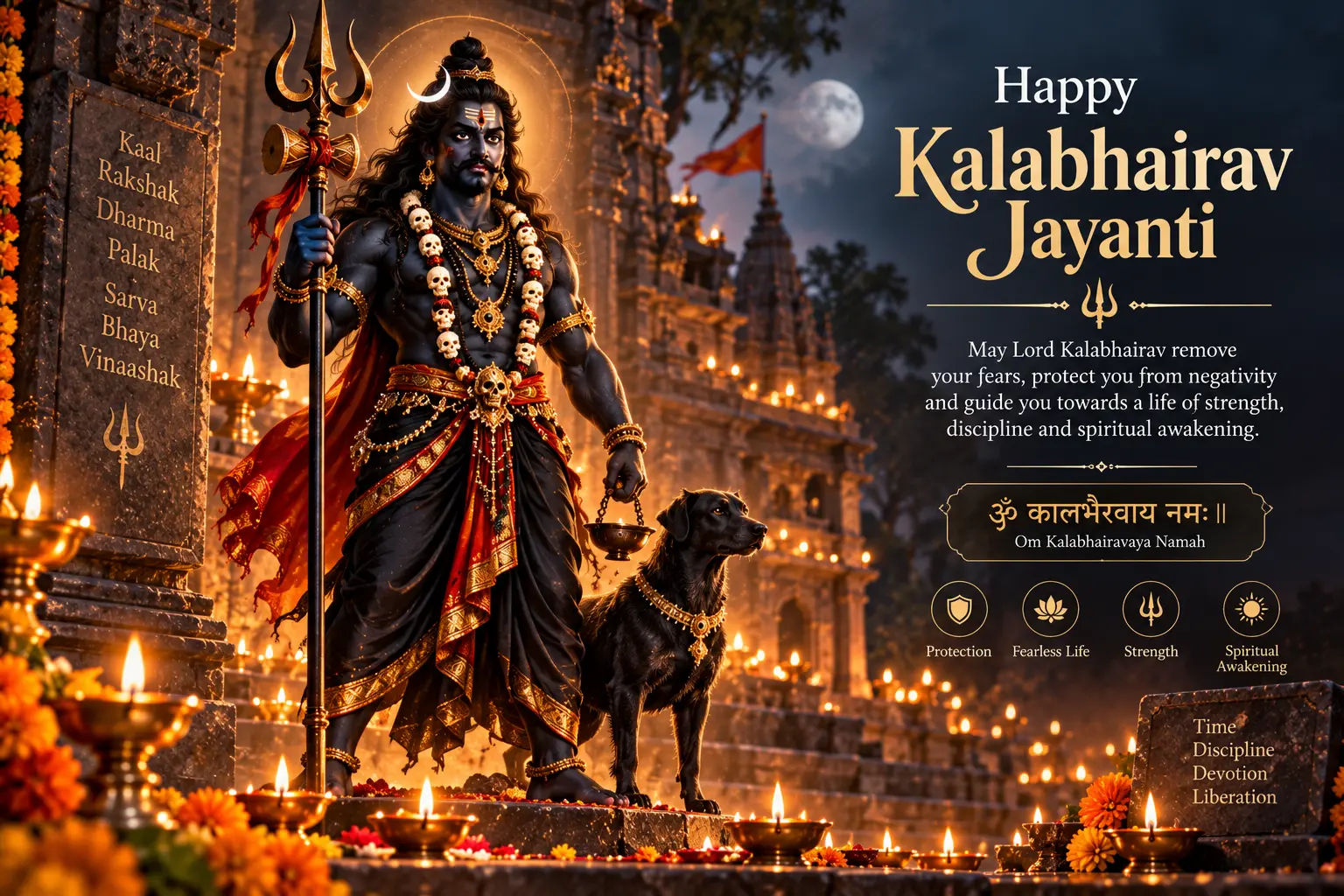
Kalabhairav Jayanti is dedicated to Lord Kalabhairava, a manifestation of Lord Shiva.
It is observed on Margashirsha Krishna Ashtami.
Kalabhairava is traditionally associated with time, protection, justice, and discipline.
Kalabhairava is regarded as the guardian deity of Kashi.
Dogs are traditionally associated with Kalabhairava and are regarded as his vahana.
Kalabhairav Jayanti is an important Hindu festival dedicated to Lord Kalabhairava, a powerful manifestation of Lord Shiva. It is observed on the Ashtami, or eighth lunar day, of the Krishna Paksha during the Hindu month of Margashirsha. The festival is particularly significant in Shaiva traditions and is associated with protection, discipline, justice, time, fearlessness, and the destruction of negative forces. \n\nThe name Kalabhairava combines the concept of Kala, meaning time, with Bhairava, a fierce and protective manifestation of Shiva.
Lord Kalabhairava is therefore traditionally understood as a divine representation of time and as a guardian who protects devotees and sacred places. He is especially associated with Kashi, or Varanasi, where he is revered as the city's guardian deity. \n\nOne important traditional story explains the origin of Bhairava through an episode involving Lord Brahma and Lord Shiva. According to the story, Brahma developed excessive pride regarding his creative power.
Shiva manifested Bhairava to remove this arrogance and restore humility and cosmic order. The story is interpreted as a reminder that even knowledge and power can become destructive when they are accompanied by ego. \n\nAnother important aspect of Kalabhairava worship is the association with justice and karma. Kalabhairava is traditionally regarded as a deity who represents the consequences of one's actions.
His fierce appearance should therefore not simply be understood as representing violence. Symbolically, it represents the uncompromising nature of truth, time, responsibility, and cosmic law. \n\nDevotees observe Kalabhairav Jayanti by visiting Shiva or Bhairava temples, performing abhisheka and puja, lighting lamps, offering flowers and devotional items, and reciting prayers or mantras. Some devotees observe a fast throughout the day and dedicate the evening to worship and meditation.
\n\nBlack sesame, mustard oil, flowers, lamps, fruits, and other traditional offerings may be used according to regional and family customs. Dogs have a special association with Kalabhairava because the dog is traditionally regarded as his vahana, or vehicle. Feeding dogs is therefore considered an act of devotion by many followers. \n\nThe festival also has an important philosophical connection with time.
Every individual is subject to the passage of time, and time cannot be stopped or reversed. Kalabhairava therefore reminds devotees that life is temporary and that time should be used wisely. \n\nThis idea gives the festival relevance beyond ritual worship. A person can use Kalabhairav Jayanti as an opportunity to examine how they spend their time, whether they are living responsibly, and whether fear, anger, ego, or attachment control their decisions.
\n\nKalabhairava is also associated with protection. Devotees traditionally seek protection from negative influences, fear, obstacles, and harmful forces. However, the deeper spiritual interpretation is protection from one's own destructive tendencies. \n\nThe festival is celebrated in different ways across India.
Kashi has particularly strong Kalabhairava traditions, but temples dedicated to Bhairava and Shiva throughout the country observe the occasion with special prayers. \n\nKalabhairav Jayanti in 2026 falls on December 1 and is listed as Margashirsha Krishna Ashtami in Indian Hindu calendars. Multiple regional calendars, including calendars for Rajasthan, Haryana, Uttar Pradesh, Bihar, Karnataka and Kerala, list the same date. \n\nThe deeper purpose of the festival is therefore not fear but transformation.
Kalabhairava represents the courage required to face reality, accept the passage of time, overcome ego, and live according to dharma. \n\nFor devotees, the day can be used for prayer, fasting, meditation, charity, feeding animals, visiting a temple, and reflecting on personal responsibility. \n\nKalabhairav Jayanti ultimately combines Shaiva devotion with powerful philosophical ideas about time, justice, discipline, humility, fearlessness, and responsible living.
What is Kalabhairav Jayanti?
Kalabhairav Jayanti is a sacred Hindu festival observed with devotion and religious rituals. It holds deep spiritual significance in the Hindu lunar calendar.
When is Kalabhairav Jayanti observed?
The exact date changes every year based on the Hindu lunar calendar. Check the Daily Panchang on GuruCool for accurate tithi and muhurat timings.
What are the main rituals of Kalabhairav Jayanti?
Devotees observe fasts, perform puja, chant mantras, and engage in charitable activities during Kalabhairav Jayanti. Specific rituals vary by region and family tradition.
What is the spiritual significance of Kalabhairav Jayanti?
Kalabhairav Jayanti holds great religious importance in Hinduism. Observing it with full devotion is believed to bring blessings, ancestral merit, and spiritual liberation.
How can I get guidance for Kalabhairav Jayanti rituals?
You can consult expert Vedic astrologers on GuruCool for personalized guidance on performing rituals correctly as per your birth chart and family tradition.