





Support

Consult about
Horoscope
Wallpapers
Ringtones
Services
Company
Help
Payments


Refund if not satisfied

Support Available

Privacy Confidentiality
© 2024 GuruCool.life. All rights reserved
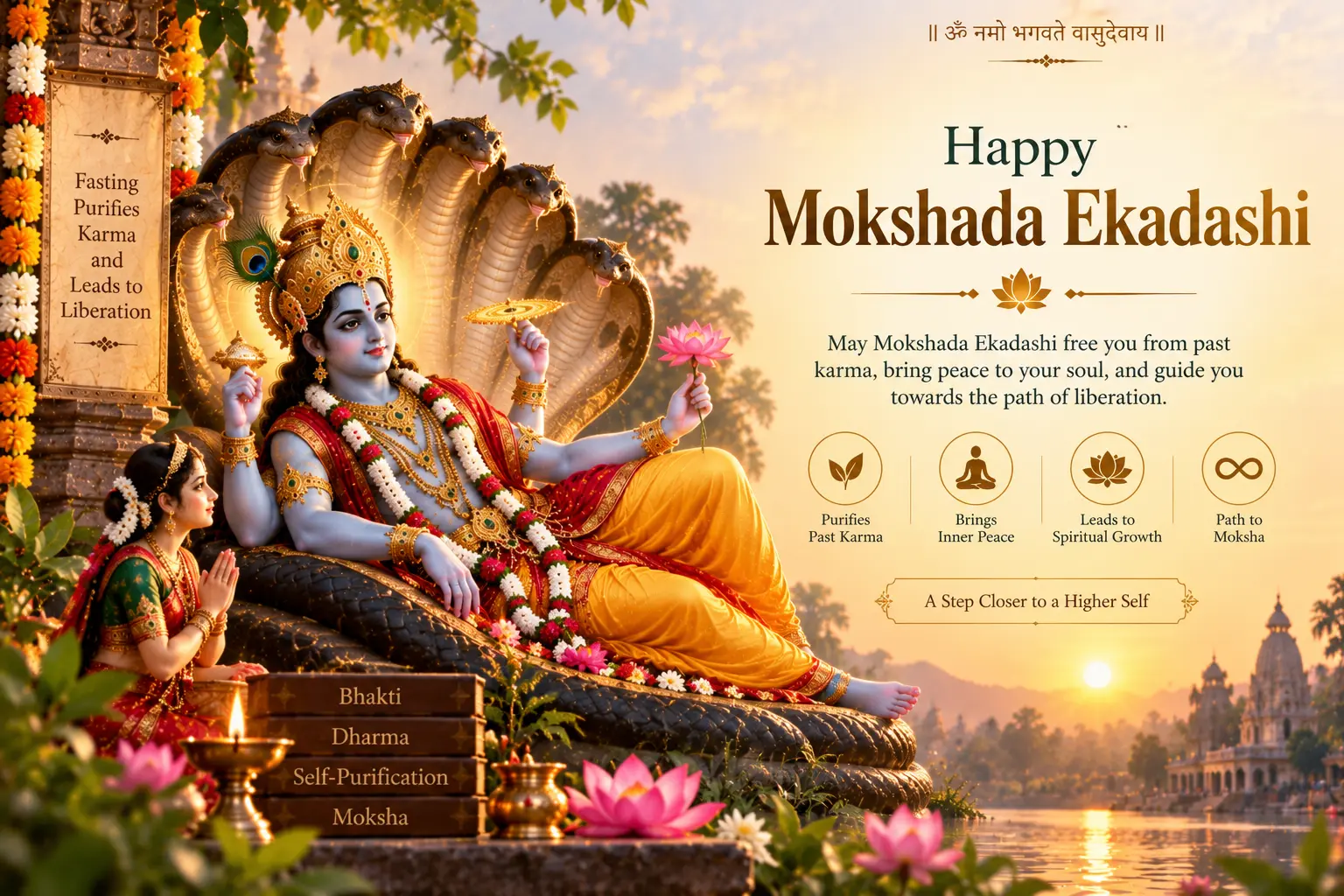
Mokshada Ekadashi occurs during Margashirsha Shukla Paksha.
It is dedicated to Lord Vishnu and associated with moksha.
Gita Jayanti occurs on the same Ekadashi in 2026.
The Bhagavad Gita is traditionally studied on this day.
Mokshada Ekadashi is an important Hindu fasting observance dedicated to Lord Vishnu and associated with the spiritual goal of moksha, or liberation. It is observed on Margashirsha Shukla Ekadashi and in 2026 occurs on December 20, the same day as Gita Jayanti. \n\nThe word Mokshada is derived from the idea of granting or leading toward moksha. In Hindu philosophy, moksha refers to liberation from ignorance, attachment, and the cycle of birth and death.
Mokshada Ekadashi therefore emphasizes spiritual purification and the pursuit of liberation. \n\nEkadashi is the eleventh lunar day and is traditionally considered suitable for fasting and spiritual discipline. Devotees observe Ekadashi twice each lunar month and use the day to reduce material distractions and focus on prayer, meditation, scripture, and devotion. \n\nMokshada Ekadashi has particular significance because it coincides with Gita Jayanti.
The Bhagavad Gita was traditionally delivered by Lord Krishna on this Ekadashi. As a result, the day combines two major forms of spiritual practice: fasting and philosophical study. \n\nDevotees may worship Lord Vishnu or Krishna with Tulsi leaves, flowers, lamps, incense, fruits, and other offerings. Some visit temples or participate in devotional singing.
\n\nFasting practices vary significantly. Some devotees observe a complete fast, while others consume fruits, milk, nuts, or specially permitted fasting foods. Grains and beans are commonly avoided. \n\nThe spiritual purpose of fasting is self-control.
Ekadashi encourages devotees to reduce attachment to food and sensory pleasures and redirect attention toward spiritual development. \n\nReading the Bhagavad Gita is especially meaningful on Mokshada Ekadashi. Devotees may study one or more chapters, listen to a discourse, or contemplate teachings about karma, dharma, devotion, and liberation. \n\nThe festival also has traditions concerning ancestors and spiritual merit.
In some Hindu traditions, the merit generated through religious observance is dedicated to the spiritual welfare of deceased family members. \n\nCharity is therefore another meaningful practice. Feeding people, donating food, clothing, or other necessities, and helping someone in need can complement fasting and prayer. \n\nThe fast is traditionally concluded on Dwadashi during an appropriate Parana period.
Since Parana is based on local sunrise and tithi conditions, it should be calculated according to the user's location rather than stored as one India-wide time. \n\nThe deeper philosophical meaning of Mokshada Ekadashi is that liberation requires transformation of consciousness. A person cannot achieve meaningful spiritual progress simply through external ritual. Discipline, knowledge, devotion, ethical action, and self-awareness are all emphasized.
\n\nThe coincidence with Gita Jayanti reinforces this idea. Krishna's teachings encourage Arjuna to perform his responsibilities while overcoming attachment and fear. \n\nIn 2026, Mokshada Ekadashi falls on December 20. Major Indian Hindu calendars identify this as Margashirsha Shukla Ekadashi and also list Gita Jayanti on the same day.
\n\nFor modern devotees, the festival can be observed through a suitable fast, Vishnu or Krishna worship, Gita reading, meditation, charity, and reflection on personal responsibilities. \n\nPeople who cannot safely fast can participate through prayer, scripture reading, charity, and devotional activities. Spiritual observance does not require unsafe physical practices. \n\nMokshada Ekadashi ultimately represents the aspiration to move from ignorance toward knowledge, from attachment toward freedom, and from selfishness toward devotion and dharma.
\n\nIt is therefore both a religious fasting day and an opportunity for serious spiritual reflection.
What is Mokshada Ekadashi?
Mokshada Ekadashi is a sacred Hindu festival observed with devotion and religious rituals. It holds deep spiritual significance in the Hindu lunar calendar.
When is Mokshada Ekadashi observed?
The exact date changes every year based on the Hindu lunar calendar. Check the Daily Panchang on GuruCool for accurate tithi and muhurat timings.
What are the main rituals of Mokshada Ekadashi?
Devotees observe fasts, perform puja, chant mantras, and engage in charitable activities during Mokshada Ekadashi. Specific rituals vary by region and family tradition.
What is the spiritual significance of Mokshada Ekadashi?
Mokshada Ekadashi holds great religious importance in Hinduism. Observing it with full devotion is believed to bring blessings, ancestral merit, and spiritual liberation.
How can I get guidance for Mokshada Ekadashi rituals?
You can consult expert Vedic astrologers on GuruCool for personalized guidance on performing rituals correctly as per your birth chart and family tradition.