





Support

Consult about
Horoscope
Wallpapers
Ringtones
Services
Company
Help
Payments


Refund if not satisfied

Support Available

Privacy Confidentiality
© 2024 GuruCool.life. All rights reserved
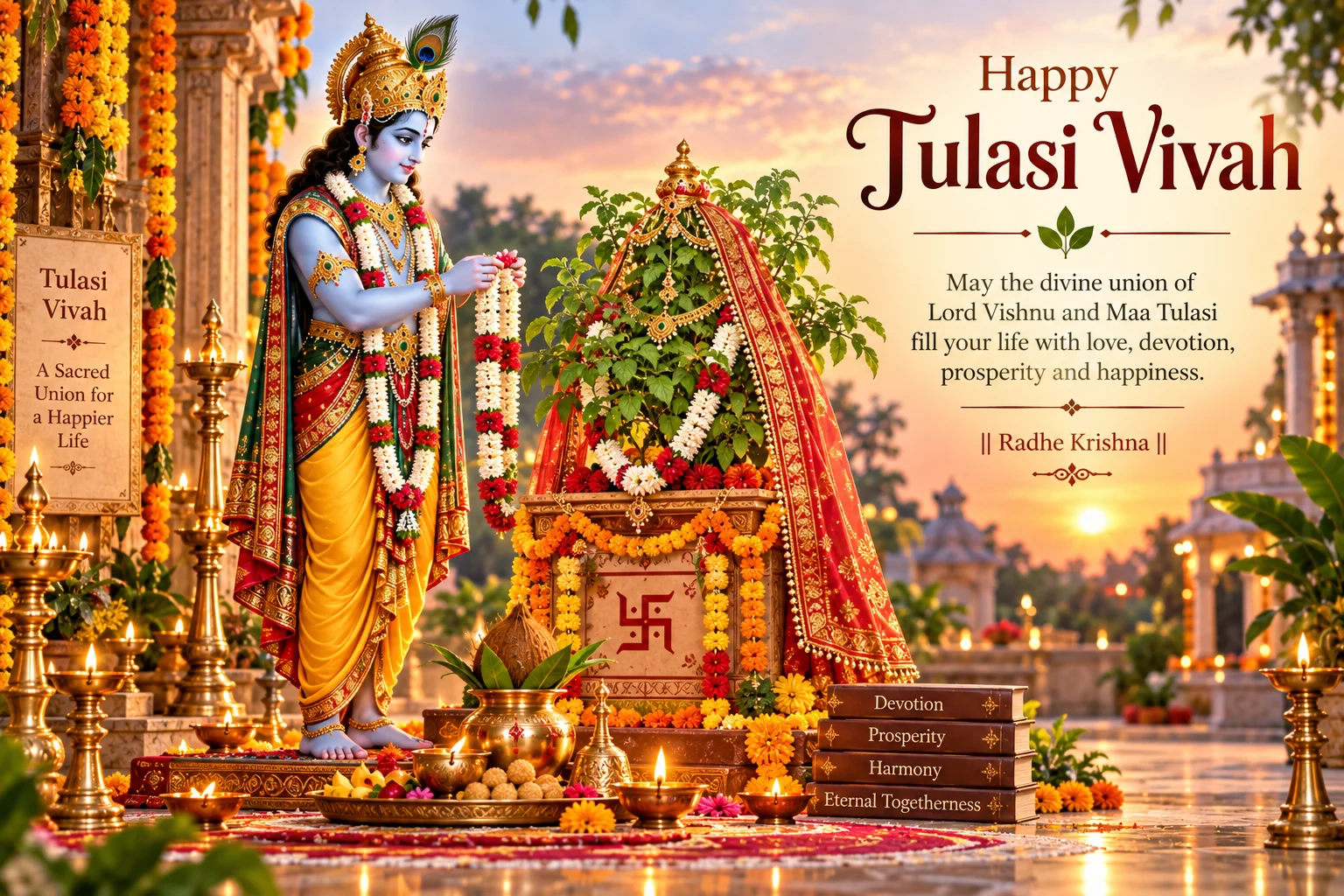
Tulasi Vivah is the ceremonial marriage of Tulasi with Vishnu or Krishna.
It is traditionally associated with Kartika Shukla Dwadashi and the Devutthana period.
Tulasi is considered a sacred plant in Hindu households.
The ceremony often resembles a traditional Hindu wedding.
Tulasi Vivah traditionally marks the beginning of the auspicious wedding season.
Tulasi Vivah is a sacred Hindu ceremonial wedding in which the Tulasi plant, revered as Goddess Tulasi, is symbolically married to Lord Vishnu or one of his forms, particularly Krishna or Shaligram. The festival is traditionally observed during Kartika Shukla Paksha and is closely associated with Devutthana Ekadashi and Dwadashi. \n\nTulasi, commonly known as holy basil, occupies an important place in Hindu households. It is traditionally worshipped as a sacred plant and is associated with purity, devotion, protection, and Goddess Lakshmi-related traditions.
\n\nThe story behind Tulasi Vivah is connected with Vrinda, a deeply devoted woman whose story appears in Hindu Puranic literature. Different scriptures and regional traditions tell the story with variations. In one widely known version, Vrinda was devoted to her husband Jalandhara, whose spiritual power was connected with her chastity and devotion. The story eventually leads to the transformation of Vrinda into the Tulasi plant.
Tulasi subsequently becomes closely associated with Lord Vishnu. \n\nTulasi Vivah symbolically represents the divine union between Tulasi and Vishnu. It is often performed like a traditional Hindu wedding, complete with decoration, ritual offerings, prayers, mantras, and celebration. \n\nBefore the ceremony, the Tulasi plant and surrounding area are cleaned and decorated.
The plant may be dressed in a sari or decorated with ornaments, flowers, and jewelry. A symbolic representation of Vishnu or Shaligram is prepared as the groom. \n\nA small wedding mandap may be constructed around the Tulasi plant. Family members participate in the ceremony, and traditional wedding rituals may be performed.
The exact procedure differs by region and family tradition. \n\nTulasi Vivah is also associated with the beginning of the Hindu wedding season. Because many auspicious ceremonies are traditionally avoided during Chaturmas, the completion of this period is followed by a return to weddings and other social ceremonies. \n\nThe festival therefore has both religious and social importance.
It represents divine union, renewal, prosperity, devotion, and the return of auspicious activity. \n\nDevotees may observe a fast until the ceremony and prepare traditional vegetarian food afterward. Lamps, flowers, sweets, fruits, and devotional offerings are commonly used. \n\nThe festival also reinforces the sacred role of Tulasi in Hindu homes.
Many families maintain a Tulasi plant in a courtyard or dedicated space and perform daily worship. Tulasi leaves are traditionally offered to Lord Vishnu and Krishna. \n\nIn 2026, Tulasi Vivah is observed on November 21. The Dwadashi tithi spans November 21 in the relevant observance, although exact tithi timings should be calculated for the user's location.
\n\nThe deeper meaning of Tulasi Vivah lies in devotion and sacred partnership. The ceremony presents marriage not simply as a social contract but as a sacred union based on responsibility, devotion, mutual respect, and dharma. \n\nThe festival is also an expression of reverence for nature. Tulasi is both a living plant and a sacred symbol, reminding devotees that nature can be approached with gratitude and respect.
\n\nTulasi Vivah therefore combines mythology, household worship, environmental reverence, marriage symbolism, community celebration, and Vaishnava devotion. \n\nFor families, it can be a simple home ceremony or a large temple celebration. Regardless of scale, the central theme remains the same: devotion, purity, auspiciousness, and the celebration of divine union.
What is Tulasi Vivah?
Tulasi Vivah is a sacred Hindu festival observed with devotion and religious rituals. It holds deep spiritual significance in the Hindu lunar calendar.
When is Tulasi Vivah observed?
The exact date changes every year based on the Hindu lunar calendar. Check the Daily Panchang on GuruCool for accurate tithi and muhurat timings.
What are the main rituals of Tulasi Vivah?
Devotees observe fasts, perform puja, chant mantras, and engage in charitable activities during Tulasi Vivah. Specific rituals vary by region and family tradition.
What is the spiritual significance of Tulasi Vivah?
Tulasi Vivah holds great religious importance in Hinduism. Observing it with full devotion is believed to bring blessings, ancestral merit, and spiritual liberation.
How can I get guidance for Tulasi Vivah rituals?
You can consult expert Vedic astrologers on GuruCool for personalized guidance on performing rituals correctly as per your birth chart and family tradition.