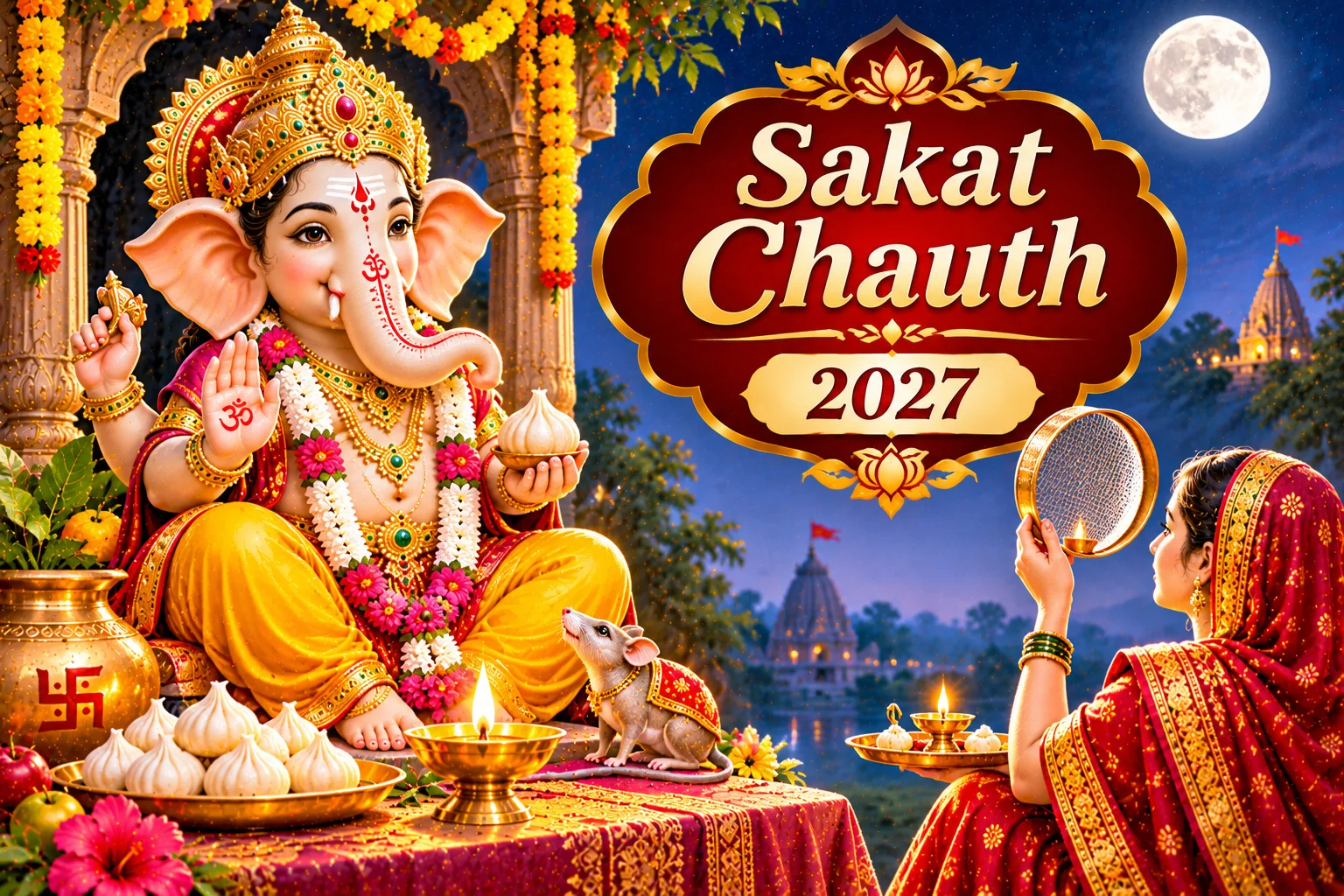
Sakat Chauth is an important Hindu fasting festival dedicated primarily to Lord Ganesha and Goddess Sakat Mata. It is observed on Krishna Paksha Chaturthi, the fourth day of the waning lunar fortnight, during the month traditionally known as Magha in North Indian calendars.
The festival is also known as Sankat Chauth, Tilkut Chauth, Til Chauth, Tilkuta Chauth, Maghi Chauth and Magha Sankashti Chaturthi. It is associated with the monthly Sankashti Chaturthi observance dedicated to Lord Ganesha, but has special importance in North Indian household traditions.
Sakat Chauth is especially observed by mothers who pray for the long life, good health, safety and happiness of their children. Devotees also worship Lord Ganesha to seek protection from difficulties, removal of obstacles and blessings for family prosperity.
A distinctive feature of this festival is the preparation and offering of Tilkut, a traditional sweet made by pounding roasted sesame seeds with jaggery or sugar. Sesame seeds and jaggery are considered especially significant offerings on this occasion.
Devotees generally observe a fast throughout the day and perform the evening Puja dedicated to Lord Ganesha and Sakat Mata. They listen to the traditional Sakat Chauth Vrat Katha, offer Tilkut and other food offerings, and worship Chandra Dev after moonrise.
The fast is traditionally completed after sighting the Moon and offering Arghya. The Moon worship is an important part of the Sankashti Chaturthi tradition and marks the conclusion of the day's fasting.
A popular Sakat Chauth folk narrative tells the story of an elderly woman whose only son was placed inside a potter's burning kiln. Through her sincere prayers to Lord Ganesha and Sakat Mata, the child was protected and emerged unharmed. This story is remembered as an expression of divine protection and a mother's devotion.
Why is Sakat Chauth Celebrated?
Sakat Chauth is celebrated to worship Lord Ganesha and Goddess Sakat Mata and seek protection from Sankat, meaning difficulties, hardships and obstacles. The festival is especially associated with mothers praying for the long life, health and well-being of their children.
The observance is connected with the Sankashti Chaturthi tradition, in which devotees worship Lord Ganesha during Krishna Paksha Chaturthi and complete their fast after offering Arghya to the Moon. The Magha observance is particularly important in many North Indian communities.
The traditional offering of Tilkut represents the importance of sesame and jaggery in winter-season worship. Devotees prepare sesame-based sweets, offer them to Lord Ganesha and distribute them as Prasad.
The Sakat Chauth Katha, especially the story of the elderly woman and her son in the potter's kiln, expresses the belief that sincere devotion and divine grace can protect children from danger and relieve families from suffering.
To worship Lord Ganesha, the remover of obstacles and protector of devotees.
To honour Goddess Sakat Mata and seek her protection from difficulties.
To pray for the long life, health, safety and prosperity of children.
To seek relief from family hardships, suffering and obstacles.
To observe the traditional Magha Sankashti Chaturthi fast.
To offer Tilkut and sesame-jaggery sweets to Lord Ganesha.
To listen to the Sakat Chauth Vrat Katha and remember the power of sincere devotion.
To worship Chandra Dev after moonrise and offer Arghya.
To develop patience, discipline, faith and devotion.
History and Traditional Legends of Sakat Chauth
The Divine Importance of Lord Ganesha
Lord Ganesha is one of the most widely worshipped deities in Hinduism. He is revered as the remover of obstacles, the giver of wisdom and the guardian of auspicious beginnings.
He is known by many names, including Ganapati, Vinayaka, Vighnaharta, Gajanana, Lambodara and Ekadanta. Devotees worship him before beginning important activities and seek his blessings for success, protection and prosperity.
Sakat Chauth is dedicated to Ganesha because the central purpose of the observance is to seek freedom from Sankat, or difficulties. Devotees believe that sincere worship of the Lord helps them face challenges with wisdom, courage and patience.
The festival is particularly associated with the welfare of children. Mothers pray to Lord Ganesha for protection from danger, illness and hardship, while also seeking happiness and prosperity for their families.
The Meaning of Sakat Chauth
The word Sakat is commonly associated in regional devotional usage with Sankat, meaning difficulty, trouble or hardship. Chauth refers to Chaturthi, the fourth lunar day.
Sakat Chauth therefore represents the observance of Chaturthi for relief from difficulties and the protection of family members.
The festival is also called Tilkut Chauth because Tilkut, a sweet preparation made from sesame seeds and jaggery or sugar, is an important offering on this day.
Different communities use different names for the observance. Til Chauth, Tilkuta Chauth, Sankat Chauth and Maghi Chauth are among the names used in regional traditions.
The Story of the Elderly Woman and the Potter's Kiln
One of the best-known Sakat Chauth Vrat Kathas tells the story of an elderly woman who lived in a village with her only son. She was devoted to Lord Ganesha and regularly prayed for the safety and happiness of her child.
Spiritual Significance of Sakat Chauth
Worship of Lord Ganesha as Vighnaharta
Lord Ganesha is worshipped as Vighnaharta, the remover of obstacles. Sakat Chauth reminds devotees that difficulties are a part of life and that wisdom, faith and patience help people overcome them.
Through prayer and devotion, worshippers seek the strength to face personal, family and professional challenges with a calm and positive mind.
Protection and Welfare of Children
One of the most important spiritual purposes of Sakat Chauth is praying for children's safety and well-being. Mothers observe the fast with the intention of seeking divine protection for their children.
The elderly woman's story teaches the importance of faith, love and courage in difficult circumstances. It expresses the emotional bond between a mother and her child and the hope that divine grace protects those who are vulnerable.
The Protective Power of Sakat Mata
Sakat Mata represents the protective and nurturing aspect of the Divine Mother in regional devotional traditions. Her worship expresses the desire for freedom from hardships and protection from adverse circumstances.
Devotees pray to her for family peace, children's welfare and strength during difficult periods. Her worship reflects the belief that divine compassion provides support when human efforts seem insufficient.
The Spiritual Meaning of Til
Sesame seeds have a significant place in Hindu rituals and are used in offerings, charity and seasonal religious observances. On Sakat Chauth, Tilkut represents a traditional offering made with gratitude and devotion.
The preparation of sesame sweets encourages simplicity, sharing and respect for food. Offering Tilkut to Lord Ganesha symbolises the surrender of one's efforts and resources to the divine.
How Sakat Chauth Is Celebrated
Early Morning Bath and Sankalpa
Devotees wake up early, take a bath and wear clean clothes. Mothers observing the fast prepare themselves for the day's worship and make a Sankalpa before Lord Ganesha.
The Sankalpa expresses the intention to observe Sakat Chauth for the well-being, long life and protection of children. Other devotees may make the Sankalpa for family happiness, relief from difficulties and spiritual progress.
Preparation of Tilkut
Tilkut is prepared by roasting sesame seeds and pounding them with jaggery or sugar. The mixture may be shaped into small pieces, laddoos or other traditional forms.
Some families prepare Tilkut ka Bakra, a small goat-shaped figure made from the sesame-jaggery mixture. The preparation and shape of Tilkut vary according to regional and household customs.
The prepared sweets are kept aside for offering to Lord Ganesha and Sakat Mata during the evening Puja.
Daytime Fasting
Devotees generally observe a fast from the morning until moonrise. Some follow a Nirjala fast, while others consume fruits, milk or permitted foods according to their health and family tradition.
During the day, devotees engage in prayers, mantra chanting and other devotional activities. Mothers may prepare the Puja materials and arrange Tilkut for the evening worship.
Evening Preparation of the Puja Area
In the evening, devotees clean the worship area and place an image or idol of Lord Ganesha on a decorated Chowki. In traditions that worship Sakat Mata, her image or a symbolic representation is also placed nearby.
A Kalasha filled with clean water, a lamp, incense, flowers, Durva grass, Tilkut and other offerings are arranged for the Puja.
Sakat Chauth Puja Vidhi (Step by Step)
1
Wake Up Early and Take a Holy Bath
Wake up early in the morning, take a bath and wear clean clothes. Clean the Puja area and prepare for the Sakat Chauth Vrat. Devotees may wear traditional yellow, red or other auspicious clothing according to family customs.
2
Take the Vrat Sankalpa
Sit before Lord Ganesha and make a sincere Sankalpa to observe Sakat Chauth. Mothers may pray for the long life, health and protection of their children. Other devotees may pray for family welfare, prosperity and relief from difficulties.
3
Prepare Tilkut and Other Offerings
Roast sesame seeds and prepare Tilkut by pounding them with jaggery or sugar. Make sesame-jaggery laddoos or other traditional sweets. In households that follow the custom, prepare a small Tilkut ka Bakra.
4
Prepare the Puja Platform
Place a clean cloth on a Chowki and install an image or idol of Lord Ganesha. Place an image or symbolic representation of Sakat Mata nearby if she is worshipped in your family tradition. Arrange a Kalasha, flowers, Durva grass, incense and other Puja materials.
5
Sakat Chauth Puja Samagri List
Main Puja Materials
Image or idol of Lord Ganesha
Image or symbolic representation of Sakat Mata
Clean Puja Chowki
Red or yellow Puja cloth
Kalasha filled with clean water
Panchapatra and spoon
Bell
Aarti plate
Mauli or sacred thread
Chunari for Sakat Mata, where customary
Tilkut and Sesame Offerings
White sesame seeds
Black sesame seeds, where customary
Jaggery
Sugar, if used in the family recipe
Sesame-jaggery laddoos
Tilkut
Tilkut ka Bakra, where customary
Ghee for preparing sweets
Tilkut is the distinctive offering associated with Sakat Chauth. It is prepared by roasting sesame seeds and pounding them with jaggery or sugar. The ingredients and shape of the preparation vary by region and household.
Mantras and Prayers for Sakat Chauth
Ganesha Moola Mantra
ॐ गं गणपतये नमः॥
Om Gam Ganapataye Namah
Simple Meaning: Salutations to Lord Ganapati, the remover of obstacles and giver of wisdom, success and auspicious beginnings.
Vakratunda Mahakaya Mantra
वक्रतुण्ड महाकाय सूर्यकोटि समप्रभ। निर्विघ्नं कुरु मे देव सर्वकार्येषु सर्वदा॥
Vakratunda Mahakaya Suryakoti Samaprabha, Nirvighnam Kuru Me Deva Sarvakaryeshu Sarvada
Simple Meaning: O Lord Ganesha, with your curved trunk and mighty form, whose brilliance is equal to millions of suns, please remove all obstacles from my undertakings.
Sakat Chauth Vrat Rules and Fasting Guidelines
Fasting Rules
Devotees traditionally observe a fast on Sakat Chauth from the morning until moonrise. Some mothers observe a Nirjala fast, while others follow a fruit-based or partial fast. The appropriate form depends on personal health, family tradition and the devotee's Sankalpa.
Begin the fast after taking a bath and making the Sankalpa.
Observe a Nirjala fast only if your health and circumstances safely permit it.
A Phalahar fast may include fruits, milk and permitted fasting foods.
Some devotees consume a simple meal according to their family tradition.
Complete the fast after the Moon worship and Arghya.
Avoid overeating when breaking the fast.
Do not force yourself to undertake a strict or waterless fast.
Tilkut and Sesame Offering Rules
Tilkut and sesame-jaggery sweets are traditional offerings on Sakat Chauth. Their preparation and distribution are important household practices in many North Indian communities.
Prepare Tilkut using clean and suitable sesame seeds.
Use jaggery or sugar according to family tradition.
Offer Tilkut to Lord Ganesha during the Puja.
Offer sesame laddoos and other suitable Naivedya.
Distribute Prasad respectfully among family members.
Avoid wasting the food prepared for the offering.
Dos and Don'ts of Sakat Chauth
Good Practices (Do's)
Begin the day with a bath and a sincere Sankalpa.
Worship Lord Ganesha with devotion.
Worship Sakat Mata if it is part of your family tradition.
Prepare Tilkut using sesame seeds and jaggery.
Offer sesame-jaggery sweets to Lord Ganesha.
Offer Durva grass, flowers, Akshata and suitable Naivedya.
Sakat Chauth Across Regions
Region
Local Name
Rajasthan
Sakat Chauth or Tilkuta Chauth
Sakat, Alwar, Rajasthan
Sakat Mata
Uttar Pradesh
Sakat Chauth or Ganesh Chauth
Braj Region
Ganesh Chauth
Bihar
Tilkut Chauth or Til Sankat
Jharkhand
Tilkut Chauth
Madhya Pradesh
Sakat Chauth
Delhi and Haryana
Sakat Chauth or Tilkut Chauth
Gujarat
Til Chaturthi
Maharashtra
Maghi Sankashti Chaturthi
Karnataka
Sankashti Chaturthi
Tamil Nadu
Sankatahara Chaturthi
Sakat Chauth FAQs
What is Sakat Chauth?
Sakat Chauth is a Hindu fasting festival dedicated to Lord Ganesha and, in several regional traditions, Goddess Sakat Mata. It is observed on Magha Krishna Chaturthi and is especially associated with prayers for the health, safety and long life of children.
When is Sakat Chauth celebrated?
Sakat Chauth is traditionally observed on Krishna Paksha Chaturthi during the month of Magha in North Indian lunar calendars. Its Gregorian date changes every year.
Which deity is worshipped on Sakat Chauth?
Lord Ganesha is the principal deity worshipped on Sakat Chauth. In many North Indian households, particularly in Rajasthan and parts of Uttar Pradesh, Goddess Sakat Mata or Chauth Mata is also worshipped.
In Rajasthan and several other North Indian regions, devotees also worship Sakat Mata or Chauth Mata alongside Lord Ganesha. Some households prepare a small goat-shaped figure called Tilkut ka Bakra from sesame and jaggery as part of their traditional observance.
Sakat Chauth teaches the importance of faith, maternal love, patience, self-discipline and gratitude. It reminds devotees to seek divine guidance during difficult times and to pray for the welfare of their families and all living beings.
To express gratitude for divine protection and blessings.
To encourage charity, food donation and kindness towards people in need.
To strengthen family bonds and pray for the well-being of all family members.
In the village, a potter was facing a serious problem. Whenever he placed earthen pots inside his kiln and lit the fire, the pots did not bake properly. Despite repeated attempts, his work continued to fail.
Seeking a solution, the potter approached a person who advised him to place a living child inside the kiln whenever it was fired. According to the cruel suggestion, the child's presence would supposedly allow the pots to bake successfully.
The potter began following this advice, and children from the village were taken one after another. Eventually, the turn came to the elderly woman's only son.
The mother was devastated when she learned that her child had been taken to the kiln. She pleaded for his safety but could not prevent the potter from carrying out the plan.
It was the sacred day of Sakat Chauth. The elderly woman placed her faith in Lord Ganesha and Goddess Sakat Mata. She prayed sincerely throughout the day and night, asking the divine Mother and Lord Ganesha to protect her son.
She continued her prayers with complete devotion, believing that divine grace could overcome even the most frightening danger.
When the kiln was opened, the villagers were astonished. The earthen pots had baked properly, but the elderly woman's son was found alive and unharmed inside the kiln.
The mother was filled with gratitude and joy. She recognised the event as the grace of Lord Ganesha and Goddess Sakat Mata, whose protection had saved her child.
The story became associated with Sakat Chauth and the belief that sincere devotion can protect children and help families overcome severe difficulties. Mothers continue to listen to this Katha while observing the fast and praying for their children's welfare.
The Significance of the Potter's Kiln Story
The story of the elderly woman is a popular household Vrat Katha rather than a universally established Puranic episode. Its wording and details vary across printed devotional collections and regional oral traditions.
The elderly woman represents unwavering faith and a mother's love for her child. Her prayers symbolise the belief that devotion provides strength during periods of fear, uncertainty and suffering.
The kiln represents a dangerous and difficult situation from which ordinary human efforts cannot easily provide protection. The child's survival represents divine grace and the protection sought through worship.
The story is remembered on Sakat Chauth to encourage faith, courage, maternal devotion and the belief that difficulties can be overcome through divine blessings.
The Worship of Sakat Mata
In several North Indian traditions, especially in Rajasthan and parts of Uttar Pradesh, Sakat Mata is worshipped alongside Lord Ganesha on Sakat Chauth.
Sakat Mata is revered as a protective Mother Goddess who helps devotees overcome hardships and safeguards children from difficulties. Her worship is particularly associated with maternal prayers and family welfare.
The name Sakat Mata reflects the regional devotional understanding of the Goddess as a protector who removes Sankat. Her worship may include flowers, kumkum, a traditional cloth offering, sweets and household Naivedya.
Some communities worship a clay image or symbolic representation of Chauth Mata or Sakat Mata. The form of worship differs from one family and region to another.
The Significance of Tilkut
Tilkut is one of the most important offerings associated with Sakat Chauth. It is traditionally prepared by roasting sesame seeds and pounding them with jaggery or sugar until they form a sweet mixture.
Sesame is known as Til and jaggery is known as Gud. Their combination is used to prepare Tilkut, Til Laddoo and other traditional winter sweets.
Sesame has an important place in Hindu religious observances, particularly in winter-season rituals and charity. It is associated with purity, auspiciousness and the performance of devotional offerings.
Tilkut is offered to Lord Ganesha and, in some regional traditions, to Sakat Mata. It is later distributed among family members and devotees as Prasad.
The preparation and sharing of Tilkut also represent togetherness, generosity and gratitude. Some households prepare a special figure from Tilkut as part of their local Sakat Chauth customs.
The Tradition of Tilkut ka Bakra
In some parts of Rajasthan, Uttar Pradesh and Madhya Pradesh, households prepare a small goat-shaped figure from sesame and jaggery mixture. This figure is popularly known as Tilkut ka Bakra.
The figure is placed before the deities during the Puja and forms part of certain local Sakat Chauth customs. In some families, a child or son of the household symbolically cuts the figure after the worship.
The practice has different local explanations and is not followed by every community. It should be understood as a regional household custom rather than a compulsory ritual for all devotees.
The Tilkut figure is subsequently distributed as Prasad according to family tradition.
The Significance of Moon Worship
Sakat Chauth is observed as the Magha Sankashti Chaturthi in North Indian traditions. Sankashti Chaturthi worship includes offering Arghya to Chandra Dev after the Moon rises.
Devotees wait for the Moon to become visible and offer water, sometimes mixed with milk, sesame seeds and Akshata, while praying for the welfare of their families.
The Moon is regarded as an important celestial deity in Hindu tradition and is associated with the mind, peace and emotional balance. Moon worship on Sankashti Chaturthi forms part of the traditional method of completing the fast.
After offering Arghya and completing the prescribed worship, devotees break their fast according to their family customs.
Sakat Chauth and Sankashti Chaturthi
Sankashti Chaturthi is a monthly observance dedicated to Lord Ganesha, observed on Krishna Paksha Chaturthi. Devotees fast during the day, worship Ganesha and offer Arghya to the Moon after moonrise.
Sakat Chauth is the special North Indian observance associated with the Magha Krishna Chaturthi. It is particularly important for mothers praying for their children's welfare and is distinguished by the worship of Sakat Mata and the offering of Tilkut in many communities.
The names used for the lunar month can differ according to the Amanta and Purnimanta calendar systems. As a result, the same lunar observance may be described using different month names in different regional Panchangs.
Although Sakat Chauth has a special regional identity, its central Ganesha worship and moonrise-based fast completion are connected with the broader Sankashti Chaturthi tradition.
The Tradition of Mothers Observing the Vrat
Sakat Chauth is especially associated with mothers who observe the fast for their children. They pray for their children's long life, physical well-being, safety, happiness and success.
The fast is traditionally observed with great devotion. Mothers prepare Tilkut, listen to the Vrat Katha and worship Lord Ganesha and Sakat Mata before offering Arghya to the Moon.
The observance is also meaningful for unmarried women, married women without children and other devotees who wish to pray for family welfare, protection and relief from difficulties.
The festival reflects the importance of maternal love, family responsibility and the spiritual strength that comes from prayer and faith.
Moon Worship and Mental Peace
The worship of Chandra Dev is an important part of Sankashti Chaturthi observance. The Moon is associated in Hindu tradition with the mind, calmness and emotional balance.
Offering Arghya to the Moon after moonrise represents gratitude and the completion of the day's devotional discipline. It also encourages devotees to cultivate peace, patience and mental clarity.
Faith During Difficult Times
The central message of the Sakat Chauth Katha is that devotion can provide hope and strength during periods of fear and uncertainty.
The elderly woman's prayers demonstrate unwavering faith in Lord Ganesha and Sakat Mata. The story encourages devotees to remain courageous and compassionate even when facing difficult circumstances.
Self-Discipline and Devotional Commitment
Fasting on Sakat Chauth is a way to practise self-control, patience and spiritual discipline. Devotees dedicate the day to prayer, worship, listening to the Katha and charitable actions.
The value of the fast lies in sincere devotion rather than physical hardship. A fast observed according to one's health and capacity can be accompanied by the same spirit of faith and gratitude.
Family Harmony and Prosperity
Sakat Chauth is observed for the welfare of children and the happiness of the family. Devotees pray for good health, mutual understanding, protection and prosperity in their homes.
The festival encourages families to come together for Puja, listen to the Vrat Katha and share Prasad, strengthening their emotional and spiritual bonds.
Charity and Compassion
Charity is a meaningful part of Hindu devotional life. On Sakat Chauth, devotees may donate sesame seeds, jaggery, food grains, clothing or meals to people in need.
Acts of generosity express the spirit of compassion associated with Ganesha worship and remind devotees that religious observance should be accompanied by kindness towards others.
Worship of Lord Ganesha and Sakat Mata
Devotees worship Lord Ganesha with flowers, Durva grass, sandalwood paste, kumkum, Akshata, incense and a lit lamp. Tilkut, sesame laddoos, fruits and other suitable food offerings are presented as Naivedya.
In households that follow the Sakat Mata tradition, devotees also offer flowers, kumkum, a Chunari or other customary materials to the Goddess.
The worship is performed with prayers for children's safety, family welfare, prosperity and freedom from difficulties.
Listening to the Sakat Chauth Vrat Katha
After the Puja, devotees listen to or read the Sakat Chauth Vrat Katha. The popular story describes an elderly woman's only son being placed inside a potter's burning kiln and being protected through her sincere prayers.
Some households listen to the Katha together, with women and family members participating in the devotional gathering. Regional versions may include additional stories and different ritual customs.
Offering Arghya to Chandra Dev
After the Moon rises, devotees view Chandra Dev and offer Arghya using a vessel containing clean water. Some traditions add milk, sesame seeds, Akshata and white flowers to the offering.
Devotees pray for peace, family happiness and the well-being of their children. The fast is traditionally completed only after the Moon worship and the prescribed offerings.
Breaking the Fast and Distributing Prasad
After offering Arghya to the Moon, devotees offer Tilkut and other Naivedya to Lord Ganesha and Sakat Mata. They receive Prasad and break their fast according to their family tradition.
Tilkut and sesame-jaggery sweets are shared among family members, children and neighbours. Some households distribute food and other items as charity.
Traditional Household Customs
Prepare Tilkut from roasted sesame seeds and jaggery.
Make Tilkut laddoos or a traditional Tilkut figure.
Worship Lord Ganesha and Sakat Mata according to family custom.
Listen to the Sakat Chauth Vrat Katha.
Offer Arghya to the Moon after moonrise.
Distribute Tilkut and other Prasad among family members.
Offer food, sesame seeds or other donations to people in need.
In some households, perform the Tilkut ka Bakra custom.
Charity and Annadana
Devotees may donate sesame seeds, jaggery, food grains, fruits, clothes and other essential items. Some families arrange meals for people in need or support charitable food distribution.
Charity is performed according to one's ability and with a sincere intention to help others.
Invoke Lord Ganesha
Begin the Puja by remembering Lord Ganesha and seeking his blessings. Offer flowers, Durva grass, sandalwood paste and Akshata. Chant Om Gam Ganapataye Namah with devotion.
6
Worship Goddess Sakat Mata
In traditions that worship Sakat Mata, offer kumkum, flowers, a Chunari and other customary materials. Pray for protection from difficulties and for the well-being of children and family members.
7
Offer Tilkut and Sesame Sweets
Offer Tilkut, sesame-jaggery laddoos, jaggery and other suitable Naivedya to Lord Ganesha. Seasonal fruits and other vegetarian food may also be offered according to family tradition.
8
Light the Lamp and Incense
Light a ghee or oil lamp and incense before the deities. Offer flowers and pray for peace, health, prosperity and freedom from difficulties.
9
Chant Ganesha Mantras
Chant Om Gam Ganapataye Namah or other familiar Ganesha mantras. Devotees may recite the Ganesha Atharvashirsha, Sankashta Nashana Ganesha Stotram or Ganesha Chalisa.
10
Listen to the Sakat Chauth Vrat Katha
Read or listen to the traditional Sakat Chauth Katha, especially the story of the elderly woman whose son was protected in the potter's kiln through her sincere prayers. Reflect on the importance of faith, patience and divine protection.
11
Perform Tilkut ka Bakra Ritual if Customary
In households that follow the regional custom, place the Tilkut ka Bakra before the deities and perform the customary symbolic ritual. The practice differs by family and is not compulsory for all devotees.
12
Perform Ganesha Aarti
Perform Aarti of Lord Ganesha using a lit lamp. Sing a traditional Ganesha Aarti and offer prayers to Lord Ganesha and Sakat Mata for the protection and welfare of the family.
13
Offer Arghya to the Moon
After moonrise, offer Arghya to Chandra Dev using clean water in a lota. Some traditions include milk, sesame seeds, Akshata and white flowers. Pray for peace, health and the well-being of children.
14
Offer Prasad and Complete the Worship
Offer Tilkut and other Prasad to Lord Ganesha and Sakat Mata. Bow before the deities and express gratitude for their blessings.
15
Break the Fast
After completing the Moon worship and Arghya, break the fast according to your health and family tradition. Distribute Tilkut and other Prasad among family members and children.
Flowers and Ganesha Puja Materials
Durva grass
Red flowers
Marigold flowers
Jasmine flowers
Flower garlands
Kumkum
Roli
Turmeric
Akshata
Sandalwood paste
Betel leaves
Betel nuts
Coconut
Naivedya and Prasad
Tilkut
Sesame-jaggery laddoos
Modak
Laddu
Jaggery
Fresh fruits
Bananas
Coconut
Sweet potato
Radish
Sugarcane
Seasonal fruits and vegetables
Other traditional vegetarian sweets
Moon Arghya Materials
Copper or silver lota
Clean water
A small quantity of milk, if customary
Sesame seeds
Akshata
White flowers
Small lamp
The Moon offering is performed after moonrise. The exact materials used in Arghya may differ according to regional and family traditions.
Sarve Bhavantu Sukhinah, Sarve Santu Niramayah, Sarve Bhadrani Pashyantu, Ma Kashchid Duhkha Bhag Bhavet
Simple Meaning: May all beings be happy and free from illness. May everyone experience goodness, and may no one suffer.
Prepare Tilkut ka Bakra only if it is part of your family custom.
Ganesha and Sakat Mata Worship Rules
Lord Ganesha is the principal deity of Sakat Chauth. In several regional traditions, Sakat Mata or Chauth Mata is worshipped alongside him. Devotees should follow the customs of their family and local temple.
Keep the Puja area clean.
Offer Durva grass, flowers, Akshata and suitable Naivedya to Lord Ganesha.
Offer kumkum, flowers and other customary materials to Sakat Mata where worshipped.
Chant Ganesha mantras with devotion.
Listen to the Sakat Chauth Vrat Katha.
Perform Aarti and distribute Prasad.
Avoid treating every regional custom as compulsory.
Moon Worship and Arghya Rules
Offering Arghya to Chandra Dev after moonrise is an important part of Sankashti Chaturthi and Sakat Chauth observance. Devotees complete the fasting ritual after performing the Moon worship according to their tradition.
Wait for moonrise and sight the Moon where visible.
Offer clean water using a lota or suitable vessel.
Add milk, sesame seeds, Akshata or flowers if customary.
Chant Om Somaya Namah while offering Arghya.
Pray for peace, health and family welfare.
Complete the fast after the prescribed Moon worship.
Sakat Chauth Katha Rules
Listening to the Sakat Chauth Vrat Katha is an important devotional practice in many households. The story of the elderly woman and her son is especially popular in North Indian traditions.
Listen to or read the Katha with devotion.
Maintain a peaceful atmosphere during the narration.
Pray for the welfare and protection of children.
Follow the timing of the Katha according to family tradition.
Remember that regional versions of the story may differ.
Charity and Good Conduct
Charity and compassionate behaviour are meaningful ways to observe Sakat Chauth. Devotees may donate sesame seeds, jaggery, food grains and meals to people in need.
Donate sesame seeds and jaggery where appropriate.
Offer food to people in need.
Practise kindness and patience.
Avoid anger, dishonesty and harmful behaviour.
Respect elders, children and family members.
Share Prasad with others.
Give according to your ability without expecting recognition.
Health and Safety During Fasting
Religious fasting should not compromise health. People with diabetes, chronic illness, pregnancy, advanced age or medication requirements should avoid strict fasting unless medically appropriate. A partial fast or simple meal accompanied by sincere worship is a meaningful alternative.
Stay hydrated if your chosen fasting practice permits water.
Do not discontinue prescribed medicines to maintain a fast.
Avoid prolonged fasting if it causes weakness or dizziness.
Choose a partial fast when necessary.
Seek medical advice if fasting may affect an existing health condition.
Prioritise the safety of children, elderly people and unwell devotees.
Listen to or read the Sakat Chauth Vrat Katha.
Pray for the health, safety and long life of children.
Offer Arghya to Chandra Dev after moonrise.
Chant Om Gam Ganapataye Namah.
Complete the fast according to your health and family tradition.
Distribute Tilkut and other Prasad among family members.
Donate sesame seeds, jaggery or food to people in need.
Practise patience, humility, compassion and self-control.
Respect regional and family traditions associated with the festival.
Things to Avoid (Don'ts)
Do not force yourself to observe a strict or waterless fast.
Do not neglect prescribed medicines or medical advice.
Avoid non-vegetarian food and intoxicating substances during the traditional fast.
Do not consume the Puja offerings before they have been presented to the deities.
Avoid wasting Tilkut, sesame seeds and other food offerings.
Do not disrespect Lord Ganesha, Sakat Mata or other devotees.
Avoid anger, dishonesty and unnecessary arguments.
Do not assume every region follows the same Sakat Chauth rituals.
Do not treat Tilkut ka Bakra as a compulsory ritual.
Do not confuse Sakat Chauth with Bhadrapada Ganesh Chaturthi.
Do not conclude the traditional Sankashti fast before completing the Moon worship.
Avoid unsafe or excessive fasting practices, especially for children, elderly people and those with medical conditions.
Do not litter the Puja area or public spaces.
Andhra Pradesh and Telangana
Sankashti Chaturthi
North India
Sankat Chauth
Why do mothers observe Sakat Chauth?
Mothers traditionally observe Sakat Chauth to pray for their children's long life, good health, safety, happiness and prosperity. The fast is also associated with seeking protection from difficulties and hardships.
What is another name for Sakat Chauth?
Sakat Chauth is also known as Sankat Chauth, Tilkut Chauth, Til Chauth, Tilkuta Chauth, Maghi Chauth and Magha Sankashti Chaturthi. The names differ according to regional customs.
Why is Sakat Chauth called Tilkut Chauth?
It is called Tilkut Chauth because Tilkut, a sweet made by pounding roasted sesame seeds with jaggery or sugar, is an important offering to Lord Ganesha on this day.
What is the significance of Tilkut on Sakat Chauth?
Tilkut is a traditional sesame-based sweet offered to Lord Ganesha and distributed as Prasad. Sesame has an important place in Hindu religious observances, and the preparation of Tilkut represents devotion, gratitude and sharing.
Who is Sakat Mata?
Sakat Mata is a protective Mother Goddess worshipped in several regional traditions on Sakat Chauth. Devotees pray to her for relief from difficulties and for the safety and well-being of their children and families.
What is the story of Sakat Chauth?
A popular Sakat Chauth Vrat Katha tells the story of an elderly woman whose only son was placed inside a potter's burning kiln. The mother prayed sincerely to Lord Ganesha and Sakat Mata throughout the night. When the kiln was opened, the child was found alive and unharmed. The story is remembered as an expression of divine protection and maternal devotion.
Is Sakat Chauth the same as Sankashti Chaturthi?
Sakat Chauth is the special North Indian observance associated with Magha Krishna Chaturthi, which corresponds to the Magha Sankashti Chaturthi tradition. It shares the Ganesha worship, fasting and Moon Arghya practices of Sankashti Chaturthi, while also having distinctive regional customs such as Sakat Mata worship and Tilkut offerings.
Is Sakat Chauth also called Maghi Chauth?
Yes. In several North Indian traditions, the Magha Krishna Chaturthi observance is also known as Maghi Chauth. The name refers to its association with the lunar month of Magha.
What is Tilkut ka Bakra?
Tilkut ka Bakra is a small goat-shaped figure made from sesame seeds and jaggery mixture in some regional household traditions. It is placed before the deities during the Puja, and some families perform a symbolic cutting ritual before distributing it as Prasad.
What is the significance of Moon worship on Sakat Chauth?
Moon worship is an important part of Sankashti Chaturthi observance. Devotees offer Arghya to Chandra Dev after moonrise and complete their fast according to the traditional ritual. The Moon is associated with peace and mental calmness in Hindu tradition.
When should the Sakat Chauth fast be broken?
The fast is traditionally broken after the Moon rises, devotees sight Chandra Dev and offer Arghya. The exact moonrise time varies by location and year.
What should be offered to Lord Ganesha on Sakat Chauth?
Common offerings include Tilkut, sesame-jaggery laddoos, Durva grass, flowers, fruits, coconut, jaggery and other suitable vegetarian sweets. The offerings may differ according to family tradition.
Which mantra should be chanted on Sakat Chauth?
Om Gam Ganapataye Namah is a widely used mantra for Lord Ganesha. Devotees may also chant Om Vighneshwaraya Namah and Om Lambodaraya Namah.
Is fasting compulsory on Sakat Chauth?
Fasting is a traditional part of the observance, but the strictness varies. Devotees may observe a complete, fruit-based or partial fast according to their health and family customs. Sincere worship and prayer are more important than undertaking a fast that harms one's health.
Can unmarried women observe Sakat Chauth?
Yes. Unmarried women and other devotees may observe Sakat Chauth to seek Lord Ganesha's blessings, family welfare, protection and relief from difficulties. The intention and Sankalpa can be made according to personal devotion.
Can Sakat Chauth Puja be performed at home?
Yes. Devotees can perform the Puja at home by worshipping Lord Ganesha, and Sakat Mata where customary, offering Tilkut, flowers and Durva grass, listening to the Vrat Katha and offering Arghya to the Moon after moonrise.
What is the difference between Sakat Chauth and Ganesh Chaturthi?
Sakat Chauth is observed on Magha Krishna Chaturthi and is associated with fasting, Tilkut offerings, Moon worship and prayers for children's welfare. The major annual Ganesh Chaturthi festival is observed on Bhadrapada Shukla Chaturthi and celebrates the traditional birth of Lord Ganesha.
Why is Sakat Chauth important in Rajasthan?
Sakat Chauth has a strong household tradition in Rajasthan. Mothers worship Lord Ganesha and Sakat Mata, prepare Tilkut, listen to the Vrat Katha and pray for their children's welfare. Some families also follow the Tilkut ka Bakra custom.
What is the spiritual message of Sakat Chauth?
Sakat Chauth teaches faith, patience, maternal love, self-discipline and trust in divine protection. It encourages devotees to face hardships with courage and pray for the welfare of their families and all living beings.
Which sacred texts mention the Sankashti Chaturthi observance?
The Sankashti Chaturthi tradition is associated with Hindu Puranic and devotional literature, including Ganesha-related accounts and ritual traditions. The specific Sakat Chauth household stories are transmitted through regional oral traditions and printed Vrat Katha collections.
Is the story of the potter's kiln mentioned in a Purana?
The popular story of the elderly woman and the potter's kiln is primarily known as a regional household Vrat Katha. Its versions circulate through oral storytelling and devotional collections. It should not be presented as a confirmed episode from a specific Purana.
Who was the elderly woman in the Sakat Chauth Katha?
The elderly woman is the central character in a popular Sakat Chauth folk narrative. She is remembered for her devotion to Lord Ganesha and Sakat Mata and her prayers that protect her only son from the danger of the potter's burning kiln.
Why was the child placed inside the potter's kiln?
According to the popular folk story, a potter's earthen pots repeatedly failed to bake properly. Acting on cruel advice, he began placing a living child inside the kiln. When the elderly woman's son was chosen, his mother prayed to Lord Ganesha and Sakat Mata for his protection.
How was the child saved in the Sakat Chauth story?
The elderly woman prayed throughout the night with unwavering devotion. When the potter's kiln was opened, the child was found alive and unharmed. The event is understood in the Katha as the grace and protection of Lord Ganesha and Sakat Mata.
What does the potter's kiln symbolise in the Sakat Chauth Katha?
In the devotional interpretation of the story, the kiln represents danger, hardship and a difficult situation. The child's survival symbolises divine protection and the power of sincere faith during times of suffering.
What is the connection between Sakat Chauth and Lord Ganesha?
Lord Ganesha is the principal deity of Sakat Chauth because he is worshipped as Vighnaharta, the remover of obstacles. Devotees seek his protection from difficulties and pray for their children's health and family welfare.
What is the connection between Sakat Chauth and Sakat Mata?
In regional North Indian traditions, Sakat Mata is worshipped as a protective Mother Goddess who helps devotees overcome hardships. Her worship is especially associated with the protection and welfare of children.
Why is sesame important in Sakat Chauth worship?
Sesame is an important offering in Hindu rituals and winter-season observances. On Sakat Chauth, it is used to prepare Tilkut and sesame-jaggery sweets, which are offered to Lord Ganesha and distributed as Prasad.
What is the origin of the Tilkut ka Bakra tradition?
Tilkut ka Bakra is a regional household custom found in some parts of Rajasthan, Uttar Pradesh and Madhya Pradesh. A small goat-shaped figure is made from sesame and jaggery mixture and used in the Puja. The details and explanations of the custom differ among communities.
Why is Sakat Chauth particularly associated with mothers?
The popular Sakat Chauth Katha centres on a mother praying for the safety of her only child. This story, together with the worship of Sakat Mata, has made the observance especially significant for mothers seeking their children's health, long life and protection.
Is Sakat Chauth observed in both Amanta and Purnimanta calendars?
The naming of lunar months differs between Amanta and Purnimanta calendar systems. The same Krishna Paksha Chaturthi observance may therefore be associated with different month names in regional Panchangs. For this reason, local calendar conventions should be considered when identifying the festival.
What is the relationship between Sakat Chauth and Magha Sankashti Chaturthi?
Sakat Chauth is the North Indian regional observance associated with the Magha Krishna Chaturthi Sankashti fast. It shares the worship of Lord Ganesha and Moon Arghya, while incorporating additional customs such as Tilkut offerings, Sakat Mata worship and the Sakat Chauth Katha.
Why is the Moon worshipped after Sakat Chauth Puja?
Moon worship is part of the Sankashti Chaturthi fasting tradition. Devotees offer Arghya to Chandra Dev after moonrise and complete the fast. The ritual is associated with peace, devotion and the conclusion of the day's observance.
Is Sakat Chauth the same as Sankatahara Chaturthi?
They belong to the same broader tradition of Krishna Paksha Chaturthi worship dedicated to Lord Ganesha. Sakat Chauth is the regional North Indian name associated with the Magha observance, while Sankatahara Chaturthi is a commonly used name in several southern traditions.
What is the historical importance of Sakat Chauth in Rajasthan?
Sakat Chauth has a longstanding household and regional devotional tradition in Rajasthan. Worship of Sakat Mata, the preparation of Tilkut and the observance of the children's welfare fast are important elements of its regional identity.