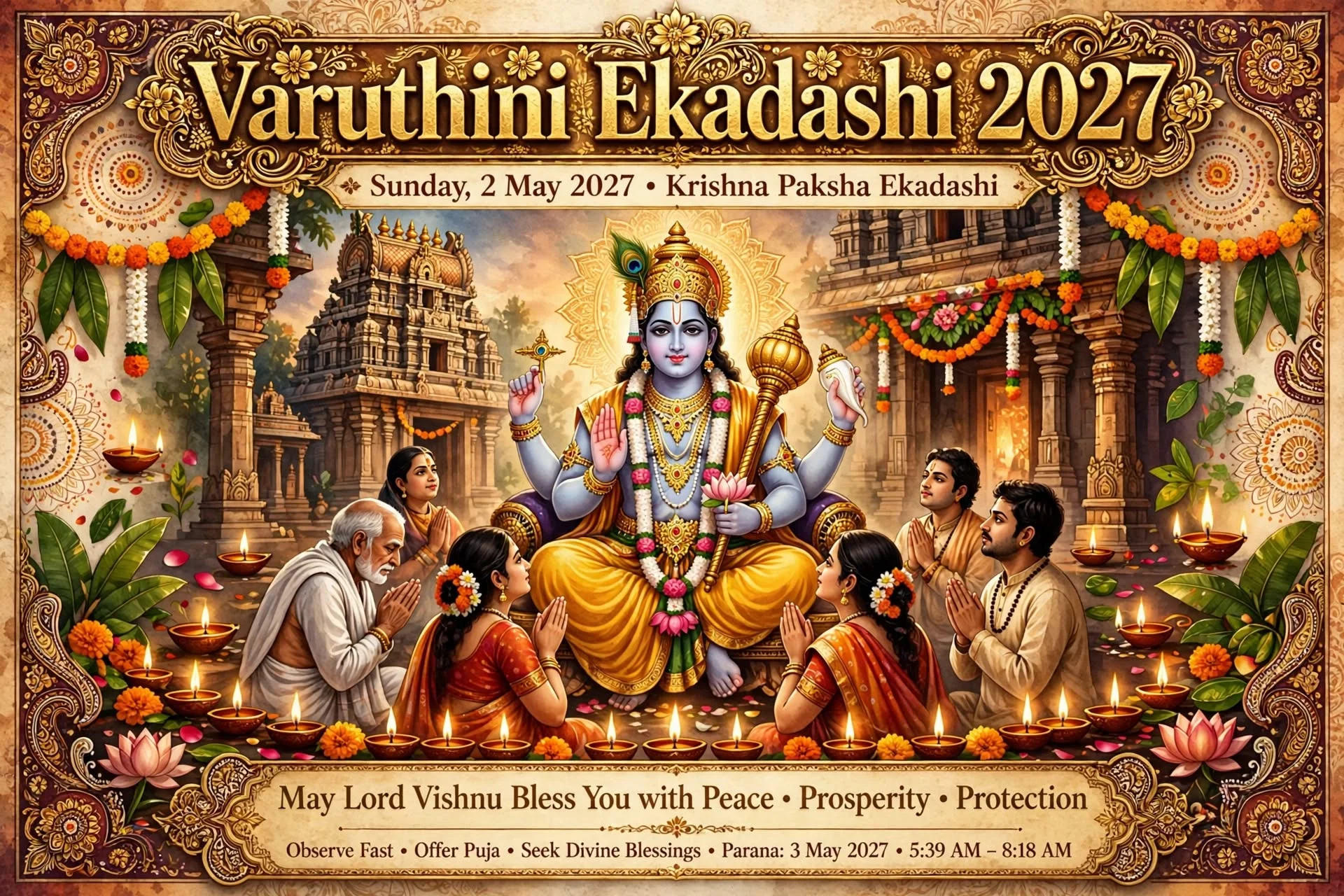
Varuthini Ekadashi, also known as Baruthani Ekadashi or Varuthini Ekadashi Vrat, is an important Hindu fasting festival dedicated to Lord Vishnu. It is observed on the Krishna Paksha Ekadashi (eleventh lunar day of the waning moon) during the month of Vaishakha according to the North Indian Purnimanta calendar. In regions following the Amanta calendar, the same observance falls during Chaitra Krishna Paksha. The Sanskrit word Varuthini is associated with protection, armour, and divine safeguarding, symbolizing the protective grace of Lord Vishnu for devotees who observe this sacred vrata with faith and discipline.
The spiritual importance of Varuthini Ekadashi is described in the Padma Purana, particularly in the Uttara Khanda, where Lord Krishna explains its significance to King Yudhishthira. According to this sacred account, observing this Ekadashi with devotion is believed to remove accumulated sins, bestow good fortune, provide protection from misfortune, and guide devotees toward spiritual liberation. The vrata is praised as possessing extraordinary religious merit, comparable to extensive austerities and highly regarded charitable offerings.
Varuthini Ekadashi is also associated with the traditional story of King Mandhata, a righteous ruler known for his generosity and devotion. According to a popular version of the Vrat Katha, the king encountered a dangerous bear while performing penance in the forest. Lord Vishnu instructed him to observe Varuthini Ekadashi and worship His divine Varaha form. Through the merit of the vrata, the king was relieved of his suffering and restored to well-being. This account symbolizes divine protection, patience, faith, and the power of sincere devotion.
The observance emphasizes fasting, worship of Lord Vishnu, recitation of sacred mantras, reading the Varuthini Ekadashi Vrat Katha, charitable giving, and maintaining ethical discipline. Devotees traditionally worship Lord Madhusudana and may also worship Lord Varaha, the boar incarnation of Vishnu, according to their family traditions. The festival teaches that spiritual protection is strengthened through self-control, truthfulness, generosity, compassion, and freedom from harmful actions.
Why is Varuthini Ekadashi Celebrated?
Varuthini Ekadashi is celebrated to worship Lord Vishnu and seek His divine protection, good fortune, spiritual purification, and liberation from the cycle of repeated birth and death. The significance of this vrata is described by Lord Krishna in the Padma Purana, where He explains to Yudhishthira that observing Varuthini Ekadashi with sincerity brings spiritual merit and protects devotees from the consequences of negative actions.
The traditional account praises this Ekadashi for the extraordinary merit associated with fasting, restraint, and charity. It compares the religious benefits of observing the vrata with extensive penance and valuable charitable offerings. The teachings also emphasize that food donation, sesame donation, and other acts of generosity are important expressions of religious responsibility.
The popular Vrat Katha of King Mandhata further illustrates the protective aspect of this Ekadashi. Through the divine guidance of Lord Vishnu, the king is instructed to observe the vrata and worship Lord Varaha. His recovery symbolizes the importance of faith, patience, devotion, and divine grace during difficult circumstances.
Seeks the divine protection of Lord Vishnu against misfortune, negative influences, and the consequences of past actions.
Promotes spiritual purification through fasting, prayer, self-discipline, and devotional worship.
Honours the sacred teachings of Lord Krishna as described in the Padma Purana.
Celebrates the spiritual merit associated with charitable activities, particularly food donation, sesame donation, and other forms of Dana.
Commemorates the traditional account of King Mandhata and the protective grace of Lord Vishnu.
Encourages worship of Lord Madhusudana and Lord Varaha according to traditional devotional practices.
Teaches the importance of truthfulness, celibacy, patience, compassion, and control over the senses.
The Divine Protection of Lord Vishnu and the Sacred Glory of Varuthini Ekadashi
The Sacred Dialogue Between Lord Krishna and King Yudhishthira
The religious significance of Varuthini Ekadashi is traditionally described in the Padma Purana, Uttara Khanda. The account presents a sacred conversation between King Yudhishthira and Lord Krishna, in which Yudhishthira seeks to understand the Ekadashi observed during the dark fortnight of the month of Vaishakha. He asks about its name, spiritual significance, prescribed observances, and the religious merit obtained by observing the vrata.
In response, Lord Krishna explains that the Ekadashi of Vaishakha Krishna Paksha is known as Varuthini Ekadashi. He describes it as an exceptionally auspicious observance that bestows good fortune in both worldly and spiritual life. According to His teachings, devotees who observe the fast with sincerity are believed to overcome the consequences of accumulated sinful actions and progress toward liberation.
Lord Krishna further explains that the spiritual merit of Varuthini Ekadashi is comparable to that obtained through ten thousand years of austerities. The account also compares its merit with the charitable donation of gold at Kurukshetra during a solar eclipse. These comparisons emphasize the extraordinary importance traditionally attributed to this Ekadashi and the spiritual value of disciplined observance.
The dialogue establishes that the vrata is not merely a dietary restriction but a comprehensive spiritual discipline involving fasting, ethical conduct, charitable giving, devotion, and control over the senses. It encourages devotees to follow righteous actions and avoid harmful behavior throughout the observance.
The Divine Merit of Charity and Annadan
An important teaching in the Varuthini Ekadashi Mahatmya concerns the spiritual importance of charitable giving. Lord Krishna explains to Yudhishthira that different forms of Dana carry different degrees of religious merit. The account describes the donation of an elephant as greater than the donation of a horse, the donation of land as greater than the donation of an elephant, and the donation of sesame seeds as especially meritorious.
Divine Protection, Karmic Purification, and the Path of Spiritual Liberation
The Protective Grace of Lord Vishnu
The name Varuthini is traditionally associated with protection, armour, and divine safeguarding. The spiritual identity of this Ekadashi is therefore closely connected with the protective grace of Lord Vishnu, who preserves the universe and protects devotees who surrender to Him with sincerity.
Observing Varuthini Ekadashi is traditionally believed to help devotees overcome difficult circumstances, reduce the consequences of negative actions, and develop the inner strength required to follow the path of Dharma. The fast encourages people to seek divine guidance rather than becoming overwhelmed by fear, anger, or suffering.
The popular story of King Mandhata illustrates this protective aspect through the king's surrender to Lord Vishnu during a moment of danger. His experience represents the importance of faith and patience when facing circumstances beyond human control.
Karmic Purification and Freedom from Past Actions
According to the Varuthini Ekadashi Mahatmya, observing the vrata with devotion is believed to diminish the effects of sinful actions and help individuals progress toward spiritual purification. The fast encourages devotees to reflect upon their behavior, recognize harmful tendencies, and develop a sincere intention to improve their lives.
The discipline of fasting helps devotees temporarily withdraw from material indulgences and focus on spiritual practices. Through prayer, meditation, scripture reading, and ethical behavior, individuals are encouraged to cultivate a more disciplined and compassionate way of living.
The vrata is therefore understood not only as a religious ritual but also as an opportunity for personal transformation. Its spiritual purpose is to encourage the abandonment of harmful habits and the development of righteous conduct.
The Spiritual Merit of Dana and Annadan
Charity is one of the most important teachings associated with Varuthini Ekadashi. The Padma Purana discusses different forms of charitable giving and especially praises the donation of food. Annadan is considered highly meritorious because food sustains life and provides direct nourishment to those in need.
Traditional Fasting, Lord Vishnu Worship, Ethical Discipline, and Charitable Observances
Dashami Preparations and Sattvic Discipline
The preparation for Varuthini Ekadashi begins on the preceding Dashami. Devotees traditionally eat only one sattvic meal and avoid overeating or consuming prohibited foods. The Padma Purana prescribes restrictions involving bell-metal vessels, urad dal, masoor dal, chickpeas, kodo millet, leafy vegetables, honey, food prepared by others, and eating more than once.
Devotees are also advised to maintain celibacy and avoid unnecessary indulgence. The purpose of these restrictions is to prepare the body and mind for the Ekadashi fast and establish an atmosphere of purity and self-control.
Many devotees clean their homes, prepare the worship area, arrange puja materials, and mentally prepare for the following day's observances.
Morning Bath and Sankalpa
On Ekadashi morning, devotees wake up early, preferably during Brahma Muhurta, and take a bath. After completing their daily purification rituals, they wear clean clothes and prepare a dedicated place for worshipping Lord Vishnu.
The devotee sits before the deity, holds water and flowers in the palm, and takes the Sankalpa to observe Varuthini Ekadashi with sincerity. The prayer expresses the intention to worship Lord Vishnu, maintain fasting discipline, avoid harmful actions, and perform charitable activities.
The Sankalpa is traditionally taken with a sincere heart, asking the Lord for strength, protection, forgiveness, and spiritual progress.
Lord Vishnu and Madhusudana Puja
The principal worship of Varuthini Ekadashi is dedicated to Lord Vishnu. Devotees establish an image or idol of the Lord and offer flowers, Tulsi leaves, sandalwood paste, incense, a ghee lamp, fruits, and traditional naivedya.
Special prayers may be offered to Lord Madhusudana, whose divine form represents the destruction of evil and preservation of Dharma. Devotees chant Om Namo Bhagavate Vasudevaya and other Vishnu mantras while meditating upon His divine qualities.
Varuthini Ekadashi Puja Vidhi (Step by Step)
1
Dashami Preparation and Sattvic Discipline
On the preceding Dashami, eat one sattvic meal and begin observing the prescribed dietary and behavioral restrictions. Avoid prohibited foods, overeating, and unnecessary indulgence. Maintain celibacy and prepare your worship materials for the following day's observance.
2
Brahma Muhurta Snana
Wake up early during Brahma Muhurta and take a ceremonial bath. Wear clean clothes and maintain physical and mental purity. After completing your morning purification, prepare the worship area for Lord Vishnu.
3
Altar Preparation and Vishnu Sthapana
Clean the place of worship and establish an image or idol of Lord Vishnu. Decorate the altar with yellow cloth, fresh flowers, Tulsi leaves, and traditional puja materials. Devotees following the Varaha tradition may also place an image of Lord Varaha.
4
Sankalpa
Sit before Lord Vishnu and take a sincere vow to observe Varuthini Ekadashi. Hold water, flowers, and Akshata in your palm while expressing your intention to maintain fasting discipline, worship the Lord, perform charity, and seek spiritual purification.
5
Varuthini Ekadashi Puja Samagri List
Lord Vishnu and Madhusudana Worship Materials
Traditional materials required for the worship of Lord Vishnu and Lord Madhusudana during Varuthini Ekadashi.
Idol or image of Lord Vishnu
Image of Lord Madhusudana, if available
Yellow cloth for the altar
Fresh yellow flowers and garland
Tulsi leaves and Tulsi garland
Sandalwood paste and kumkum
Akshata (unbroken rice grains)
Incense sticks and dhoop
Ghee lamp and cotton wicks
Bell and puja plate
Panchamrit ingredients
Gangajal or clean water
Fruits and traditional naivedya
Lord Varaha Worship Materials
Optional worship materials for devotees who follow the traditional association of Varuthini Ekadashi with Lord Varaha.
Image or idol of Lord Varaha
Yellow or red flowers
Tulsi leaves
Sandalwood paste
Mantras and Prayers for Varuthini Ekadashi
Lord Vishnu Dwadashakshari Mantra
ॐ नमो भगवते वासुदेवाय॥
Om Namo Bhagavate Vasudevaya.
Simple Meaning: I offer my salutations to Lord Vasudeva, the Supreme Divine Being who resides in all living beings. This sacred mantra expresses complete surrender, devotion, and remembrance of Lord Vishnu.
Lord Narayana Ashtakshari Mantra
ॐ नमो नारायणाय॥
Om Namo Narayanaya.
Varuthini Ekadashi Vrat Rules and Fasting Guidelines
Dashami Dietary and Behavioral Restrictions
According to the Varuthini Ekadashi Mahatmya, the preparation for the vrata begins on Dashami. Devotees are advised to eat one sattvic meal and avoid specified foods and behaviors to prepare themselves for the Ekadashi observance.
Avoid eating from bell-metal vessels.
Avoid urad dal and masoor dal.
Avoid chickpeas and kodo millet.
Avoid leafy vegetables according to the prescribed traditional restriction.
Avoid honey.
Avoid eating food prepared by another person where prohibited by the tradition.
Avoid eating more than once.
Maintain celibacy and avoid sexual activity.
Avoid overeating and unnecessary indulgence.
Eleven Restrictions on Ekadashi
The traditional Padma Purana account prescribes eleven restrictions for Ekadashi. These practices emphasize purification of speech, thoughts, behavior, and personal habits alongside fasting.
Avoid gambling and other activities involving harmful indulgence.
Avoid excessive sleep and maintain devotional awareness.
Avoid betel consumption.
Avoid cleaning the teeth with a twig where this traditional restriction is followed.
Dos and Don'ts of Varuthini Ekadashi
Good Practices (Do's)
Wake up early and take a ceremonial bath before beginning worship.
Worship Lord Vishnu with Tulsi leaves, flowers, incense, and a ghee lamp.
Take a sincere Sankalpa to observe Varuthini Ekadashi.
Recite Om Namo Bhagavate Vasudevaya with devotion.
Read or listen to the Varuthini Ekadashi Vrat Katha.
Worship Lord Madhusudana and Lord Varaha according to family tradition.
Varuthini Ekadashi Across Regions
Region
Local Name
North India
Varuthini Ekadashi
Uttar Pradesh and Mathura-Vrindavan
Varuthini Ekadashi Vrat
Maharashtra
Varuthini Ekadashi
Gujarat
Varuthini Ekadashi
South India
Varuthini Ekadashi / Chaitra Krishna Ekadashi
ISKCON and Vaishnava Communities
Varuthini Ekadashi
Varuthini Ekadashi FAQs
What is Varuthini Ekadashi?
Varuthini Ekadashi is a Hindu fasting festival dedicated to Lord Vishnu. It is observed during Krishna Paksha of Vaishakha according to the North Indian Purnimanta calendar and is associated with divine protection, spiritual purification, good fortune, and liberation.
When is Varuthini Ekadashi observed?
Varuthini Ekadashi is observed on the eleventh lunar day of the waning fortnight of Vaishakha. In regions following the Amanta calendar, it is associated with Chaitra Krishna Paksha.
Which deity is worshipped on Varuthini Ekadashi?
Lord Vishnu is the principal deity worshipped on Varuthini Ekadashi. Devotees traditionally worship Him as Lord Madhusudana, and some also worship His Varaha incarnation according to the traditional King Mandhata Vrat Katha.
Inspires devotees to overcome harmful habits and progress toward spiritual liberation.
The teaching further praises the donation of gold and places food donation above material gifts. Annadan, or feeding others, is described as an exceptionally important charitable act because food sustains all living beings. Through food, human beings, ancestors, and divine beings are symbolically nourished and satisfied.
The account also discusses the importance of Kanyadana and the ethical responsibility associated with marriage and family relationships. It condemns greed and the exploitation of daughters for financial gain while praising the sincere and respectful performance of charitable and familial responsibilities.
Lord Krishna explains that observing Varuthini Ekadashi grants spiritual merit comparable to these highly regarded charitable acts. The underlying teaching is that devotion should be accompanied by generosity, ethical conduct, and compassion toward others.
The Story of King Mandhata and the Divine Protection of Lord Vishnu
A popular traditional version of the Varuthini Ekadashi Vrat Katha describes King Mandhata, a righteous ruler renowned for his generosity, religious devotion, and commitment to Dharma. He ruled his kingdom with justice and compassion and was respected for his spiritual discipline.
According to this associated legend, King Mandhata once travelled into a forest to perform intense penance and meditation. While deeply absorbed in his spiritual practice, he encountered a dangerous wild bear. The animal attacked him, began biting his leg, and attempted to drag him away into the forest.
Despite the severe pain and danger, the king did not abandon his devotion or respond with anger. Instead, he called upon Lord Vishnu for divine protection. Hearing the sincere prayers of His devotee, Lord Vishnu appeared and destroyed the attacking bear with His divine Sudarshana Chakra.
Although the king was rescued from the animal, his leg had already been severely injured. He became distressed and asked the Lord why such suffering had come upon him despite his devotion and righteous conduct.
Lord Vishnu explained that the suffering was connected with the consequences of actions from a previous birth. He advised the king to travel to Mathura and observe Varuthini Ekadashi with complete devotion. The Lord also instructed him to worship His Varaha form and perform the prescribed religious observances.
The Restoration of King Mandhata Through Varuthini Ekadashi
Following the instructions of Lord Vishnu, King Mandhata travelled to the sacred region of Mathura and observed Varuthini Ekadashi with faith and discipline. He performed the prescribed fasting, worshipped Lord Varaha, recited sacred prayers, and devoted himself to the remembrance of the Supreme Lord.
Through the spiritual merit of his observance and the divine grace of Lord Vishnu, the king's suffering was relieved and his damaged leg was restored according to the traditional account. He regained his physical well-being and continued his life with renewed devotion and gratitude.
The story teaches that difficult circumstances should not weaken a devotee's faith. It emphasizes patience, surrender, righteous conduct, and the belief that sincere devotion can help individuals overcome the consequences of past actions.
This narrative is widely associated with Varuthini Ekadashi in popular devotional literature. It should be distinguished from the Padma Purana's Varuthini Mahatmya dialogue, which praises the vrata and mentions King Mandhata but does not narrate the bear episode in that chapter.
The Spiritual Significance of King Dhundhumara
The Varuthini Ekadashi Mahatmya also refers to King Dhundhumara, another ruler traditionally associated with the spiritual merit of this sacred vrata. Lord Krishna mentions that King Dhundhumara, like King Mandhata, attained the heavenly realm through the influence of Varuthini Ekadashi.
The reference to these righteous kings reinforces the importance of the Ekadashi as a spiritual observance that transcends ordinary material achievements. Their examples are used to illustrate the power of devotion, religious discipline, and righteous conduct.
The account encourages devotees from every stage of life to observe the vrata according to their capacity and to cultivate qualities such as humility, generosity, patience, and faith in Lord Vishnu.
The Ten, Eleven, and Twelve Sacred Restrictions
One distinctive aspect of Varuthini Ekadashi is the detailed discipline prescribed for Dashami, Ekadashi, and Dwadashi. The Padma Purana describes different restrictions for each of these three days, encouraging devotees to maintain purity and self-control throughout the complete fasting observance.
On Dashami, devotees are traditionally advised to avoid certain foods and behaviors, including eating from bell-metal vessels, consuming particular pulses, honey, eating another person's food, eating twice, and sexual activity.
On Ekadashi, the emphasis shifts toward mental and behavioral discipline. Gambling, excessive sleep, betel consumption, slander, theft, violence, anger, lying, and sexual indulgence are among the activities traditionally prohibited.
On Dwadashi, devotees are advised to continue maintaining discipline while completing the observance and breaking the fast during the prescribed Parana period. These restrictions demonstrate that the purpose of Ekadashi extends beyond abstaining from grains and includes purification of speech, thoughts, habits, and actions.
The sacred account also describes the importance of sesame donation, gold donation, land donation, and other traditional forms of Dana. These teachings encourage devotees to understand that wealth and material resources should be used responsibly and shared with people who require assistance.
The festival reminds devotees that religious merit is not limited to performing personal rituals. Helping the hungry, supporting the underprivileged, and giving according to one's financial capacity are meaningful expressions of devotion.
The Importance of Self-Control and Indriya Nigraha
Varuthini Ekadashi places considerable emphasis on controlling the senses and maintaining ethical discipline. The traditional restrictions prescribed for Dashami, Ekadashi, and Dwadashi address food, sleep, speech, behavior, and personal conduct.
Avoiding gambling, anger, dishonesty, violence, slander, and excessive indulgence encourages devotees to develop mental stability and self-control. The observance also emphasizes celibacy and restraint from activities that distract the mind from spiritual practices.
The deeper teaching is that fasting becomes meaningful when it is accompanied by purification of thoughts and actions. A devotee is encouraged to practice patience, truthfulness, humility, and compassion throughout the observance.
Worship of Lord Madhusudana and Lord Varaha
Lord Vishnu is the principal deity worshipped on Varuthini Ekadashi. Devotees traditionally worship Him as Lord Madhusudana, the destroyer of the Madhu demon, and seek His blessings for protection, spiritual progress, and freedom from negative influences.
The popular King Mandhata legend also associates the observance with Lord Varaha, the boar incarnation of Vishnu. Lord Varaha represents the divine power that protects the Earth and restores cosmic balance. Worshipping this form symbolizes divine intervention, restoration, and protection during difficult circumstances.
Devotees may worship Lord Vishnu in His general form or specifically worship Lord Varaha according to their family traditions and devotional practices.
The Path Toward Moksha
The Varuthini Ekadashi Mahatmya describes the vrata as a means of attaining spiritual merit and ultimately progressing toward liberation. Moksha represents freedom from the repeated cycle of birth and death and the realization of one's spiritual relationship with the Supreme Lord.
Through fasting, mantra recitation, charitable giving, and devotion, devotees are encouraged to reduce attachment to material pleasures and focus on the eternal nature of the soul.
The observance teaches that true spiritual protection is not merely freedom from external difficulties but also freedom from ignorance, harmful desires, and destructive behavior.
Some devotees also perform Shodashopachara Puja, offering the traditional sixteen forms of worship, while others follow a simpler Panchopachara Puja according to their family customs.
Lord Varaha Worship and the Traditional Katha
The popular Vrat Katha of King Mandhata connects Varuthini Ekadashi with Lord Varaha. Devotees who follow this tradition may worship the Varaha form of Lord Vishnu and offer prayers seeking protection, restoration, and relief from difficulties.
Reading or listening to the Varuthini Ekadashi Vrat Katha is an important part of the observance. Devotees listen to the sacred dialogue between Lord Krishna and Yudhishthira and reflect upon the importance of fasting, charity, restraint, and devotion.
The story of King Mandhata is also narrated in many devotional traditions to emphasize that sincere surrender and divine grace can help individuals face difficult circumstances.
Ekadashi Fasting and Dietary Observances
Devotees observe the Varuthini Ekadashi fast according to their health, family traditions, and religious customs. Some follow Nirjala fasting without food or water, while others observe Phalahar by consuming fruits, milk, and permitted fasting preparations.
Regular grains, rice, wheat, and pulses are traditionally avoided during the Ekadashi fast. Devotees may consume fasting foods prepared from permitted ingredients such as fruits, milk, nuts, and certain fasting flours according to their customs.
The purpose of fasting is to develop self-control and dedicate the day to spiritual activities. People who cannot safely observe a strict fast may follow a lighter form of observance while maintaining devotion and ethical discipline.
The Eleven Restrictions of Ekadashi
The Padma Purana prescribes eleven activities that devotees should avoid on Ekadashi. These include gambling, excessive sleep, betel consumption, speaking ill of others, slander, theft, violence, sexual indulgence, anger, and lying. Traditional instructions also include restrictions involving cleaning the teeth with a twig.
These restrictions demonstrate that Varuthini Ekadashi is concerned with mental and behavioral purification in addition to dietary fasting. Devotees are encouraged to maintain truthful speech, avoid unnecessary conflict, control their senses, and spend their time in prayer and spiritual contemplation.
Dana, Annadan, and Charitable Activities
Charitable giving is an important feature of Varuthini Ekadashi. The sacred teachings emphasize food donation and other forms of Dana as meaningful ways to express devotion and compassion.
Devotees may donate sesame seeds, food grains, clothes, and other useful necessities to deserving people. Feeding the hungry and supporting underprivileged families are particularly encouraged. Charity should be performed according to one's financial capacity and without pride or expectation of personal rewards.
The teaching of Annadan reminds devotees that spiritual observances should benefit society. By sharing food and resources, individuals express gratitude for their blessings and develop a compassionate relationship with other living beings.
Night Vigil, Bhajan, and Vishnu Smarana
Many devotees remain awake during the night of Ekadashi, dedicating their time to Lord Vishnu through devotional songs, mantra recitation, scripture reading, and meditation. This practice is known as Jagran and is traditionally associated with maintaining continuous remembrance of the Lord.
Devotees may recite Vishnu Sahasranama, chant the Dwadashakshari Mantra, sing devotional bhajans, and listen to religious discourses. The purpose of Jagran is to reduce attachment to ordinary pleasures and keep the mind focused on divine remembrance.
The traditional teachings also advise avoiding excessive sleep, anger, slander, dishonesty, and harmful activities during the observance.
Dwadashi Parana and Completion of the Vrat
The Varuthini Ekadashi observance is completed on the following Dwadashi. Devotees wake up, perform their morning purification rituals, worship Lord Vishnu, and offer prayers before breaking the fast.
Parana should be performed during the prescribed Dwadashi Parana period after sunrise and according to the local Panchang. Devotees should pay attention to Hari Vasara and avoid breaking the fast during this period.
After completing Parana, devotees may offer food or Dakshina to Brahmins and people in need according to their family traditions. The vrata concludes with prayers of gratitude to Lord Vishnu for His blessings and guidance.
Lord Vishnu Avahana
Invoke Lord Vishnu with folded hands and meditate upon His divine form. Pray for protection, forgiveness, prosperity, and spiritual progress. Chant sacred Vishnu prayers and offer your devotion with sincerity.
6
Panchopachara or Shodashopachara Puja
Perform the traditional worship of Lord Vishnu by offering water, sandalwood paste, flowers, incense, a ghee lamp, Tulsi leaves, fruits, and other suitable offerings. Devotees following the elaborate method may perform Shodashopachara Puja with sixteen traditional forms of worship.
7
Tulsi Archana and Vishnu Sahasranama
Offer fresh Tulsi leaves and flowers to Lord Vishnu while chanting His sacred names. Recite Vishnu Sahasranama or other devotional prayers according to your capacity. Tulsi is traditionally considered especially dear to Lord Vishnu.
8
Lord Madhusudana Worship
Meditate upon Lord Madhusudana, a divine form of Vishnu associated with the destruction of evil. Offer yellow flowers, sandalwood paste, incense, and prayers while chanting Om Namo Bhagavate Vasudevaya.
9
Lord Varaha Puja
Devotees following the traditional King Mandhata narrative may worship Lord Varaha, the boar incarnation of Vishnu. Offer flowers, Tulsi leaves, incense, a ghee lamp, and fruits while praying for divine protection and the restoration of well-being.
10
Varuthini Ekadashi Vrat Katha
Read or listen to the Varuthini Ekadashi Mahatmya describing the sacred dialogue between Lord Krishna and Yudhishthira. Also listen to the popular King Mandhata Vrat Katha according to family tradition. Reflect upon the teachings of devotion, charity, and self-control.
11
Ekadashi Fasting and Indriya Nigraha
Observe the chosen form of fasting, such as Nirjala or Phalahar, according to personal health and tradition. Avoid prohibited grains and foods, gambling, dishonesty, anger, slander, violence, and other harmful activities. Dedicate the day to prayer and meditation.
12
Vishnu Mantra Japa
Chant Om Namo Bhagavate Vasudevaya or Om Namo Narayanaya using a Tulsi mala. Devotees may also chant Lord Varaha mantras according to their devotional tradition. Maintain concentration and meditate upon the protective grace of Lord Vishnu.
13
Naivedya Offering
Prepare suitable sattvic offerings such as fruits, milk, and permitted fasting preparations. Offer them to Lord Vishnu with devotion and distribute the prasadam after worship according to the fasting rules being followed.
14
Dana and Annadan
Donate food, sesame seeds, grains, clothes, or other useful necessities to deserving people according to your capacity. Feed people in need and perform charitable activities without pride or expectation of reward.
15
Evening Aarti and Ekadashi Jagran
Perform evening Aarti before Lord Vishnu using a ghee lamp or camphor. Chant Vishnu mantras, recite devotional hymns, sing bhajans, and listen to religious discourses. Devotees who follow the Jagran tradition may remain awake during the night in remembrance of the Lord.
16
Dwadashi Parana
On the following Dwadashi, perform morning worship and complete the fast during the prescribed Parana period. Follow the local Panchang, avoid Hari Vasara, and offer prayers of gratitude to Lord Vishnu before concluding the vrata.
Incense and dhoop
Ghee lamp
Fruits and sattvic naivedya
Clean water for ritual offerings
Fasting and Sattvic Food Materials
Permitted food materials for devotees observing Phalahar or other traditional forms of Ekadashi fasting.
Fresh seasonal fruits
Milk and curd, where permitted
Makhana
Sabudana
Permitted fasting flour
Rock salt (Sendha Namak)
Dry fruits and nuts
Coconut and coconut water
Ghee
Ingredients for traditional fasting preparations
Charity and Dana Materials
Traditional charitable offerings associated with the teachings of Varuthini Ekadashi and the importance of Dana and Annadan.
Sesame seeds
Food grains and rice
Wheat and other useful grains
Clothes and garments
Fresh fruits and food packets
Cooked meals for Annadan
Water and other necessities
Dakshina according to financial capacity
Aarti, Mantra, and Havan Materials
Additional devotional materials used for mantra recitation, traditional fire rituals, and the completion of worship.
Tulsi mala for mantra japa
Camphor for Aarti
Pure cow ghee
Cotton wicks
Havan Kund, if performing Havan
Havan Samagri
Sacred wood for Havan
Copper or brass water vessel
Clean puja cloth
Simple Meaning: I bow to Lord Narayana, the Supreme Protector and the divine refuge of all living beings. Chanting this mantra represents surrender, devotion, and the seeking of divine protection.
Lord Varaha Mantra
ॐ नमो भगवते वराहाय नमः॥
Om Namo Bhagavate Varahaya Namah.
Simple Meaning: I offer my salutations to Lord Varaha, the divine incarnation of Lord Vishnu who rescued the Earth and restored cosmic balance. This prayer expresses devotion and seeks the Lord's protective grace.
Simple Meaning: I meditate upon Lord Vishnu, whose form is peaceful, who rests upon the cosmic serpent, whose navel bears the lotus, and who supports the entire universe. His divine appearance resembles the vast sky and the color of rain-bearing clouds.
Om Narayanaya Vidmahe Vasudevaya Dhimahi, Tanno Vishnuh Prachodayat.
Simple Meaning: We meditate upon Lord Narayana and focus our minds on Lord Vasudeva. May Lord Vishnu illuminate our intellect and guide us toward the path of righteousness and spiritual wisdom.
Do not speak ill of other people.
Avoid slander, gossip, and unnecessary criticism.
Do not steal or take anything that does not belong to you.
Avoid violence and causing harm to living beings.
Maintain celibacy and avoid sexual indulgence.
Control anger and avoid hostile behavior.
Speak truthfully and avoid lying.
Dwadashi Restrictions and Parana Discipline
The observance continues into Dwadashi, when devotees complete the fast through the prescribed Parana. The traditional text also describes dietary and behavioral restrictions for this day to maintain discipline until the vrata is properly concluded.
Avoid bell-metal vessels according to the traditional restriction.
Avoid urad dal and masoor dal.
Avoid alcohol and honey.
Avoid excessive oil consumption according to the prescribed observance.
Avoid eating more than once before completing the prescribed ritual.
Maintain celibacy.
Avoid unnecessary travel and excessive physical exertion.
Avoid prohibited foods and inappropriate company.
Break the fast only during the prescribed Dwadashi Parana period.
Fasting and Dietary Discipline
Varuthini Ekadashi fasting can be observed through different methods according to an individual's health, physical capacity, and family tradition. The primary purpose is to develop self-control and dedicate the day to Lord Vishnu rather than impose unnecessary physical hardship.
Nirjala Vrat: Complete abstinence from food and water for devotees who can safely observe it.
Phalahar Vrat: Consumption of permitted fruits, milk, nuts, and fasting preparations.
Sattvic Vrat: Following a restricted sattvic diet according to family tradition.
Avoid regular grains, rice, wheat, and prohibited pulses during the fast.
Avoid meat, alcohol, tobacco, and other prohibited substances.
Maintain cleanliness and prepare food according to Ekadashi rules.
Avoid overeating after completing the fast.
Guidelines for Spiritual and Ethical Purity
The deeper purpose of Varuthini Ekadashi is to purify the mind and develop righteous behavior. Devotees should use the observance as an opportunity to overcome negative habits and strengthen their devotion to Lord Vishnu.
Worship Lord Vishnu with sincerity and devotion.
Recite Vishnu mantras and listen to the Varuthini Ekadashi Vrat Katha.
Practice truthfulness, humility, and patience.
Avoid anger, slander, dishonesty, and harmful behavior.
Maintain celibacy and control over the senses.
Perform charity and food donation according to your capacity.
Avoid gambling and unnecessary indulgence.
Spend time in meditation, prayer, and scripture reading.
Remain compassionate toward all living beings.
Charity and Devotional Service
Charity is an important teaching of the Varuthini Ekadashi Mahatmya. Devotees are encouraged to use their resources responsibly and help people who are hungry, underprivileged, or in need of assistance.
Donate food and perform Annadan.
Donate sesame seeds and other useful materials according to tradition.
Offer clothes and necessities to deserving people.
Support religious and charitable activities.
Give charity without pride or expectation of rewards.
Respect parents, elders, teachers, and all living beings.
Observe fasting according to your health and physical capacity.
Maintain celibacy and practice self-control.
Avoid anger, slander, gambling, dishonesty, and harmful behavior.
Donate food, sesame seeds, clothes, and other necessities to deserving people.
Perform Annadan and help people in need.
Spend time in prayer, meditation, devotional singing, and scripture reading.
Observe the traditional Dashami, Ekadashi, and Dwadashi restrictions.
Break the fast during the prescribed Dwadashi Parana period.
Things to Avoid (Don'ts)
Do not consume regular grains, rice, wheat, and prohibited pulses during the Ekadashi fast.
Avoid urad dal, masoor dal, chickpeas, and kodo millet during the prescribed restriction period.
Do not consume alcohol, meat, or other prohibited substances.
Avoid honey and foods prohibited by the traditional Dashami and Dwadashi rules.
Do not engage in gambling, theft, violence, or dishonest activities.
Avoid slander, gossip, criticism, and speaking ill of others.
Do not become angry or intentionally harm other living beings.
Avoid sexual indulgence and maintain celibacy during the observance.
Do not sleep excessively or neglect devotional activities.
Do not perform strict Nirjala fasting if your health does not permit it.
Avoid excessive eating and inappropriate indulgence after fasting.
Do not break the fast outside the prescribed Parana period without considering the local Panchang.
What does the word Varuthini mean?
Varuthini is traditionally associated with protection, armour, and divine safeguarding. The name symbolizes the protective grace of Lord Vishnu and the spiritual protection sought by devotees through fasting and worship.
Why is Varuthini Ekadashi considered important?
Varuthini Ekadashi is considered important because the Padma Purana praises its spiritual merit and describes its ability to bestow good fortune, reduce the consequences of negative actions, and guide devotees toward liberation. It also emphasizes charity, self-control, and devotion to Lord Vishnu.
What are the benefits of observing Varuthini Ekadashi?
According to traditional religious belief, observing Varuthini Ekadashi with devotion helps purify the mind, reduce the effects of past negative actions, develop self-discipline, and accumulate spiritual merit. It is also associated with divine protection, prosperity, and spiritual liberation.
What is the significance of fasting on Varuthini Ekadashi?
Fasting represents self-control, devotion, and freedom from excessive material indulgence. It allows devotees to dedicate their time to prayer, meditation, mantra recitation, and worship of Lord Vishnu.
Can devotees observe Nirjala fasting on Varuthini Ekadashi?
Yes. Some devotees observe Nirjala fasting without food or water. However, this is a strict form of fasting and should only be undertaken by people whose health and physical capacity permit it.
Can fruits be consumed during Varuthini Ekadashi fasting?
Yes. Devotees following Phalahar fasting may consume permitted fruits, milk, nuts, and traditional fasting preparations according to their family customs.
Which foods should be avoided on Varuthini Ekadashi?
Devotees traditionally avoid rice, wheat, regular grains, pulses, and other prohibited foods. Alcohol, meat, and foods restricted by the family's Ekadashi tradition should also be avoided.
Which mantra should be chanted on Varuthini Ekadashi?
Devotees can chant Om Namo Bhagavate Vasudevaya or Om Namo Narayanaya. Those worshipping Lord Varaha may also recite Om Namo Bhagavate Varahaya Namah.
Why is Lord Varaha worshipped on Varuthini Ekadashi?
The popular King Mandhata Vrat Katha connects this Ekadashi with the worship of Lord Varaha. According to the story, Lord Vishnu instructed King Mandhata to observe Varuthini Ekadashi and worship His Varaha form to overcome his suffering.
What should be donated on Varuthini Ekadashi?
Devotees may donate food, sesame seeds, grains, clothes, and other useful necessities according to their capacity. Annadan, or feeding people in need, is especially praised in the traditional Varuthini Ekadashi Mahatmya.
Can devotees sleep during Varuthini Ekadashi?
Traditional observances encourage devotees to avoid excessive sleep and spend the night in devotional activities such as chanting, meditation, and scripture reading. Some devotees observe a complete night vigil known as Jagran.
When should the Varuthini Ekadashi fast be broken?
The fast is completed on the following Dwadashi during the prescribed Parana period. Devotees should follow the local Panchang and avoid breaking the fast during Hari Vasara.
What is Annadan and why is it important on Varuthini Ekadashi?
Annadan means donating food to people in need. The Varuthini Ekadashi Mahatmya particularly praises food donation because food sustains all living beings. It teaches devotees to express devotion through generosity and service.
Is Varuthini Ekadashi observed in South India?
Yes. The corresponding Ekadashi is observed in South India as well. In regions following the Amanta calendar, it is associated with Chaitra Krishna Paksha rather than Vaishakha Krishna Paksha.
What is the main spiritual lesson of Varuthini Ekadashi?
The central lesson is that devotion must be accompanied by self-control, truthfulness, compassion, and charitable giving. The festival teaches devotees to overcome harmful habits and seek the protective grace of Lord Vishnu.
Where is the significance of Varuthini Ekadashi described?
The Varuthini Ekadashi Mahatmya is traditionally found in the Uttara Khanda of the Padma Purana. It describes a dialogue between Lord Krishna and King Yudhishthira about the glory, spiritual merit, and rules of the vrata.
Who narrated the Varuthini Ekadashi Mahatmya?
According to the traditional account, Lord Krishna narrated the significance of Varuthini Ekadashi to King Yudhishthira after Yudhishthira asked about the Ekadashi of Vaishakha Krishna Paksha.
What is the story of King Mandhata on Varuthini Ekadashi?
According to a popular associated Vrat Katha, King Mandhata was attacked by a bear while performing penance in the forest. Lord Vishnu rescued him and instructed him to observe Varuthini Ekadashi and worship Lord Varaha. Through the merit of the vrata, his suffering was relieved.
Why did Lord Vishnu instruct King Mandhata to observe Varuthini Ekadashi?
In the popular Vrat Katha, Lord Vishnu instructed King Mandhata to observe the vrata to overcome the consequences of past actions and regain his well-being. The story emphasizes devotion, patience, and divine protection.
Who was King Dhundhumara in the Varuthini Ekadashi tradition?
King Dhundhumara is another ruler mentioned in the Varuthini Ekadashi Mahatmya. Lord Krishna refers to him alongside King Mandhata as an example of someone who attained the heavenly realm through the spiritual merit of this vrata.
What is the importance of charity in the Varuthini Ekadashi Mahatmya?
The Mahatmya describes the spiritual merit of different charitable gifts, including sesame seeds, gold, land, and food. It especially praises Annadan because food nourishes all living beings and represents compassion and generosity.
What are the Dashami restrictions of Varuthini Ekadashi?
The traditional text advises avoiding bell-metal vessels, urad dal, masoor dal, chickpeas, kodo millet, leafy vegetables, honey, food prepared by others, eating twice, and sexual activity on Dashami.
What are the eleven restrictions prescribed for Ekadashi?
The traditional restrictions include avoiding gambling, excessive sleep, betel consumption, cleaning the teeth with a twig, speaking ill of others, slander, theft, violence, sexual indulgence, anger, and lying.
What is the connection between Varuthini Ekadashi and Lord Varaha?
The popular King Mandhata Vrat Katha associates the observance with Lord Varaha. Lord Vishnu instructs the king to worship His Varaha form as part of the spiritual remedy for his suffering.
Does the Padma Purana contain the story of King Mandhata and the bear?
The Varuthini Ekadashi chapter of the Padma Purana, Uttara Khanda, presents the dialogue between Lord Krishna and Yudhishthira about the merit and rules of the vrata. It mentions King Mandhata but does not narrate the bear episode in that chapter. The bear story is found in popular associated Vrat Katha traditions.
What spiritual merit is associated with reading the Varuthini Ekadashi Vrat Katha?
According to the traditional Mahatmya, reading or hearing the glory of Varuthini Ekadashi is associated with the merit of donating a thousand cows. This is a scriptural expression of the extraordinary spiritual importance attributed to the observance.
Why does the Varuthini Ekadashi Mahatmya emphasize self-control?
The Mahatmya teaches that fasting and religious austerities should be supported by control over the senses, truthful speech, ethical behavior, and freedom from harmful habits. Self-control is presented as an essential foundation of spiritual progress.