




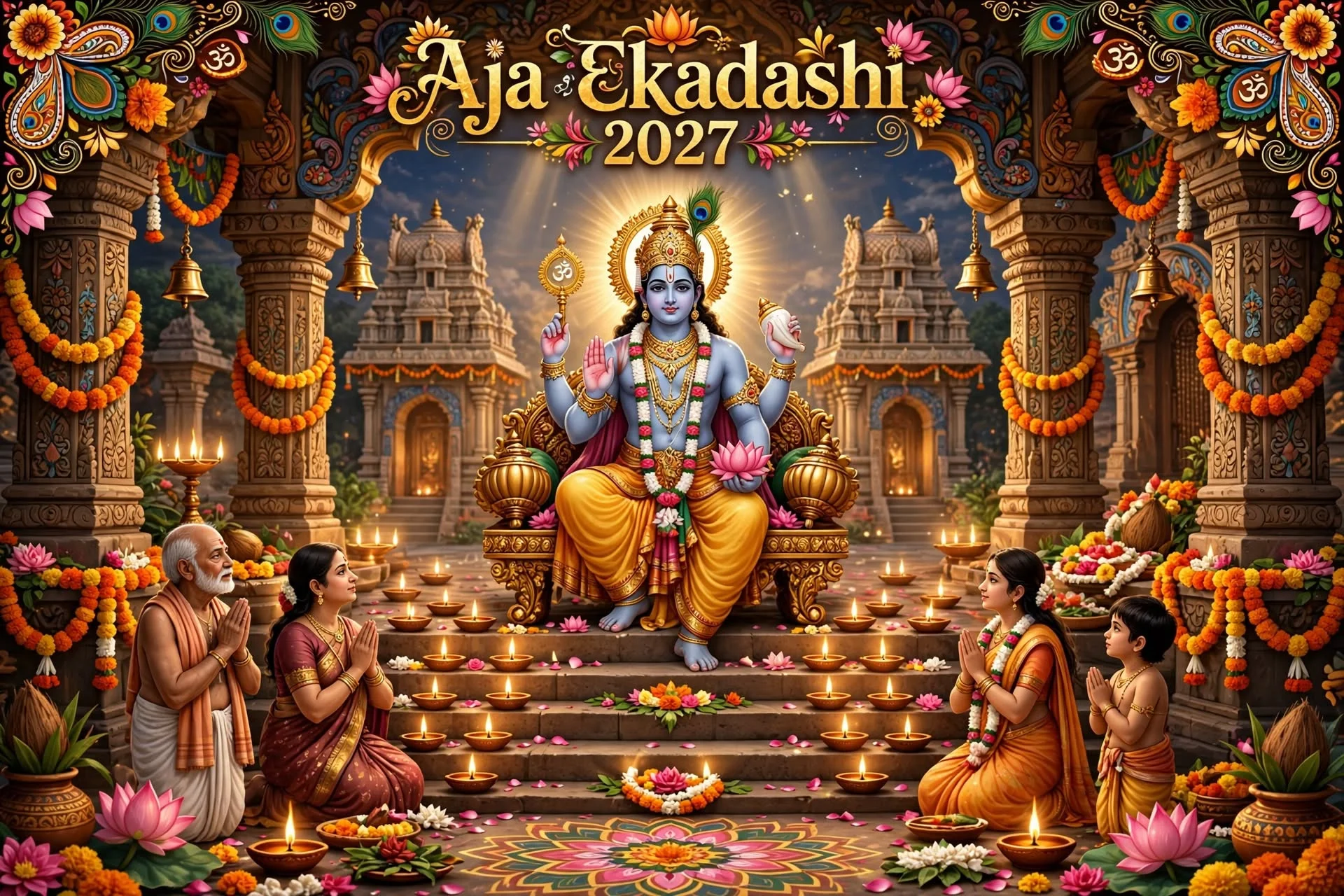
Aja Ekadashi, also celebrated with immense spiritual reverence as Ananda Ekadashi, is observed on the eleventh lunar day (Ekadashi tithi) of the Krishna Paksha (dark waning fortnight) in the sacred monsoon month of Bhadrapada (or Shravana in the Amanta calendar). Dedicated to Bhagwan Vishnu in His divine form as Hrishikesha (the supreme master of the senses), this sanctified vrata is extolled in the Brahmavaivarta Purana and Padma Purana as an extraordinary spiritual penance capable of destroying all accumulated sins, reversing catastrophic worldly misfortunes, and bestowing liberation (Moksha).
Aja Ekadashi 2027: Date, Puja Timings, Rituals & Stories
Aja Ekadashi Timings & Panchang
Important festival dates and auspicious timings
Usha Arghya (Sunrise)
05:57 am
Sandhya Arghya (Sunset)
06:48 pm
Start Date
Saturday, 28 Aug 2027
Puja Muhurat
03:25 pm – 12:42 pm
Aja Ekadashi
The divine glory of Aja Ekadashi is eternally enshrined in the poignant, heroic history of the truthful King Harishchandra of Ayodhya. Having sacrificed his imperial throne, royal treasury, beloved queen Taramati, and son Rohitashva to preserve the sanctity of truth (Satya), Harishchandra was reduced to working as a menial assistant in the cremation grounds of Kashi. Guided by Sage Gautama, the noble king observed the waterless fast of Aja Ekadashi with spotless devotion. By the supreme grace of Lord Hrishikesha, his past karmas were instantly dissolved: his dead son was revived, his queen restored, his kingdom returned with glory, and his entire kingdom ascended to Vaikuntha.
Devotees observe Aja Ekadashi through rigorous fasting, abstaining completely from all food grains, pulses, and tamasic ingredients. The day is spent in congregational chanting of the Vishnu Sahasranama, offering fragrant yellow flowers and fresh Tulsi leaves to Lord Vishnu, and keeping a night-long devotional vigil (Jagaran). The merit of observing Aja Ekadashi is declared in scripture to be superior to the performance of the Ashvamedha Yajna and bathing in all the holy pilgrimage waters of the earth.
Why is Aja Ekadashi Celebrated?
Aja Ekadashi is celebrated to seek the unconditional grace of Lord Vishnu in His form as Hrishikesha, the dispeller of past karmic suffering and sovereign protector of truth.
According to the Brahmavaivarta Purana, human suffering is often the fruition of past-life transgressions that block health, prosperity, and peace of mind. Observing Aja Ekadashi burns these negative karmas like a blazing fire consumes dry grass.
The festival honors the unconquerable virtue of King Harishchandra, reminding humanity that steadfast fidelity to Truth (Dharma) will eventually triumph over all trials, with God Himself acting as the ultimate redeemer.
- Dissolving deep-seated karmic offenses and ending epochs of severe adversity.
- Commemorating the redemption of King Harishchandra and the revival of Prince Rohitashva.
- Worshiping Lord Hrishikesha to gain mastery over erratic senses and mental turmoil.
- Attaining spiritual merit greater than giving charity of gold or performing Vedic horse sacrifices.
- Securing divine peace, familial reunion, and eventual liberation in the spiritual realm of Vaikuntha.
Scriptural Foundations in the Brahmavaivarta Purana and Padma Purana
The Dialogue Between Lord Krishna and King Yudhishthira
In the Brahmavaivarta Purana, Dharmaraja Yudhishthira entreats Lord Sri Krishna: 'O Janardana, what is the name of the Ekadashi that falls in the dark fortnight of the month of Bhadrapada? What is its unique potency, and which deity is propitiated? Please enlighten me.'
Lord Krishna replies: 'O King, hear attentively the history of Aja Ekadashi, an observance so potent that merely hearing its glories cleanses the soul of past sins. To illustrate its boundless mercy, I shall recount to you the trials and ultimate redemption of the illustrious King Harishchandra of the Solar dynasty.'
The Trials of King Harishchandra in Kashi
King Harishchandra was renowned across the cosmos for his unyielding commitment to truth. To satisfy a spiritual debt to Sage Vishwamitra, the king gave away his vast empire, wealth, and royal ornaments. Journeying penniless to Kashi with his wife Taramati and young son Rohitashva, Harishchandra sold his queen and son into domestic service and sold himself to a low-caste crematorium attendant (Chandala) to pay the final dakshina.
For years, the emperor of the earth guarded burning funeral pyres, collecting cremation fees in sorrow, poverty, and isolation. One fateful night, Queen Taramati arrived weeping at the cremation ground carrying the lifeless body of their young son Rohitashva, who had died of a venomous snakebite. Even in this zenith of grief, Harishchandra refused to allow cremation without the customary fee, choosing adherence to duty over personal despair.
Sage Gautama's Counsel and Divine Restoration
Deeply afflicted by his sovereign's suffering, the venerable Sage Gautama visited Harishchandra's crematorium and consoled him: 'O noble King, your immense suffering is the ripening of past-life karmic deeds. By divine providence, in seven days arrives the sacred Aja Ekadashi of Bhadrapada Krishna Paksha. Observe a complete waterless fast, remain awake through the night, and worship Lord Hrishikesha with pure Tulsi leaves. All your sins and afflictions will vanish.'
Sense Mastery, Karmic Expiation, and the Power of Satya
Hrishikesha: The Supreme Controller of the Senses
The presiding deity of Aja Ekadashi is Lord Vishnu as Hrishikesha ('Hrishika' meaning senses, and 'Isha' meaning master). Human karma accumulates when the senses pursue selfish material gratification without moral restraint.
By observing a complete fast on Aja Ekadashi, the seeker willingly masters the tongue, eyes, and mind, surrendering their sensory faculties to Hrishikesha and gaining deep inner tranquility.
The Alchemy of Uncompromising Truth (Satya)
King Harishchandra's trial demonstrates that truthfulness is the highest form of spiritual tapasya. When an individual refuses to compromise on moral righteousness, even in the deepest crematorium of worldly despair, God personally intervenes to transform suffering into eternal joy (Ananda).
Aja Ekadashi inspires seekers to maintain personal integrity during difficult personal crises, knowing that divine redemption is inevitable.
Dashami Preparation, Ekadashi Worship, and Dvadashi Parana
Preliminary Restraint on Dashami Evening
The observance begins on Dashami (the tenth lunar day). Devotees consume only a single sattvic vegetarian meal before sunset, avoiding grains, honey, and pulses. They retire early with pure thoughts and prayers.
Fresh Tulsi leaves must be gathered on Dashami afternoon, as plucking Tulsi leaves on Ekadashi is strictly forbidden by scriptural injunctions.
Ekadashi Rites, Jagaran, and Dvadashi Consecration
On Ekadashi, seekers wake during Brahma Muhurta, bathe with holy water, establish an altar draped in yellow silk, and worship Lord Vishnu with Panchamrita, sandalwood, yellow flowers, and Tulsi leaves.
The entire night is spent in devotional vigil (Jagaran), singing the glories of Lord Narayana. The fast is broken on Dvadashi morning during the prescribed muhurta after feeding Brahmins and offering charity.
Aja Ekadashi Puja Vidhi (Step by Step)
- 1
Brahma Muhurta Snana & Sankalpa
Wake early before sunrise, take a purificatory bath in clean water mixed with holy Ganga jal, wear fresh yellow unstitched clothing, and make the solemn Aja Ekadashi Vrata Sankalpa.
- 2
Altar Setup & Kalash Sthapana
Spread a fresh yellow silk cloth on a wooden chauki, install the idol or image of Lord Vishnu / Hrishikesha, and establish a sanctified Kalash with mango leaves and a coconut.
- 3
Avahana and Dhyana
Invoke Bhagwan Hrishikesha with folded hands, meditating upon His enchanting four-armed form holding conch, discus, mace, and lotus, with Goddess Lakshmi at His side.
- 4
Panchamrita Abhishekam
Bathe the Shaligram shila or brass idol with pure cow milk, curd, honey, ghee, and sugar, followed by sanctified water infused with fragrant Tulsi leaves.
- 5
Pitambara and Chandan Samarpan
Adorn Lord Vishnu in brilliant yellow silk garments (Pitambara) and apply fragrant yellow Malayagiri sandalwood paste on His forehead.
Aja Ekadashi Puja Samagri List
Deity and Altar Essentials
- Idol or image of Lord Vishnu / Hrishikesha or Shaligram Shila
- Wooden chowki covered with fresh yellow silk fabric
- Copper or brass Kalash, unbroken coconut, and five fresh mango leaves
- Pure brass five-wick cow-ghee lamp, cotton wicks, and natural camphor
- Brass bell (Ghanti) and Panchapatra with Achamani spoon
Botanical, Anointing, and Floral Items
- Abundant fresh holy Tulsi leaves and Manjari (plucked on Dashami)
- Fresh yellow marigold garlands, yellow lotus flowers, and fragrant jasmine
- Malayagiri yellow sandalwood paste, rolli, and sacred turmeric powder
- Unbroken white raw rice grains mixed with turmeric (Akshata)
- Sandalwood incense sticks (agarbatti) and natural camphor tablets
Naivedyam and Panchamrita Offerings
- Panchamrita ingredients: raw cow milk, curd, wild honey, cow ghee, and sugar
- Fresh seasonal fruits: bananas, apples, pomegranate, and sweet pears
- Assorted dry fruits: soaked almonds, raisins, cashews, and lotus seeds (Makhana)
- Clean drinking water in a brass lota with Tulsi leaves
Mantras and Prayers for Aja Ekadashi
Aja Ekadashi Vrat Rules and Fasting Guidelines
Fasting Discipline and Prohibitions
Devotees observe a strict fast throughout the 24 hours of Ekadashi. Those who can observe waterless fasting (Nirjala) do so; householders typically consume water, milk, and fresh fruits (Phalahari). All cereal grains, wheat, rice, pulses, onions, and garlic are completely prohibited.
- Strict avoidance of all food grains, pulses, cereals, and mustard seeds.
- Do not pluck fresh Tulsi leaves on Ekadashi tithi.
- Observe complete celibacy, truthful speech, and avoid sleeping during daytime.
- Break the fast (Parana) on Dvadashi morning during the prescribed muhurta.
Spiritual Wakefulness and Charity
Spend the night in spiritual contemplation and singing kirtans (Jagaran). On Dvadashi morning, donate food, clothing, and dakshina to Brahmins and the poor before eating.
Dos and Don'ts of Aja Ekadashi
Good Practices (Do's)
- Wake up early during Brahma Muhurta, bathe, and resolve to observe the Aja Ekadashi fast.
- Worship Lord Vishnu with yellow sandalwood paste, yellow flowers, and holy Tulsi leaves.
- Read or listen to the sacred legend of King Harishchandra from the Brahmavaivarta Purana.
- Keep a night-long devotional vigil (Jagaran) chanting the Vishnu Sahasranama.
- Break the fast on Dvadashi morning during the prescribed muhurta after feeding the needy.
Aja Ekadashi Across Regions
| Region | Local Name |
|---|---|
| North India (Uttar Pradesh, Rajasthan, Bihar) | Aja Ekadashi |
| Maharashtra & Karnataka | Ananda Ekadashi / Aja Ekadashi |
| Gujarat | Aja Agiyaras |
Aja Ekadashi FAQs
What is Aja Ekadashi?
Aja Ekadashi is a sacred fast observed on the eleventh lunar day of Krishna Paksha in Bhadrapada, dedicated to Lord Vishnu as Hrishikesha to erase past sins and end severe adversity.
Why is this Ekadashi also called Ananda Ekadashi?
It is called Ananda Ekadashi because observing it dissolves all sorrow and confers supreme transcendental bliss ('Ananda') upon the practitioner.
Which form of Lord Vishnu is worshiped on Aja Ekadashi?
Lord Vishnu is worshiped in His divine form as Bhagwan Hrishikesha, the supreme lord and master of all sensory faculties.
Upcoming Festivals
View All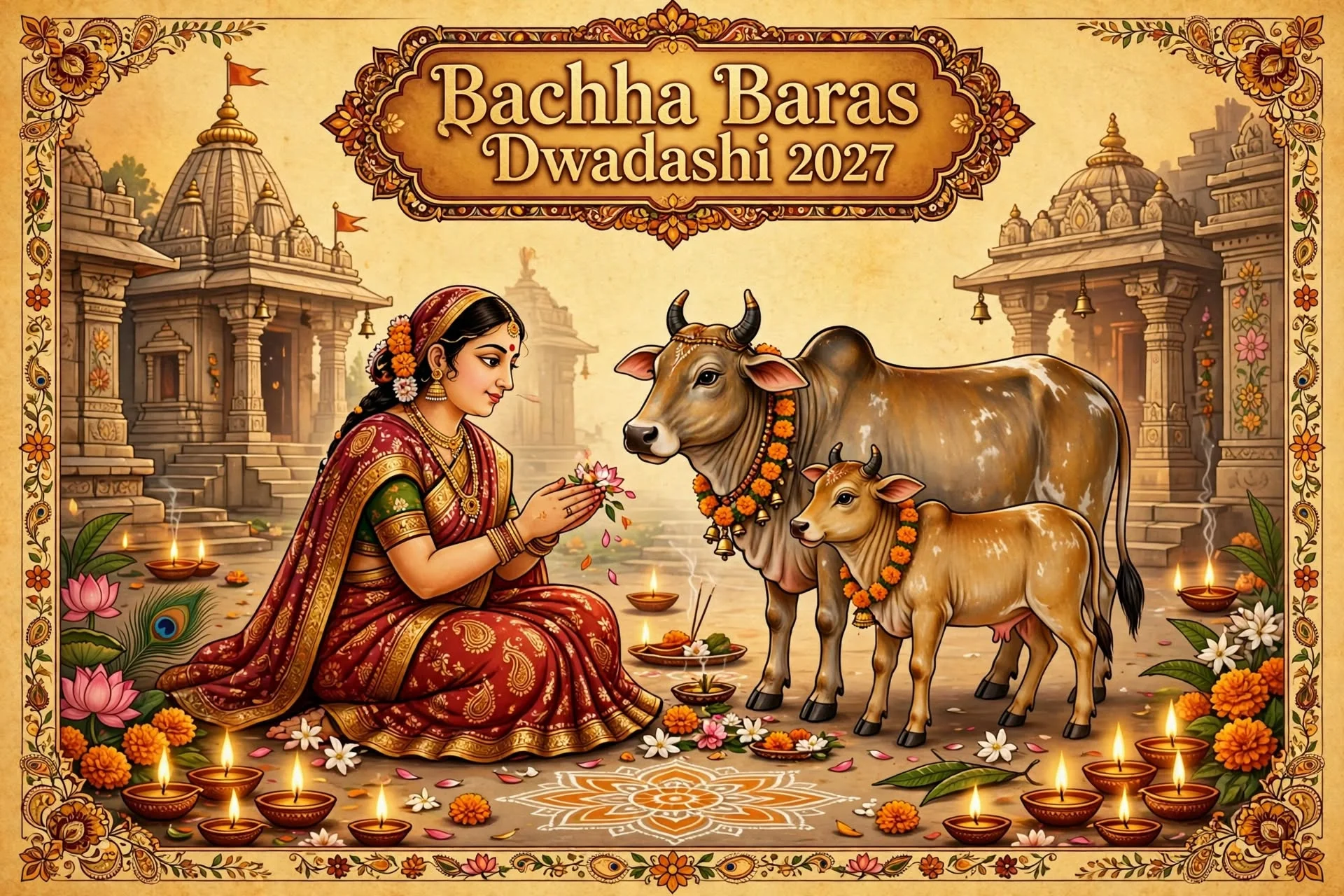
Saturday, Aug 28, 2027
Bachha Baras Dwadashi
Bachha Baras Dwadashi, also reverently celebrated as Govatsa Dwadashi, Vasu Baras, or Vatsa Dwadashi, is observed on the twelfth lunar day (Dwadashi tithi) of Krishna Paksha in the sacred monsoon month of Bhadrapada (or Shravana in the Amanta calendar scheme). Falling four days after Krishna Janmashtami, this heartwarming festival is dedicated exclusively to the adoration of Kamadhenu's celestial daughter, the divine cow Nandini, and her young suckling calf (Bachha / Vatsa), celebrating maternal devotion, rural cattle welfare, and the sacred spiritual bond between humanity and the animal kingdom.
View Festival Guide
Sunday, Aug 29, 2027
Ravi Pradosh Vrat
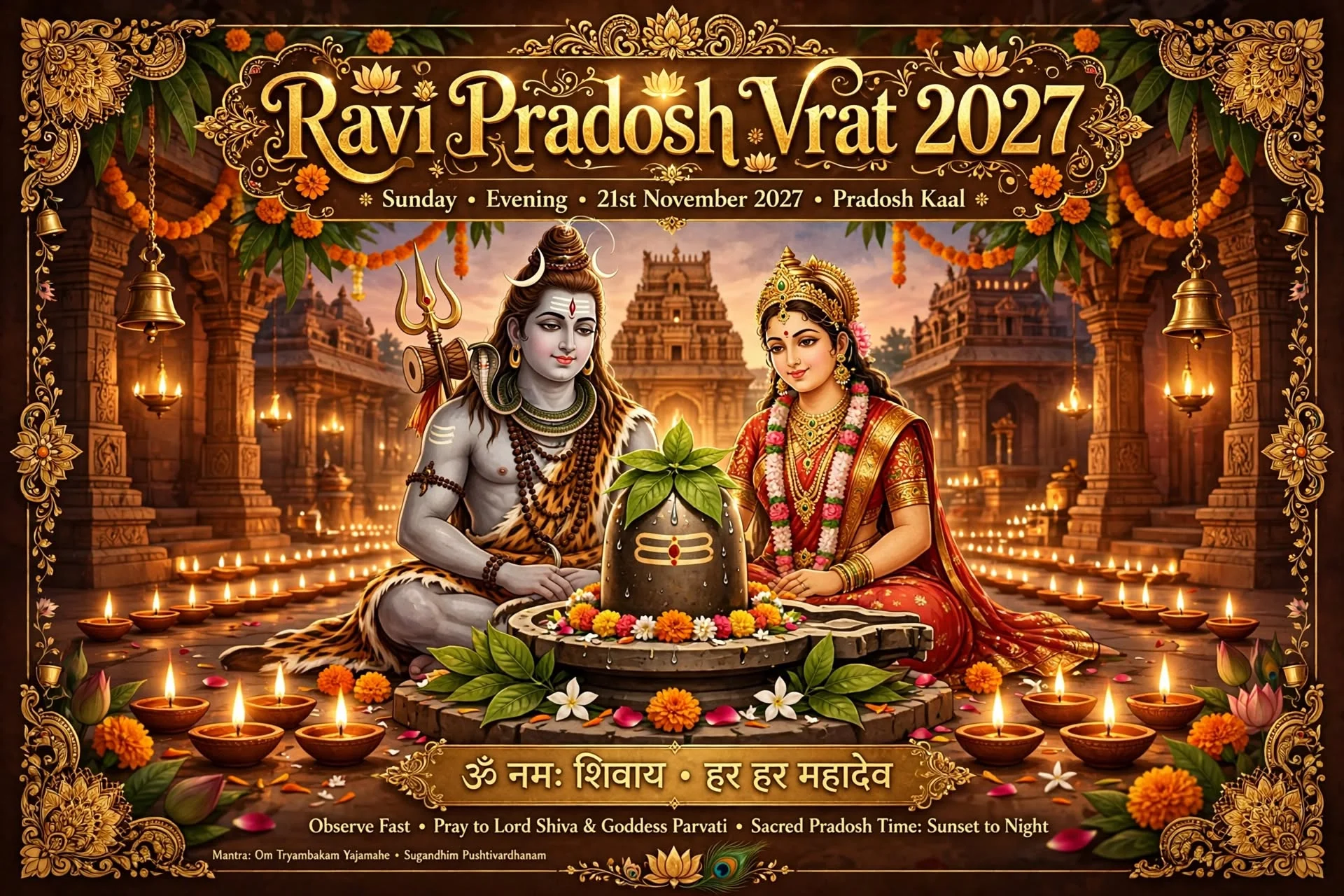
Ravi Pradosh Vrat is an exceptionally sacred fasting day observed on the thirteenth lunar day (Trayodashi) that coincides with a Sunday (Ravivara). Dedicated to Lord Shiva, the cosmic dissolver of sorrow, this bimonthly vow unites the healing radiance of Surya Bhagavan with the boundless compassion of Mahadeva. Observed during the twilight Sandhya period, it is believed to banish physical ailments, clear karmic obstructions, and bestow vitality and longevity.
View Festival Guide
Tuesday, Aug 31, 2027
Pithori Amavasya
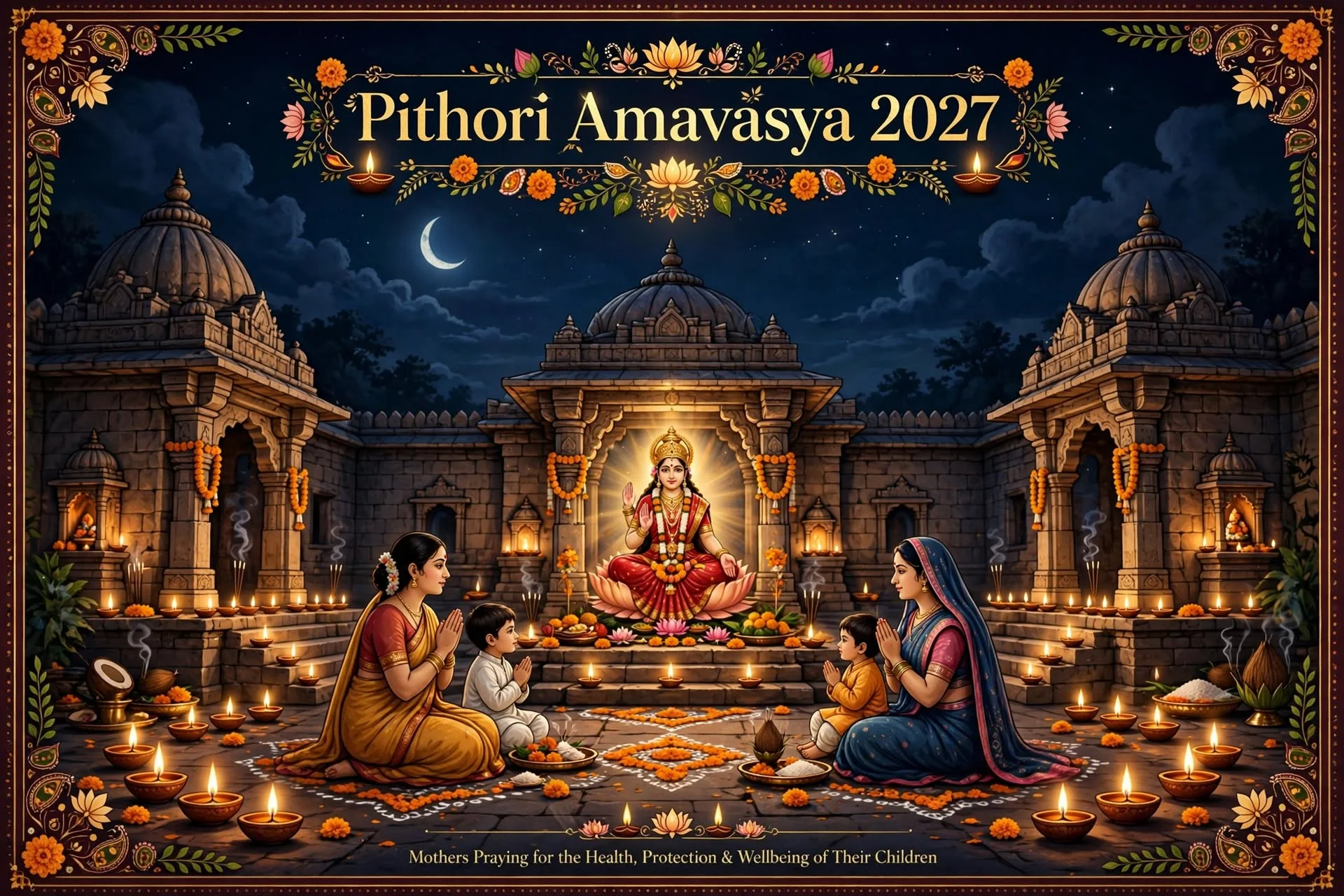
Pithori Amavasya, also reverently celebrated across India as Kushagrahani Amavasya, Pola Amavasya, or Pithori Vrat, is the sacred New Moon day concluding the holy monsoon month of Shravana (or Bhadrapada in the Purnimanta calendar scheme). Dedicated to Goddess Durga, Goddess Parvati, and the Sixty-Four Yoginis (Chausath Yogini), this ancient festival is celebrated with profound devotion by mothers for the longevity, health, moral strength, and spiritual protection of their children, as well as the pacification of ancestral souls (Pitrus).
View Festival Guide
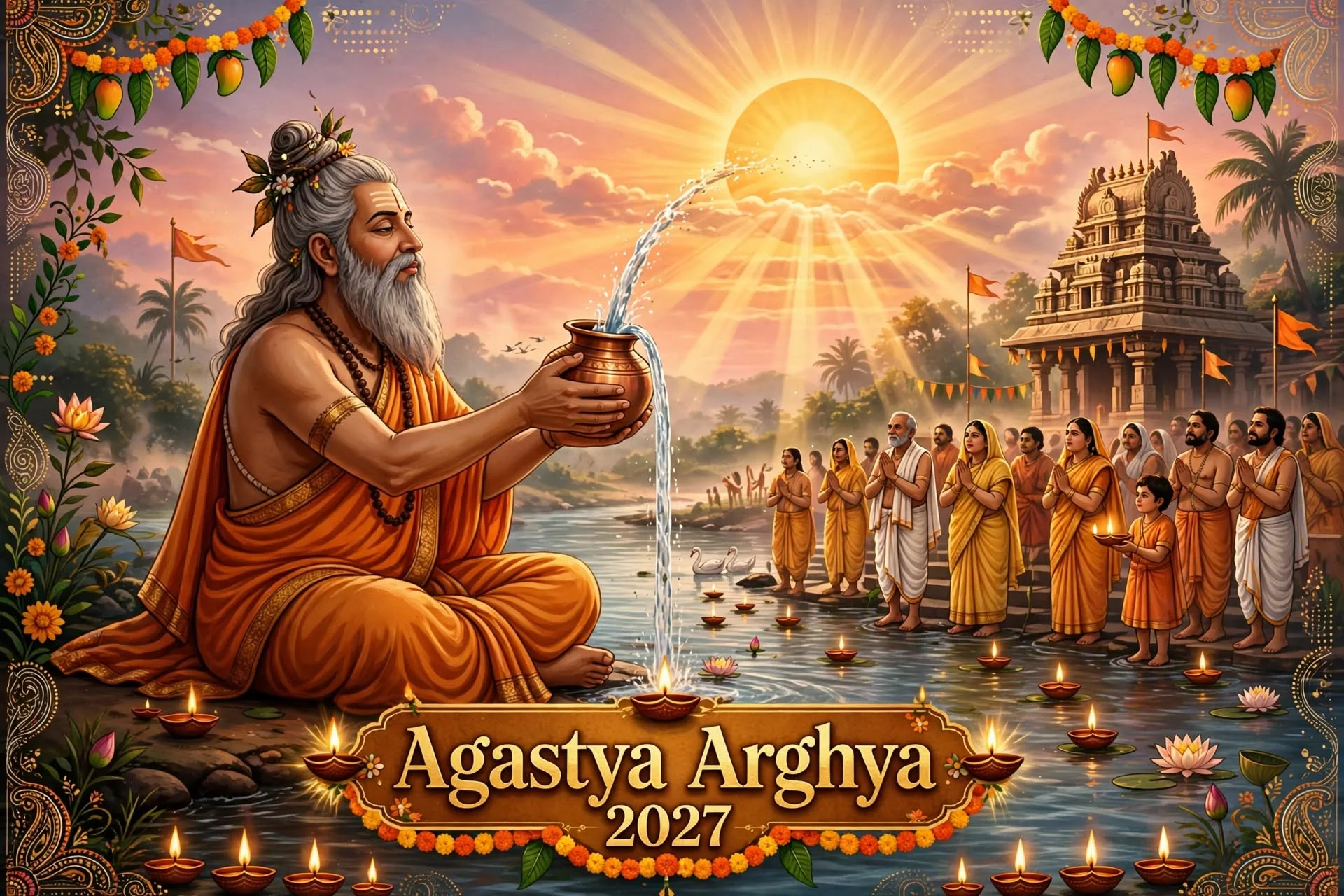
Tuesday, Aug 31, 2027
Agastya Arghya
Agastya Arghya, also known as Agastya Udaya Arghya, is a profound astronomical and Vedic ritual observed during the transition of late monsoon into early autumn (Sharad Ritu), when the celestial star Canopus (known in Sanskrit as the Agastya Nakshatra) first rises above the southern horizon at dawn. In ancient Indian astronomy (Surya Siddhanta) and Puranic literature, the dawn rising of Agastya is celebrated as an extraordinary cosmic event marking the physical and energetic purification of all terrestrial waters, the calming of turbulent monsoon rivers, and the pacification of atmospheric toxins.
View Festival Guide

Tuesday, Aug 31, 2027
Anvadhan
Anvadhan (अन्वाधान) is an ancient, highly revered Vedic ritual and spiritual observance in Sanatana Dharma performed on the day immediately preceding the New Moon (Amavasya) or Full Moon (Purnima). Rooted in the pristine traditions of the Shrauta and Grihya Sutras, Anvadhan literally translates to 'the solemn placing and replenishment of sacred fuel wood into the consecrated Vedic fires'. In traditional Vedic ritualism, householders (Grihasthas) and priests who maintain the sacred Agnihotra fires perform Anvadhan to prepare the sacrificial altars for the grand Darsha Yajna (New Moon sacrifice) or Paurnamasa Yajna (Full Moon sacrifice) scheduled for the following day.
View Festival Guide

Tuesday, Aug 31, 2027
Shravana Amavasya
Shravana Amavasya, also known as Darsha Amavasya, Hariyali Amavasya, or Pola Amavasya, is the dark New Moon night marking the grand conclusion of the sacred, rejuvenating monsoon month of Shravana. Positioned at the pivotal threshold between the height of the rainy season and the onset of early autumn, this sanctified tithi holds monumental spiritual, ancestral, and ecological significance across the Indian subcontinent.
View Festival Guide

Tuesday, Aug 31, 2027
Darsha Amavasya
Darsha Amavasya is a significant new moon observance in the Hindu calendar designating the specific night when the Moon is completely invisible to the human eye, having fully merged into the conjunction of the Sun.
View Festival Guide