




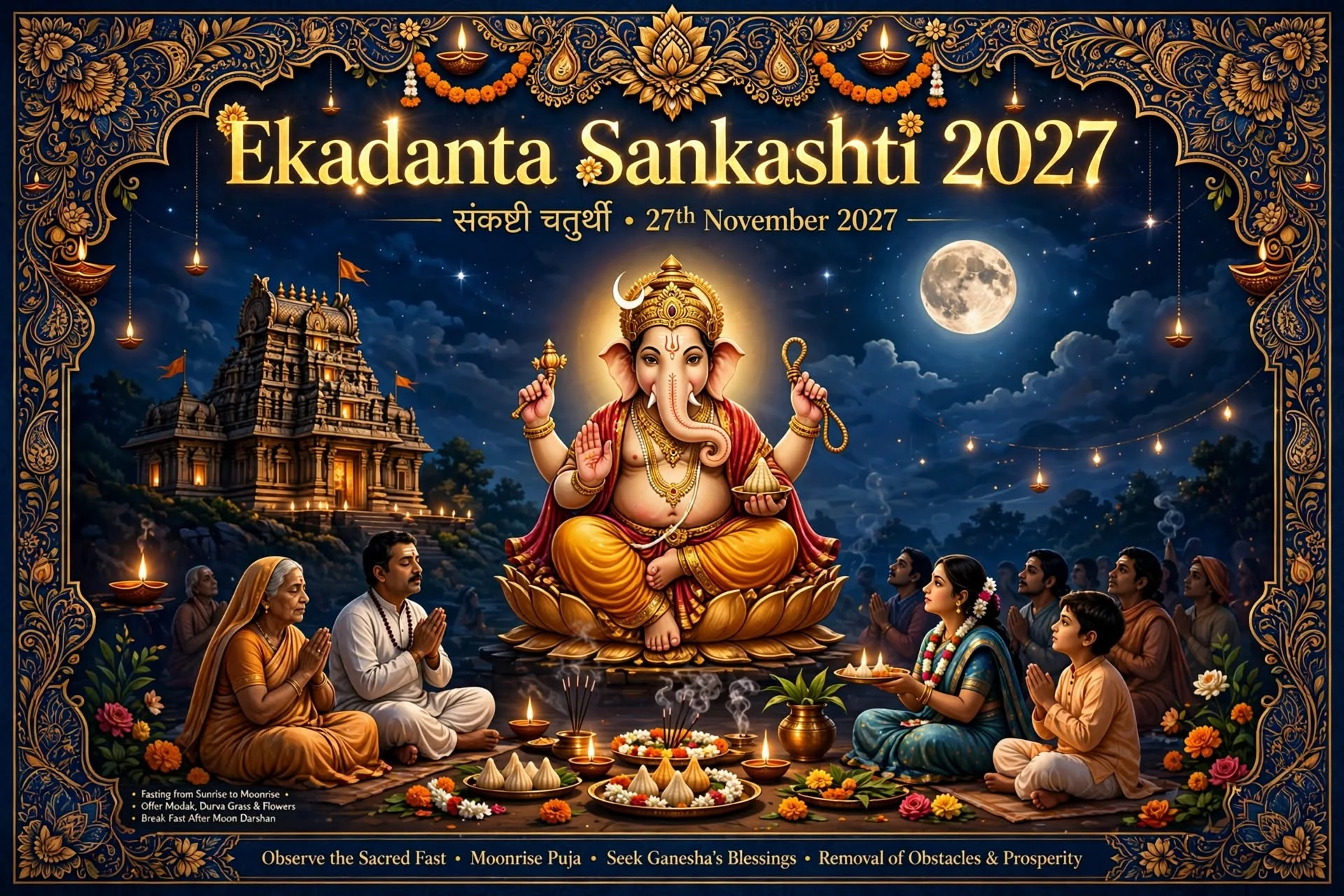
Ekadanta Sankashti Chaturthi, also celebrated as Ekadanta Sankashti Vrat, is a powerful monthly observance dedicated to Lord Ganesha, occurring during the Krishna Paksha (waning fortnight) on the fourth lunar day (Chaturthi tithi) of the Hindu lunar month of Vaishakha (or Jyeshtha in the Purnimanta system). The term "Sankashti" translates to "deliverance from distress or crisis" (Sankat-Nivaran), signifying that this sacred vrata removes formidable obstacles, clears karmic debts, and brings peace and success to the devotee's life.
Ekadanta Sankashti 2027: Date, Puja Timings, Rituals & Stories
Ekadanta Sankashti Timings & Panchang
Important festival dates and auspicious timings
Usha Arghya (Sunrise)
06:52 am
Sandhya Arghya (Sunset)
06:17 pm
Start Date
Wednesday, 24 Feb 2027
Puja Muhurat
06:17 pm – 07:33 pm
Ekadanta Sankashti
On this specific Chaturthi, Lord Ganesha is invoked in His iconic divine manifestation as "Ekadanta"—the single-tusked deity presiding over the Ekadanta Peetha. According to ancient lore from the Ganesha Purana and Mudgala Purana, the single tusk of Ganesha represents non-duality (Advaita), supreme sacrifice, and the unyielding focus required to accomplish great cosmic deeds, such as breaking his own tusk to write the Mahabharata when his quill broke, or wielding it to vanquish the arrogant demon Madasura.
Devotees observe a strict dawn-to-moonrise fast, performing elaborate Ganesha pujas with fresh Durva grass, red flowers, and 21 Modakas. The fast reaches its sacred culmination only after sighting the Moon (Chandra Darshan) at night and offering Arghya of sanctified water and raw milk to Chandra Dev and Lord Ekadanta.
Why is Ekadanta Sankashti Celebrated?
Ekadanta Sankashti is celebrated to overcome seemingly insurmountable hurdles in life, dispel mental anxiety, and seek Lord Ganesha's divine guidance and protection. Hindu scriptures emphasize that the evening moonrise on Sankashti Chaturthi is charged with divine vibrations that dissolve sorrow and bring clarity of intellect (Buddhi) and spiritual accomplishment (Siddhi).
It is also celebrated to venerate the supreme wisdom and selfless sacrifice of Lord Ekadanta, who demonstrated that outward physical perfection is secondary to moral fortitude and intellectual service to creation.
- Invokes Lord Ekadanta Ganesha for the removal of all obstacles, debts, and crises (Sankat-Haran).
- Dissolves intellectual arrogance and egotistical pride, symbolized by the vanquishing of Madasura.
- Brings peace of mind, emotional grounding, and mental focus through the evening Moon worship.
- Bestows prosperity, wisdom, domestic harmony, and spiritual evolution.
The Sacrifice of the Single Tusk and the Defeat of Madasura
The Vanquishing of the Demon Madasura
In the Mudgala Purana, an arrogant demon named Madasura, born from the pride and delusion of the cosmic forces, performed severe penance to propitiate Shukracharya and conquered the three worlds. Drunk with conceit (Mada), he dethroned the gods, banned sacred rituals, and tormented sages. The helpless devas sought refuge in Lord Ganesha.
Lord Ganesha manifested in the form of Ekadanta, riding upon His divine mouse vahana. Wielding His single tusk as a divine weapon radiating the light of non-dual consciousness, Ekadanta confronted Madasura. The moment the demon beheld the majestic form of Ekadanta, his pride dissolved. Madasura prostrated at the Lord's feet, surrendering his arrogance, and was granted refuge in the nether realms, promising never to trouble righteous beings.
The Legend of the Broken Tusk for the Mahabharata
Another celebrated legend in the Mahabharata narrates that when Sage Vedavyasa requested Lord Ganesha to write down the colossal epic Mahabharata, Ganesha laid down the condition that Vyasa must dictate continuously without pause. Vyasa agreed, stipulating that Ganesha must not write down any verse without fully understanding its meaning.
During the intense writing process, Ganesha's reed quill suddenly broke. Unwilling to halt the continuous divine dictation, the Lord snapped off his own right ivory tusk without hesitation, dipped it in ink, and continued writing without missing a single syllable, forever earning the glorious title Ekadanta.
Source: Mudgala Purana, Ekadanta Khanda & Ganesha Purana, Upasana Khanda
Non-Duality, Focus, and the Subjugation of Arrogance
Ekadanta as Non-Duality (Advaita)
Philosophically, "Eka" means One and "Danta" means tusk. While normal elephants have two tusks representing duality (pleasure and pain, light and dark, success and failure), Lord Ganesha with one tusk represents Advaita—the non-dual Supreme Reality that transcends all dualistic opposites. It teaches the seeker to maintain equanimity amidst worldly dualities.
Sacrifice for Higher Wisdom
Breaking one's own tusk to write the scripture symbolizes that the pursuit of divine wisdom and cosmic truth demands the sacrifice of personal comfort and physical vanity. True beauty lies in intellectual service and compassion.
Observance Protocol, Daytime Fast, and Moonrise Arghya
Daytime Fasting and Durva Offering
Devotees observe a strict fast from dawn. The morning puja is performed with fresh Durva grass (twenty-one blades tied into bundles), red hibiscus flowers, and lighting a cow ghee lamp. The daytime is spent chanting the Ganesha Atharvashirsha and the 108 names of Ganesha.
Night Chandra Darshan and Arghya
The fast reaches its climax at night upon moonrise. Devotees check the local moonrise timing, prepare an Arghya vessel with water, milk, chandan, and akshata, view the moon, and pour the oblation while reciting sacred mantras. Afterwards, they partake of the 21 Modakas and break their fast.
Ekadanta Sankashti Puja Vidhi (Step by Step)
- 1
Pratah Snana
Take an early morning bath, wear fresh traditional yellow or red clothing, and purify the home altar with Gangajal.
- 2
Sankalpa
Hold flowers, akshata, and water in hand, resolving to observe Ekadanta Sankashti fast until moonrise for obstacle removal and spiritual peace.
- 3
Altar Preparation
Place a clean wooden altar facing north or east, drape with red or yellow cloth, and install the idol of Lord Ekadanta Ganesha.
- 4
Deepa Sthapana and Dhoop
Light a pure cow ghee lamp and burn fragrant guggul or sandalwood incense to cleanse the ambient space.
- 5
Lord Ekadanta Avahana
Invoke Lord Ganesha with folded hands, meditating upon His single-tusked, compassionate form bearing the noose and goad.
- 6
Ekadanta Sankashti Puja Samagri List
Deity Consecration and Altar Articles
Materials required for the ceremonial worship of Lord Ekadanta.
- Idol of Lord Ganesha (clay/metal/stone)
- Red or yellow silk cloth for altar
- Pure sindoor (vermilion) and chandan paste
- Unbroken rice grains (Akshata)
- Gangajal in copper vessel
- Panchamrita ingredients
Botanical and Floral Offerings
Herbal botanicals sacred to Lord Ganapati.
- 21 bundles of fresh green Durva grass
- Fresh red hibiscus flowers (Jaswand)
- Yellow marigold garlands
- Fragrant natural dhoop sticks
- Pure cow ghee lamp and cotton wicks
Modak and Moonrise Offerings
Confectionery and articles for the night moon oblation.
- 21 Modaks (steamed ukadiche or fried)
- Motichoor or besan laddus
- Raw cow milk mixed with water for Moon Arghya
Mantras and Prayers for Ekadanta Sankashti
Ekadanta Sankashti Vrat Rules and Fasting Guidelines
Fasting Guidelines from Sunrise to Moonrise
The fast begins at sunrise on Chaturthi and continues unbroken until the moon rises at night.
- Observe complete abstinence from grains, cereals, pulses, and beans
- Those unable to observe strict waterless fast may consume fruits, milk, sabudana, and peanuts
- Maintain peaceful thoughts, control anger, and chant Ganesha mantras throughout the day
Moonrise Arghya and Fast Completion
The fast is concluded strictly after sighting the moon and offering water oblations.
- View the moon with reverence and pour the consecrated milk-water Arghya in a clean plate
- Offer prayers to Lord Ganesha, sing the aarti, and break the fast by eating a consecrated Modak
- A simple sattvic meal with sendha namak may be partaken after completing the moon oblation
Dos and Don'ts of Ekadanta Sankashti
Good Practices (Do's)
- Wake up early, bathe, and worship Lord Ganesha with 21 blades of fresh Durva grass.
- Offer red hibiscus flowers, sindoor, and 21 Modaks to Lord Ekadanta.
- Wait patiently for moonrise and offer the sacred Arghya before breaking the fast.
- Chant the Vakratunda Maha-Mantra and the Ganesha Atharvashirsha.
- Feed stray animals, especially cows and rodents/birds, with clean food.
Ekadanta Sankashti Across Regions
| Region | Local Name |
|---|---|
| Western India (Maharashtra & Goa) | Sankashti Chaturthi / Sankashta Harana Chaturthi |
| Southern India (Karnataka, Tamil Nadu, Andhra Pradesh) | Sankatahara Chathurthi |
| Northern India (Uttar Pradesh, Rajasthan, Madhya Pradesh) | Sankat Chauth / Ganesh Sankashti |
Ekadanta Sankashti FAQs
Why is viewing the Moon essential on Sankashti Chaturthi?
Unlike Vinayaka Chaturthi in Bhadrapada (where viewing the moon is traditionally avoided due to the Ganesha-Chandra curse legend), on Sankashti Chaturthi the fast is consecrated and concluded specifically through the darshan and Arghya of the Moon, which represents mind purification.
What is the significance of the single tusk (Ekadanta)?
The single tusk represents Advaita (non-duality), the power of single-minded focus, and the willingness to sacrifice physical comfort for higher spiritual knowledge, as demonstrated when Ganesha broke his tusk to write the Mahabharata.
Why are 21 blades of Durva grass offered to Ganesha?
According to the Ganesha Purana, when Lord Ganesha swallowed the demon Analasura (who embodied fire and agony), the heat burned His stomach. Sages offered 21 blades of cooling Durva grass, which instantly pacified the cosmic heat.
Upcoming Festivals
View All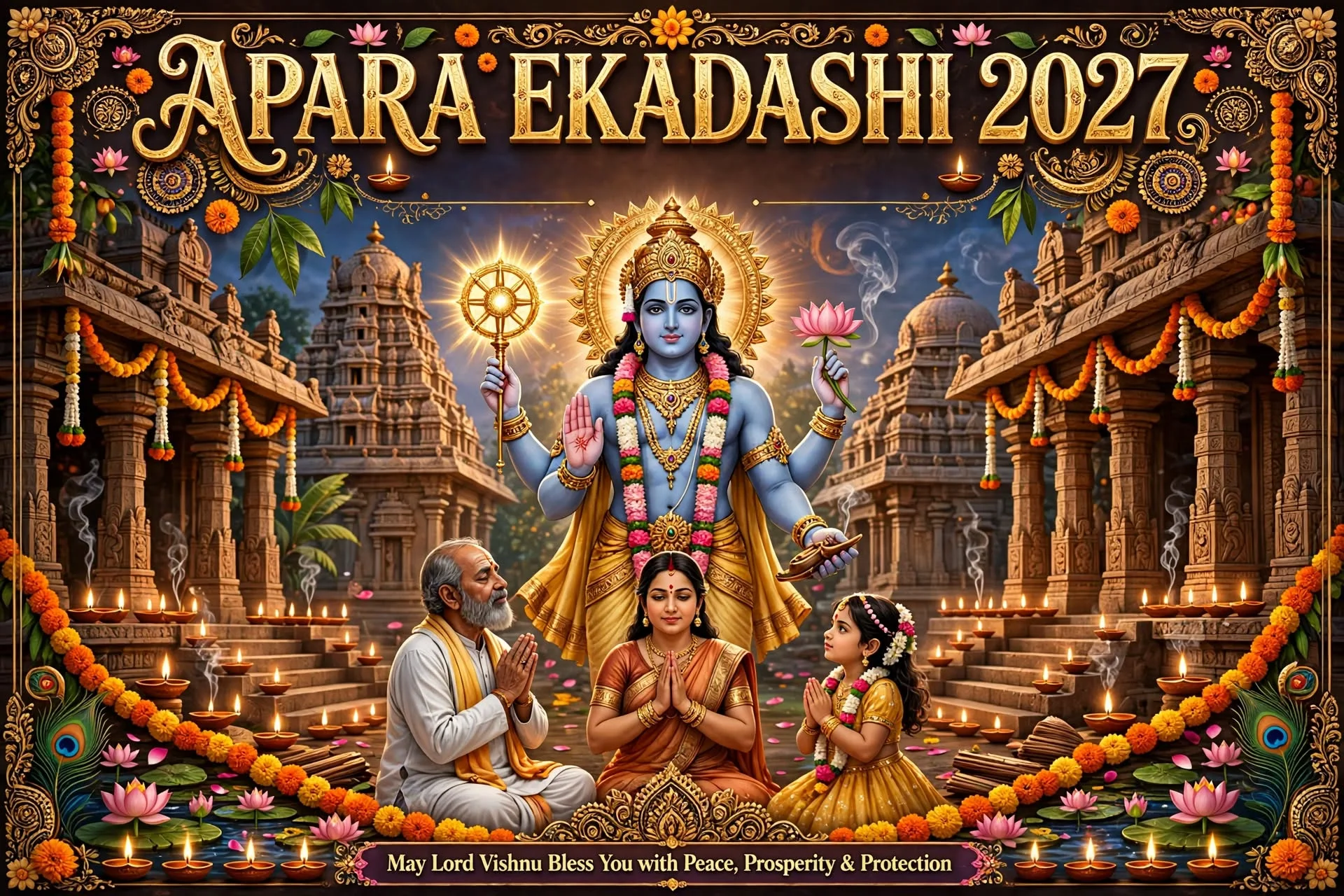
Tuesday, Jun 1, 2027
Apara Ekadashi
Apara Ekadashi, also known as Achala Ekadashi, is a sacred Hindu fasting observance dedicated to Lord Vishnu. It falls on the Ekadashi Tithi, the eleventh lunar day of Krishna Paksha in the month of Jyeshtha according to the Purnimanta calendar. In the Amanta calendar followed in several western and southern Indian regions, the same observance is associated with Vaishakha Krishna Paksha.
View Festival Guide
Wednesday, Jun 2, 2027
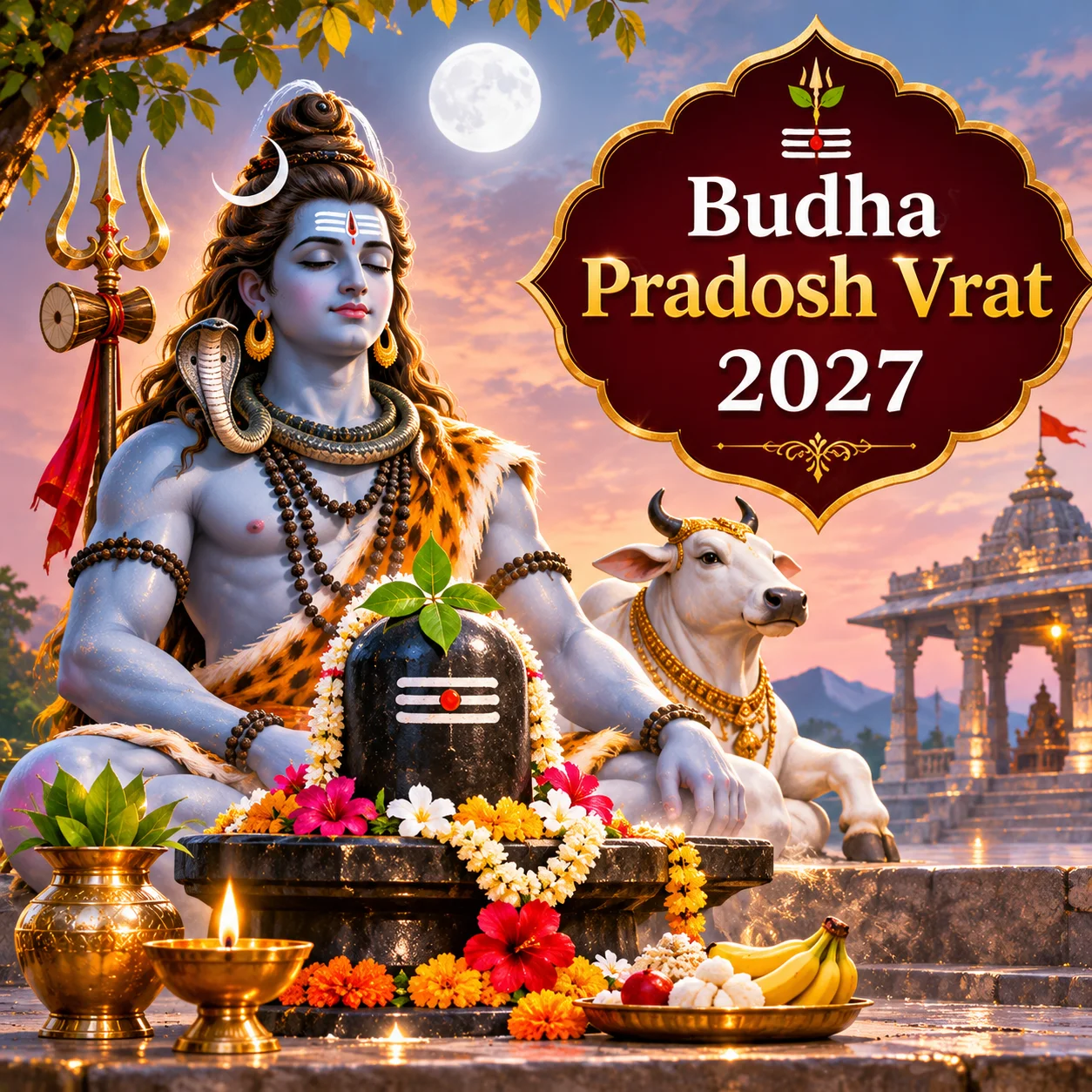
Budha Pradosh Vrat
Budha Pradosh Vrat, also known as Saumya Vara Pradosham, is a sacred bimonthly Hindu observance occurring when the Trayodashi tithi (thirteenth lunar day) coincides with a Wednesday (Budhavara) during the Pradosha Kaal twilight period.
View Festival Guide
Friday, Jun 4, 2027
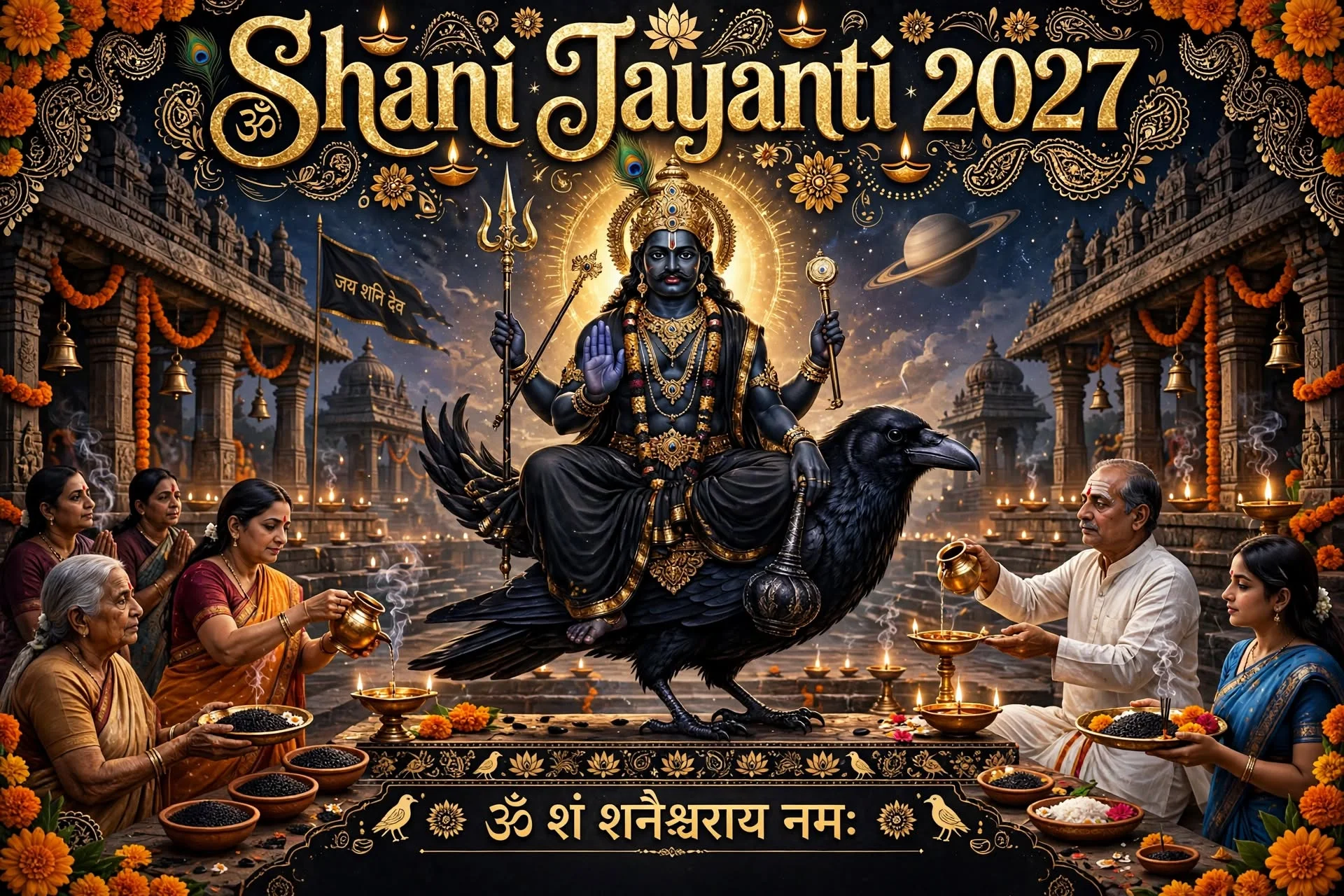
Shani Jayanti
Shani Jayanti, also known as Shani Janma Jayanti or Shani Amavasya, is an important Hindu observance dedicated to Lord Shani, the deity associated with the planet Saturn and one of the nine Navagrahas. Devotees observe this sacred day as the birth anniversary of Shani Dev, the son of Lord Surya and Goddess Chhaya. It is traditionally celebrated on Jyeshtha Amavasya, the new moon day in the Hindu month of Jyeshtha according to the Purnimanta calendar system.
View Festival Guide

Friday, Jun 4, 2027
Darsha Amavasya
Darsha Amavasya is a significant new moon observance in the Hindu calendar designating the specific night when the Moon is completely invisible to the human eye, having fully merged into the conjunction of the Sun.
View Festival Guide

Friday, Jun 4, 2027
Anvadhan
Anvadhan (अन्वाधान) is an ancient, highly revered Vedic ritual and spiritual observance in Sanatana Dharma performed on the day immediately preceding the New Moon (Amavasya) or Full Moon (Purnima). Rooted in the pristine traditions of the Shrauta and Grihya Sutras, Anvadhan literally translates to 'the solemn placing and replenishment of sacred fuel wood into the consecrated Vedic fires'. In traditional Vedic ritualism, householders (Grihasthas) and priests who maintain the sacred Agnihotra fires perform Anvadhan to prepare the sacrificial altars for the grand Darsha Yajna (New Moon sacrifice) or Paurnamasa Yajna (Full Moon sacrifice) scheduled for the following day.
View Festival Guide
Friday, Jun 4, 2027
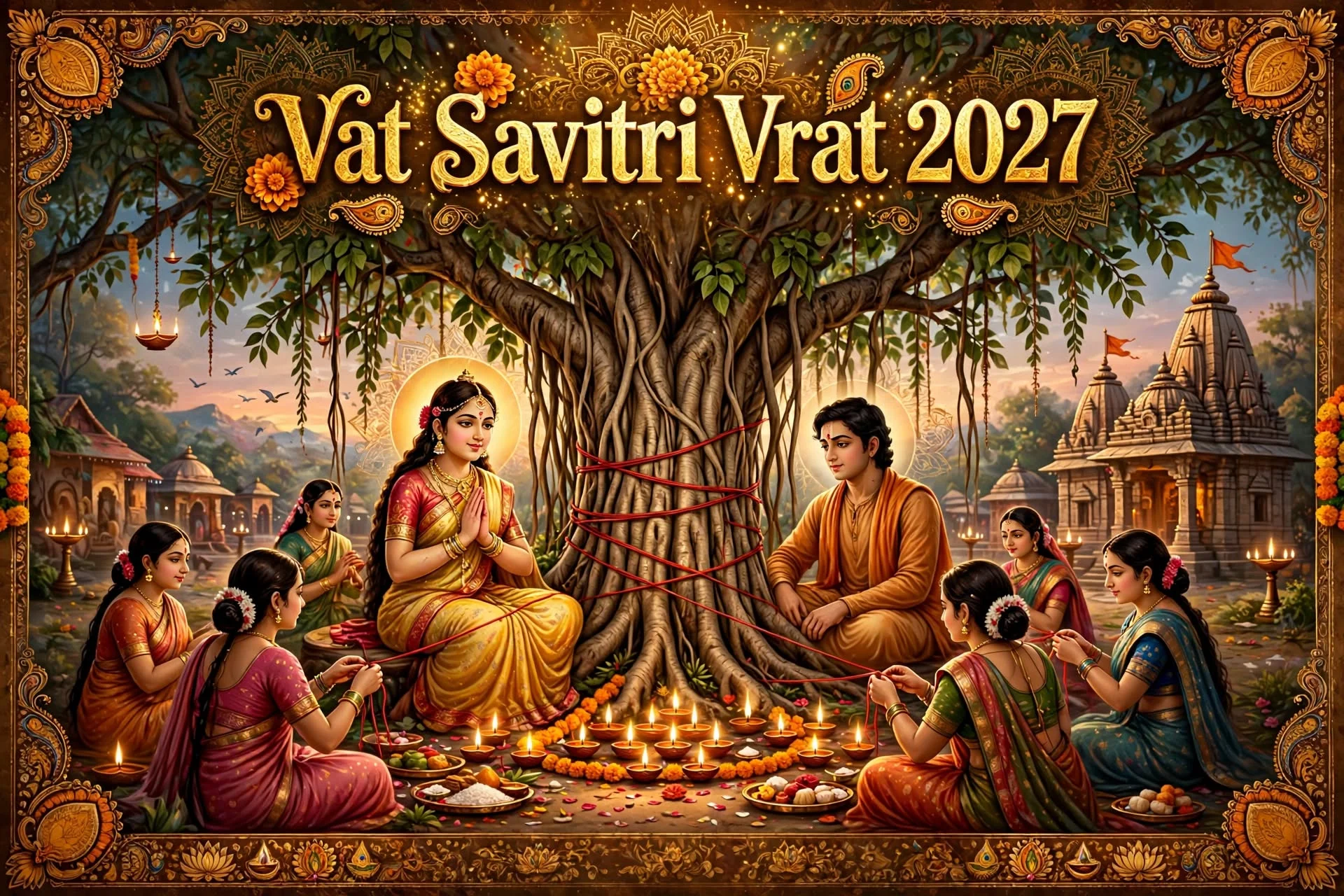
Vat Savitri Vrat
Vat Savitri Vrat is an important Hindu observance dedicated to the devotion, courage and determination of Savitri, the legendary wife of Satyavan. The festival is traditionally observed by married women who pray for their husband's long life, good health, prosperity and the well-being of their family.
View Festival Guide
Friday, Jun 4, 2027
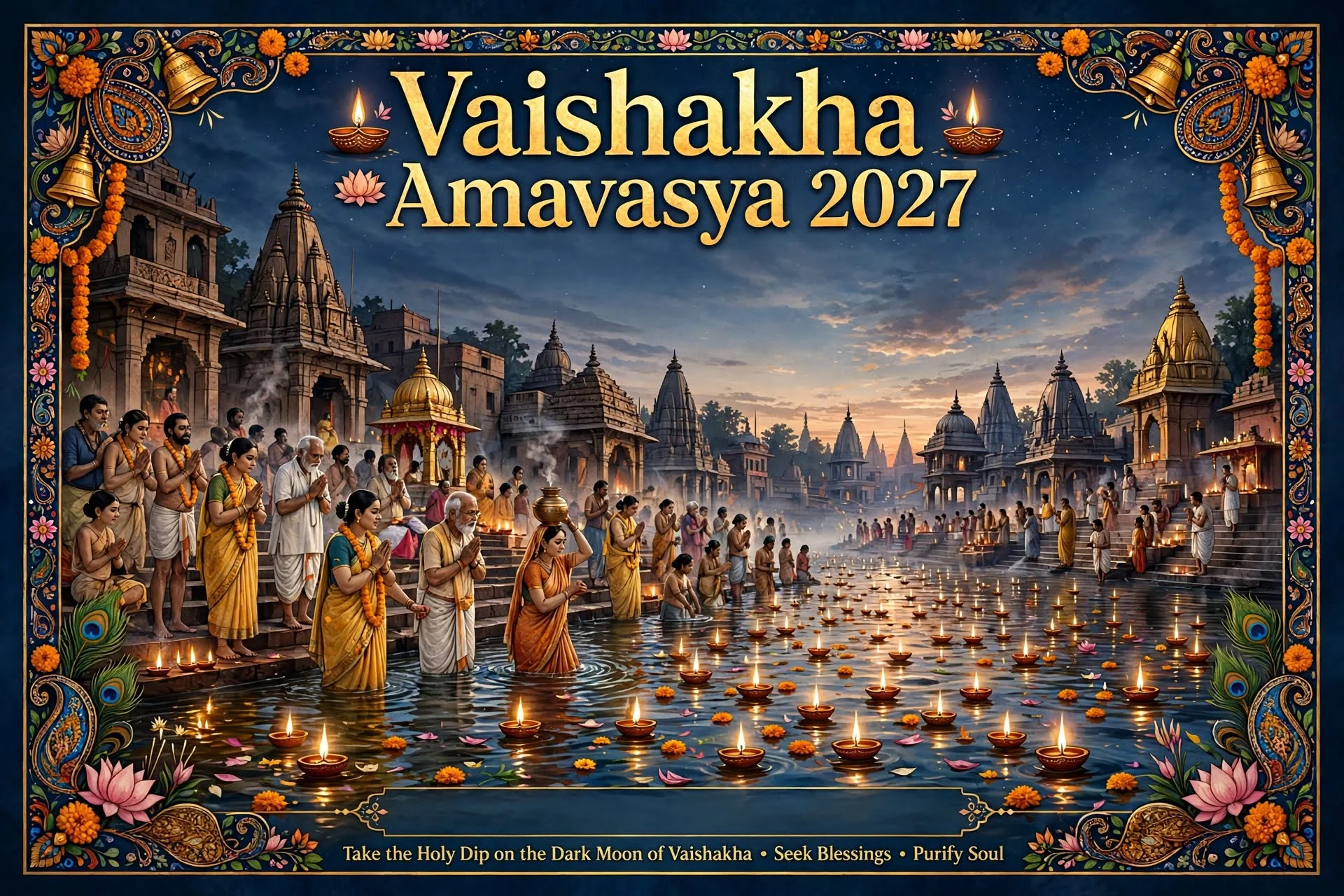
Vaishakha Amavasya
Vaishakha Amavasya is the new moon day observed during the Hindu month of Vaishakha according to the Amanta lunar calendar. It is considered an important day for worship, spiritual purification, remembrance of ancestors, charity, and religious observances. In the Purnimanta calendar, the same new moon is generally known as Jyeshtha Amavasya. The difference in naming arises from the two lunar calendar systems and does not indicate two separate new moons.
View Festival Guide

Saturday, Jun 5, 2027
Ishti
Ishti is a foundational Vedic ritual observance appearing prominently in Hindu Panchangs on the Pratipada tithi (the first lunar day) following either Amavasya (new moon) or Purnima (full moon), marking the prescribed performance day for the fortnightly Vedic Darsha-Purnamasa sacrifices.
View Festival Guide