




Gajanana Sankashti, celebrated on the fourth lunar day (Chaturthi) of the Krishna Paksha in the holy Hindu month of Ashadha according to the Amavasyanta calendar, or Shravana Krishna Chaturthi in the Purnimanta calendar (occurring in late July), is an immensely powerful fasting day dedicated to Bhagwan Ganesha in His divine elephant-faced form of Gajanana. Revered across the Bhavishya Purana, Ganesha Purana, and Mudgala Purana, the word 'Sankashti' originates from 'Sankata-Nashana', denoting the miraculous divine potency of this tithi to dissolve, uproot, and eradicate all insurmountable worldly crises, emotional anxieties, and spiritual obstacles.
Gajanana Sankashti 2027: Date, Puja Timings, Rituals & Stories
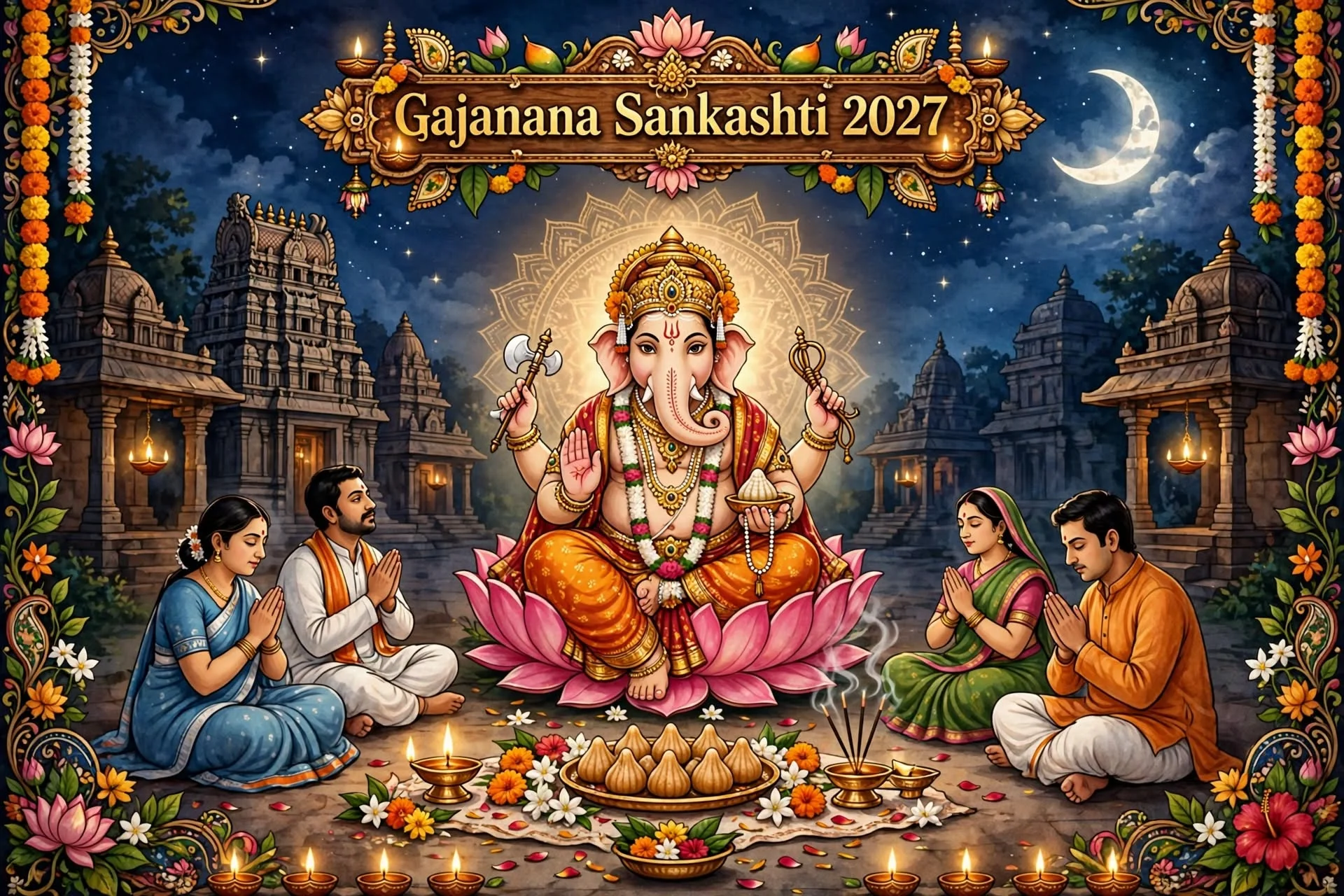
Gajanana Sankashti Timings & Panchang
Important festival dates and auspicious timings
Usha Arghya (Sunrise)
06:52 am
Sandhya Arghya (Sunset)
06:17 pm
Start Date
Wednesday, 24 Feb 2027
Puja Muhurat
06:17 pm – 07:33 pm
Gajanana Sankashti
The observance of Gajanana Sankashti is intimately associated with the Gajanana Peetha and the Mahaganapati manifestation. According to the Mudgala Purana, Ganesha assumed the Gajanana incarnation to conquer Lobhasura, the demon of insatiable greed and covetousness. By worshiping Gajanana on this sacred night, spiritual aspirants conquer the inner vices of avarice, sensory attachment, and mental agitation, receiving boons of supreme intellect (Buddhi), auspiciousness (Riddhi), and prosperity (Siddhi).
Celebrated with monumental devotion across Western, Central, and Southern India—particularly in Maharashtra, Karnataka, and Tamil Nadu—devotees observe an unbending fast from dawn until the rising of the moon. As nightfall arrives, worshipers perform a sixteen-step Shodashopachara puja of Lord Ganesha offering twenty-one blades of fresh green Durva grass, sweet steamed Modaks, and red hibiscus flowers. The fast concludes only after offering sacred milk and water libations (Chandra Arghya) to the Moon God, harmonizing psychological peace with spiritual abundance.
Why is Gajanana Sankashti Celebrated?
The celebration of Gajanana Sankashti is anchored in sacred scriptural dialogues found in the Ganesha Purana (Upasana Khanda) and the Bhavishya Purana, where Lord Shiva instructs Goddess Parvati on the incomparable efficacy of the monthly Sankashti fast.
According to the Mudgala Purana, the ferocious demon Lobhasura was born from the cosmic gaze of Lord Shiva directed at Kubera's wealth. Empowered by severe tapasya to Lord Shukracharya, Lobhasura conquered all three worlds, displacing Indra, the planetary deities, and human kings, plunging the universe into the grip of ruthless greed, exploitation, and moral degradation. The displaced deities sought refuge in Sage Raibhya, who instructed them to invoke Ganesha in His Gajanana form.
Lord Ganesha appeared as Gajanana, wielding the divine axe (Parashu) and the lotus. Merely hearing the thunderous roar of Gajanana's trunk and beholding His calm, all-encompassing elephant countenance, Lobhasura's heart was purified of greed. He surrendered unconditionally at the Lord's lotus feet and was granted redemption. Ever since, devotees celebrate Gajanana Sankashti to eliminate obstacles caused by external enemies and inner greed.
- Invoking Lord Gajanana to dissolve insurmountable obstacles, debts, and life crises (Sankata Nashana).
- Conquering internal greed (Lobha), sensory cravings, and financial anxieties through austere fasting.
- Propitiating Lord Ganesha with twenty-one blades of sacred Durva grass, steamed Modaks, and red hibiscus.
- Performing Chandra Arghya at moonrise to soothe planetary afflictions and achieve mental tranquility.
- Attaining the blessings of Riddhi (spiritual wealth), Siddhi (perfection), and Buddhi (discriminative intellect).
Scriptural Origins in the Mudgala Purana and the Vanquishing of Lobhasura
The Manifestation of Lobhasura and the Humiliation of the Devas
In the sixth Khanda of the Mudgala Purana, the narrative recounts how Kubera, the treasurer of the gods, once visited Mount Kailash to offer prostrations to Lord Shiva. As Lord Shiva gazed upon Kubera's opulence, a dynamic cosmic entity was born from Shiva's gaze, embodying the primordial principle of greed and covetousness. The entity sought the tutelage of Shukracharya, the preceptor of the asuras, who named him Lobhasura and initiated him into the rigorous penance of Shiva.
Pleased by his austerities, Shiva granted him the boon of invincibility. Emboldened by absolute power, Lobhasura marshaled a vast army, subdued the mortal kings, conquered the netherworld, and laid siege to Amaravati, casting Indra and the gods into exile. Virtue perished, and unbridled greed corrupted the human mind.
The Counsel of Sage Raibhya and the Advent of Gajanana
The destitute devas fled to the hermitage of Sage Raibhya in the forest. Raibhya instructed them: 'O celestials, when greed overtakes the cosmos, neither weapons nor diplomacy can conquer it. You must invoke the Supreme Reality who transcends all greed—Lord Gajanana, who bears the head of an elephant to swallow the universe and the ears of a winnowing basket to separate truth from falsehood.'
The devas engaged in continuous meditation on Gajanana on the fourth day of the dark fortnight. Radiant as a thousand rising suns, Ganesha manifested before them, His majestic elephant trunk curled auspiciously, holding the noose (Pasha), goad (Ankusha), and bowl of Modaks. He sent his messenger, Sage Mudgala, to advise Lobhasura to surrender.
The Surrender of Lobhasura and the Origin of the Sankashti Vrata
When Lobhasura entered the presence of Gajanana, the terrifying aura of greed completely evaporated from his mind. Overcome by divine love and reverence, the demon prostrated with his forehead touching Ganesha's lotus feet, praying: 'O Lord, pardon my arrogance! Slay my ego, not my life.'
The Elephant Head, The Winnowing Ears, and Lunar Receptivity
The Esoteric Anatomy of Gajanana
The elephant head of Lord Gajanana carries profound metaphysical meaning described in the Ganesha Atharvashirsha. The large head signifies immense wisdom, cosmic intellect (Mahat Tattva), and the vast capacity to assimilate profound spiritual knowledge.
His large winnowing-basket ears (Surpakarna) symbolize the capacity of a wise seeker to listen attentively to spiritual truths while filtering out petty gossip and falsehood, just as a winnow retains the nourishing grain while discarding the worthless chaff. His single tusk (Ekadanta) represents non-dual reality (Advaita), having broken the second tusk of duality.
The Subjugation of Greed (Lobha)
Greed is categorized in the Bhagavad Gita as one of the three primary gateways to self-destruction (Kama, Krodha, and Lobha). Greed creates an insatiable psychological void where no amount of material wealth ever brings contentment.
By meditating on Gajanana on Sankashti Chaturthi, the seeker invokes the divine grace that dissolves the restless compulsion to hoard and covet, replacing it with Santosh (inner contentment) and gratitude.
The Moonrise Ritual (Chandra Darshana Tattva)
Unlike Vinayaka Chaturthi (where looking at the moon is traditionally avoided due to the legend of the moon's vanity), Sankashti Chaturthi requires offering Arghya directly to the Moon God before breaking the fast. The moon represents the human mind (Manas).
Offering pure water and milk to the moon under Ganesha's blessings aligns the agitated mind with divine stillness, soothing anxiety, cooling the nervous system, and restoring emotional balance.
Fasting Injunctions, Home Rituals, and Moonrise Timing
Morning Cleansing and Sankalpa
Devotees rise early during Brahma Muhurta, take a holy bath, wear clean traditional attire (yellow or red), and clean the domestic shrine. A bronze, brass, or clay idol of Lord Gajanana is consecrated upon a red silk-covered chowki.
The devotee takes the formal Sankalpa to observe an uncompromising fast from sunrise until moonrise, pledging their speech, actions, and thoughts to Lord Ganesha's service.
Day-Long Japa and Evening Puja Preparation
Throughout the day, devotees abstain from cooked grains, practicing mantra japa of the Ganesha Moola Mantra or reciting the Sankata Nashana Ganesha Stotram. In the late evening, fresh Modaks (twenty-one in count) are steamed using rice flour, fresh grated coconut, and jaggery.
Twenty-one clean, fresh sprigs of Durva grass (each containing three or five blades) are tied into bundles and prepared for the archana.
The Moonrise Chandra Arghya and Breaking the Fast
As the moon rises in the night sky, devotees perform the grand Shodashopachara puja, offering Durva, red flowers, and Modaks to Lord Ganesha. Stepping outside or onto balconies, devotees offer Arghya of cold water mixed with raw milk, white sandalwood, and flowers to the moon.
After prostrating before the moon and Lord Ganesha, the fast is broken by partaking of the steamed Modaks and a light sattvic meal.
Gajanana Sankashti Puja Vidhi (Step by Step)
- 1
Pratah Snana and Shuddhi (Morning Purification)
Wake early before dawn, take a purifying bath with water infused with Gangajal, wear clean traditional red or yellow garments, and sprinkle holy water across the worship area.
- 2
Sankalpa (Taking the Sankashti Fast Vow)
Sit on a clean kusha or wool asana facing East, hold water, akshata, and a red flower in your right palm, and recite the solemn Sanskrit Sankalpa pledging to fast until moonrise for obstacle removal.
- 3
Gajanana Avahana and Dhyana (Invocation of Lord Ganesha)
Invoke Bhagwan Gajanana holding the noose, goad, and modak, adorned with a snake sacred thread, welcoming His divine presence onto the consecrated pedestal with flowers and akshata.
- 4
Asana and Padya (Offering Seat and Washing Feet)
Offer a consecrated seat draped in red silk to Lord Ganesha, followed by offering fresh water in an achamani spoon to wash His divine lotus feet.
- 5
Arghya and Achamana (Offering Scented Water and Sips)
Gajanana Sankashti Puja Samagri List
Deity Offerings and Altar Materials
- Consecrated metal, stone, or clay idol of Lord Ganesha (Gajanana)
- Wooden chowki covered in fresh red silk fabric
- Copper Panchapatra, Achamani spoon, and holy Gangajal
- Organic orange Sindoor, red sandalwood powder, and turmeric
- Pure cow ghee lamp with cotton wicks, natural camphor, and aromatic incense
Sacred Botanicals and Floral Samagri
- Twenty-one bundles of fresh green Durva grass (three-leaf sprigs, thoroughly washed)
- Fresh red hibiscus flowers (essential for Ganesha puja) and red rose garlands
- Whole betel leaves (Paan), whole areca nuts (Supari), and green cardamom
- Uncooked raw white rice mixed with turmeric powder (Akshata)
Naivedya and Chandra Arghya Items
- Twenty-one freshly steamed sweet Modaks (Ukadiche Modak made with rice flour, coconut, and jaggery)
- Sesame seed and jaggery ladoos (Til Ladoo) and sweet boondi ladoos
- Panchamrita ingredients: cow milk, curd, wild honey, cow ghee, and raw sugar
- Fresh raw milk, white flowers, and silver/brass cup for evening Chandra Arghya
Mantras and Prayers for Gajanana Sankashti
Gajanana Sankashti Vrat Rules and Fasting Guidelines
Fasting Injunctions and Dietary Code
Devotees observe a strict fast on Sankashti Chaturthi from sunrise until the moon rises in the night sky. While some observe a water-only fast, householders typically consume a light fruit-and-milk diet (Phalahari) during the day. All grains, wheat, rice, pulses, and beans are strictly prohibited during the fast. Foods consumed after moonrise must be purely vegetarian, prepared with rock salt (Sendha Namak), avoiding onions, garlic, mushrooms, and heavy spices.
- Total abstinence from non-vegetarian food, alcohol, tobacco, onions, and garlic.
- Strict fasting until the sighting of the moon and the completion of Chandra Arghya.
- Breaking of the fast must be initiated by partaking of the blessed Modak and consecrated milk.
Conduct and Mental Equanimity
Devotees cultivate peaceful speech, patience, and generosity throughout the day. Criticizing others, harboring greed, engaging in anger, and deceptive financial transactions are strictly avoided, aligning the heart with Lord Gajanana's boundless contentment.
Dos and Don'ts of Gajanana Sankashti
Good Practices (Do's)
- Wake up early and take a purifying bath wearing traditional red or yellow clothing.
- Observe a fast with patience until the rising of the moon in the night sky.
- Offer twenty-one fresh green Durva grass blades and red hibiscus flowers to Lord Ganesha.
- Prepare twenty-one steamed sweet Modaks as holy Naivedya.
- Offer Chandra Arghya with raw milk and water at the exact time of moonrise.
- Recite the Sankata Nashana Ganesha Stotram and Ganesha Atharvashirsha.
Gajanana Sankashti Across Regions
| Region | Local Name |
|---|---|
| Maharashtra (Pune, Mumbai, Ashta Vinayak) | Sankashti Chaturthi and Ganapati Aradhana |
| Karnataka and Tamil Nadu | Sankatahara Chaturthi |
| North India (Uttar Pradesh, Madhya Pradesh, Rajasthan) | Sankashti Chauth Vrat |
Gajanana Sankashti FAQs
What is Sankashti Chaturthi?
Sankashti Chaturthi is the monthly fourth lunar day (Chaturthi) of the Krishna Paksha dedicated to Lord Ganesha. It is celebrated to overcome life crises, dissolve debts, and remove insurmountable obstacles (Sankata Nashana).
Why is this observance called Gajanana Sankashti?
It is called Gajanana Sankashti because on this day Lord Ganesha is worshiped in His Gajanana (elephant-faced) incarnation, who vanquished Lobhasura (the demon of greed) and blessed devotees with contentment and freedom from obstacles.
Why is Durva grass so essential in Ganesha puja?
According to Puranic legend, when Ganesha swallowed the fire demon Analasura to save the universe, the Lord experienced intense internal heat. The rishis offered twenty-one blades of cooling Durva grass, which instantly pacified the heat, making Durva His favorite offering.
Upcoming Festivals
View All
Thursday, Jul 29, 2027
Kamika Ekadashi
Kamika Ekadashi is an immensely sacred fast observed on the eleventh lunar day (Ekadashi) of the Krishna Paksha (waning phase of the moon) in the Hindu month of Shravana according to the Amavasyanta calendar, or Ashadha Krishna Paksha in the North Indian Purnimanta calendar (occurring in mid-July). It is the first Ekadashi to fall within the holy rainy season of Chaturmas.
View Festival Guide
Friday, Jul 30, 2027
Vaishnava Kamika Ekadashi
Vaishnava Kamika Ekadashi is the exclusive, deeply devotional Ekadashi fast observed by initiates and followers of the four orthodox Vaishnava Sampradayas—Sri Sampradaya (Ramanujacharya), Brahma Sampradaya (Madhvacharya / Gaudiya Vaishnavism), Rudra Sampradaya (Vallabhacharya / Vishnuswami), and Sanaka Sampradaya (Nimbarkacharya)—falling on the Krishna Paksha of the Hindu month of Shravana (Ashadha Krishna in North Indian reckoning, occurring in late July). While Smarta householders determine Ekadashi based on the presence of the eleventh tithi at sunrise, orthodox Vaishnavas strictly adhere to the rigorous astronomical rule of 'Shuddha Ekadashi' codified in the Padma Purana, Varaha Purana, and Hari Bhakti Vilasa, completely rejecting any day that has the slightest overlap with Dashami (the tenth tithi) during the pre-dawn Arunodaya period.
View Festival Guide
Friday, Jul 30, 2027
Gauna Kamika Ekadashi
Gauna Kamika Ekadashi is the specialized, highly disciplined secondary observance of Kamika Ekadashi falling on the Dwadashi tithi (twelfth lunar day) or the subsequent sunrise of the Krishna Paksha in the holy Hindu month of Shravana (Ashadha Krishna in Purnimanta reckoning, occurring in late July). While Smarta householders observe Ekadashi on the primary day when the eleventh tithi is devoid of Dashami overlap, ascetic renunciates (Sannyasis), widows, and disciples belonging to specific orthodox monastic lineages observe the fast on the 'Gauna' (secondary or subsequent) day, strictly adhering to the rigorous mathematical and scriptural injunctions of the Hari Bhakti Vilasa, Dharma Sindhu, and Nirnaya Sindhu.
View Festival Guide
Saturday, Jul 31, 2027
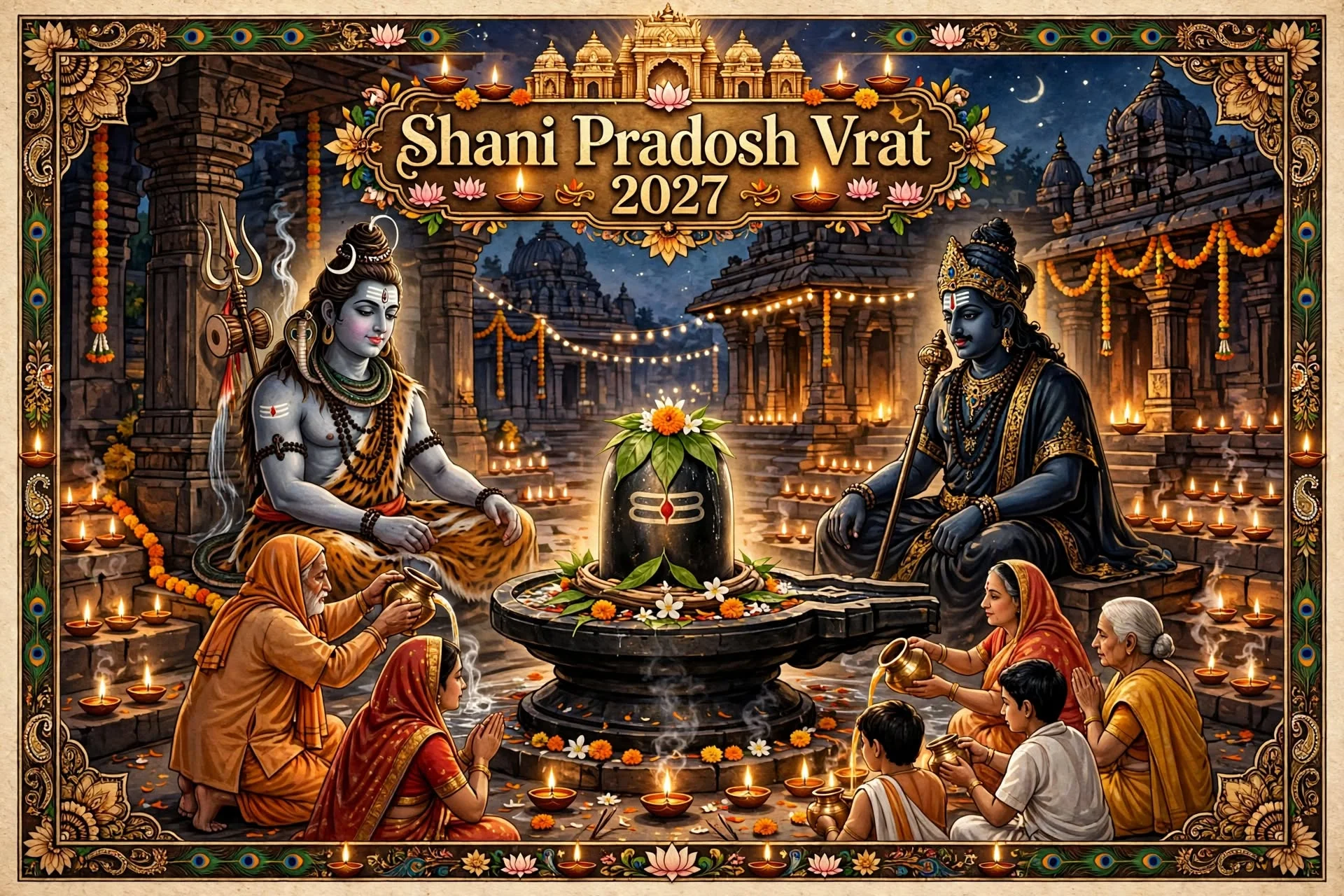
Shani Pradosh Vrat
Shani Pradosh Vrat is an exceptionally potent, revered, and astrologically transformative bi-monthly Hindu fasting observance dedicated to Lord Shiva, Goddess Parvati, and Lord Shani Deva (the planetary deity of Saturn). Occurring on the thirteenth day (Trayodashi tithi) of either the waxing (Shukla) or waning (Krishna) lunar fortnight when it coincides with a Saturday (Shanivara), this sacred vow is lauded across Vedic and Puranic literature as the supreme, infallible spiritual remedy for dissolving chronic karmic impediments, neutralizing severe planetary afflictions, and securing profound peace and prosperity.
View Festival Guide

Monday, Aug 2, 2027
Anvadhan
Anvadhan (अन्वाधान) is an ancient, highly revered Vedic ritual and spiritual observance in Sanatana Dharma performed on the day immediately preceding the New Moon (Amavasya) or Full Moon (Purnima). Rooted in the pristine traditions of the Shrauta and Grihya Sutras, Anvadhan literally translates to 'the solemn placing and replenishment of sacred fuel wood into the consecrated Vedic fires'. In traditional Vedic ritualism, householders (Grihasthas) and priests who maintain the sacred Agnihotra fires perform Anvadhan to prepare the sacrificial altars for the grand Darsha Yajna (New Moon sacrifice) or Paurnamasa Yajna (Full Moon sacrifice) scheduled for the following day.
View Festival Guide
Monday, Aug 2, 2027
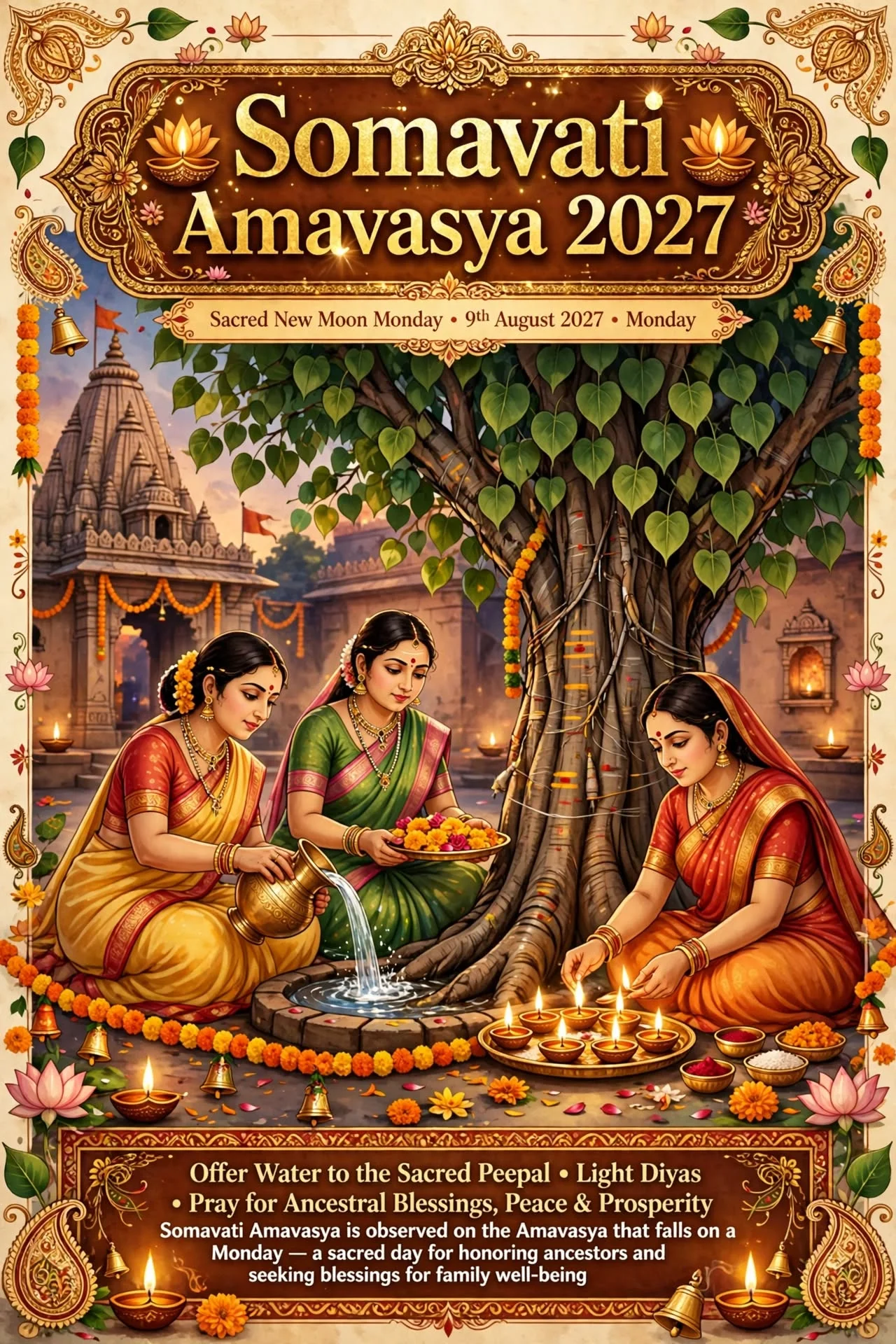
Somavati Amavasya
Somavati Amavasya is an exceedingly rare, sacred, and astrologically exalted Hindu fasting and pilgrimage observance that occurs when the New Moon day (Amavasya tithi) coincides with a Monday (Somavara). In Vedic tradition, Monday is governed by Soma (the Moon God / Chandra Deva) and is supremely sacred to Lord Shiva, who adorns the crescent moon upon His crown as Chandrashekhara. When the quiet, contemplative energy of Amavasya merges with the gentle, nectarine cooling rays of Monday, it creates an extraordinary cosmic alignment that is lauded across Sanatana Dharma as the 'King of all Amavasyas'.
View Festival Guide

Monday, Aug 2, 2027
Surya Grahan
Surya Grahan (Solar Eclipse) is a momentous astronomical and spiritual phenomenon in the Hindu calendar occurring on an Amavasya (new moon day) when the Moon passes between the Sun and the Earth, momentarily obscuring the solar disc from terrestrial view.
View Festival Guide

Monday, Aug 2, 2027
Darsha Amavasya
Darsha Amavasya is a significant new moon observance in the Hindu calendar designating the specific night when the Moon is completely invisible to the human eye, having fully merged into the conjunction of the Sun.
View Festival Guide