




Kamika Ekadashi is an immensely sacred fast observed on the eleventh lunar day (Ekadashi) of the Krishna Paksha (waning phase of the moon) in the Hindu month of Shravana according to the Amavasyanta calendar, or Ashadha Krishna Paksha in the North Indian Purnimanta calendar (occurring in mid-July). It is the first Ekadashi to fall within the holy rainy season of Chaturmas.
Kamika Ekadashi 2027: Date, Puja Timings, Rituals & Stories
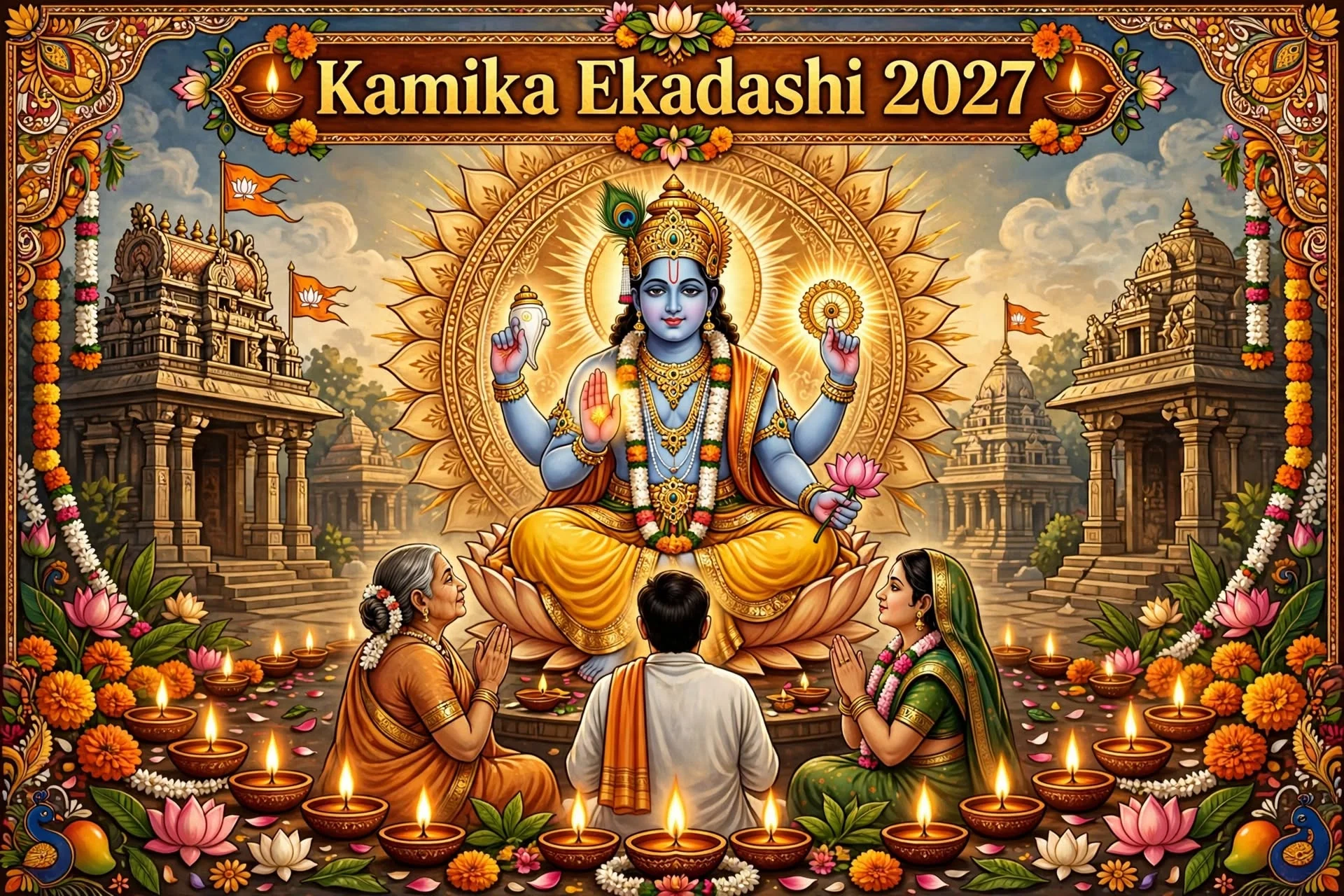
Kamika Ekadashi Timings & Panchang
Important festival dates and auspicious timings
Usha Arghya (Sunrise)
05:26 am
Sandhya Arghya (Sunset)
07:23 pm
Start Date
Wednesday, 30 Jun 2027
Puja Muhurat
10:04 pm – 08:31 pm
Kamika Ekadashi
Dedicated to Lord Vishnu in His divine form of Sridhara (the consort of Goddess Sri/Lakshmi), Kamika Ekadashi is celebrated across sacred scriptures as the granter of all righteous desires (Kama) and the supreme purifier of negative karmic residue. The Brahma Vaivarta Purana and Skanda Purana affirm that simply hearing the glory of Kamika Ekadashi bestows the spiritual merit equivalent to performing an Ashvamedha Yajna.
A central hallmark of Kamika Ekadashi is the supreme emphasis placed on the worship of the holy Tulsi (sacred basil) plant. Scriptures state that offering a single fresh sprig of Tulsi to Lord Vishnu on this sanctified day yields greater spiritual fruit than donating immense quantities of gold, silver, and precious gems, purifying the devotee from even the most severe spiritual transgressions.
Why is Kamika Ekadashi Celebrated?
The observance of Kamika Ekadashi is illuminated in the sacred dialogues recorded in the Brahmavaivarta Purana, where Lord Brahma narrates its peerless virtues to Sage Narada, and Lord Krishna reveals its sanctity to King Yudhishthira.
According to Puranic legend, an affluent landlord in an ancient village accidentally caused the death of a pious Brahmin during an unexpected altercation. Burdened by unbearable remorse for committing Brahma-hatya (the sin of killing a Brahmin), the landlord sought redemption from learned sages, who instructed him that observing Kamika Ekadashi with total contrition and devotional worship of Lord Vishnu was the sole path to absolve his heavy karmic burden.
Through unreserved fasting, night vigil, and offering Tulsi leaves at the feet of Lord Sridhara, the landlord was absolved of his guilt, and his departed ancestors attained peace in the heavenly realms. Since that time, seekers observe Kamika Ekadashi to achieve inner purification and spiritual freedom.
- Eradicating severe past karmic sins and granting complete spiritual absolution.
- Propitiating Lord Vishnu in His eternal form as Sridhara during the auspicious Chaturmas.
- Honoring Goddess Tulsi, whose worship on this day brings immense spiritual merit.
- Elevating departed ancestors (Pitrus) to celestial realms through devotional merit.
The Dialogue of Brahma and Narada and the Legend of Karmic Redemption
Sage Narada's Inquiry and Lord Brahma's Revelation
In the Brahmavaivarta Purana, the celestial traveler Sage Narada asks Lord Brahma: 'O Creator, please instruct me regarding the Ekadashi of Shravana Krishna Paksha. What is its name, who is its presiding deity, and what spiritual fruits are obtained by its observance?'
Lord Brahma joyfully replied: 'O Narada, that Ekadashi is named Kamika. The merit acquired by observing Kamika Ekadashi surpasses that of taking holy baths in the sacred waters of Kashi, Kurukshetra, Kedarnath, and Ganga during solar eclipses. The supreme deity of this vrata is Bhagwan Sridhara, the eternal harbor of peace.'
The Landlord and the Inadvertent Sin of Brahma-hatya
Lord Krishna narrated to King Yudhishthira the historical incident of a wealthy but hot-tempered village chieftain. One day, during a heated dispute over land boundaries, the chieftain unintentionally struck a pious Brahmin, who succumbed to his injury. Stricken with horror and anguish, the chieftain organized the Brahmin's funeral rites, but the local Brahmins refused to accept his donations or attend the shraddha, declaring him tainted by Brahma-hatya.
Desperate for spiritual healing, the landlord sought out a revered hermit sage living on the outskirts of the forest. The sage took pity on his genuine sorrow and said: 'On the upcoming Kamika Ekadashi, observe an austere fast. Worship Lord Sridhara with fragrant flowers and sacred Tulsi leaves, and sit in prayer throughout the night.'
The Vision of Lord Sridhara and Final Liberation
The chieftain followed the instructions meticulously. He fasted, prayed, fed the needy, and sat before the idol of Lord Vishnu with unbroken devotion. As dawn broke on Dwadashi, Lord Vishnu appeared in His four-armed divine form, touching the devotee with His conch and announcing that his sincere repentance and devotion on Kamika Ekadashi had dissolved all traces of sin.
The chieftain spent the rest of his life in virtuous philanthropy and attained Vaikuntha upon shedding his mortal frame.
The Supremacy of Devotion, Repentance, and Tulsi Mahatmya
The Power of Genuine Contrition over Ritual Mechanics
Kamika Ekadashi exemplifies the transformative psychological and spiritual power of genuine repentance (Prayaschitta). In Hindu theology, while the law of Karma is inexorable, sincere surrender to the Supreme Divine with a repentant heart burns past negative impressions (Samskaras) like dry grass in a forest fire.
It reminds spiritual aspirants that no individual is permanently condemned by past mistakes if they cultivate humility, reform their actions, and take shelter in the Divine.
The Cosmic Glory of Goddess Tulsi
Scriptures declare that Tulsi is the beloved eternal consort of Lord Vishnu (Vrinda Devi). The Skanda Purana states that one who worships Lord Vishnu with fresh Tulsi leaves on Kamika Ekadashi attains the merit of all Vedic sacrifices combined.
Even Yamaraja (the lord of death) and his messengers cannot approach a person whose body is purified by Tulsi water and who has honored Lord Hari with Tulsi on this sacred day.
The Chaturmas Spiritual Shield
Falling within the early phase of Chaturmas, Kamika Ekadashi serves as a spiritual shield. As atmospheric negative energies and physical ailments rise with monsoon humidity, the fasting protocols and herbal intake (Tulsi and holy water) fortify both biological immunity and mental clarity.
Observance Guidelines and Ritual Protocols for Kamika Ekadashi
Commencement on Dashami Evening
The observance begins on Dashami evening with a light vegetarian meal before sunset. Devotees refrain from heavy pulses, leafy greens, and spices, purifying their thought and speech before retiring to bed.
Morning Rituals and Tulsi Worship
On Ekadashi morning, devotees rise during Brahma Muhurta, bathe in fresh water infused with Gangajal, and perform formal morning prayers. A special circumambulation (Pradakshina) of the Tulsi plant is performed, offering water and bowing to Vrinda Devi.
Worship of Lord Vishnu as Sridhara is conducted using the Shodashopachara method with special focus on yellow silk garments, fragrant sandalwood, and green Tulsi leaves.
Night Vigil and Charitable Parana on Dwadashi
Devotees stay awake through the night (Jagaran) singing Vishnu bhajans, reciting the Bhagavad Gita or Vishnu Sahasranama. On Dwadashi, after completing the morning puja and feeding a Brahmin or gifting food grains to the poor, the fast is broken during the designated Parana muhurta.
Kamika Ekadashi Puja Vidhi (Step by Step)
- 1
Snana and Sankalpa (Purifying Bath and Solemn Vow)
Bathe early in the morning with pure water chanting the names of sacred rivers. Stand or sit before the altar, take water, akshata, and a flower in your right hand, and recite the Kamika Ekadashi Sankalpa pledging an unblemished fast.
- 2
Dhyana and Sridhara Avahana (Meditation and Invocation)
Meditate upon Bhagwan Sridhara holding the conch, discus, mace, and lotus, adorned with the Kaustubha gem and Srivatsa mark, welcoming His divine presence into the altar.
- 3
Asana and Padya (Offering Seat and Washing Feet)
Offer a consecrated yellow silk asana to the Lord, followed by offering fresh water in an achamani spoon to wash His divine lotus feet.
- 4
Arghya and Achamana (Offering Water Oblation and Sips)
Present Arghya consisting of clean water infused with sandalwood and flowers to the hands of the Lord, followed by offering water three times for Achamana.
- 5
Panchamrita Snana (Sacred Nectar Bath)
Kamika Ekadashi Puja Samagri List
Primary Puja and Deity Utensils
- Idol of Lord Vishnu / Krishna / Shaligram Shila
- Copper or brass Panchapatra, Achamani spoon, and Puja bell
- Pure brass oil/ghee lamp with cotton wicks and pure cow ghee
- Natural camphor (Karpura) and fragrant dhoop sticks
- Kusha grass mat for seated meditation
Sacred Tulsi and Botanical Items
- Abundant fresh Tulsi leaves and Tulsi Manjari (plucked on Dashami day)
- Yellow marigold flowers, yellow chrysanthemums, and fresh lotus blooms
- Fragrant yellow sandalwood paste, Kumkum, and Akshata
- Fresh betel leaves (Paan), whole betel nuts (Supari), and green cardamom
Panchamrita and Naivedya Items
- Pure raw cow milk, curd, wild honey, cow ghee, and raw cane sugar
- Seasonal fresh fruits (apples, bananas, pomegranate, pears)
- Dry fruits: soaked almonds, cashews, raisins, and foxnuts (makhana)
- Ganga water in a consecrated copper Kalash
Mantras and Prayers for Kamika Ekadashi
Kamika Ekadashi Vrat Rules and Fasting Guidelines
Dietary Protocols and Fasting Codes
Devotees observe fasting according to their health capacity: Nirjala (waterless), Sajala (with water), or Phalahari (fruits and milk). All grains, wheat, rice, barley, lentils, and beans are strictly prohibited. Food should be prepared with rock salt (Sendha Namak) and free of pungent spices.
- Total abstinence from grains, rice, lentils, legumes, flours, onions, garlic, and mushrooms.
- Permissible foods include fresh fruits, cow milk, homemade paneer, sabudana, and water chestnut flour.
- Strict avoidance of alcohol, caffeine, and tobacco.
Moral Discipline and Parana Protocol
Devotees practice truthfulness, sexual abstinence (Brahmacharya), and gentle speech. On Dwadashi morning, after completing worship and offering charity to the needy, the fast is broken strictly during the designated Parana time before Dwadashi ends.
Dos and Don'ts of Kamika Ekadashi
Good Practices (Do's)
- Wake up during Brahma Muhurta and take a purifying bath with holy river water or Gangajal.
- Worship Lord Vishnu as Sridhara with fresh, aromatic Tulsi leaves and yellow flowers.
- Observe a pure sattvic fruit fast or waterless fast according to your physical strength.
- Recite the Vishnu Sahasranama and chant the Om Namo Bhagavate Vasudevaya mantra.
- Distribute food, clothes, and financial charity to the poor and needy on Dwadashi.
Kamika Ekadashi Across Regions
| Region | Local Name |
|---|---|
| North India (Uttar Pradesh, Bihar, Rajasthan, Madhya Pradesh) | Kamika Ekadashi Vrat |
| South India (Andhra Pradesh, Telangana, Karnataka, Tamil Nadu) | Kamika Ekadashi / Shravana Krishna Ekadashi |
| Gujarat | Kamika Agiyaras |
Kamika Ekadashi FAQs
What is the meaning of the name 'Kamika'?
The word 'Kamika' is derived from 'Kama' (righteous desire). It signifies the Ekadashi that fulfills all righteous and noble aspirations of the devotee while conferring spiritual liberation.
Why is Tulsi worship so important on Kamika Ekadashi?
Scriptures state that offering Tulsi leaves to Lord Vishnu on Kamika Ekadashi yields greater spiritual merit than offering mounds of gold or silver, and grants divine protection from all negative karmic repercussions.
Can rice be eaten on Kamika Ekadashi?
No, eating rice on any Ekadashi, including Kamika Ekadashi, is strictly prohibited in Hindu scriptures, as symbolic negative energies reside in grains during this lunar phase.
Upcoming Festivals
View All
Friday, Jul 30, 2027
Vaishnava Kamika Ekadashi
Vaishnava Kamika Ekadashi is the exclusive, deeply devotional Ekadashi fast observed by initiates and followers of the four orthodox Vaishnava Sampradayas—Sri Sampradaya (Ramanujacharya), Brahma Sampradaya (Madhvacharya / Gaudiya Vaishnavism), Rudra Sampradaya (Vallabhacharya / Vishnuswami), and Sanaka Sampradaya (Nimbarkacharya)—falling on the Krishna Paksha of the Hindu month of Shravana (Ashadha Krishna in North Indian reckoning, occurring in late July). While Smarta householders determine Ekadashi based on the presence of the eleventh tithi at sunrise, orthodox Vaishnavas strictly adhere to the rigorous astronomical rule of 'Shuddha Ekadashi' codified in the Padma Purana, Varaha Purana, and Hari Bhakti Vilasa, completely rejecting any day that has the slightest overlap with Dashami (the tenth tithi) during the pre-dawn Arunodaya period.
View Festival Guide
Friday, Jul 30, 2027
Gauna Kamika Ekadashi
Gauna Kamika Ekadashi is the specialized, highly disciplined secondary observance of Kamika Ekadashi falling on the Dwadashi tithi (twelfth lunar day) or the subsequent sunrise of the Krishna Paksha in the holy Hindu month of Shravana (Ashadha Krishna in Purnimanta reckoning, occurring in late July). While Smarta householders observe Ekadashi on the primary day when the eleventh tithi is devoid of Dashami overlap, ascetic renunciates (Sannyasis), widows, and disciples belonging to specific orthodox monastic lineages observe the fast on the 'Gauna' (secondary or subsequent) day, strictly adhering to the rigorous mathematical and scriptural injunctions of the Hari Bhakti Vilasa, Dharma Sindhu, and Nirnaya Sindhu.
View Festival Guide
Saturday, Jul 31, 2027
Shani Pradosh Vrat
Shani Pradosh Vrat is an exceptionally potent, revered, and astrologically transformative bi-monthly Hindu fasting observance dedicated to Lord Shiva, Goddess Parvati, and Lord Shani Deva (the planetary deity of Saturn). Occurring on the thirteenth day (Trayodashi tithi) of either the waxing (Shukla) or waning (Krishna) lunar fortnight when it coincides with a Saturday (Shanivara), this sacred vow is lauded across Vedic and Puranic literature as the supreme, infallible spiritual remedy for dissolving chronic karmic impediments, neutralizing severe planetary afflictions, and securing profound peace and prosperity.
View Festival Guide
Monday, Aug 2, 2027
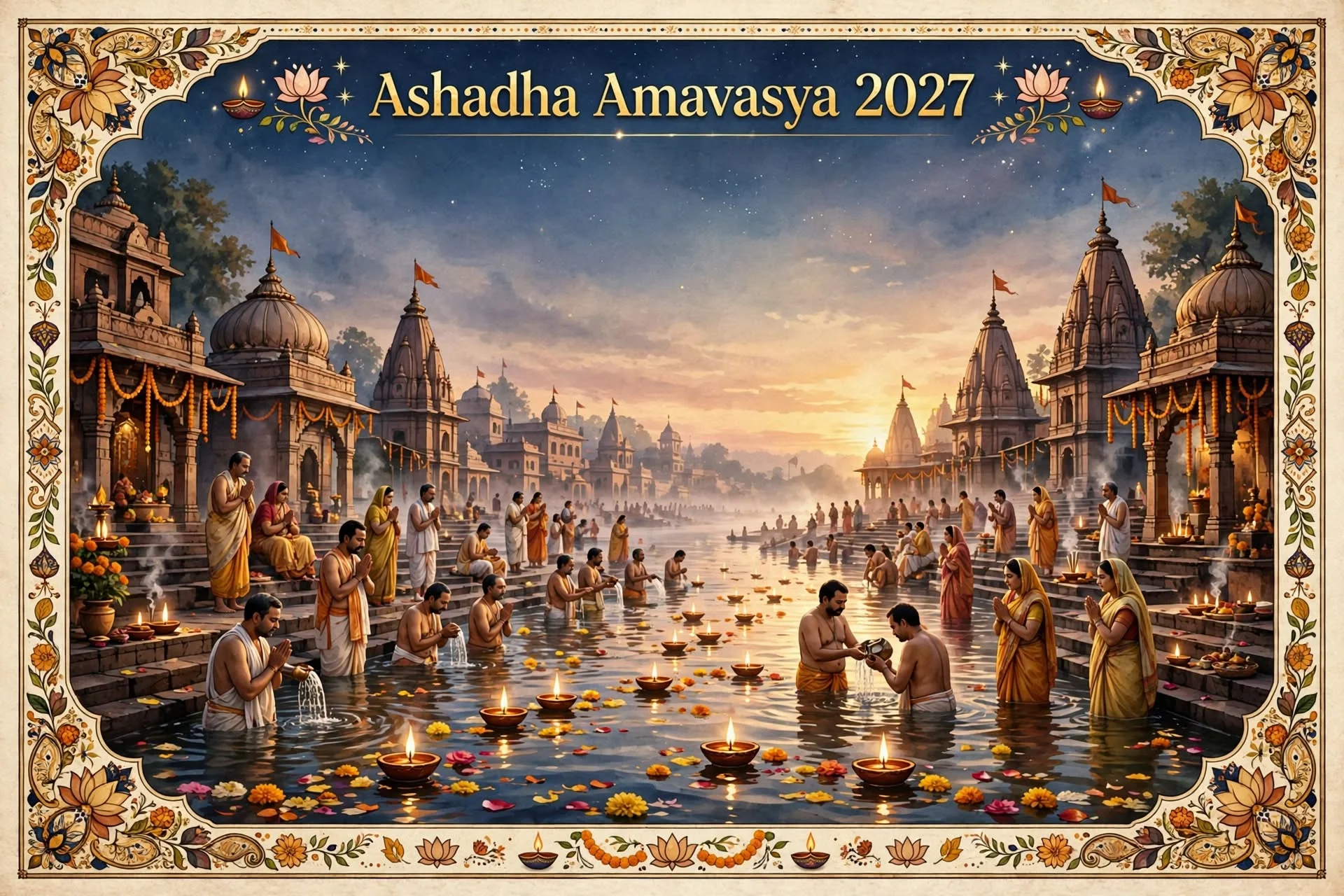
Ashadha Amavasya
Ashadha Amavasya, traditionally revered as Chhad Dahi Amavasya, Deepa Amavasya, or Hariyali Amavasya in several regional calendars, is the solemn new moon tithi concluding the Krishna Paksha of the sacred Hindu month of Ashadha. Falling at the zenith of the monsoon season, this sacred tithi marks an astrological and energetic threshold when the sun and moon align in complete celestial conjunction. In Vedic cosmology, Amavasya is presided over by Aryaman and the ancestral spirits (Pitrus), rendering this day uniquely potent for ancestral libations (Pitru Tarpana), holy river bathing, environmental reverence, and the lighting of auspicious lamps.
View Festival Guide

Monday, Aug 2, 2027
Surya Grahan
Surya Grahan (Solar Eclipse) is a momentous astronomical and spiritual phenomenon in the Hindu calendar occurring on an Amavasya (new moon day) when the Moon passes between the Sun and the Earth, momentarily obscuring the solar disc from terrestrial view.
View Festival Guide
Monday, Aug 2, 2027
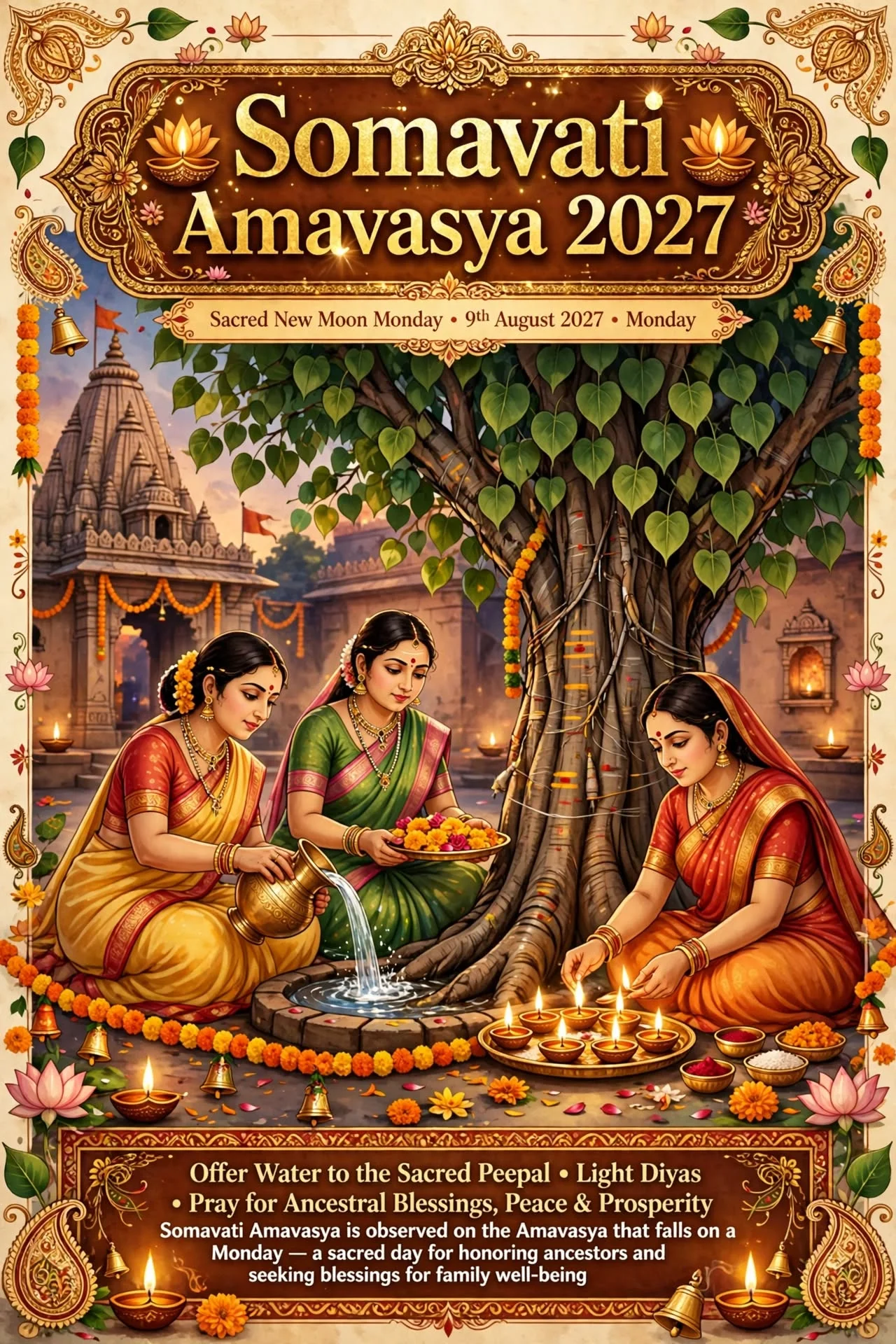
Somavati Amavasya
Somavati Amavasya is an exceedingly rare, sacred, and astrologically exalted Hindu fasting and pilgrimage observance that occurs when the New Moon day (Amavasya tithi) coincides with a Monday (Somavara). In Vedic tradition, Monday is governed by Soma (the Moon God / Chandra Deva) and is supremely sacred to Lord Shiva, who adorns the crescent moon upon His crown as Chandrashekhara. When the quiet, contemplative energy of Amavasya merges with the gentle, nectarine cooling rays of Monday, it creates an extraordinary cosmic alignment that is lauded across Sanatana Dharma as the 'King of all Amavasyas'.
View Festival Guide

Monday, Aug 2, 2027
Darsha Amavasya
Darsha Amavasya is a significant new moon observance in the Hindu calendar designating the specific night when the Moon is completely invisible to the human eye, having fully merged into the conjunction of the Sun.
View Festival Guide

Monday, Aug 2, 2027
Anvadhan
Anvadhan (अन्वाधान) is an ancient, highly revered Vedic ritual and spiritual observance in Sanatana Dharma performed on the day immediately preceding the New Moon (Amavasya) or Full Moon (Purnima). Rooted in the pristine traditions of the Shrauta and Grihya Sutras, Anvadhan literally translates to 'the solemn placing and replenishment of sacred fuel wood into the consecrated Vedic fires'. In traditional Vedic ritualism, householders (Grihasthas) and priests who maintain the sacred Agnihotra fires perform Anvadhan to prepare the sacrificial altars for the grand Darsha Yajna (New Moon sacrifice) or Paurnamasa Yajna (Full Moon sacrifice) scheduled for the following day.
View Festival Guide