




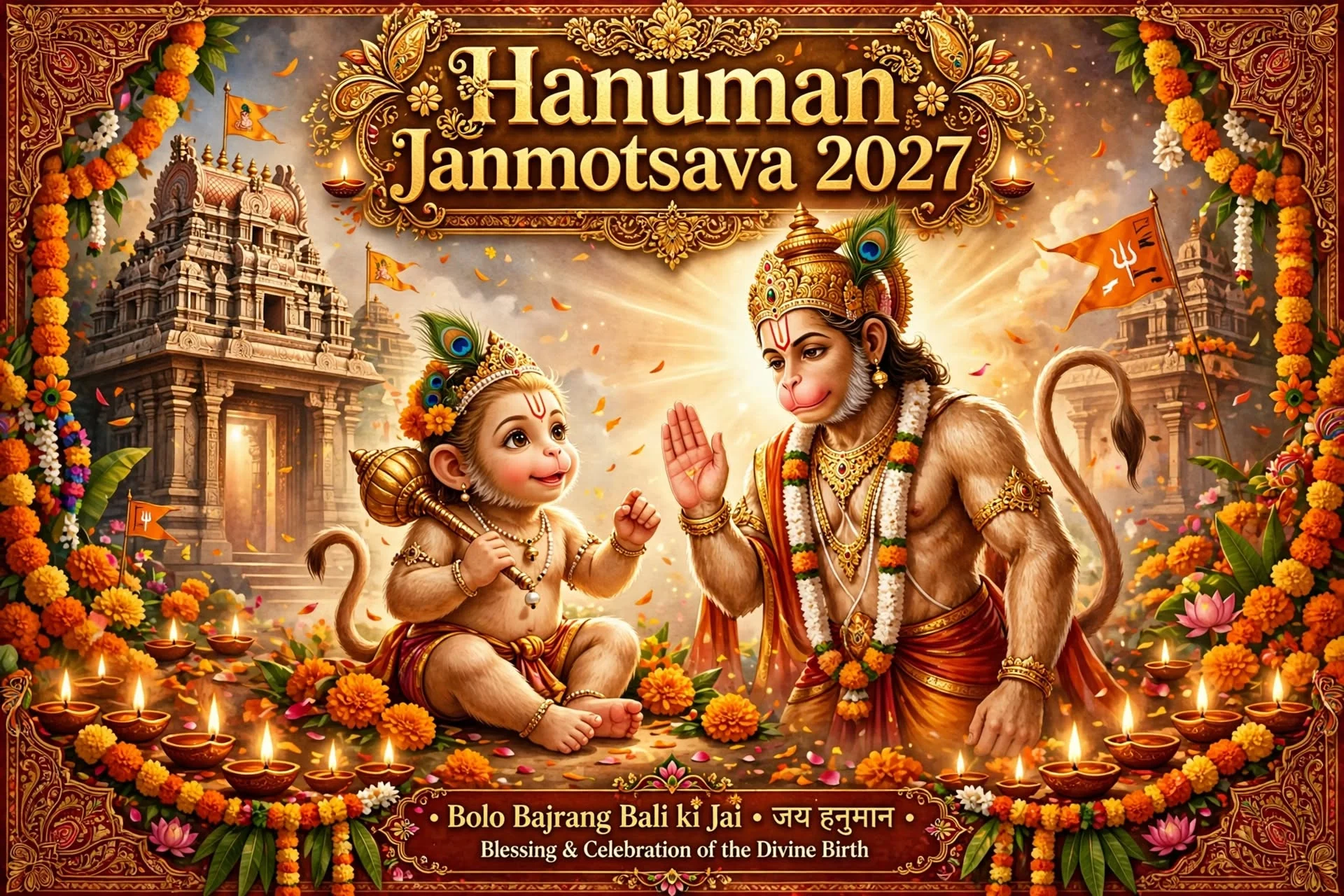
Hanuman Janmotsava marks the glorious birth celebration of Sri Hanuman, the immortal Rudra avatar of Lord Shiva and the supreme paragon of unalloyed devotion (Dasa Bhakti) to Lord Sri Rama. Celebrated with profound reverence on the full moon day (Purnima) of the sacred month of Chaitra, this divine occasion honors the eternal presence of Bajrangbali on earth. Traditional Vedic scholars and Vaishnava acharyas specifically designate this holy day as 'Janmotsava' (the celebration of birth) rather than 'Jayanti', because Sri Hanuman is one of the seven sacred Chiranjivis (deathless immortals) who eternally resides on earth wherever the holy name of Rama is chanted.
Hanuman Janmotsava 2027: Date, Puja Timings, Rituals & Stories
Hanuman Janmotsava Timings & Panchang
Important festival dates and auspicious timings
Usha Arghya (Sunrise)
05:51 am
Sandhya Arghya (Sunset)
06:50 pm
Start Date
Tuesday, 20 Apr 2027
Puja Muhurat
06:08 am – 03:57 am
Hanuman Janmotsava
The scriptural foundations of Hanuman Janmotsava are detailed in the Valmiki Ramayana, the Skanda Purana, the Shiva Purana, and the Agastya Samhita. Manifesting as the son of Mata Anjana and King Kesari through the divine grace of Vayu Dev (the Wind God), Lord Hanuman was blessed by Lord Brahma and all celestial devas with invincibility, supreme wisdom, mastery of speech, and the eight supernatural perfections (Ashta Siddhis). His life stands as an eternal monument to the power of selfless service, absolute celibacy (Brahmacharya), and unconditional surrender to God.
Devotees celebrate Hanuman Janmotsava with intense ascetic discipline and ecstatic joy. Worshippers gather in temples before dawn, anointing the deity's murti with sanctified orange-red vermilion mixed in pure jasmine oil (Sindoor Chola), offering garlands of 108 betel leaves (Paan Mala), and kindling mustard-oil lamps. The atmosphere reverberates with continuous recitations of the Hanuman Chalisa, Sundarkand, and Bajrang Baan, followed by distributing sacred Boondi and Besan Laddus to dispel sorrow, protect against negative energies, and awaken moral fortitude.
Why is Hanuman Janmotsava Celebrated?
Hanuman Janmotsava is celebrated to revere the living, immortal presence of Sri Hanuman on earth, seek his invincible protection against fear, dark forces, and planetary afflictions, and draw inspiration from his flawless embodiment of strength, wisdom, and humble servitude to Lord Rama.
- Reverence of the Living Chiranjivi: Honors Sri Hanuman as an immortal divine protector who actively listens to and aids sincere devotees on earth.
- Annihilation of Fear & Negative Forces: Invokes the boundless power of Sankat Mochan to dispel phobias, evil spirits, and psychological depression.
- Pacification of Saturn's Malefic Effects: Worshipping Hanuman on his Janmotsava provides supreme relief from Shani's Sade Sati and Dhaiya.
- Awakening of Inner Purity & Willpower: Inspires seekers to cultivate self-control, celibacy (Brahmacharya), and focused intellectual clarity.
The Eternal Manifestation of the Deathless Rudra
Mata Anjana's Tapas and the Wind God's Delivery
Ancient Puranic chronicles record that Mata Anjana performed severe penance atop Mount Matanga to bring forth an incarnation of Lord Shiva who would be invincible, deeply compassionate, and completely dedicated to righteousness. Pleased by her devotion, Lord Shiva chose to manifest his eleventh Rudra form as her son.
Simultaneously, as King Dasharatha in Ayodhya completed the Putrakameshti Yajna, a kite seized a portion of the sacred celestial pudding (Payasa) from Queen Kausalya's dish. Vayu Dev, the Wind God, carried this sanctified essence across the skies and placed it into Mata Anjana's meditation-clasped palms, by which the divine child was conceived.
The Boon of Chiranjivi and Mother Sita's Blessing
Upon Chaitra Purnima, Lord Hanuman was born in all his radiant glory. Years later, after Hanuman successfully located Mother Sita in the Ashoka Vatika of Lanka, conveyed Lord Rama's message, and destroyed the pride of Ravana, Mother Sita was overwhelmed with gratitude.
She blessed Hanuman with the immortal boon: 'Ajara Amara Guna Nidhi Suta Hohu' (May you remain forever free from old age, immortal, and an ocean of all divine virtues!). Lord Rama further affirmed that as long as the story of Rama is recited in the mortal world, Hanuman's physical presence will remain on earth to guide, protect, and bless virtuous souls.
Source: Shiva Purana, Valmiki Ramayana & Agastya Samhita
Yogic & Philosophical Essence of Marutinandan
The Master of Prana and the Eightfold Siddhis
In esoteric Hatha Yoga and Tantra, Hanuman is the personification of purified Prana (life-force energy). When the vital breath is tamed and directed toward Lord Rama (the supreme soul), the eight supernatural powers (Ashta Siddhis)—Anima (shrinking), Mahima (expanding), Garima (increasing weight), Laghima (becoming weightless), Prapti, Prakamya, Ishitva, and Vashitva—naturally awaken.
Hanuman's greatness lies in the fact that he never utilized these powers for personal aggrandizement, but exclusively for the service of God, demonstrating that spiritual power must always be subordinate to humility and devotion.
Why Traditional Scholars Prefer 'Janmotsava' Over 'Jayanti'
In classical Sanskrit terminology, 'Jayanti' historically refers to the birth anniversary of mortal beings who have lived and departed their physical forms. In contrast, 'Janmotsava' signifies the celebration of birth for an eternal, living divine being.
Because Sri Hanuman is a Chiranjivi—one who never leaves his mortal manifestation and is ever present wherever the Ramayana is chanted—celebrating his appearance as 'Janmotsava' honors his living reality and immediate accessibility to his devotees.
Worship Traditions & Festive Observances of Janmotsava
Dawn Snana, Sindoor Chola, and Akhanda Patha
The celebration commences before sunrise. Devotees take a holy bath, wear auspicious saffron or red attire, and assemble in shrines for the early morning Mangala Aarti. The core ritual of 'Sindoor Chola' is conducted, wherein the deity's idol is anointed with pure orange-red vermilion blended with fragrant jasmine oil.
Devotees perform Akhanda recitations of the Hanuman Chalisa, chanting the sacred verses 100 or 108 times, alongside the powerful verses of the Sundarkand and the Bajrang Baan, creating an impenetrable energetic shield against adversity.
Paan Mala Samarpan and Community Bhandaras
Devotees offer a garland of 108 fresh betel leaves (Paan Mala), Akada blossoms, and sweet Besan or Boondi Laddus. Saffron victory flags inscribed with 'Jai Shri Ram' are hoisted atop temples and residential homes.
In the afternoon and evening, mass community kitchens (Bhandaras) distribute rich feasts of puris, sabzi, halwa, and cooling drinks to pilgrims, celebrating the compassionate, protective spirit of Bajrangbali.
Hanuman Janmotsava Puja Vidhi (Step by Step)
- 1
Brahma Muhurta Snana & Sankalpa
Wake before dawn, take a purifying bath with Gangajal-infused water, wear clean red or saffron clothes, and recite the solemn vow of Hanuman Janmotsava.
- 2
Altar & Peetha Sthapana
Cleanse the family shrine, spread a vibrant red silk cloth over a wooden chauki, and place a consecrated idol or framed picture of Lord Hanuman and Sri Rama.
- 3
Kalash Sthapana
Establish a sacred copper Kalash filled with holy water, betel nut, silver coin, and mango leaves, placing a coconut wrapped in red thread on top.
- 4
Dhyan & Avahana
Meditate upon Sri Hanuman, golden-complexioned, radiant, holding a mace and mountain, with his right hand in Abhaya mudra, invoking his living presence.
- 5
Panchamrit & Gangajal Abhishekam
Gently bathe the idol with raw cow milk, curd, honey, ghee, sugar, and abundant fragrant Gangajal, wiping clean with a fresh cloth.
Hanuman Janmotsava Puja Samagri List
Altar & Chola Offerings
Sacred ingredients required to prepare the altar and offer the traditional Sindoor Chola.
- Idol or framed picture of Lord Hanuman and Sri Ram Darbar
- Pure orange-red vermilion (Hanumani Sindoor) and pure jasmine oil (Chameli ka Tel)
- Red silk cloth, wooden chauki, copper Kalash, whole coconut, and mango leaves
- Gangajal, raw cow milk, curd, honey, cow ghee, and sugar for Panchamrit
Botanical Offerings & Sacred Garlands
Sacred flowers and traditional leaf garlands beloved by Bajrangbali.
- Fresh betel leaves strung into a garland of 108 leaves (Paan Mala)
- Akada (crown flower) garland and fresh red marigold blossoms
- Yajnopavita (sacred thread) and red moli thread
- Pure cow-ghee or mustard oil brass lamps, cotton wicks, and Guggul dhoop
Naivedya & Prasad Ingredients
Traditional sweets and nutritious food offerings for Lord Hanuman.
- Sweet yellow Boondi and authentic Besan Laddus (or Motichoor Laddus)
- Roasted black chickpeas (Bhuna Chana) and organic jaggery (Gud)
- Fresh bananas, seasonal fruits, dry fruits, and paan with supari and cloves
Mantras and Prayers for Hanuman Janmotsava
Hanuman Janmotsava Vrat Rules and Fasting Guidelines
Observance Guidelines for Hanuman Janmotsava
Specific devotional disciplines and conduct codes for Hanuman Janmotsava.
- Fasting Discipline: Devotees maintain a single-meal fast or phalahari fast until evening Aarti, abstaining from grains, salt, and non-vegetarian food.
- Strict Brahmacharya: Maintain absolute physical and mental celibacy, cultivating pure thoughts and speech.
- Hanuman Chalisa Japa: Recite the Hanuman Chalisa with devotion; reciting it 7, 11, or 108 times brings immense spiritual strength.
- Benevolent Service: Practice humility, help the distressed, and organize food distribution (Bhandara) for the public.
Dos and Don'ts of Hanuman Janmotsava
Good Practices (Do's)
- Wake early, bathe, and wear clean red, saffron, or yellow clothing.
- Chant the Hanuman Chalisa, Sundarkand, and the sacred name of Sri Rama.
- Offer orange-red Sindoor mixed with jasmine oil, betel leaves, and Boondi laddus.
- Serve food and water to the needy, travelers, and monkeys with respect.
Things to Avoid (Don'ts)
Hanuman Janmotsava Across Regions
| Region | Local Name |
|---|---|
| Northern India | Hanuman Janmotsav |
| Andhra Pradesh & Telangana | Hanuman Jayanthi (41-day Deeksha) |
| Gujarat & Western India | Hanuman Janmotsav |
Hanuman Janmotsava FAQs
What is Hanuman Janmotsava?
Hanuman Janmotsava is the birth celebration of Lord Hanuman, the immortal Rudra avatar of Lord Shiva, celebrated on Chaitra Purnima.
Why do scholars prefer the term 'Janmotsava' over 'Jayanti' for Lord Hanuman?
'Janmotsava' signifies the birth celebration of an immortal, living divine being; since Sri Hanuman is a living Chiranjivi on earth, Janmotsava is the philosophically precise term.
What is the spiritual benefit of reciting the Sundarkand on this day?
The Sundarkand glorifies Hanuman's heroic deeds, eliminating insurmountable obstacles, fear, negative energies, and mental depression.
Upcoming Festivals
View All
Tuesday, Apr 20, 2027
Anvadhan
Anvadhan (अन्वाधान) is an ancient, highly revered Vedic ritual and spiritual observance in Sanatana Dharma performed on the day immediately preceding the New Moon (Amavasya) or Full Moon (Purnima). Rooted in the pristine traditions of the Shrauta and Grihya Sutras, Anvadhan literally translates to 'the solemn placing and replenishment of sacred fuel wood into the consecrated Vedic fires'. In traditional Vedic ritualism, householders (Grihasthas) and priests who maintain the sacred Agnihotra fires perform Anvadhan to prepare the sacrificial altars for the grand Darsha Yajna (New Moon sacrifice) or Paurnamasa Yajna (Full Moon sacrifice) scheduled for the following day.
View Festival Guide
Tuesday, Apr 20, 2027
Chaitra Purnima
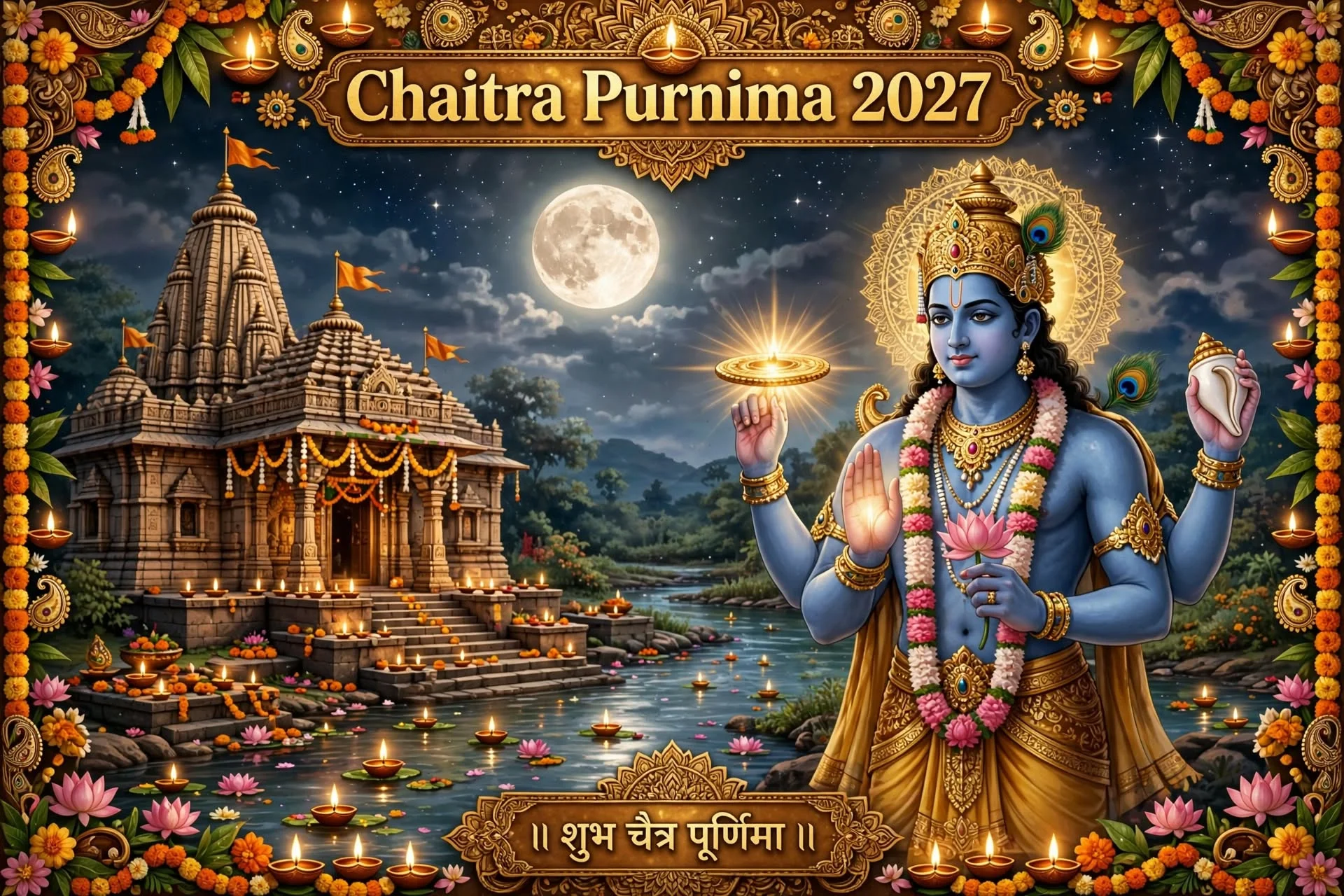
Chaitra Purnima, celebrated on the full moon day of the sacred month of Chaitra, holds an elevated position in the Hindu calendar as the inaugural full moon of the new lunar year. Characterized by the radiant illumination of the moon in the constellation of Chitra, this sacred tithi marks the arrival of the spring equinox's zenith and serves as a powerful spiritual vortex for holy river baths, Satyanarayana worship, ancestral prayers, and widespread charitable giving.
View Festival Guide
Tuesday, Apr 20, 2027
Hanuman Jayanti
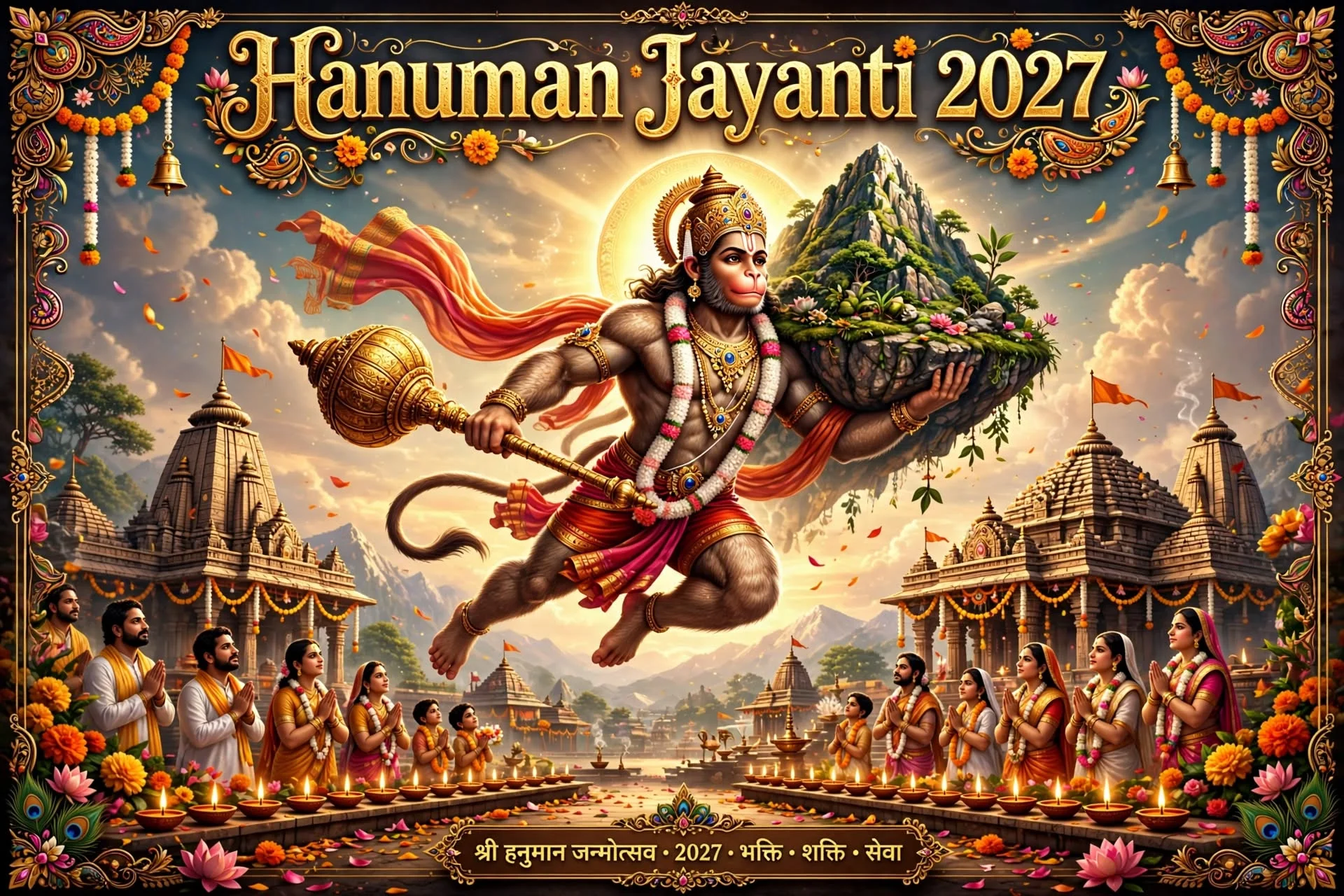
Hanuman Jayanti marks the glorious appearance anniversary of Sri Hanuman, the Rudra avatar of Lord Shiva, the foremost servant of Lord Sri Rama, and the eternal epitome of selfless devotion (Seva), valor, and spiritual strength. Celebrated on the full moon day (Purnima) of the sacred month of Chaitra, this auspicious festival commemorates the auspicious moment when Lord Hanuman manifested on earth to assist Lord Rama in vanquishing the forces of evil and establishing the eternal kingdom of righteousness (Dharma).
View Festival Guide

Wednesday, Apr 21, 2027
Ishti
Ishti is a foundational Vedic ritual observance appearing prominently in Hindu Panchangs on the Pratipada tithi (the first lunar day) following either Amavasya (new moon) or Purnima (full moon), marking the prescribed performance day for the fortnightly Vedic Darsha-Purnamasa sacrifices.
View Festival Guide
Saturday, Apr 24, 2027
Vikata Sankashti
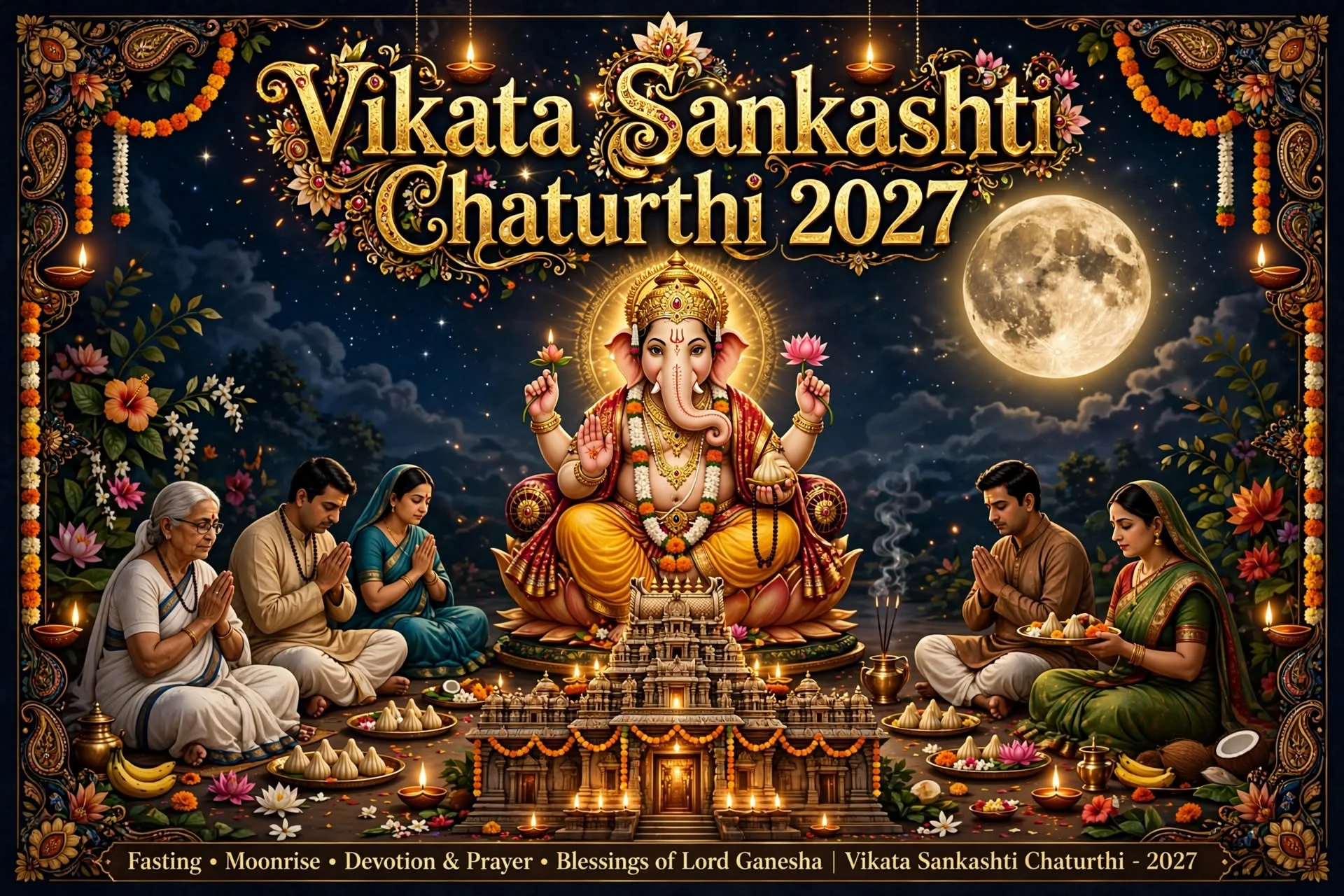
Vikata Sankashti Chaturthi is an auspicious fasting day dedicated to Lord Ganesha, celebrated on the fourth lunar day of the waning moon (Krishna Paksha Chaturthi) following Chaitra Purnima. In the traditional Purnimanta calendar, this tithi falls in the month of Vaishakha, while in the Amanta calendar followed in Maharashtra, Gujarat, and southern India, it falls in the month of Chaitra. Dedicated to 'Vikata Ganapati'—the fierce, formidable, and obstacle-crushing form of Lord Ganesha—this sacred fast possesses the divine power to demolish the most insurmountable hardships and emotional turmoil.
View Festival Guide
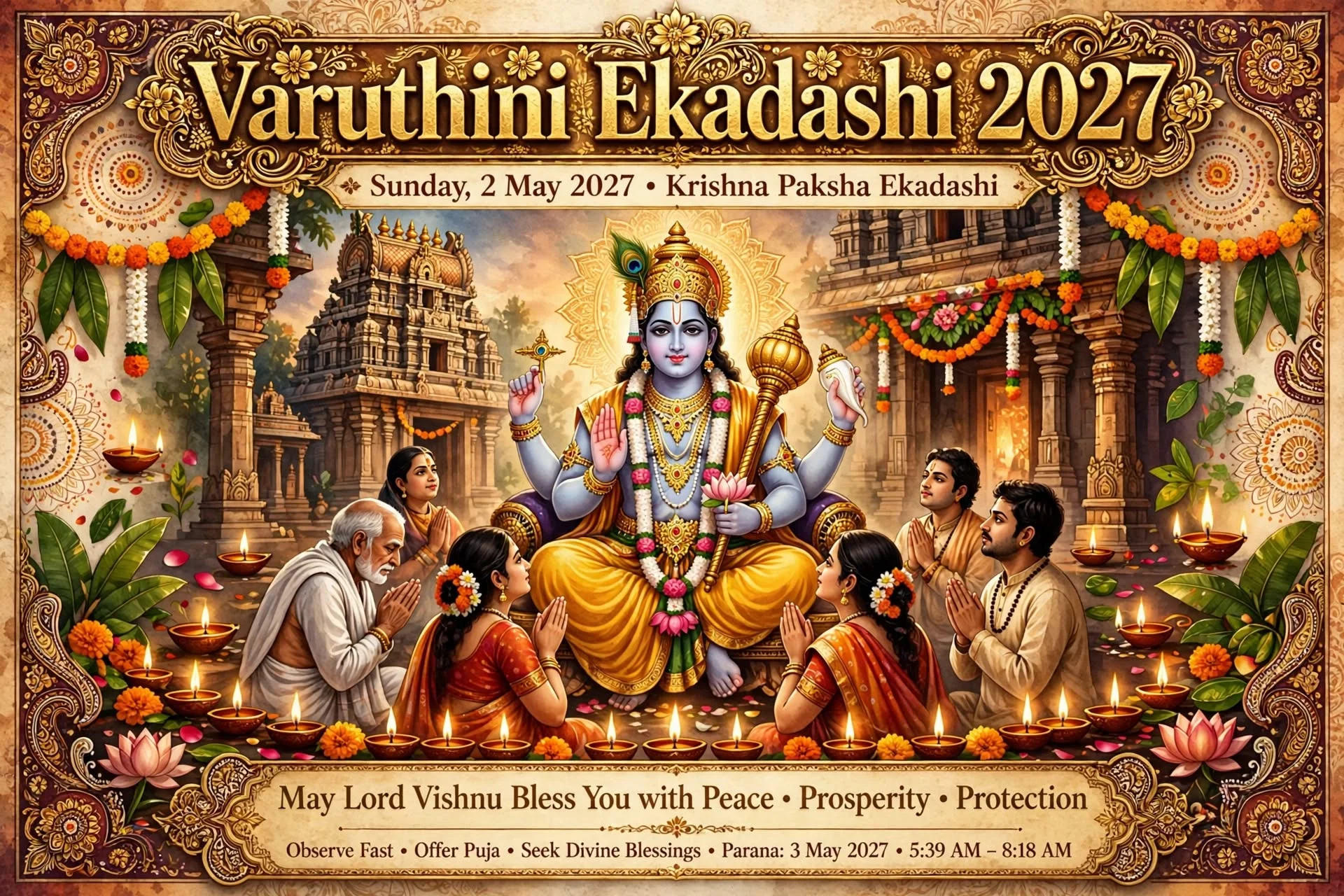
Sunday, May 2, 2027
Varuthini Ekadashi
Varuthini Ekadashi, also known as Baruthani Ekadashi or Varuthini Ekadashi Vrat, is an important Hindu fasting festival dedicated to Lord Vishnu. It is observed on the Krishna Paksha Ekadashi (eleventh lunar day of the waning moon) during the month of Vaishakha according to the North Indian Purnimanta calendar. In regions following the Amanta calendar, the same observance falls during Chaitra Krishna Paksha. The Sanskrit word Varuthini is associated with protection, armour, and divine safeguarding, symbolizing the protective grace of Lord Vishnu for devotees who observe this sacred vrata with faith and discipline.
View Festival Guide
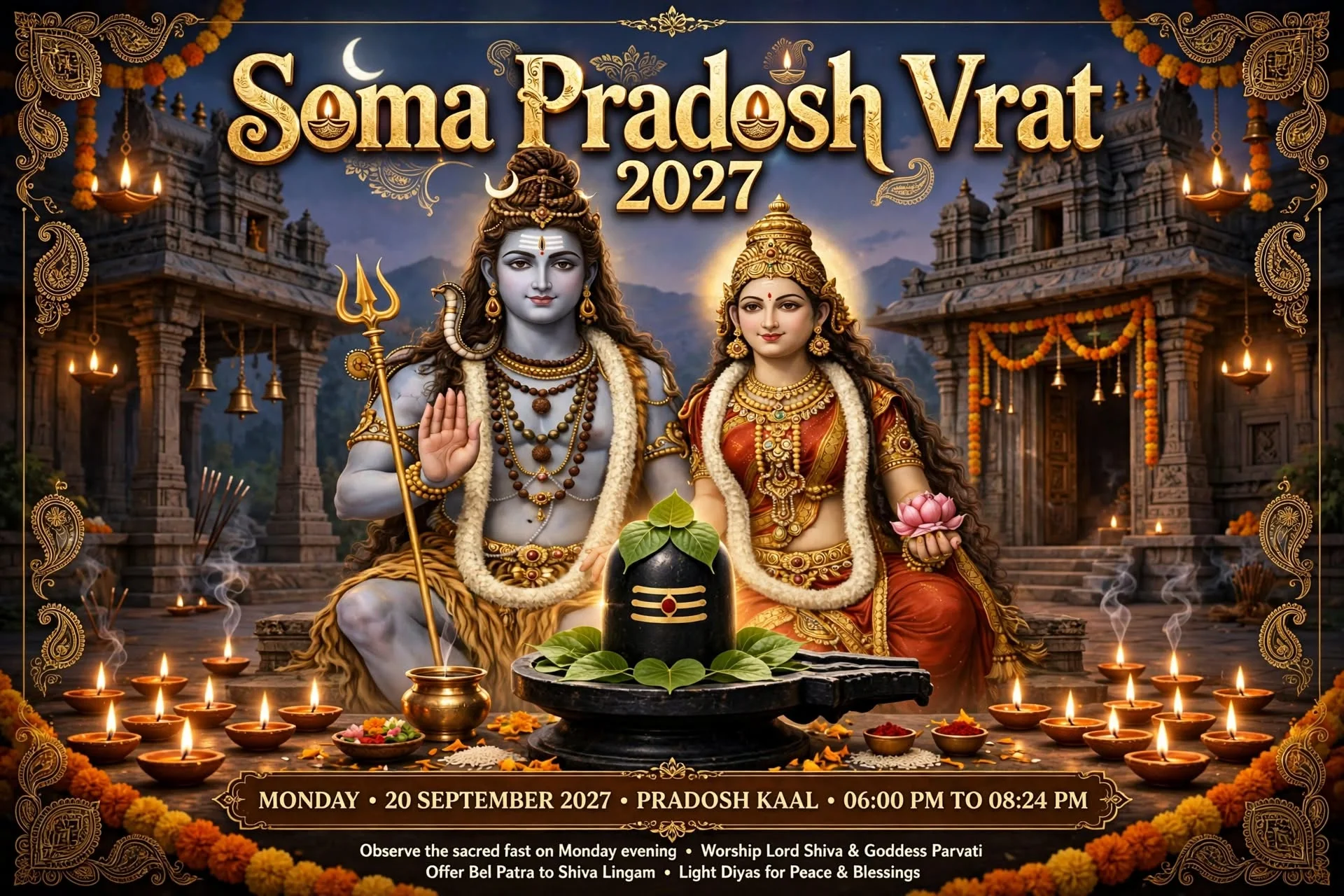
Monday, May 3, 2027
Soma Pradosh Vrat
Soma Pradosh Vrat, also known as Som Pradosh Vrat or Soma Trayodashi, is a Hindu fasting and worship observance dedicated primarily to Lord Shiva. It is observed when Trayodashi, the thirteenth lunar day of either Shukla Paksha or Krishna Paksha, coincides with Monday. Monday is traditionally associated with Lord Shiva, which gives this Pradosh observance its name.
View Festival Guide

Thursday, May 6, 2027
Darsha Amavasya
Darsha Amavasya is a significant new moon observance in the Hindu calendar designating the specific night when the Moon is completely invisible to the human eye, having fully merged into the conjunction of the Sun.
View Festival Guide