




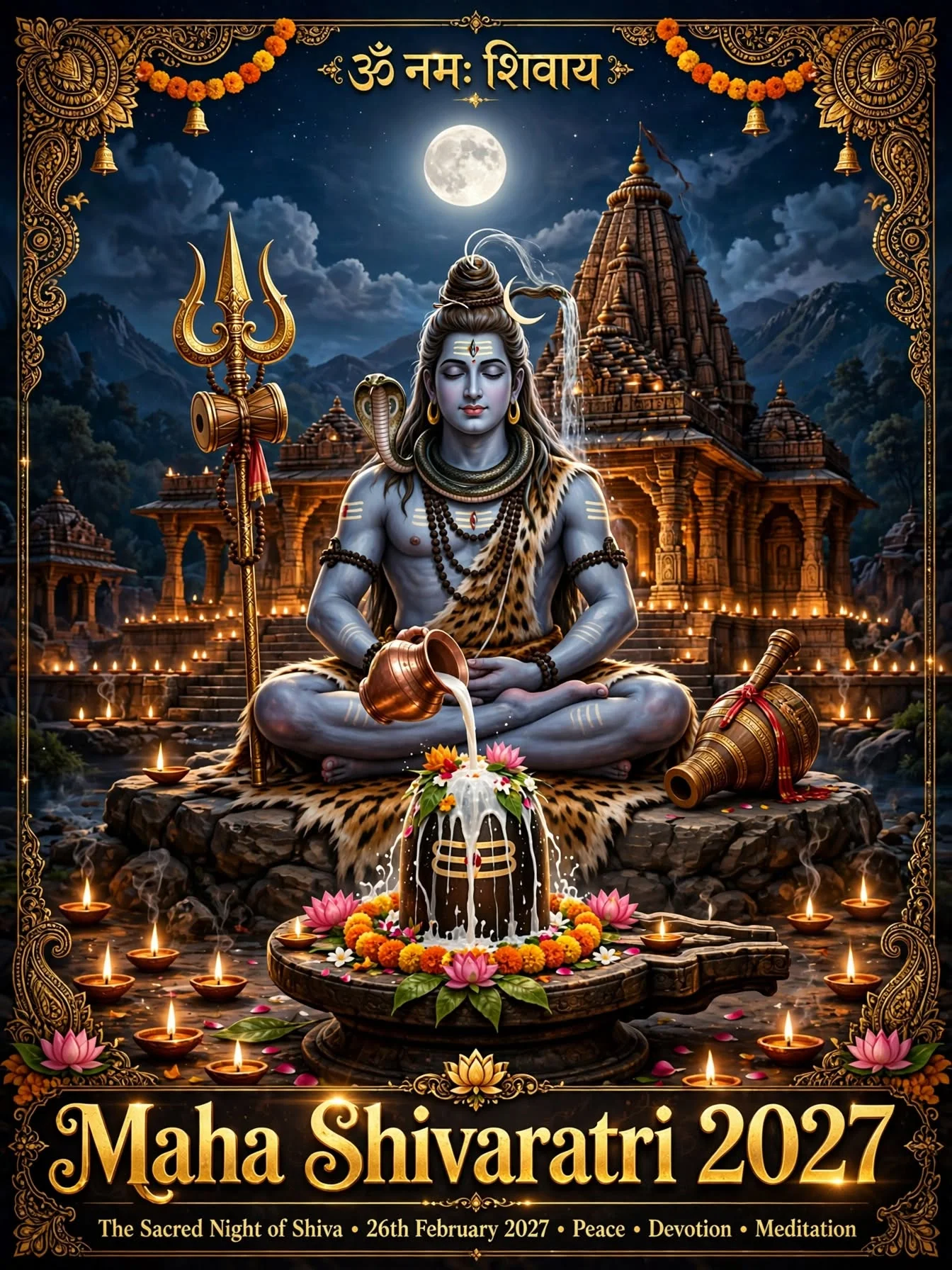
Maha Shivaratri, literally translated as 'The Great Night of Shiva', is the paramount and most spiritually profound festival dedicated to Lord Shiva in Sanatana Dharma. Celebrated on the fourteenth day (Chaturdashi tithi) of the Krishna Paksha (waning moon fortnight) during the lunar month of Phalguna according to the North Indian Purnimanta calendar (corresponding to Magha Krishna Chaturdashi in the South Indian and Western Indian Amanta calendar), this sacred night represents the pinnacle of Shaivite spiritual devotion, cosmic alignment, and yogic transformation.
Maha Shivaratri 2027: Date, Puja Timings, Rituals & Stories
Maha Shivaratri Timings & Panchang
Important festival dates and auspicious timings
Usha Arghya (Sunrise)
06:42 am
Sandhya Arghya (Sunset)
06:24 pm
Start Date
Saturday, 6 Mar 2027
Puja Muhurat
09:54 am – 12:03 pm
Maha Shivaratri
Unlike most Hindu festivals characterized by external jubilant feasts and colorful revelry, Maha Shivaratri is predominantly an inward, contemplative festival of rigorous penance, solemn fasting (Upavasa), profound meditation (Dhyana), and all-night devotional wakefulness (Ratri Jagaran). On this consecrated night, the planetary positions and cosmological energies in the Northern Hemisphere align in a manner that creates a natural, powerful surge of upward spiritual energy (Kundalini Urdhvaretas) in the human body, enabling seekers to overcome physical limitations and experience heightened states of consciousness.
The antiquity and transcendental significance of Maha Shivaratri are extolled in the Shiva Purana (Vidyeshvara Samhita and Rudra Samhita), the Linga Purana, and the Skanda Purana. The scriptures commemorate this night as the timeless moment when Lord Shiva manifested as the infinite, beginningless, and endless cosmic pillar of radiant light (Jyotirlinga or Lingodbhava) to dissolve the egos of Lord Brahma and Lord Vishnu. It is also celebrated with boundless reverence as the auspicious night of the divine celestial wedding of Lord Shiva and Goddess Parvati, symbolizing the eternal communion of the Supreme Consciousness (Purusha) and Dynamic Creative Energy (Prakriti).
Devotees observe Maha Shivaratri by taking early morning purificatory baths in sacred rivers or holy Gangajal, maintaining an unbroken twenty-four-hour fast, and performing continuous four-prahara worship of the Shiva Linga throughout the night. Each prahara (three-hour segment) features specific sacred Abhishekam using cow milk, curd, ghee, honey, sugarcane juice, and holy water, accompanied by the offering of sacred Bilva leaves (Belpatra), Dhatura, and holy ash (Bhasma). The supreme hour of the night is the Nishita Kaal (midnight midnight window), where the chant of the Rudram, Chamakam, and Mahamrityunjaya Mantra awakens supreme liberation (Moksha) and inner peace.
Why is Maha Shivaratri Celebrated?
Maha Shivaratri is celebrated to honor the manifestation of Lord Shiva as the formless, infinite pillar of cosmic light (Jyotirlinga / Lingodbhava), establishing the supremacy of transcendent divine reality over all created forms.
The festival commemorates the celestial marriage of Lord Shiva and Goddess Parvati, celebrating the sacred cosmic union of consciousness (Purusha) and divine cosmic energy (Prakriti) that sustains and regenerates the universe.
It marks the night when Lord Shiva drank the lethal Halahala venom during the Samudra Manthan to protect creation, keeping it held in His throat and being worshiped by the Devas with all-night vigils and continuous cooling water offerings.
Devotees observe this sacred night to transcend the cyclical bondages of karma, control the wandering sensory mind, awaken spiritual vitality, and attain the supreme grace of Lord Mahadeva, leading to liberation (Moksha).
Scriptural Chronicles and Sacred Lore of Maha Shivaratri
The Appearance of the Infinite Jyotirlinga (Lingodbhava)
The foundational theological chronicle of Maha Shivaratri is expounded in the Shiva Purana (Vidyeshvara Samhita, Chapters 9-11) and the Linga Purana. At the dawn of creation, an intense theological dispute arose between Lord Brahma (the creator) and Lord Vishnu (the preserver) regarding who was the supreme sovereign of the universe.
As their argument intensified into a cosmic conflict, a colossal, dazzling column of fire and light (Jyotirlinga) without beginning, middle, or end suddenly erupted between them, dimming their celestial weapons. Awed and humbled by this incomprehensible phenomenon, Brahma assumed the form of a white swan (Hamsa) and flew upward into the infinite skies to find the summit of the column, while Vishnu assumed the form of a colossal boar (Varaha) and burrowed down through the subterranean realms to locate its subterranean base.
After thousands of years of exploration, Lord Vishnu could not discover the foundation and returned with humility, acknowledging the infinite majesty of the pillar. Lord Brahma, failing to find the peak, conspired with the Ketaki flower that had fallen from the heavens to falsely testify that Brahma had seen the crest. At that instant on Phalguna Krishna Chaturdashi midnight, the fiery pillar cracked open, and Lord Shiva manifested in His radiant, five-faced, ten-armed form (Sadashiva).
Lord Shiva praised Lord Vishnu for his truthfulness and granted him equal worship, but reprimanded Brahma for his falsehood, decreeing that Brahma would not have public temples on earth, and barred the deceitful Ketaki flower from being offered in Shiva worship. Because Lord Shiva manifested His Linga form on this midnight, it is eternally celebrated as the sacred hour of Lingodbhava.
The Divine Marriage of Shiva and Parvati (Kalyana Sundara)
In the Shiva Purana (Rudra Samhita, Parvati Khanda), Maha Shivaratri marks the celestial marriage of Lord Shiva and Goddess Parvati, the daughter of the Mountain King Himavan. Following the tragic immolation of Sati at Daksha's sacrifice, Lord Shiva had retreated into deep samadhi, detached from creation.
Cosmic, Yogic, and Esoteric Dimensions of Maha Shivaratri
Upward Surge of Pranic Energy (Kundalini Urdhvaretas)
In yogic science, Maha Shivaratri coincides with a distinct astronomical and geomagnetic configuration in the Northern Hemisphere that triggers a natural, powerful upward movement of spiritual energy within the human spine (Merudanda).
Staying upright with a straight spine throughout the night vigil allows practitioners to naturally channel dormant Kundalini energy from the Muladhara base chakra upward toward the crown Sahasrara chakra, dissolving psychological conditioning and awakening spiritual enlightenment.
Transcendence of the Sensory Mind (Manas Nasha)
The Moon is the presiding deity of the human mind (Manas). On Krishna Chaturdashi, the lunar crescent is nearly invisible, possessing only one-sixteenth of its light, representing a mind that is naturally quieted, subdued, and ripe for spiritual conquest.
By fasting and meditating on this fourteenth night, the individual ego (Ahamkara) dissolves into universal consciousness (Shivatva), achieving true mastery over the senses and liberation from mental afflictions.
Four-Prahara Worship and the Four Purusharthas
The night of Maha Shivaratri is divided into four distinct praharas (three-hour quarters from sunset to sunrise). Worship conducted across these four praharas corresponds to the fulfillment and transcendence of the four legitimate human aims: Dharma (righteousness), Artha (material prosperity), Kama (fulfillment of noble desires), and Moksha (spiritual liberation).
Each prahara employs specific abhisheka substances (milk, curd, ghee, honey) to purify the physical, energetic, mental, and causal bodies of the seeker.
The Supreme Potency of Nishita Kaal
The most auspicious and metaphysically charged period of Maha Shivaratri is the Nishita Kaal—the precise astronomical midnight window lasting approximately 48 minutes (two ghatikas) centered around true midnight.
Comprehensive Ritual Observance and Guide for Maha Shivaratri
Dawn Purificatory Bath and Solemn Maha Sankalpa
Devotees rise before dawn during Brahma Muhurta, take a holy bath in a sacred river or in clean water infused with holy Gangajal, sesame seeds, and Tulsi. Wear clean, unstitched traditional attire (preferably white or pale yellow).
Sit facing East or North before the Shiva altar and take the solemn Maha Shivaratri Vrat Sankalpa holding water, akshata, Bilva leaves, and a coin, pledging unbroken fast and all-night vigil for the grace of Lord Shiva.
Daytime Temple Darshan and Continuous Japa
Visit a neighborhood Shiva temple or holy Jyotirlinga shrine to offer initial water, milk, and Bilva leaves. Maintain unbroken mental or vocal repetition of the Shiva Panchakshari Mantra ('Om Namah Shivaya') or the Mahamrityunjaya Mantra throughout the day.
Strict practitioners observe Nirjala Upavasa (complete waterless fast). Those with health requirements may consume fruits, milk, water, and phalahari items without grains or salt.
Four-Prahara Night Long Abhisheka (Chaar Pahar Puja)
The night is divided into four worship segments: First Prahara (6:00 PM to 9:00 PM) features pure cow milk abhisheka; Second Prahara (9:00 PM to 12:00 AM) features cow curd abhisheka; Third Prahara / Nishita Kaal (12:00 AM to 3:00 AM) features pure desi cow ghee and honey abhisheka with grand Rudrabhishekam; Fourth Prahara (3:00 AM to 6:00 AM) features sugarcane juice and holy Gangajal abhisheka.
During each prahara, offer fresh three-leaflet Bilva leaves, Dhatura, Bhasma, and fragrant sandalwood, accompanied by Vedic recitations.
Dawn Maha Aarti, Surya Namaskar, and Parana
At the break of dawn (Amavasya morning), conclude the all-night vigil with the grand Karpura Maha Aarti while chanting the Shiva Tandava Stotra. Perform Surya Namaskar and offer Arghya to the Sun.
Maha Shivaratri Puja Vidhi (Step by Step)
- 1
Brahma Muhurta Snana and Pratah Sankalpa
Wake before dawn during Brahma Muhurta. Recite morning Shiva shlokas and take a purificatory bath with clean water mixed with holy Gangajal and black sesame seeds. Make a solemn Sankalpa vow to observe complete fasting and all-night vigil (Jagaran) for the love and grace of Lord Shiva.
- 2
Altar Sanctification and Linga Sthapana
Clean the puja altar thoroughly. Cover a wooden chowki with clean white or red silk cloth. Place a consecrated brass, copper, stone, or Parad (mercury) Shiva Linga inside a clean Abhisheka Patra (shallow tray) with the drainage spout facing North.
- 3
Deepa Prajvalan and Achamana
Light an oil or pure cow-ghee lamp on the right side of the altar and aromatic dhoop on the left. Perform Achamana by ceremonially sipping consecrated water thrice with the holy names of God and purify your hands.
- 4
First Prahara Puja: Cow Milk Abhisheka (Evening)
During the first quarter of the night (approx. 6:00 PM to 9:00 PM), bathe the Shiva Linga with fresh, unboiled pure cow milk followed by holy Gangajal, chanting 'Om Namah Shivaya'. Offer raw sugar, white sandalwood paste, and fresh three-leaf Bilva patra.
Maha Shivaratri Puja Samagri List
Four-Prahara Abhisheka Liquids
Sacred liquids and holy waters required for continuous all-night Maha Shivaratri abhishekam.
- Pure unboiled cow milk (1 liter) for First Prahara
- Fresh homemade cow-milk curd (500 ml) for Second Prahara
- Pure desi cow ghee (250 grams) and raw organic honey (200 grams) for Third Prahara
- Fresh sugarcane juice (500 ml) and pure holy Gangajal (1 bottle) for Fourth Prahara
- Rose water and clean filtered water in a large copper vessel
Sacred Leaves, Flora, and Aromatics
Botanical elements and cooling fragrances cherished by Lord Shiva.
- Fresh three-leaflet Bilva leaves (Belpatra) - at least 108 unblemished leaves
- Dhatura fruits and Dhatura flowers - 5 pieces each
- Tender green Bhaang leaves - 1 bunch
- Pure sacred Vibhuti (Bhasma) - 1 packet
- White and yellow sandalwood paste (Shweta & Ashtagandha Chandan)
- White flowers (Kaner, Jasmine, Aparajita) and fresh flower garlands
- Bhimseni camphor for aarti and sandalwood incense sticks (Dhoop)
Naivedya, Fruits, and Altar Items
Mantras and Prayers for Maha Shivaratri
Maha Shivaratri Vrat Rules and Fasting Guidelines
Strict Fasting Injunctions
Rules governing the 24-hour Maha Shivaratri fast:
- The fast begins at dawn on Chaturdashi and continues unbroken until sunrise of the next day (Amavasya).
- Devotees observe either complete waterless fasting (Nirjala) or take water, milk, and fresh fruits (Phalahari).
- All grains, cereals, rice, wheat, pulses, beans, garlic, onions, and non-vegetarian food are completely forbidden.
- Do not consume common sea salt; rock salt (Sendha Namak) may be taken sparingly in phalahari food if required.
All-Night Vigil (Ratri Jagaran)
Mandatory conduct during the night vigil:
- Devotees must stay awake throughout the night, sitting upright with a straight spine during meditation.
- Do not sleep during the day on Chaturdashi or during the night hours, as sleeping dissipates accumulated spiritual merit.
- Engage in continuous recitation of Sri Rudram, Shiva Chalisa, Shiva Sahasranama, or the Mahamrityunjaya Mantra.
- Maintain complete celibacy (Brahmacharya) and shun anger, falsehood, and worldly gossip.
Parana Regulations (Breaking the Fast)
Guidelines for properly concluding the fast on the following morning:
- Parana must be done after sunrise on the following morning, within the prescribed Chaturdashi/Amavasya Parana window.
Dos and Don'ts of Maha Shivaratri
Good Practices (Do's)
- Wake early during Brahma Muhurta, take a purificatory bath with holy Gangajal, and make a sincere Sankalpa.
- Observe a strict 24-hour fast and maintain continuous all-night vigil (Ratri Jagaran).
- Perform or participate in the four-prahara abhishekam of the Shiva Linga throughout the night.
- Offer fresh three-leaflet Bilva leaves (Belpatra), Dhatura, Bhasma, and seasonal fruits to Lord Shiva.
- Chant the Mahamrityunjaya Mantra and Shiva Panchakshari Mantra ('Om Namah Shivaya') continuously.
Maha Shivaratri Across Regions
| Region | Local Name |
|---|---|
| Varanasi and Kashi (Uttar Pradesh) | Kashi Vishwanath Maha Shringar & Barat |
| Ujjain (Madhya Pradesh) | Mahakaleshwar Shiv Navratri & Bhasma Aarti |
| Kashmir (North India) | Herath & Vatuk Puja |
| Tamil Nadu and Andhra Pradesh (South India) | Arunachala Girivalam & Srisailam Brahmotsavam |
Maha Shivaratri FAQs
What is Maha Shivaratri?
Maha Shivaratri is the premier Hindu festival dedicated to Lord Shiva, celebrated on the Krishna Chaturdashi of Phalguna (Purnimanta) or Magha (Amanta) month, honoring the manifestation of the cosmic Jyotirlinga and the divine marriage of Shiva and Parvati.
How is Maha Shivaratri different from the monthly Shivaratri (Masa Shivaratri)?
While Masa Shivaratri occurs every month on the Krishna Chaturdashi, Maha Shivaratri in Phalguna/Magha is the supreme annual night of cosmic alignment, carrying the highest spiritual potency, where virtues of all monthly fasts are combined.
What is the importance of staying awake all night (Jagaran)?
On Maha Shivaratri, natural planetary forces cause an upward surge of spiritual energy in the human spine. Remaining awake with a straight spine allows practitioners to channel this energy toward spiritual awakening and self-realization.
Upcoming Festivals
View All
Sunday, Mar 7, 2027
Darsha Amavasya
Darsha Amavasya is a significant new moon observance in the Hindu calendar designating the specific night when the Moon is completely invisible to the human eye, having fully merged into the conjunction of the Sun.
View Festival Guide
Monday, Mar 8, 2027
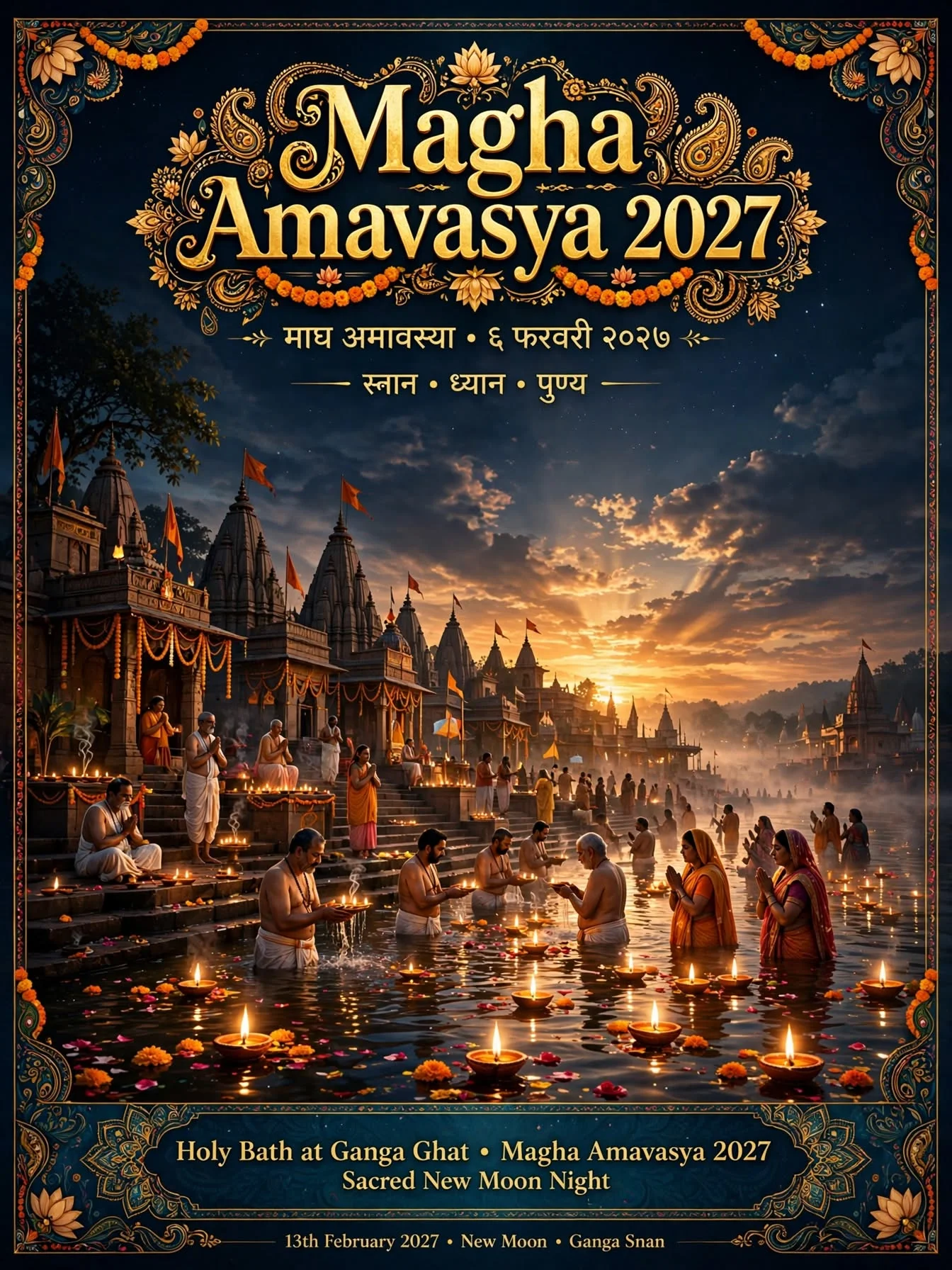
Magha Amavasya
Magha Amavasya, celebrated with supreme spiritual reverence throughout India, is the sacred New Moon day (Amavasya tithi) occurring during the holy lunar month of Magha according to the Hindu calendar (specifically marking the culmination of Magha in the Amanta calendar followed in Maharashtra, Gujarat, Karnataka, Andhra Pradesh, and Tamil Nadu, corresponding to the new moon preceding Phalguna). Revered as one of the most spiritually charged junctures in Sanatana Dharma, this sacred day is widely observed as 'Mauni Amavasya'—the holy day of complete ascetic silence (Mauna Vrata), deep contemplation, ancestral redemption, and sacred holy bathing.
View Festival Guide
Monday, Mar 8, 2027
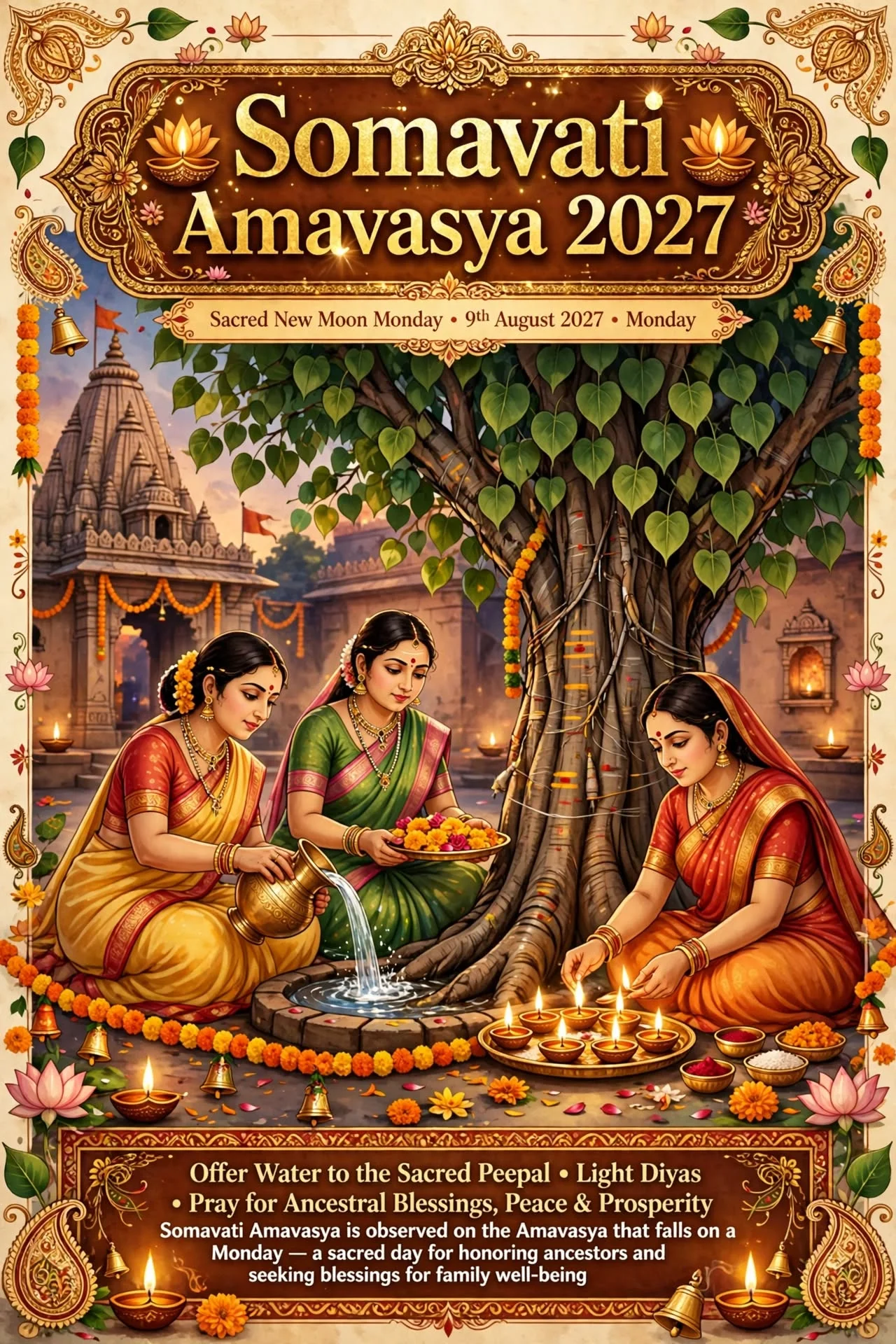
Somavati Amavasya
Somavati Amavasya is an exceedingly rare, sacred, and astrologically exalted Hindu fasting and pilgrimage observance that occurs when the New Moon day (Amavasya tithi) coincides with a Monday (Somavara). In Vedic tradition, Monday is governed by Soma (the Moon God / Chandra Deva) and is supremely sacred to Lord Shiva, who adorns the crescent moon upon His crown as Chandrashekhara. When the quiet, contemplative energy of Amavasya merges with the gentle, nectarine cooling rays of Monday, it creates an extraordinary cosmic alignment that is lauded across Sanatana Dharma as the 'King of all Amavasyas'.
View Festival Guide

Tuesday, Mar 9, 2027
Ishti
Ishti is a foundational Vedic ritual observance appearing prominently in Hindu Panchangs on the Pratipada tithi (the first lunar day) following either Amavasya (new moon) or Purnima (full moon), marking the prescribed performance day for the fortnightly Vedic Darsha-Purnamasa sacrifices.
View Festival Guide
Tuesday, Mar 9, 2027
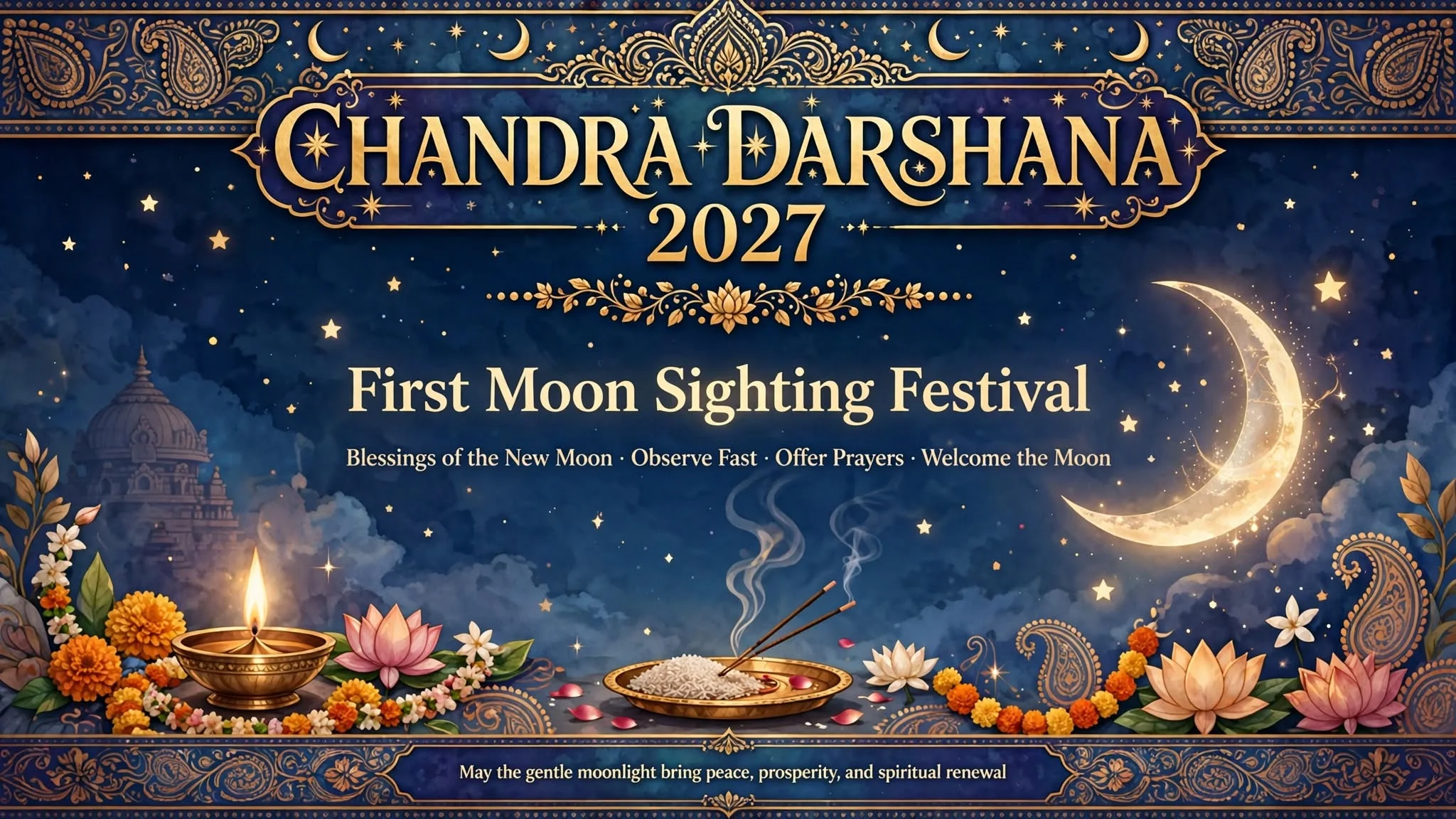
Chandra Darshana
Chandra Darshana is a revered monthly Hindu observance dedicated to sighting, venerating, and offering oblation to the delicate waxing crescent Moon immediately following the new moon (Amavasya), typically occurring during the twilight of Shukla Paksha Pratipada or Dwitiya.
View Festival Guide
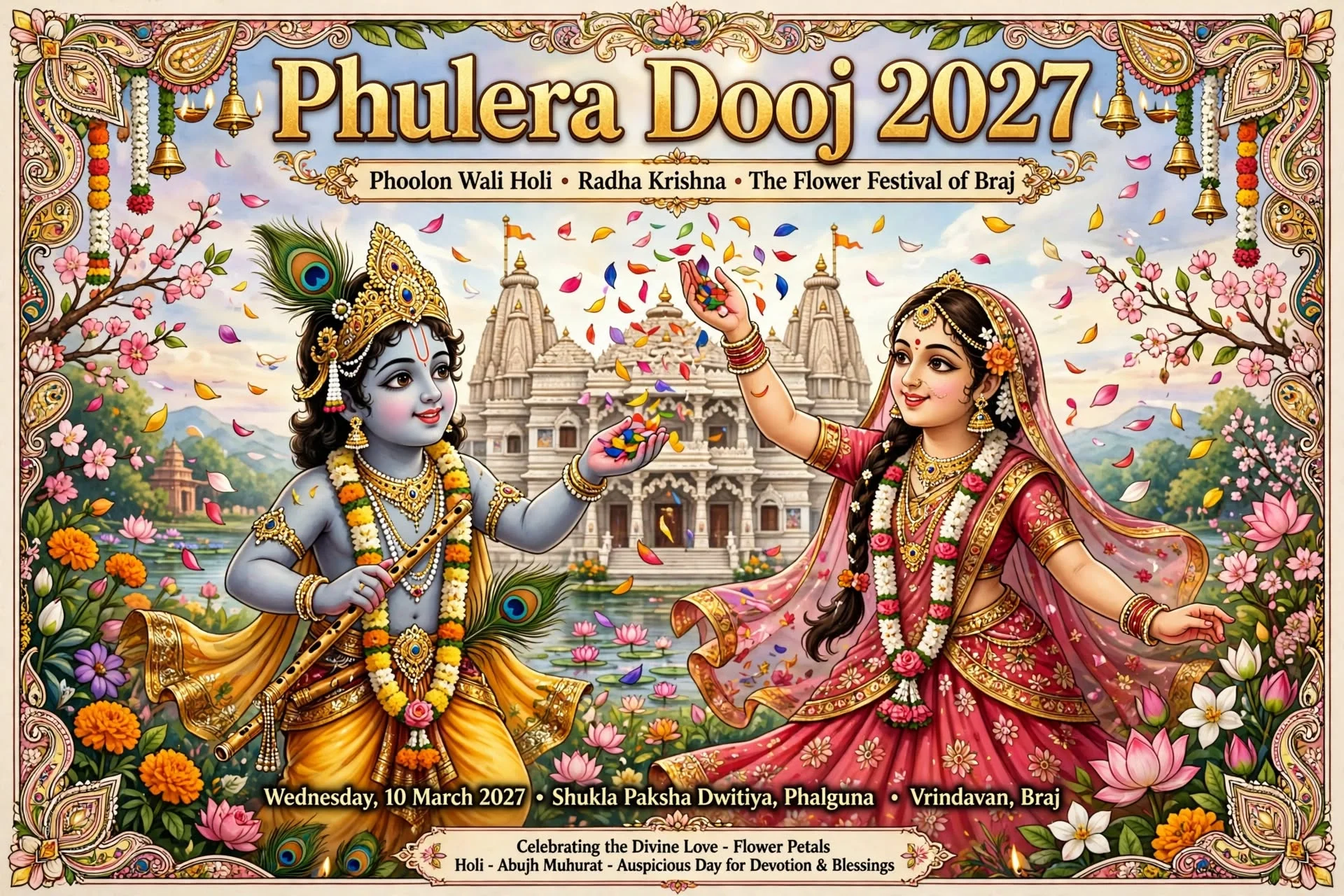
Wednesday, Mar 10, 2027
Phulera Dooj
Phulera Dooj (फुलेरा दूज) is a wonderfully joyous, vibrant, and spiritually sweet Hindu festival celebrated on the second day (Dwitiya tithi) of the Shukla Paksha (waxing moon fortnight) in the holy month of Phalguna according to the traditional Hindu calendar. Dedicated to the supreme divine couple, Bhagavan Sri Krishna and Sri Radha Rani, this radiant festival heralds the arrival of the spring festival of colors (Holi) across the sacred land of Braj (Vrindavan, Mathura, Barsana, Nandgaon, and Govardhan). The word 'Phulera' is derived from 'Phool' (blossoming flowers), and on this day, the divine realm of Braj is enveloped in an enchanting floral ecstasy.
View Festival Guide
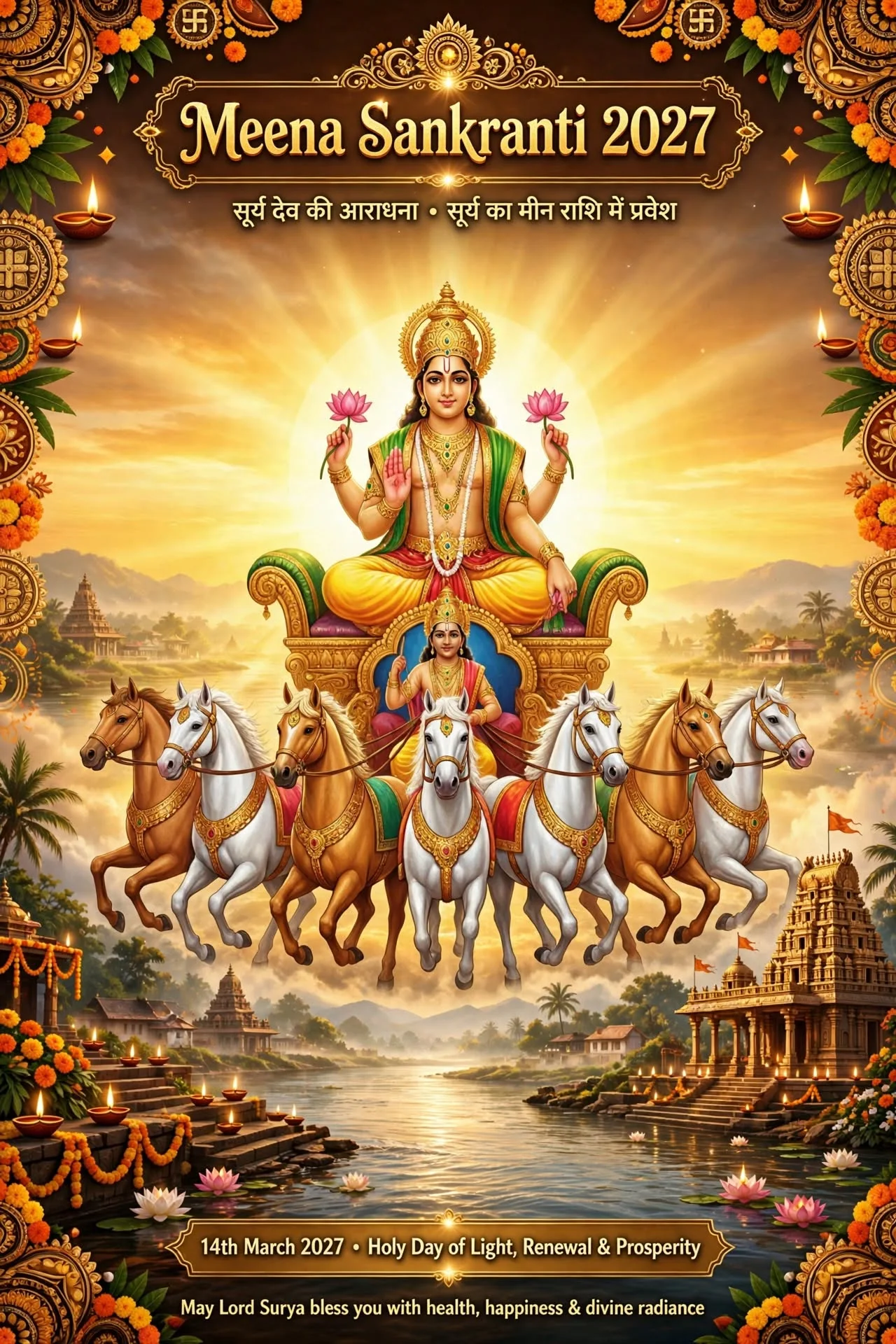
Monday, Mar 15, 2027
Meena Sankranti
Meena Sankranti is a paramount astronomical transit and holy festival in the Hindu solar calendar, marking the entry of the Sun God (Surya Deva) from Kumbha Rashi (Aquarius) into Meena Rashi (Pisces). In Vedic astronomy and Jyotisha, this celestial ingression signifies the commencement of the twelfth and final solar month (Meena Masa) of the sidereal solar year. Occurring in mid-March, Meena Sankranti holds extraordinary significance across Sanatana Dharma as an auspicious juncture of profound spiritual purification, solar adoration, and charitable oblations.
View Festival Guide
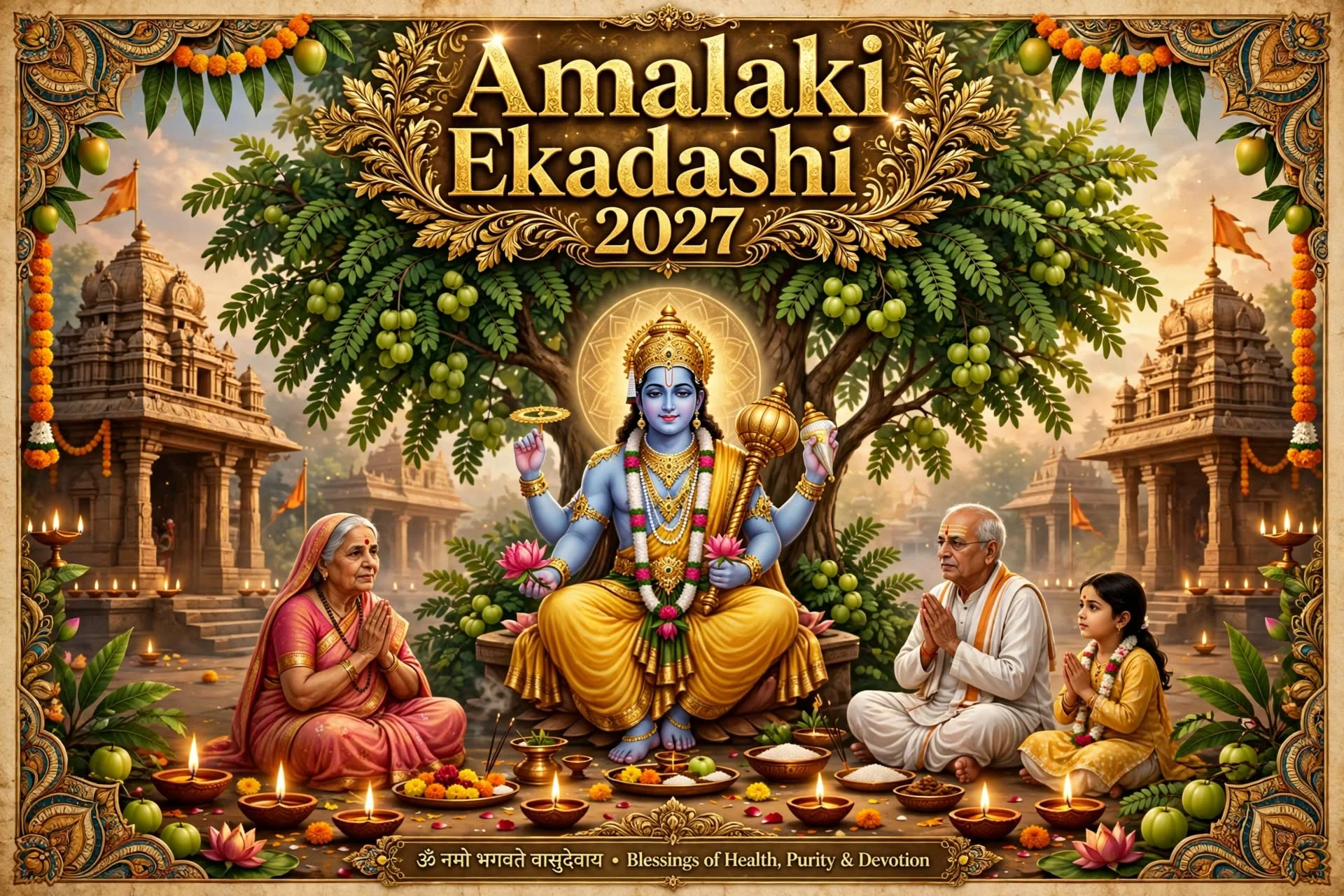
Thursday, Mar 18, 2027
Amalaki Ekadashi
Amalaki Ekadashi, also known as Amla Ekadashi, is a celebrated and spiritually illuminating Hindu fasting observance observed on the eleventh day (Ekadashi tithi) of the Shukla Paksha (waxing moon fortnight) in the auspicious month of Phalguna according to the traditional Hindu calendar. Occurring majestically between the great festivals of Maha Shivaratri and Holi, this sacred Ekadashi is uniquely consecrated to the veneration of the holy Amalaki tree (Indian Gooseberry - Phyllanthus emblica) and Lord Sri Hari Vishnu. In Vedic metaphysics and Ayurveda, the Amalaki tree is revered as the first botanical tree to manifest in the cosmos, imbued with the living divine presence of Lord Vishnu, Goddess Lakshmi, and the entire celestial pantheon.
View Festival Guide