




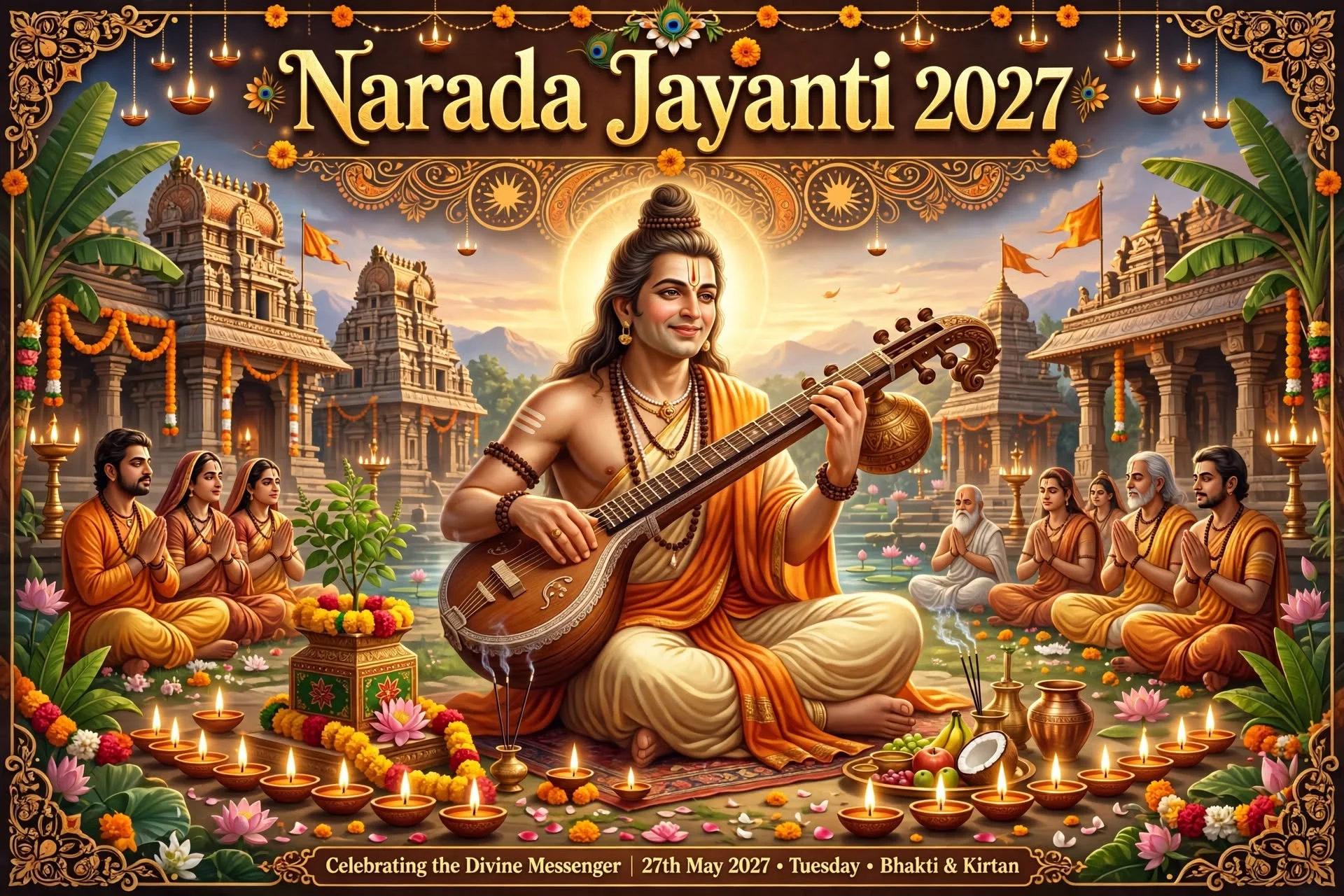
Narada Jayanti marks the appearance anniversary of Devarshi Narada, the supreme celestial sage, divine messenger of the cosmos, master of the Veena, and eternal pioneer of Harinama Sankirtana. Celebrated on the Pratipada tithi (first lunar day) of the Krishna Paksha directly following Vaishakha Purnima (in the month of Jyeshtha in the Purnimanta system, or Vaishakha Krishna Pratipada), this festival commemorates the appearance of the great Manasaputra (mind-born son) of Lord Brahma who traverses the three cosmic worlds unobstructed, singing the praises of Lord Narayana upon his celestial lute, the Mahati Veena.
Narada Jayanti 2027: Date, Puja Timings, Rituals & Stories
Narada Jayanti Timings & Panchang
Important festival dates and auspicious timings
Usha Arghya (Sunrise)
05:28 am
Sandhya Arghya (Sunset)
07:08 pm
Start Date
Friday, 21 May 2027
Puja Muhurat
04:28 pm – 05:23 pm
Narada Jayanti
In Vedic and Pauranic traditions, Devarshi Narada is revered as the world's primordial communicator and the divine cosmic reporter ("Prathama Patrakara"). Unlike common dramatic caricatures that depict him merely as a stirrer of discord, authentic scriptures reveal that every conflict engineered by Narada was an intentional, divinely calculated catalyst that brought about the destruction of tyrannical demons (such as Kamsa, Ravana, and Hiranyakashipu) and accelerated cosmic justice.
Devarshi Narada is the revered author of the Narada Bhakti Sutras and the Narada Purana, and the supreme spiritual preceptor who initiated Sage Valmiki into the Ramayana and inspired Maharshi Vedavyasa to compose the Srimad Bhagavatam. Devotees and journalists observe Narada Jayanti through recitations, musical tributes, seminars on ethical communication, and chanting the sacred name of Narayana.
Why is Narada Jayanti Celebrated?
Narada Jayanti is celebrated to honor the supreme ideal of unmotivated, ecstatic devotion (Ahetuki Bhakti) and ethical communication dedicated entirely to the welfare of the universe (Lokahita). Devarshi Narada demonstrated that music, speech, and communication reach their highest perfection when utilized to elevate human consciousness and promote truth.
It is also celebrated to venerate the master guru who transformed a highway robber (Ratnakara) into Sage Valmiki, guided a five-year-old child (Dhruva) to achieve cosmic elevation, instructed Prahlada in his mother's womb, and inspired Vyasa to author the Bhagavatam.
- Commemorates the appearance of Devarshi Narada, the divine cosmic sage and messenger.
- Celebrates the eternal glory of Harinama Sankirtana and the sacred power of devotional music.
- Honors the primordial pioneer of truthful, ethical, and fearless communication (Patrakarita).
- Inspires single-minded devotion (Bhakti), spiritual humility, and universal detachment.
The Descent of the Divine Bard and the Transformation of Vyasa
Past Life and the Boon of Eternal Transcendence
In the First Canto of the Srimad Bhagavatam, Devarshi Narada personally narrated his previous life to Sage Vyasa. He explained that in the prior Kalpa, he was born as the humble son of a maidservant serving self-realized sages (Bhakti-vedantas) during their four-month monsoon retreat (Chaturmasya). By eating the remnants of their sanctified food and listening to their discourses on Lord Krishna, his heart was completely cleansed of material attachments.
Following the demise of his mother, the young boy wandered into the forest, sat in deep meditation under a banyan tree, and had a momentary, breathtaking vision of Lord Vishnu within his heart. A divine voice proclaimed: "In this lifetime you shall see Me no more; but by your intense longing, you will take birth in the next Kalpa as My immortal companion." When Brahma began creation in the current Kalpa, Narada manifested as his mind-born son, gifted with the Mahati Veena and the boon of traveling anywhere across creation.
Directing Sage Vyasa to the Srimad Bhagavatam
Despite dividing the four Vedas, composing the 108 Upanishads, the Mahabharata, and the Brahma Sutras, Maharshi Vedavyasa felt profound dissatisfaction and despondency in his heart on the banks of the Saraswati River. Narada arrived at his hermitage and pointed out the reason: "O Vyasa, you have written exhaustively about dharma, artha, kama, and ritual duties, but you have not directly and gloriously described the unalloyed, transcendental pastimes of Lord Krishna."
Inspired by Narada's instructions, Sage Vyasa immersed himself in Samadhi and composed the twelve cantos of the immortal Srimad Bhagavata Purana, which became the supreme crest-jewel of Vedic literature.
Source: Srimad Bhagavata Purana, Skandha 1, Adhyayas 5-6 & Narada Purana
The Philosophy of Bhakti and Ethical Communication
The Teachings of the Narada Bhakti Sutras
In his immortal treatise, the Narada Bhakti Sutras, Devarshi Narada defines devotion as: "Sa tvasmin parama-prema-rupa"—it is of the nature of supreme, unconditional love for God. He explains that true devotion is completely devoid of selfish desire, immortal, and grants absolute fulfillment, rendering the human soul peaceful and universally benevolent.
Communication as a Sacred Cosmic Instrument
As the primordial communicator (Adya Patrakara), Narada never communicated for sensationalism, gossip, or personal profit. Every piece of news he carried between Swarga, Vaikuntha, Kailash, and Patala served a larger cosmic necessity: shattering the complacency of tyrants, awakening dormant virtues, and accelerating the manifestation of avatars. He exemplifies communication anchored in cosmic responsibility.
Observance Protocol, Musical Offerings, and Seminars
Dawn Worship and Veena / Music Archana
Devotees awaken early, bathe, and set up an altar with an image or idol of Devarshi Narada carrying his Veena, flanked by Lord Vishnu and Goddess Saraswati. Musicians, kirtankars, and vocalists gather to offer classical ragas, bhajans, and Harinama sankirtan in honor of the celestial bard.
Journalism and Media Observances (Patrakar Divas)
Across India, journalist associations and cultural academies celebrate Narada Jayanti as National Communication and Journalism Day. Symposia, discussions on ethical media reporting, and awards for fearless, truthful journalism in public interest are organized.
Narada Jayanti Puja Vidhi (Step by Step)
- 1
Pratah Snana
Take an early morning bath, wear clean traditional yellow or saffron clothing, and prepare the worship altar with Gangajal.
- 2
Sankalpa
Hold flowers, akshata, and pure water in hand, taking a vow to observe Narada Jayanti with truthful speech, music, and devotion.
- 3
Altar Preparation
Place an image of Devarshi Narada holding the Veena alongside Lord Narayana and Goddess Saraswati on a clean wooden seat.
- 4
Deepa Sthapana and Dhoop
Light a pure cow ghee lamp representing divine intellectual light and burn natural sandalwood incense.
- 5
Devarshi Narada Avahana
Invoke the presence of Devarshi Narada with folded hands, meditating upon his joyful, radiant form singing the praises of Hari.
- 6
Narada Jayanti Puja Samagri List
Deity Consecration and Altar Articles
Materials required for the ceremonial worship of Devarshi Narada.
- Idol or portrait of Devarshi Narada with Veena
- Portrait of Lord Narayana and Goddess Saraswati
- Yellow and saffron cloth for altar
- Pure sandalwood paste and kumkum
- Panchamrita ingredients and Gangajal
- Sacred thread (Janeu)
Musical and Aromatic Items
Substances and instruments celebrating devotional music.
- Musical instruments (Veena, Tanpura, Kartal, or Bell)
- Fresh yellow marigolds and white flowers
- Sacred Tulasi leaves and garlands
- Pure cow ghee lamp and wicks
- Bhimseni camphor for aarti
Naivedya and Food Offerings
Sattvic food offerings acceptable for Narada Jayanti.
- Yellow boondi laddus or besan laddus
- Fresh seasonal fruits (Mangoes, Bananas)
Mantras and Prayers for Narada Jayanti
Narada Jayanti Vrat Rules and Fasting Guidelines
Sattvic Conduct and Speech Purification
Observing Narada Jayanti requires practicing truthfulness and control of the voice.
- Observe strict truthfulness (Satya-Vrata) throughout the day
- Abstain from gossip, backbiting, rumors, and frivolous conversation
- Dedicate speech entirely to chanting holy names, studying scripture, or sharing uplifting wisdom
Dietary Protocol and Charity
Simple vegetarian diet and honoring communicators and teachers.
- Consume a light sattvic diet free from meat, alcohol, onions, and garlic
- Gift books, pens, musical instruments, or support to honest journalists, teachers, and writers
- Break any fast in the evening after singing Harinama kirtan and offering aarti
Dos and Don'ts of Narada Jayanti
Good Practices (Do's)
- Wake up early, bathe, and worship Devarshi Narada and Lord Narayana.
- Sing or listen to devotional bhajans, kirtans, or classical Veena music.
- Practice truthfulness, gentle speech, and mindfulness in communication.
- Support and encourage honest, courageous journalists, teachers, and musicians.
- Study the Narada Bhakti Sutras or the First Canto of the Srimad Bhagavatam.
Narada Jayanti Across Regions
| Region | Local Name |
|---|---|
| Pan-India (Cultural & Media Academies) | Narada Jayanti / Vishwa Samvad Diwas |
| Karnataka & Maharashtra (Narada Temple, Korva, Raichur) | Devarshi Narada Jayanthi Utsava |
| Northern India (Vrindavan, Mathura, Naimisharanya) | Devarshi Narada Prakatotsav |
Narada Jayanti FAQs
Why is Devarshi Narada considered the primordial journalist (Adya Patrakara)?
Narada traversed the three worlds carrying crucial information between gods, demons, and mortals. His reporting was fearless, accurate, and always dedicated to the larger purpose of cosmic welfare (Lokahita).
What is the name of Devarshi Narada's musical lute (Veena)?
His divine lute is named the Mahati Veena, gifted to him by Lord Brahma, upon which he continuously plays transcendental melodies glorifying Lord Narayana.
Which monumental scriptures did Narada directly inspire?
Devarshi Narada inspired Sage Valmiki to write the epic Ramayana and guided Maharshi Vedavyasa to compose the Srimad Bhagavata Purana.
Upcoming Festivals
View All
Friday, May 21, 2027
Ishti
Ishti is a foundational Vedic ritual observance appearing prominently in Hindu Panchangs on the Pratipada tithi (the first lunar day) following either Amavasya (new moon) or Purnima (full moon), marking the prescribed performance day for the fortnightly Vedic Darsha-Purnamasa sacrifices.
View Festival Guide
Sunday, May 23, 2027
Ekadanta Sankashti
Ekadanta Sankashti Chaturthi, also celebrated as Ekadanta Sankashti Vrat, is a powerful monthly observance dedicated to Lord Ganesha, occurring during the Krishna Paksha (waning fortnight) on the fourth lunar day (Chaturthi tithi) of the Hindu lunar month of Vaishakha (or Jyeshtha in the Purnimanta system). The term "Sankashti" translates to "deliverance from distress or crisis" (Sankat-Nivaran), signifying that this sacred vrata removes formidable obstacles, clears karmic debts, and brings peace and success to the devotee's life.
View Festival Guide
Tuesday, Jun 1, 2027
Apara Ekadashi
Apara Ekadashi, also known as Achala Ekadashi, is a sacred Hindu fasting observance dedicated to Lord Vishnu. It falls on the Ekadashi Tithi, the eleventh lunar day of Krishna Paksha in the month of Jyeshtha according to the Purnimanta calendar. In the Amanta calendar followed in several western and southern Indian regions, the same observance is associated with Vaishakha Krishna Paksha.
View Festival Guide
Wednesday, Jun 2, 2027
Budha Pradosh Vrat
Budha Pradosh Vrat, also known as Saumya Vara Pradosham, is a sacred bimonthly Hindu observance occurring when the Trayodashi tithi (thirteenth lunar day) coincides with a Wednesday (Budhavara) during the Pradosha Kaal twilight period.
View Festival Guide

Friday, Jun 4, 2027
Anvadhan
Anvadhan (अन्वाधान) is an ancient, highly revered Vedic ritual and spiritual observance in Sanatana Dharma performed on the day immediately preceding the New Moon (Amavasya) or Full Moon (Purnima). Rooted in the pristine traditions of the Shrauta and Grihya Sutras, Anvadhan literally translates to 'the solemn placing and replenishment of sacred fuel wood into the consecrated Vedic fires'. In traditional Vedic ritualism, householders (Grihasthas) and priests who maintain the sacred Agnihotra fires perform Anvadhan to prepare the sacrificial altars for the grand Darsha Yajna (New Moon sacrifice) or Paurnamasa Yajna (Full Moon sacrifice) scheduled for the following day.
View Festival Guide
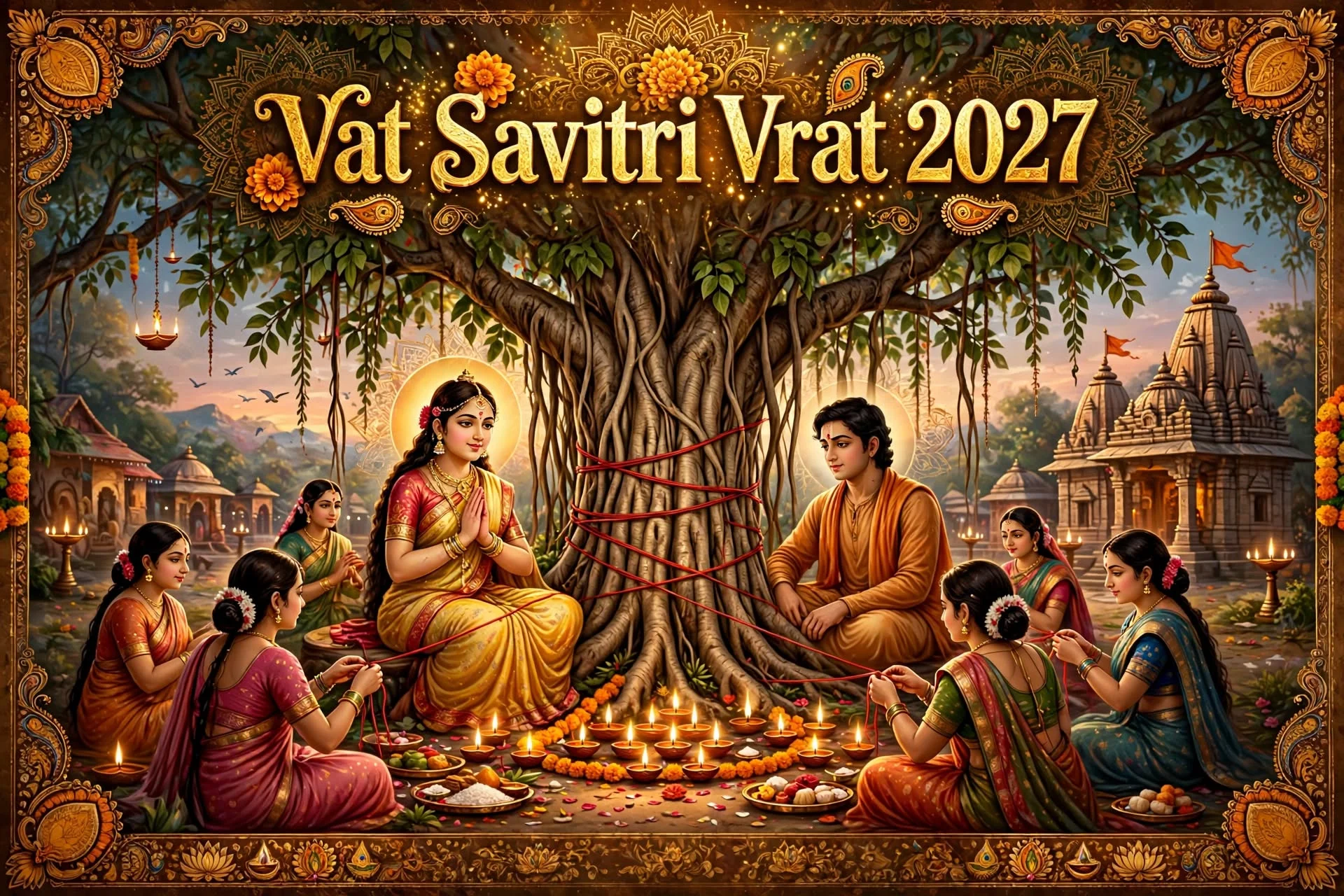
Friday, Jun 4, 2027
Vat Savitri Vrat
Vat Savitri Vrat is an important Hindu observance dedicated to the devotion, courage and determination of Savitri, the legendary wife of Satyavan. The festival is traditionally observed by married women who pray for their husband's long life, good health, prosperity and the well-being of their family.
View Festival Guide
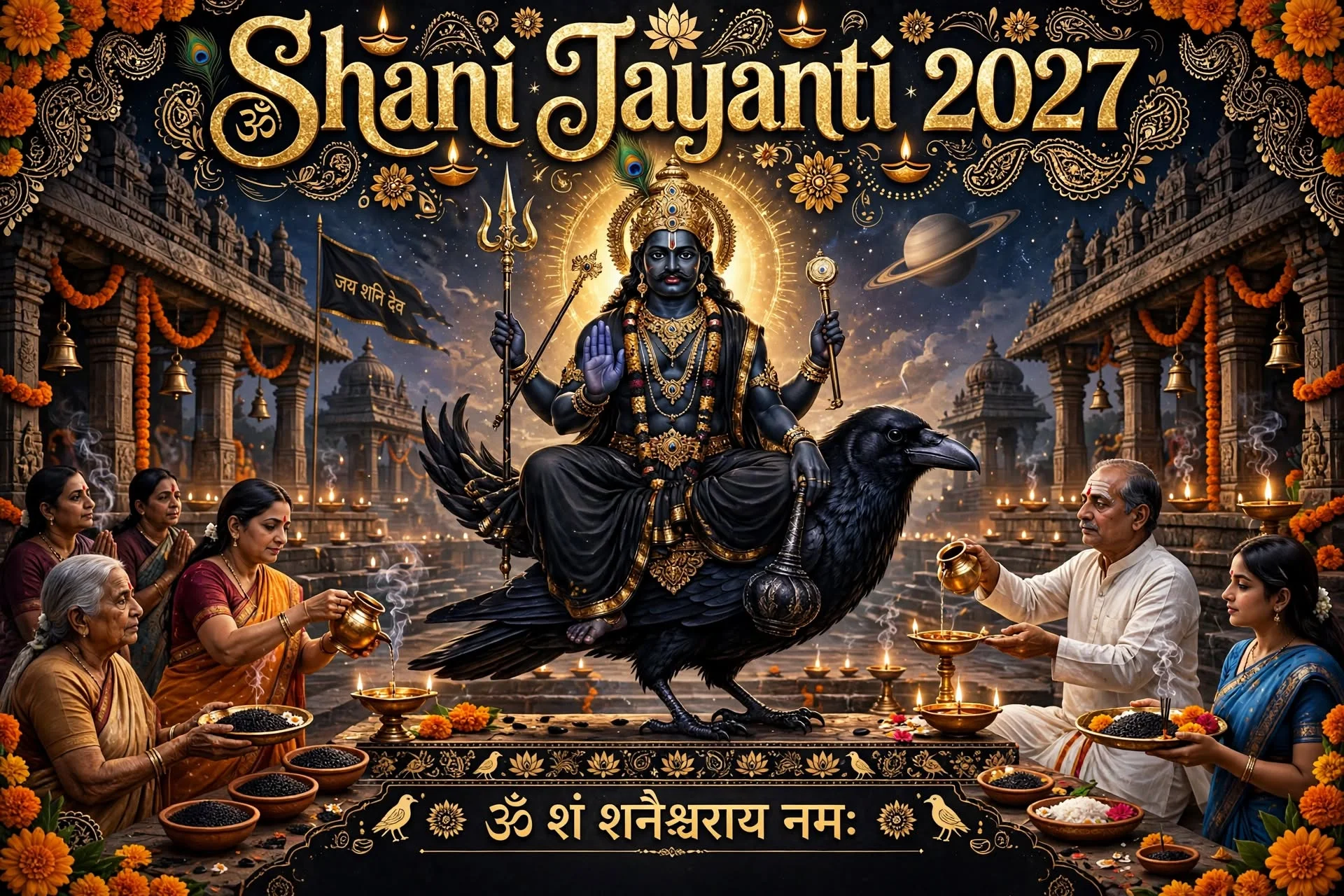
Friday, Jun 4, 2027
Shani Jayanti
Shani Jayanti, also known as Shani Janma Jayanti or Shani Amavasya, is an important Hindu observance dedicated to Lord Shani, the deity associated with the planet Saturn and one of the nine Navagrahas. Devotees observe this sacred day as the birth anniversary of Shani Dev, the son of Lord Surya and Goddess Chhaya. It is traditionally celebrated on Jyeshtha Amavasya, the new moon day in the Hindu month of Jyeshtha according to the Purnimanta calendar system.
View Festival Guide

Friday, Jun 4, 2027
Darsha Amavasya
Darsha Amavasya is a significant new moon observance in the Hindu calendar designating the specific night when the Moon is completely invisible to the human eye, having fully merged into the conjunction of the Sun.
View Festival Guide