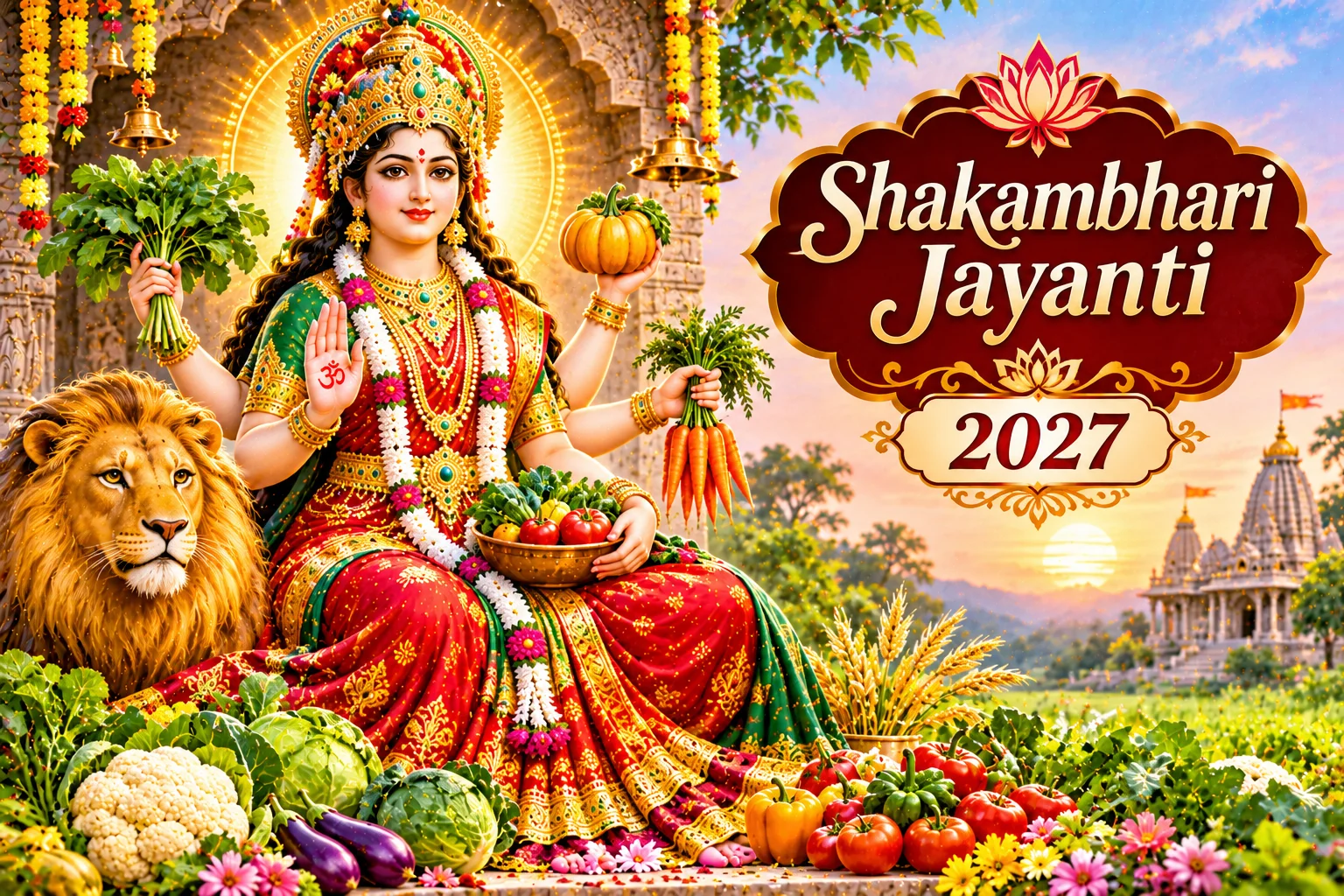
Shakambhari Jayanti is a sacred Hindu festival celebrating the divine appearance of Goddess Shakambhari, a compassionate manifestation of Goddess Durga and Adi Shakti. She is worshipped as the Goddess of vegetation, nourishment, food and the natural resources that sustain life.
The festival is traditionally observed on Pausha Purnima, the full moon day of the Shukla Paksha in the Hindu month of Pausha. It is also known as Shakambhari Purnima and marks the concluding day of Shakambhari Navratri in traditions that observe this festival.
Goddess Shakambhari is believed to have manifested during a prolonged period of drought and famine to protect living beings from hunger. According to traditional accounts, she nourished the world with vegetables, fruits, roots, leaves and other natural produce that emerged through her divine power.
The name Shakambhari is traditionally associated with the Sanskrit word Shaka, meaning vegetables or edible vegetation. She is therefore revered as the Mother who nourishes the world and provides the food necessary for the survival of all living beings.
Goddess Shakambhari is also associated with the name Shatakshi, meaning the one with a hundred eyes. The traditional legend describes her compassionate tears flowing as life-giving water during a severe drought, relieving the suffering of sages, humans, animals and other creatures.
The festival is especially significant in Rajasthan, Uttar Pradesh and other parts of North India. Important temples dedicated to the Goddess are found in Sambhar and Sakrai in Rajasthan and in the Shivalik region near Saharanpur in Uttar Pradesh.
Devotees celebrate Shakambhari Jayanti by worshipping the Goddess, decorating her shrine with seasonal vegetables and fruits, reciting Devi prayers, observing fasts and distributing food to people in need. Seasonal produce is considered a particularly meaningful offering because it represents the nourishment associated with the Goddess.
Why is Shakambhari Jayanti Celebrated?
Shakambhari Jayanti is celebrated to commemorate the divine manifestation of Goddess Shakambhari, who appeared to relieve the suffering of living beings during a prolonged drought and famine. She is worshipped as the compassionate Mother who provides vegetables, fruits, herbs, roots and other forms of nourishment.
The festival expresses gratitude towards the Divine Mother for the food and natural resources that sustain life. Devotees offer seasonal produce to the Goddess and pray for agricultural prosperity, sufficient rainfall, food security and the well-being of all living beings.
The observance also commemorates the victory of the Goddess over Durgamasura, the demon associated with the crisis described in traditional accounts. Her victory represents the restoration of righteousness, divine protection and the balance necessary for life to flourish.
To commemorate the divine appearance of Goddess Shakambhari.
To worship the Divine Mother as the provider of food, vegetation and nourishment.
To remember the traditional legend of the hundred-year drought and the suffering of living beings.
To honour Goddess Shatakshi, whose compassionate tears are associated with the restoration of water and life.
To celebrate the victory of Goddess Durga over Durgamasura.
To seek blessings for agricultural prosperity, healthy crops and sufficient rainfall.
To pray for freedom from hunger, poverty, scarcity and natural hardships.
To express gratitude for fruits, vegetables, grains, herbs and other gifts of nature.
To practise Annadana and distribute food among people in need.
To encourage compassion towards animals, plants and all living beings.
History and Sacred Legend of Goddess Shakambhari
The Divine Origin of Goddess Shakambhari
Goddess Shakambhari is regarded as a manifestation of the supreme Divine Mother, Adi Shakti. She represents the nurturing and protective power of the Goddess and is particularly associated with vegetation, food, herbs and the nourishment of living beings.
Her appearance is described in Hindu sacred traditions associated with the Devi Mahatmya and the Devi Bhagavata Purana. These traditions connect her manifestation with a devastating period of drought, the suffering of the world and the restoration of divine order.
Unlike forms of the Goddess primarily associated with battle or destruction, Shakambhari is especially revered for her nurturing nature. Her identity reflects the belief that the Divine Mother protects the world not only by defeating evil but also by providing the necessities of life.
The Hundred-Year Drought and the Suffering of the World
According to the traditional legend, the world once experienced a terrible period of drought that continued for one hundred years. Rainfall disappeared, rivers and water sources diminished, vegetation withered and crops failed.
The earth became barren, and humans, animals, sages and other living beings suffered from severe hunger and thirst. Without water and food, the natural balance of the world was disturbed.
The crisis is associated with the demon Durgamasura, who had obtained control over the sacred Vedas through his power and penance. In the traditional account, the absence of the Vedic knowledge and the disruption of religious practices contributed to the suffering and disorder of the world.
The sages understood that ordinary efforts could not end the calamity. They therefore turned towards the Supreme Goddess through prayer, meditation and devotional worship, seeking her protection and compassion.
The Appearance of Goddess Shatakshi
Spiritual Significance of Shakambhari Jayanti
The Divine Mother as the Provider of Nourishment
Goddess Shakambhari represents the nurturing aspect of Adi Shakti. Her worship reminds devotees that food, water, vegetation and natural resources are essential blessings that sustain all forms of life.
The Goddess is not only worshipped as a divine protector but also as the source of nourishment. Her form teaches that caring for the hungry, protecting crops and respecting the natural world are meaningful expressions of devotion.
The Symbolism of Shatakshi
The name Shatakshi represents the Goddess with a hundred eyes. Her eyes symbolise compassion, awareness and the divine ability to witness the suffering of every living being.
Her tears are traditionally associated with the restoration of water during the great drought. This symbolism teaches that compassion has the power to bring hope and renewal during periods of hardship.
The Importance of Food and Annadana
Food is regarded as a fundamental blessing in Hindu spiritual traditions. Goddess Shakambhari embodies the principle that nourishment should be respected, protected and shared.
Annadana, the donation of food, is therefore an especially meaningful act on Shakambhari Jayanti. Feeding hungry people transforms devotion into practical compassion and reflects the Goddess's own nurturing nature.
The festival encourages devotees to reduce food waste, share surplus produce and support people who struggle to obtain sufficient food.
Respect for Nature and Agriculture
The worship of Goddess Shakambhari expresses reverence for the earth and its ability to provide food. Vegetables, fruits, herbs and grains are recognised as gifts of nature that require water, healthy soil, sunlight and the work of farmers.
How Shakambhari Jayanti Is Celebrated
Early Morning Bath and Sankalpa
Devotees wake early, take a bath and wear clean clothes. They clean the Puja area and prepare an image or idol of Goddess Shakambhari for worship.
A Sankalpa is made with devotion, expressing the intention to observe Shakambhari Jayanti and seek the blessings of the Divine Mother. Some devotees also begin or complete their Shakambhari Navratri observance according to their family tradition.
Worship of Goddess Shakambhari
The Goddess is worshipped with flowers, incense, a lamp, sandalwood paste, fruits and other traditional offerings. Her image may be decorated with fresh vegetables, leafy greens, roots and seasonal produce.
Devotees pray to her as the provider of nourishment and protector of the natural world. They seek blessings for sufficient food, healthy crops, family prosperity and freedom from scarcity.
Offering Seasonal Vegetables and Fruits
Fresh vegetables and fruits are the most distinctive offerings associated with Shakambhari worship. Devotees arrange seasonal produce before the Goddess as a symbolic expression of gratitude.
Common offerings may include spinach, fenugreek leaves, carrots, radishes, gourds, brinjal, peas, fruits, roots and other locally available produce.
After the Puja, the offerings may be distributed as Prasad or used to prepare food for family members and devotees according to temple and household customs.
Shakambhari Navratri Observances
In traditions that observe Shakambhari Navratri, devotees worship the Goddess throughout the Pausha Shukla Paksha observance, beginning from the customary starting Tithi and concluding on Pausha Purnima.
Shakambhari Jayanti Puja Vidhi (Step by Step)
1
Wake Up Early and Take a Holy Bath
Wake up early in the morning, take a bath and wear clean clothes. Clean the Puja area and prepare a suitable place for worshipping Goddess Shakambhari. Maintain a peaceful and devotional atmosphere.
2
Prepare the Puja Platform
Place a clean cloth on a Puja Chowki and install an image or idol of Goddess Shakambhari. Decorate the worship area with flowers, leaves and seasonal vegetables. Keep the required Puja materials ready.
3
Take the Sankalpa
Sit before the Goddess and make a sincere Sankalpa to observe Shakambhari Jayanti. Pray for food security, good health, agricultural prosperity, family welfare and the well-being of all living beings.
4
Invoke Lord Ganesha
Begin the Puja by remembering Lord Ganesha and seeking his blessings for the successful completion of the worship. Offer flowers, incense and a prayer according to your family tradition.
5
Invoke Goddess Shakambhari
Shakambhari Jayanti Puja Samagri List
Main Puja Materials
Image or idol of Goddess Shakambhari
Image of Goddess Durga or Adi Shakti, if available
Clean Puja Chowki
Red, yellow or other customary Puja cloth
Kalasha filled with clean water
Panchapatra and spoon
Bell
Aarti plate
Sacred thread, where customary
Vegetables and Natural Offerings
Spinach
Fenugreek leaves
Mustard greens
Coriander leaves
Carrots
Radishes
Gourds
Brinjal
Cauliflower
Peas
Potatoes and other roots
Seasonal green vegetables
Fresh herbs
Mantras and Prayers for Shakambhari Jayanti
Shakambhari Devi Moola Mantra
ॐ शाकम्भर्यै नमः॥
Om Shakambharyai Namah
Simple Meaning: Salutations to Goddess Shakambhari, the divine Mother who nourishes and protects all living beings through the gifts of vegetation and food.
Shatakshi Devi Mantra
ॐ शताक्ष्यै नमः॥
Om Shatakshyai Namah
Salutations to Goddess Shatakshi, the compassionate Mother whose divine eyes witness the suffering of all beings and whose grace restores life and nourishment.
Shakambhari Jayanti Vrat Rules and Fasting Guidelines
Fasting Rules
Devotees may observe a fast on Shakambhari Jayanti according to their health, family tradition and personal devotion. Some observe a complete fast, while others follow a fruit-based fast or a simple vegetarian diet. The central purpose is to develop self-discipline and devotion to the Divine Mother.
Observe a complete fast only if your health and circumstances permit.
A Phalahar fast may include fruits, milk, nuts and other permitted foods.
Some devotees follow a single-meal or partial-fasting practice.
Avoid overeating when concluding the fast.
Drink sufficient water unless medically advised otherwise.
Do not force yourself to undertake a strict or waterless fast.
Worship and Purity Rules
The worship of Goddess Shakambhari should be performed with cleanliness, sincerity and gratitude. Devotees may follow their family or temple tradition while offering flowers, fruits, vegetables and other suitable materials.
Bathe and wear clean clothes before the Puja.
Keep the worship area clean and organised.
Offer fresh vegetables and fruits wherever possible.
Use clean and suitable food materials for Naivedya.
Chant Devi mantras and recite devotional hymns.
Perform Aarti and distribute Prasad respectfully.
Dos and Don'ts of Shakambhari Jayanti
Good Practices (Do's)
Begin the day with a bath and a sincere Sankalpa.
Worship Goddess Shakambhari with devotion and gratitude.
Offer fresh seasonal vegetables, fruits, roots and leafy greens.
Chant Om Shakambharyai Namah or other familiar Devi mantras.
Read or listen to the traditional Shakambhari Devi Katha.
Recite Durga Saptashati or other suitable Devi prayers.
Shakambhari Jayanti Across Regions
Region
Local Name
Rajasthan
Shakambhari Jayanti
Sambhar, Rajasthan
Shakambhari Mata Jayanti
Sakrai, Rajasthan
Shakambhari Mata Navratri
Saharanpur, Uttar Pradesh
Shakumbhari Devi Jayanti
Uttar Pradesh
Shakambhari Purnima
Haryana
Shakambhari Jayanti
Punjab
Shakambhari Purnima
Uttarakhand
Shakambhari Devi Puja
Madhya Pradesh
Shakambhari Purnima
Gujarat
Shakambhari Jayanti
Maharashtra
Shakambhari Purnima
North India
Shakambhari Jayanti FAQs
What is Shakambhari Jayanti?
Shakambhari Jayanti is a Hindu festival celebrating the divine appearance of Goddess Shakambhari, a manifestation of Goddess Durga associated with vegetables, fruits, food and nourishment. It is traditionally observed on Pausha Purnima.
When is Shakambhari Jayanti celebrated?
Shakambhari Jayanti is traditionally celebrated on Pausha Purnima, the full moon day of the Shukla Paksha in the Hindu month of Pausha. The corresponding Gregorian date changes every year.
Who is Goddess Shakambhari?
Goddess Shakambhari is a form of Adi Shakti and Goddess Durga worshipped as the divine provider of vegetation and nourishment. She is believed to have manifested during a prolonged drought to provide food to suffering living beings.
Shakambhari Jayanti teaches the importance of gratitude, compassion, food security, environmental protection and respect for nature. The festival reminds devotees that food is a divine blessing and that sharing nourishment with others is an expression of true devotion.
To develop respect for nature, water conservation and responsible use of natural resources.
To conclude the traditional observance of Shakambhari Navratri with devotion and gratitude.
Moved by the suffering of the sages and living beings, the Divine Mother manifested in a remarkable form. She appeared with numerous eyes, through which she witnessed the misery of the world.
Because of her hundred eyes, she became known as Shatakshi. The name is traditionally interpreted as Shata, meaning hundred, and Akshi, meaning eyes.
The Goddess looked upon the suffering earth with immense compassion. Tears flowed from her eyes for an extended period and became life-giving water, restoring rivers, water sources and the possibility of vegetation returning to the land.
Her tears symbolise divine compassion and the restoration of life. The legend teaches that the Divine Mother responds to the suffering of all creatures, not only humans.
The Manifestation of Goddess Shakambhari
During the period of scarcity, the Goddess manifested the power of nourishment through her own divine form. Vegetables, fruits, roots, leaves, herbs and other edible plants appeared through her grace.
She provided these natural foods to the suffering beings, allowing them to survive until normal rainfall and agricultural conditions could return.
Because she sustained the world with Shaka, or edible vegetation, she became known as Shakambhari. Her name represents the Mother who carries, produces or provides vegetation for the nourishment of the world.
The manifestation of Shakambhari is therefore associated with food security, agriculture, fertility of the earth and the sacred relationship between living beings and nature.
The legend explains why devotees offer vegetables, fruits, grains and leafy produce to the Goddess. These offerings are not merely ritual materials; they represent gratitude for the nourishment she provides.
The Defeat of Durgamasura
The traditional narrative also describes the Goddess confronting Durgamasura, whose actions had brought suffering and disorder to the world.
After nourishing the living beings and restoring their strength, the Goddess took up the divine responsibility of destroying the demon. A fierce battle followed between the Divine Mother and Durgamasura.
Through her divine power, she defeated the demon and restored righteousness. Her victory represented the destruction of arrogance, oppression and forces that obstruct the welfare of the world.
The Goddess became associated with the name Durga through her victory over Durgamasura in this traditional account. The episode illustrates that the nurturing Mother and the powerful protector are not separate forms but expressions of the same Divine Shakti.
Her victory also symbolises the restoration of sacred knowledge, balance and harmony between the natural and spiritual worlds.
The Significance of Shatakshi and Shakambhari
The names Shatakshi and Shakambhari express two closely connected aspects of the Divine Mother. Shatakshi represents her compassionate vision and the life-giving tears that relieve suffering, while Shakambhari represents her power to nourish the world through vegetation.
Together, these forms teach that compassion must be accompanied by action. The Goddess does not merely witness the suffering of living beings; she provides the water and food required to restore life.
Her story encourages devotees to recognise the importance of water, agriculture, vegetation and food distribution. It also teaches that protecting the natural environment is closely connected with protecting life itself.
Shakambhari Navratri and Shakambhari Jayanti
Shakambhari Navratri is a traditional period of worship dedicated to Goddess Shakambhari during Pausha Shukla Paksha. In many traditions, the observance begins on Shukla Ashtami and concludes on Pausha Purnima.
Devotees worship the Goddess throughout this period through prayers, fasting, devotional readings, offerings of seasonal produce and visits to Shakambhari temples.
Pausha Purnima is celebrated as Shakambhari Jayanti or Shakambhari Purnima in these traditions. It commemorates the divine appearance of the Goddess and serves as the concluding day of the special observance.
The customs and exact duration of the festival may vary among temples and regional traditions. The central devotional theme remains gratitude towards the Mother who nourishes and protects all living beings.
The Tradition of Offering Vegetables and Fruits
One of the most distinctive features of Shakambhari worship is the offering of fresh vegetables, fruits, roots, grains and leafy produce.
The tradition directly reflects the Goddess's legendary role as the provider of vegetation during a time of famine. Devotees decorate her image or shrine with seasonal produce and offer food as an expression of gratitude.
In some temples, vegetables and fruits offered to the Goddess are later distributed as Prasad. This practice reflects the principle that food should be shared and that divine nourishment should reach as many people as possible.
The custom also encourages respect for farmers, agricultural labourers, natural resources and the food systems that sustain communities.
The Sacred Shakambhari Temples
Goddess Shakambhari is worshipped at several important temples across North India. The Shakambhari Mata temple near Sambhar in Rajasthan, the Sakrai Shakambhari temple in Rajasthan and the Shakumbhari Devi temple near Saharanpur in Uttar Pradesh are among the prominent pilgrimage centres associated with her worship.
The Sambhar tradition is especially important in Rajasthan, where the Goddess is also revered by several communities as a family deity. Her association with the region reflects the long-standing relationship between the Goddess, agriculture, land and the natural resources of the area.
At these sacred places, devotees visit throughout the year and especially during Navratri and Shakambhari Jayanti. Temple customs, local legends, fairs and forms of worship differ from one shrine to another.
Her legend reminds devotees that environmental destruction, water scarcity and agricultural hardship can affect every form of life. Protecting forests, conserving water, caring for soil and supporting sustainable agriculture are practical ways to honour the Goddess.
The Destruction of Scarcity and Adharma
The defeat of Durgamasura symbolises the destruction of forces that create suffering, ignorance and disorder. The Goddess restores righteousness and protects the world from destructive influences.
Her story teaches that divine strength is used not for domination but for the protection of the innocent and the restoration of balance.
Compassion Towards All Living Beings
The Goddess's response to the suffering of the world extends to humans, animals, sages and all other creatures. Her nourishment is not limited to one community or group.
Devotees are encouraged to cultivate kindness towards animals, protect plants, avoid unnecessary cruelty and support the well-being of others. Such conduct reflects the universal compassion represented by Shakambhari.
Purification Through Fasting and Prayer
Fasting during Shakambhari Jayanti is traditionally practised as a way to develop self-control, devotion and spiritual awareness. Devotees may observe a complete or partial fast according to their health and family customs.
Prayer, mantra chanting, meditation and devotional reading help devotees direct their thoughts towards the Divine Mother. The purpose of fasting is not simply to avoid food but to develop gratitude, discipline and control over unnecessary desires.
The Blessings of the Divine Mother
Devotees worship Goddess Shakambhari for food security, agricultural prosperity, family welfare, health and protection from scarcity.
They also seek spiritual blessings such as compassion, humility, generosity and wisdom. The festival encourages people to recognise that true prosperity includes the well-being of society and the natural world.
Daily worship may include lighting a lamp, offering flowers and vegetables, reciting Devi prayers, reading sacred accounts and performing Aarti. Some devotees observe fasting throughout the period or on selected days.
Fasting and Devotional Practices
Observe a full or partial fast according to health and family tradition.
Chant Om Shakambharyai Namah with devotion.
Recite Durga Saptashati or selected Devi Stotras.
Read or listen to the traditional story of Goddess Shakambhari.
Meditate upon the compassionate form of the Divine Mother.
Offer prayers for food security, agricultural prosperity and the welfare of all beings.
Practise truthfulness, compassion and self-restraint.
Temple Visits and Religious Fairs
Many devotees visit Shakambhari temples on this occasion. Special Puja, Abhishekam, Aarti, devotional singing and distribution of Prasad may be organised according to temple traditions.
Prominent pilgrimage centres associated with the Goddess include Sambhar and Sakrai in Rajasthan and the Shakumbhari Devi shrine near Saharanpur in Uttar Pradesh. Devotees gather at these places to seek blessings and participate in local religious observances.
Annadana and Charity
Food donation is one of the most meaningful ways to observe Shakambhari Jayanti. Devotees may distribute cooked meals, grains, fruits, vegetables and other food items to people in need.
Some households and temples organise community meals or support charitable food services. Donations may also include clothes and other essential items for people facing hardship.
Evening Aarti and Prasad Distribution
In the evening, devotees perform Aarti of Goddess Shakambhari and sing devotional hymns. They offer flowers and prayers, express gratitude for the nourishment provided by nature and seek blessings for the coming year.
After the Puja, Prasad is distributed among family members, guests and devotees. Those observing a fast conclude it according to their customary practice and health requirements.
Meditate upon Goddess Shakambhari as the compassionate manifestation of Adi Shakti. Offer a prayer requesting her presence and blessings. Chant Om Shakambharyai Namah with devotion.
6
Offer Water and Traditional Worship Materials
Offer clean water, flowers, sandalwood paste, kumkum, turmeric and Akshata according to the customary method of Devi worship. Light a lamp and incense before the Goddess.
7
Offer Seasonal Vegetables and Fruits
Arrange fresh seasonal vegetables, fruits, roots, grains and leafy greens before the Goddess. Offer them with gratitude, remembering her role as the divine provider of nourishment during the legendary famine.
8
Offer Naivedya
Prepare suitable vegetarian food, fruits, sweets or other traditional offerings as Naivedya. Some devotees prepare dishes using seasonal vegetables. Offer the food with devotion and follow the customs of your family or temple.
9
Recite Devi Mantras and Sacred Texts
Chant Om Shakambharyai Namah, Om Dum Durgayai Namah or other familiar Devi mantras. Devotees may recite Durga Saptashati, Devi Kavach, Argala Stotram, Keelak Stotram or selected hymns.
10
Read the Shakambhari Jayanti Katha
Read or listen to the traditional account of the hundred-year drought, the appearance of Goddess Shatakshi and Shakambhari, the nourishment of living beings and the defeat of Durgamasura. Reflect on the importance of compassion and gratitude.
11
Perform Goddess Aarti
Perform Aarti of Goddess Shakambhari using a lit lamp. Sing a traditional Devi Aarti and offer prayers for the welfare of family members, society, animals, farmers and all living beings.
12
Perform Annadana and Charity
Donate food, vegetables, fruits, grains or cooked meals to people in need. Offer assistance according to your ability and avoid wasting the food offered to the Goddess.
13
Distribute Prasad and Conclude the Puja
Distribute the offered Prasad among family members and devotees. Offer a final prayer of gratitude to the Goddess and conclude the worship according to your family tradition.
14
Conclude the Vrat
Those observing a fast may conclude it after completing their customary worship. Break the fast in a moderate and healthy manner. Devotees who have undertaken a longer Shakambhari Navratri observance should complete the remaining rituals according to their Sankalpa.
Other locally available edible vegetation
Fresh seasonal produce is especially meaningful in Shakambhari worship because the Goddess is traditionally associated with providing vegetables and nourishment to living beings. The exact offerings depend on regional availability and temple customs.
Fruits and Grains
Bananas
Apples
Oranges
Guavas
Pomegranates
Seasonal berries
Coconut
Wheat
Rice
Other grains and pulses
Flowers and Devi Puja Materials
Fresh red flowers
Marigold flowers
Lotus flowers, if available
Flower garlands
Durva or other traditional offerings where prescribed
Kumkum
Turmeric
Akshata
Sandalwood paste
Roli
Lighting and Fragrance Materials
Ghee or oil lamp
Cotton wicks
Incense sticks
Dhoop
Camphor
Aarti plate
Sandalwood incense
Naivedya and Prasad
Fresh fruits
Seasonal vegetables
Homemade vegetarian food
Kheer
Halwa
Puri
Coconut
Mishri
Dry fruits
Other traditional sweets
The Naivedya may include simple vegetarian dishes and seasonal produce. Some households prepare food without onion and garlic according to their devotional customs.
Charity and Annadana Materials
Cooked meals
Fresh vegetables
Fruits
Food grains
Pulses
Edible oils
Blankets
Clothing
Other essential items for people in need
Simple Meaning:
Durga Moola Mantra
ॐ दुं दुर्गायै नमः॥
Om Dum Durgayai Namah
Simple Meaning: Salutations to Goddess Durga, the divine protector who removes obstacles, destroys negative forces and grants courage and strength to devotees.
Simple Meaning: Salutations to the auspicious Divine Mother who grants welfare, fulfils righteous aspirations and provides refuge to all who seek her protection.
Ya Devi Sarvabhuteshu - Matri Rupena
या देवी सर्वभूतेषु मातृरूपेण संस्थिता। नमस्तस्यै नमस्तस्यै नमस्तस्यै नमो नमः॥
Ya Devi Sarvabhuteshu Matri Rupena Samsthita, Namastasyai Namastasyai Namastasyai Namo Namah
Simple Meaning: Salutations again and again to the Goddess who resides in all living beings in the form of the Divine Mother.
Ya Devi Sarvabhuteshu Shakti Rupena
या देवी सर्वभूतेषु शक्तिरूपेण संस्थिता। नमस्तस्यै नमस्तस्यै नमस्तस्यै नमो नमः॥
Ya Devi Sarvabhuteshu Shakti Rupena Samsthita, Namastasyai Namastasyai Namastasyai Namo Namah
Simple Meaning: Salutations again and again to the Goddess who exists within all living beings as divine energy and strength.
Om Katyayanaya Vidmahe Kanyakumari Dhimahi, Tanno Durgih Prachodayat
Simple Meaning: We meditate upon the divine Goddess Katyayani and contemplate the sacred power of the Divine Mother. May Goddess Durga guide and illuminate our intellect.
Sarve Bhavantu Sukhinah, Sarve Santu Niramayah, Sarve Bhadrani Pashyantu, Ma Kashchid Duhkha Bhag Bhavet
Simple Meaning: May all beings be happy and free from illness. May everyone experience goodness, and may no one suffer. This prayer expresses the universal compassion represented by the Divine Mother.
Follow the customary rules of the temple where worship is performed.
Vegetable and Food Offering Rules
Vegetables, fruits, roots and leafy produce are particularly significant offerings to Goddess Shakambhari. They symbolise the nourishment provided by the Divine Mother during the legendary drought.
Offer fresh and clean seasonal vegetables.
Use locally available fruits and natural produce.
Avoid wasting the food offered to the Goddess.
Distribute suitable offerings as Prasad according to temple customs.
Donate food and vegetables to people who need them.
Maintain cleanliness while preparing and distributing food.
Shakambhari Navratri Observance
Devotees who observe Shakambhari Navratri follow the customary sequence of worship during Pausha Shukla Paksha. The starting Tithi and daily rituals may differ according to regional and temple traditions.
Make a Sankalpa before beginning the observance.
Perform daily worship of the Goddess.
Offer flowers, seasonal vegetables and fruits.
Recite Devi prayers and sacred accounts.
Observe fasting according to personal health and family tradition.
Conclude the observance with worship on Pausha Purnima according to custom.
Charity and Annadana Rules
Charity is a meaningful part of Shakambhari Jayanti because the Goddess is worshipped as the provider of food. Donations should be made with humility and a genuine intention to help people in need.
Donate cooked meals, fruits, vegetables and grains.
Support community kitchens and food distribution services.
Help farmers and people affected by food scarcity where possible.
Offer clothing and other necessities to people in need.
Avoid wasting food and natural resources.
Give according to your ability without expecting recognition.
Health and Safety During Fasting
Religious fasting should never compromise health. People with diabetes, chronic illness, pregnancy, advanced age or medication requirements should avoid strict fasting unless it is medically appropriate. A simple meal accompanied by prayer, charity and devotion is a meaningful alternative.
Stay hydrated during the observance.
Do not discontinue prescribed medicines to maintain a fast.
Avoid prolonged fasting if it causes weakness or dizziness.
Choose a partial fast when necessary.
Seek medical guidance if fasting may affect an existing health condition.
Prioritise the safety of children, elderly people and unwell devotees.
Perform Aarti and distribute Prasad.
Donate cooked food, vegetables, fruits and grains to people in need.
Practise Annadana and avoid wasting food.
Show gratitude towards farmers and people involved in food production.
Conserve water and respect the natural environment.
Treat animals, plants and all living beings with compassion.
Observe fasting according to your health and family tradition.
Visit a Shakambhari temple if it is safe and practical.
Complete Shakambhari Navratri according to your chosen Sankalpa and tradition.
Things to Avoid (Don'ts)
Do not force yourself to undertake a strict or waterless fast.
Do not neglect prescribed medicines or medical advice.
Avoid non-vegetarian food and intoxicating substances during the traditional fast.
Do not offer spoiled or unclean food materials to the Goddess.
Avoid wasting the vegetables and fruits offered during worship.
Do not disrespect food, farmers, animals or natural resources.
Avoid unnecessary anger, dishonesty and harmful behaviour.
Do not waste water during ritual bathing or Puja.
Avoid littering at temples, pilgrimage centres and natural sites.
Do not treat one regional temple custom as compulsory for all devotees.
Do not assume every household follows identical Shakambhari Navratri rules.
Do not perform charity merely for public recognition or praise.
Shakambhari Navratri
Why is Goddess Shakambhari called the Goddess of Vegetables?
The name Shakambhari is traditionally associated with Shaka, meaning vegetables or edible vegetation. According to her legend, the Goddess nourished the world with vegetables, fruits, roots, leaves and herbs during a devastating famine.
What is the meaning of Shatakshi?
Shatakshi means the Goddess with a hundred eyes. According to the traditional story, the Divine Mother appeared with numerous eyes and shed compassionate tears that became life-giving water during a prolonged drought.
What is the story of Goddess Shakambhari?
According to traditional accounts, a severe drought affected the world for a prolonged period. The Goddess appeared as Shatakshi and restored water through her compassionate tears. She then manifested vegetation and provided food to living beings, earning the name Shakambhari. She later defeated Durgamasura and restored divine order.
Who was Durgamasura?
Durgamasura was a demon in the traditional legend of Goddess Shakambhari. His actions were associated with the loss of sacred knowledge and a prolonged period of suffering. The Goddess defeated him and restored righteousness and protection to the world.
Why are vegetables offered to Goddess Shakambhari?
Vegetables are especially sacred offerings because the Goddess is traditionally believed to have nourished the world with edible vegetation during a severe famine. Offering fresh vegetables, fruits, roots and grains expresses gratitude for the food and natural resources that sustain life.
Is Shakambhari Jayanti the same as Shakambhari Purnima?
Yes. Shakambhari Jayanti is commonly known as Shakambhari Purnima because it is traditionally observed on Pausha Purnima. Both names refer to the festival commemorating the Goddess's divine appearance.
What is Shakambhari Navratri?
Shakambhari Navratri is a period of worship dedicated to Goddess Shakambhari during Pausha Shukla Paksha. In many traditions, it begins on Shukla Ashtami and concludes on Pausha Purnima, which is celebrated as Shakambhari Jayanti. Its duration and daily practices may vary by regional tradition.
Which deity is worshipped on Shakambhari Jayanti?
Goddess Shakambhari, a manifestation of Adi Shakti and Goddess Durga, is the principal deity worshipped. Devotees may also worship Goddess Durga, Lord Ganesha and other deities according to their family traditions.
How is Shakambhari Jayanti celebrated?
Devotees celebrate Shakambhari Jayanti through Goddess worship, offerings of seasonal vegetables and fruits, fasting, mantra chanting, Devi Katha recitation, temple visits, Aarti and charitable food distribution.
Which mantra should be chanted on Shakambhari Jayanti?
Om Shakambharyai Namah is a simple devotional mantra dedicated to Goddess Shakambhari. Devotees may also chant Om Shatakshyai Namah, Om Dum Durgayai Namah and other Devi prayers according to their tradition.
What should be offered to Goddess Shakambhari?
Fresh vegetables, leafy greens, fruits, roots, grains, flowers and suitable vegetarian food are common offerings. Seasonal produce is especially meaningful because the Goddess is revered as the provider of nourishment.
Is fasting compulsory on Shakambhari Jayanti?
Fasting is a traditional practice but is not compulsory for everyone. Devotees may observe a complete fast, a fruit-based fast or a partial fast according to their health and family customs. Prayer, charity and sincere worship are also meaningful ways to observe the festival.
Can Shakambhari Jayanti Puja be performed at home?
Yes. Devotees can worship an image or idol of Goddess Shakambhari at home by offering flowers, seasonal vegetables, fruits, incense, a lamp and suitable Naivedya. They may recite Devi mantras, listen to the Shakambhari Katha and perform Aarti.
Which temples are famous for Goddess Shakambhari?
Prominent temples include Shakambhari Mata temple near Sambhar in Rajasthan, the Sakrai Shakambhari shrine in Rajasthan and the Shakumbhari Devi temple near Saharanpur in Uttar Pradesh. Each shrine has its own local traditions and devotional practices.
Why is Annadana important on Shakambhari Jayanti?
Annadana means the donation of food. It is particularly meaningful on this festival because Goddess Shakambhari represents nourishment and protection from hunger. Feeding people in need reflects the compassion and generosity associated with the Divine Mother.
What is the connection between Shakambhari Jayanti and agriculture?
The Goddess is associated with vegetation, crops, fruits, vegetables and the nourishment provided by the earth. Her worship encourages gratitude towards farmers, respect for agricultural resources, water conservation and concern for food security.
Can Goddess Shakambhari be worshipped during other Navratris?
Yes. Goddess Shakambhari can be worshipped throughout the year. Some temples and communities also observe her worship during Chaitra and Ashwin Navratri, while Pausha Shukla Paksha has a distinct Shakambhari Navratri tradition.
What is the spiritual message of Shakambhari Jayanti?
The festival teaches gratitude for food and water, compassion towards living beings, respect for nature, protection of agricultural resources and the importance of sharing nourishment with people in need.
Which sacred texts mention Goddess Shakambhari?
Goddess Shakambhari is associated with the Devi Mahatmya tradition within the Markandeya Purana and with accounts in the Devi Bhagavata Purana. Related descriptions of the Goddess also appear in other Puranic traditions.
What is the connection between Goddess Shakambhari and the Devi Mahatmya?
The Devi Mahatmya includes a declaration of the Goddess's future manifestation as Shakambhari during a period of drought and her defeat of the demon Durgama. The narrative establishes her role as the divine provider of vegetation and protector of living beings.
What is the relationship between Shatakshi and Shakambhari?
Shatakshi and Shakambhari are closely connected forms of the Divine Mother in the traditional drought narrative. Shatakshi represents the Goddess with a hundred eyes whose tears restore water, while Shakambhari represents her nourishing form that provides vegetation and food.
Why did Goddess Shakambhari appear on earth?
According to the traditional legend, she appeared to relieve the suffering caused by a prolonged drought and famine. She provided water through her compassionate tears and nourishment through the vegetation manifested by her divine power.
Who was responsible for the drought in the Shakambhari legend?
The drought is associated with Durgamasura in traditional accounts. His acquisition of sacred knowledge and the resulting disruption of religious order are linked with the suffering that affected the world.
How did Goddess Shakambhari defeat Durgamasura?
After providing nourishment to the suffering beings, the Goddess confronted Durgamasura in a divine battle and defeated him through her supreme power. Her victory restored righteousness and protection to the world.
Why is Goddess Shakambhari associated with Goddess Durga?
Shakambhari is regarded as a manifestation of Adi Shakti and Goddess Durga. Her nourishing form and her victory over Durgamasura represent two aspects of the same Divine Mother: compassion that sustains life and power that destroys evil.
Why is Pausha Purnima important for Shakambhari worship?
Pausha Purnima is traditionally regarded as the day of the Goddess's divine appearance and is celebrated as Shakambhari Jayanti. It also concludes Shakambhari Navratri in traditions that observe the Pausha Shukla Paksha worship period.
What is the difference between Shakambhari Jayanti and Shakambhari Navratri?
Shakambhari Navratri is the period of devotional worship dedicated to Goddess Shakambhari during Pausha Shukla Paksha. Shakambhari Jayanti is the concluding full-moon observance on Pausha Purnima, commemorating the divine appearance of the Goddess.
Why is Goddess Shakambhari worshipped in Rajasthan?
Goddess Shakambhari has a significant devotional tradition in Rajasthan, where she is worshipped at important shrines including Sambhar and Sakrai. Her association with nourishment, vegetation and the land has made her an important regional Goddess and family deity for several communities.
What is the importance of the Sambhar Shakambhari Mata temple?
The Shakambhari Mata temple near Sambhar is an important centre of devotion in Rajasthan. It is associated with the Goddess's nourishing form and is visited by devotees who seek blessings for prosperity, agricultural well-being and family welfare.
What is the significance of the Shakumbhari Devi temple near Saharanpur?
The Shakumbhari Devi temple near Saharanpur is an important North Indian pilgrimage centre dedicated to the Goddess. Devotees visit to seek her protection and blessings, participate in temple worship and follow local traditions associated with the shrine.
Why is Goddess Shakambhari considered a symbol of environmental protection?
Her legend centres on the restoration of water, vegetation and food during a devastating drought. Her worship therefore encourages respect for forests, plants, water, soil, agriculture and all natural resources that support life.
What is the traditional significance of offering vegetables as Prasad?
Vegetables offered to the Goddess represent the nourishment she provided to living beings during the legendary famine. Their distribution as Prasad reflects the belief that food is a divine blessing that should be shared rather than wasted.
Is Shakambhari Jayanti celebrated identically in every region?
No. The central worship of Goddess Shakambhari is shared, but the rituals, temple fairs, offerings, fasting practices and duration of Navratri observances differ among regions and temples. Devotees generally follow their local and family traditions.