




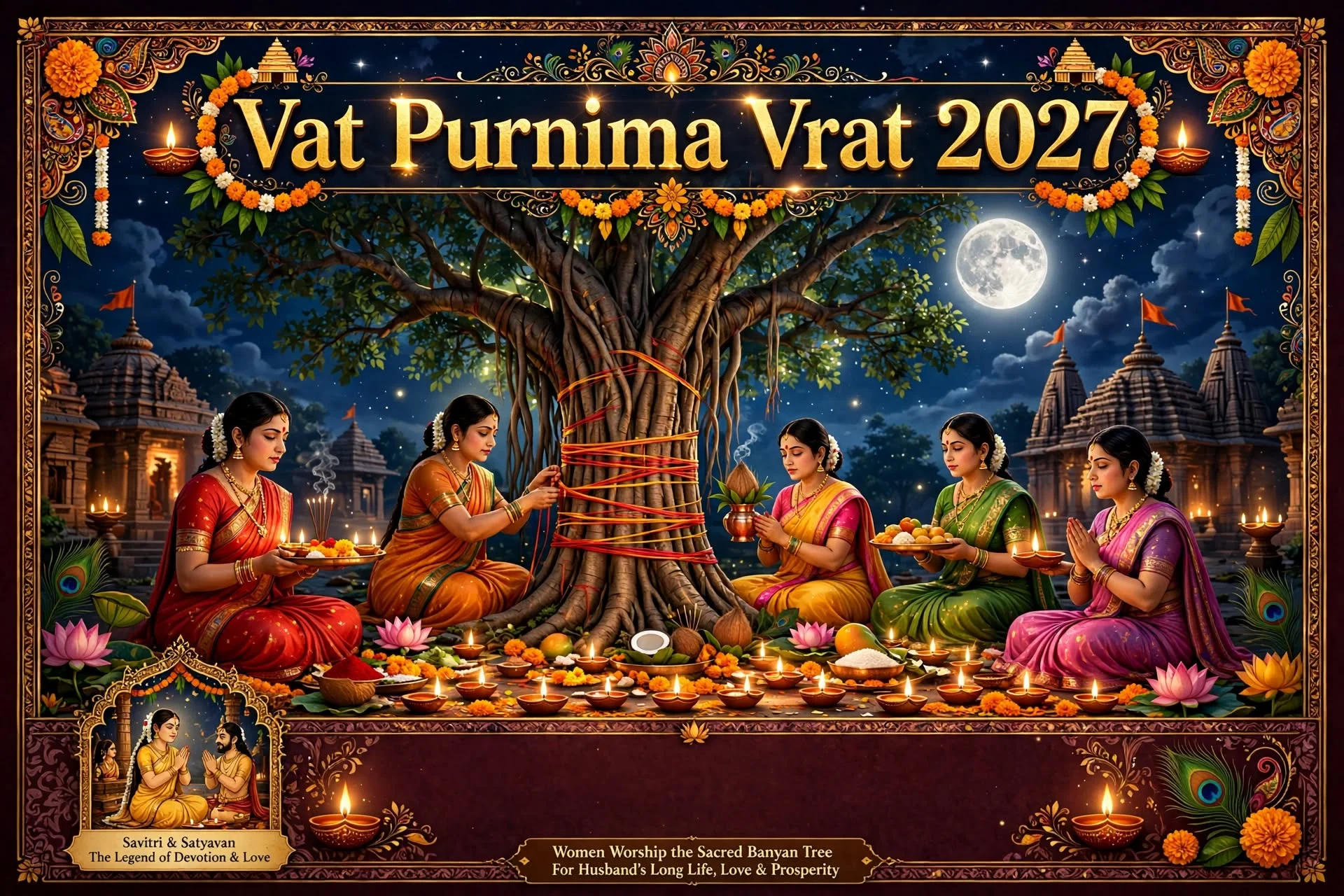
Vat Purnima Vrat, also known as Vat Savitri Purnima or Vata Pournima, is a traditional Hindu observance celebrated on Jyeshtha Shukla Purnima, the full-moon day of the Jyeshtha month. It is especially popular in Maharashtra, Gujarat, Goa and the Konkan region. The festival is associated with the devotion of Goddess Savitri towards her husband Satyavan and her encounter with Yama, the god of death.
Vat Purnima Vrat 2027: Date, Puja Timings, Rituals & Stories
Vat Purnima Vrat Timings & Panchang
Important festival dates and auspicious timings
Usha Arghya (Sunrise)
05:23 am
Sandhya Arghya (Sunset)
07:21 pm
Start Date
Friday, 18 Jun 2027
Puja Muhurat
04:35 am – 06:14 am
Vat Purnima Vrat
On this day, married women traditionally observe a fast and worship the banyan tree, known in Sanskrit as Vat or Vata Vriksha. They offer water, flowers, fruits, turmeric, vermilion and other sacred items to the tree. A cotton thread is tied or wound around its trunk while women perform pradakshina and pray for the well-being, health and longevity of their husbands and the happiness of their families.
The religious significance of Vat Purnima comes from the story of Savitri and Satyavan narrated in the Vana Parva of the Mahabharata. Savitri's wisdom, courage, determination and devotion enabled her to obtain the restoration of Satyavan's life from Yama. Her story became an enduring example of steadfastness and spiritual strength in Hindu tradition.
The banyan tree is central to the observance because it represents longevity, stability, continuity and the sustaining power of nature. Its extensive branches and long life make it a symbol of enduring existence. Worshipping the tree on this day expresses reverence for nature as well as devotion to the ideals represented by Savitri.
Vat Purnima should be distinguished from Vat Savitri Amavasya. Both observances are associated with Savitri and Satyavan, but Vat Purnima is observed on Jyeshtha Shukla Purnima, whereas the Amavasya observance is followed by many North Indian communities on Jyeshtha Amavasya. Regional and family traditions determine which observance devotees follow.
Why is Vat Purnima Vrat Celebrated?
Vat Purnima is observed to remember the devotion and determination of Savitri, who followed Yama when he took Satyavan's life and eventually secured his return. Married women traditionally undertake the vrata seeking the long life, health and well-being of their husbands. The observance also expresses prayers for family prosperity, marital harmony and the continuity of auspicious married life.
The festival is not limited to the personal story of a married couple. It also celebrates courage, wisdom, commitment, patience and the ability to uphold dharma during difficult circumstances. Savitri does not rely only on emotional appeals; she engages Yama through thoughtful words, ethical reasoning and a clear understanding of the boons he grants her.
- To honour the devotion, courage and wisdom of Goddess Savitri.
- To remember the story of Savitri and Satyavan from the Mahabharata.
- To pray for the health, longevity and well-being of one's husband.
- To seek marital harmony, family happiness and prosperity.
- To worship the banyan tree as a symbol of longevity, stability and continuity.
- To practise self-discipline, prayer, charity and spiritual reflection.
- To preserve regional customs and pass traditional stories and rituals to younger generations.
History and Origin of Vat Purnima Vrat
The central narrative associated with Vat Purnima is the story of Savitri and Satyavan, found in the Vana Parva of the Mahabharata. The episode is traditionally known as the Savitri Upakhyana or Pativrata Mahatmya. Sage Markandeya narrates the story to Yudhishthira during the Pandavas' period of exile. It presents Savitri as a woman whose intelligence, courage and commitment enable her to face Yama, the god of death.
The Mahabharata is the primary epic source for Savitri's story. The specific annual observance involving worship of the banyan tree, fasting and circumambulation developed through later vrata traditions and regional religious practices. The modern celebration should therefore be understood as a combination of an ancient epic narrative and established ritual customs.
The Birth of Savitri
According to the traditional narrative, King Ashvapati of the Madra kingdom had no children. He performed religious austerities and worshipped the divine power associated with Savitri, seeking a child. Pleased with his devotion, the goddess blessed him with a daughter. The princess was named Savitri in honour of the divine power to whom her birth was attributed.
Savitri grew into a woman known for her intelligence, beauty, dignity and strength of character. Her qualities were so remarkable that suitable royal suitors hesitated to approach her. Eventually, her father asked her to travel and choose a husband for herself.
Savitri Chooses Satyavan
During her travels, Savitri met Satyavan, the son of King Dyumatsena. Dyumatsena had lost his eyesight and kingdom and was living in the forest with his family. Satyavan lived a simple life in the forest, supporting his parents and helping them despite their difficult circumstances.
Savitri chose Satyavan as her husband and informed her father of her decision. Sage Narada, who was present at the royal court in the traditional account, warned that Satyavan possessed excellent qualities but was destined to die after a short period. His death was expected approximately one year from the time of the prediction.
Spiritual Significance of Vat Purnima
Vat Purnima carries spiritual meanings associated with devotion, courage, dharma, longevity and the relationship between human beings and nature. Its rituals are rooted in the belief that sincere prayer, self-discipline and righteous conduct help individuals cultivate a more harmonious life.
The story of Savitri provides the central spiritual teaching of the festival. Her conduct represents determination guided by wisdom. She remains committed to Satyavan but also demonstrates intelligence, patience and an understanding of dharma. Her dialogue with Yama is remembered as an example of how thoughtful speech and ethical conduct can be powerful even in the most difficult circumstances.
Savitri as an Ideal of Wisdom and Determination
Savitri is remembered as a symbol of steadfastness and courage. Her story teaches that devotion does not require helplessness or silence. She actively responds to adversity, follows the path of righteousness and uses wisdom to protect her family. Her character is therefore associated with both emotional commitment and intellectual strength.
For devotees, remembering Savitri on Vat Purnima is an opportunity to reflect on patience, responsibility, mutual respect and the importance of standing firmly for what is right.
The Banyan Tree as a Symbol of Longevity
The banyan tree is one of the most recognisable symbols of the festival. Its extensive branches, aerial roots and ability to grow over a long period make it a traditional representation of continuity, endurance and stability. The tree provides shelter to birds, animals and people and is valued in Indian cultural and ecological traditions.
Worshipping the banyan tree expresses reverence for the natural world. It also reminds devotees that human life is connected to the environment and that protecting trees and living ecosystems is an important responsibility.
Meaning of Circumambulation and Sacred Thread
How Vat Purnima Vrat Is Celebrated
Vat Purnima is generally celebrated through a combination of morning purification, fasting, banyan-tree worship, pradakshina, recitation or listening to the Savitri-Satyavan story and devotional prayers. The exact sequence differs between families, communities and local traditions.
In Maharashtra, Gujarat, Goa and the Konkan region, women commonly gather near a banyan tree to perform the puja. They wear traditional clothing, prepare offerings and worship the tree with water, flowers, turmeric, vermilion and cotton thread. The Savitri-Satyavan story is remembered during the observance.
Morning Preparation
Devotees traditionally wake up early, bathe and wear clean clothes. Married women may wear traditional sarees, apply kumkum and turmeric, and adorn themselves with bangles and other auspicious ornaments. Puja materials are arranged before visiting the banyan tree.
Some households perform preliminary worship at home before proceeding to the tree. Where a suitable banyan tree is not accessible, devotees may follow an accepted family practice using a small banyan plant or an appropriate symbolic representation.
Worship of the Banyan Tree
The banyan tree is approached with reverence. Devotees offer water at its roots and apply turmeric and kumkum according to local custom. Flowers, fruits, incense and a lamp may also be offered. The tree is worshipped as a sacred symbol associated with Savitri and the ideals of long life and stability.
A cotton thread is tied or wound around the trunk. Women perform pradakshina while praying for the well-being of their families. The number of circumambulations varies by regional and family tradition; no single number should be treated as universal.
Listening to the Savitri-Satyavan Vrat Katha
The story of Savitri and Satyavan is an important part of the observance. Devotees read or listen to the narrative from the Mahabharata or a traditional vrata-katha text. The story explains the significance of the day and reminds worshippers of Savitri's courage, intelligence and devotion.
Vat Purnima Vrat Puja Vidhi (Step by Step)
- 1
Wake Up Early and Take a Holy Bath
Wake up early on Jyeshtha Shukla Purnima and take a bath. Wear clean and traditional clothes. Prepare the puja materials and maintain a devotional state of mind. Married women may apply turmeric and kumkum and wear traditional ornaments according to family custom.
- 2
Take the Vrat Sankalpa
Sit in a clean place and take a personal sankalpa to observe Vat Purnima Vrat with devotion. Pray to Goddess Savitri and seek blessings for the well-being of the family. The wording of the sankalpa may differ according to the family tradition.
- 3
Visit the Banyan Tree
Visit a clean and accessible banyan tree with the prepared puja materials. Approach the tree respectfully. If visiting a tree is not possible, follow the symbolic or household method accepted in the family tradition.
- 4
Offer Water at the Roots
Offer clean water at the roots of the banyan tree. Some traditions also offer milk or water mixed with sacred ingredients. Use offerings in a manner that does not damage the tree or pollute the surrounding area.
- 5
Vat Purnima Vrat Puja Samagri List
Items for Banyan Tree Worship
- Clean water in a small kalash or lota
- Raw cotton thread or sacred red-yellow thread
- Fresh flowers
- Turmeric powder
- Kumkum or vermilion
- Sandalwood paste
- Akshata (unbroken rice grains)
- Incense sticks
- Cotton wicks and an oil or ghee lamp
- Camphor, if used in the family tradition
Fruits and Naivedya
Seasonal fruits are commonly offered during Vat Purnima. The selection depends on availability and local customs. Mangoes, bananas, coconuts and other seasonal fruits may be included.
- Coconut
- Mangoes or other seasonal fruits
- Bananas
- Soaked gram or chickpeas, where customary
- Jaggery or traditional sweets
- Other vegetarian naivedya prepared at home
Items for Savitri and Satyavan Worship
Mantras and Prayers for Vat Purnima Vrat
Vat Purnima Vrat Vrat Rules and Fasting Guidelines
Traditional Fasting Practices
Many married women observe a fast on Vat Purnima as an expression of devotion and prayer for their husbands' well-being. The form of fasting differs among families and regions. Some observe a strict fast, while others consume fruits, milk or permitted foods.
- Take a bath and begin the day with prayer.
- Observe the fast according to the family's established tradition.
- Worship the banyan tree with devotion.
- Remember Goddess Savitri and Satyavan.
- Read or listen to the traditional Vrat Katha.
- Offer food, fruits or other permitted items according to custom.
- Conclude the fast in accordance with the household tradition.
Food and Dietary Observances
There is no single dietary rule followed by every community observing Vat Purnima. Some devotees abstain from food for the day, while others follow a fruit-based or partial fast. The choice of food should follow the devotee's family tradition and health requirements.
- Fruits and milk may be consumed by devotees following a fruit-based fast.
- Some families prepare simple vegetarian food for the conclusion of the vrata.
- Avoiding meat and alcohol is customary for many devotees during religious observances.
- Follow local and family rules concerning grains, salt and other foods rather than assuming one rule applies everywhere.
Dos and Don'ts of Vat Purnima Vrat
Good Practices (Do's)
- Begin the day with a bath and a prayerful state of mind.
- Worship the banyan tree respectfully and avoid damaging its branches or roots.
- Offer water, flowers, fruits and other materials according to family tradition.
- Remember Goddess Savitri and listen to the Savitri-Satyavan Vrat Katha.
- Perform pradakshina according to the custom followed by the family.
- Use the sacred thread respectfully and avoid leaving plastic or non-biodegradable materials around the tree.
Vat Purnima Vrat Across Regions
| Region | Local Name |
|---|---|
| Maharashtra | Vat Pournima or Vat Savitri Vrat |
| Gujarat | Vat Purnima or Vat Savitri Purnima |
| Goa and Konkan | Vat Pournima |
| Karnataka | Vata Savitri or regional Purnima observance |
| North India | Vat Savitri Amavasya |
| Bihar and Jharkhand | Vat Savitri Vrat |
| Odisha | Sabitri Brata |
Vat Purnima Vrat FAQs
What is Vat Purnima Vrat?
Vat Purnima Vrat is a Hindu religious observance celebrated on Jyeshtha Shukla Purnima. It is associated with Goddess Savitri and Satyavan. Married women traditionally worship the banyan tree, observe a fast and pray for the well-being and longevity of their husbands and the happiness of their families.
When is Vat Purnima Vrat observed?
Vat Purnima is observed on the full-moon tithi, or Purnima, of the Hindu month of Jyeshtha. Its Gregorian date changes every year. The exact observance date should be determined using the local Panchang and the applicable regional tradition.
Why is the banyan tree worshipped on Vat Purnima?
The banyan tree is associated with longevity, stability and continuity because of its long life and extensive branches. Its worship is connected with the popular Savitri-Satyavan tradition and expresses prayers for long life, family welfare and respect for nature.
Upcoming Festivals
View All
Friday, Jun 18, 2027
Anvadhan
Anvadhan (अन्वाधान) is an ancient, highly revered Vedic ritual and spiritual observance in Sanatana Dharma performed on the day immediately preceding the New Moon (Amavasya) or Full Moon (Purnima). Rooted in the pristine traditions of the Shrauta and Grihya Sutras, Anvadhan literally translates to 'the solemn placing and replenishment of sacred fuel wood into the consecrated Vedic fires'. In traditional Vedic ritualism, householders (Grihasthas) and priests who maintain the sacred Agnihotra fires perform Anvadhan to prepare the sacrificial altars for the grand Darsha Yajna (New Moon sacrifice) or Paurnamasa Yajna (Full Moon sacrifice) scheduled for the following day.
View Festival Guide

Friday, Jun 18, 2027
Jyeshtha Purnima
Jyeshtha Purnima is the sacred full-moon day that marks the conclusion of Shukla Paksha in the Hindu month of Jyeshtha. It generally falls during May or June in the Gregorian calendar and is considered an important occasion for worship, fasting, holy bathing, charity and spiritual reflection. The word Purnima refers to the full-moon tithi, while Jyeshtha identifies the lunar month in which it occurs.
View Festival Guide

Saturday, Jun 19, 2027
Ishti
Ishti is a foundational Vedic ritual observance appearing prominently in Hindu Panchangs on the Pratipada tithi (the first lunar day) following either Amavasya (new moon) or Purnima (full moon), marking the prescribed performance day for the fortnightly Vedic Darsha-Purnamasa sacrifices.
View Festival Guide
Tuesday, Jun 22, 2027
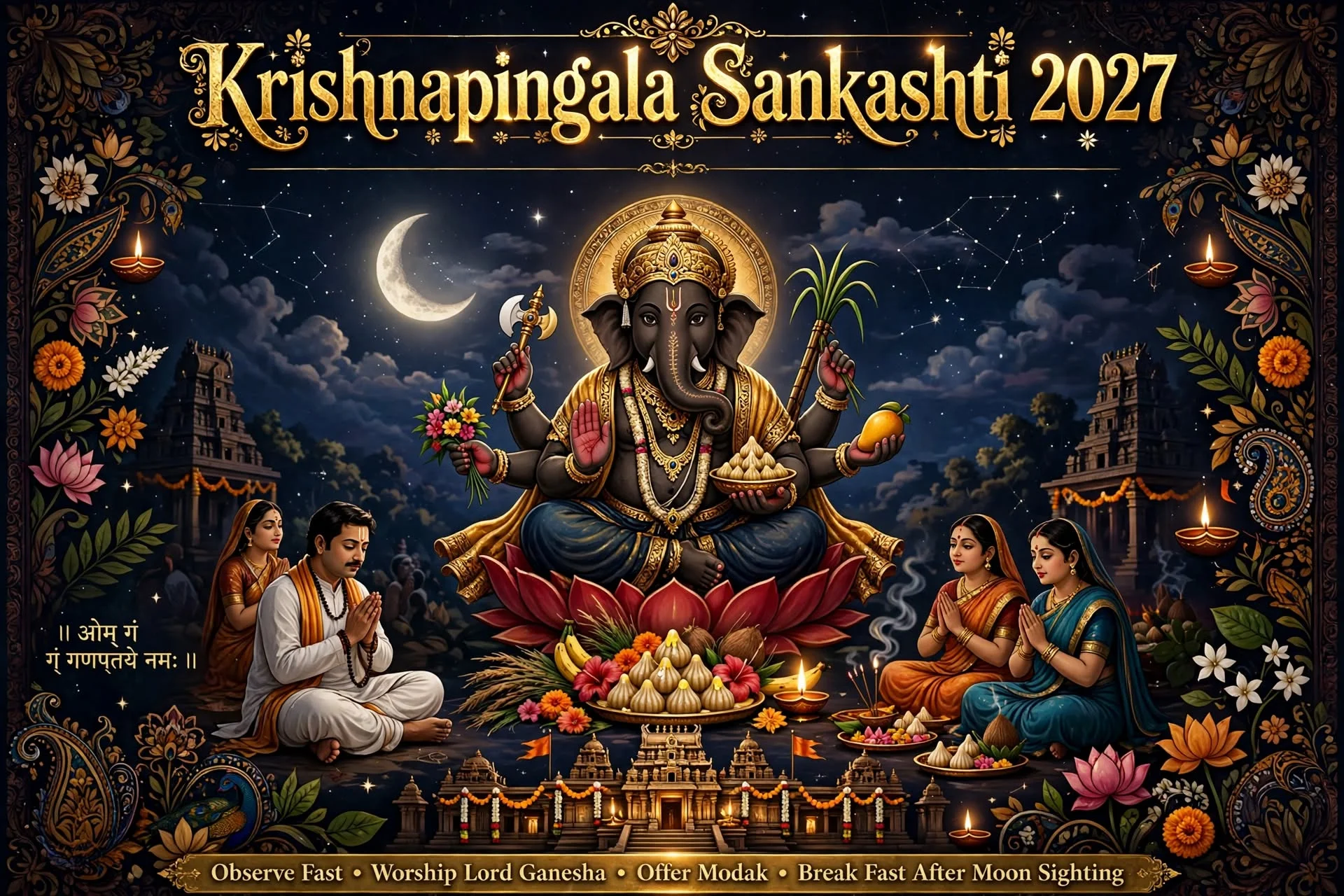
Krishnapingala Sankashti Chaturthi
Krishnapingala Sankashti Chaturthi is a sacred Hindu vrata dedicated to Lord Ganesha, observed on Krishna Paksha Chaturthi of the Jyeshtha month according to the Amanta Hindu calendar. In the Purnimanta calendar, the same lunar observance falls in Ashadha Krishna Paksha. It is one of the monthly Sankashti Chaturthi observances and is associated with the worship of Lord Ganesha in his Krishnapingala form.
View Festival Guide

Wednesday, Jun 30, 2027
Yogini Ekadashi
Yogini Ekadashi is an important Hindu fasting observance dedicated to Lord Vishnu. It falls on the Ekadashi tithi, the eleventh lunar day of the Krishna Paksha of Ashadha month according to the Purnimanta calendar. In the Amanta calendar, the same observance is known as Jyeshtha Krishna Ekadashi. It occurs between Nirjala Ekadashi and Devshayani Ekadashi in the annual cycle of Ekadashi observances.
View Festival Guide
Thursday, Jul 1, 2027
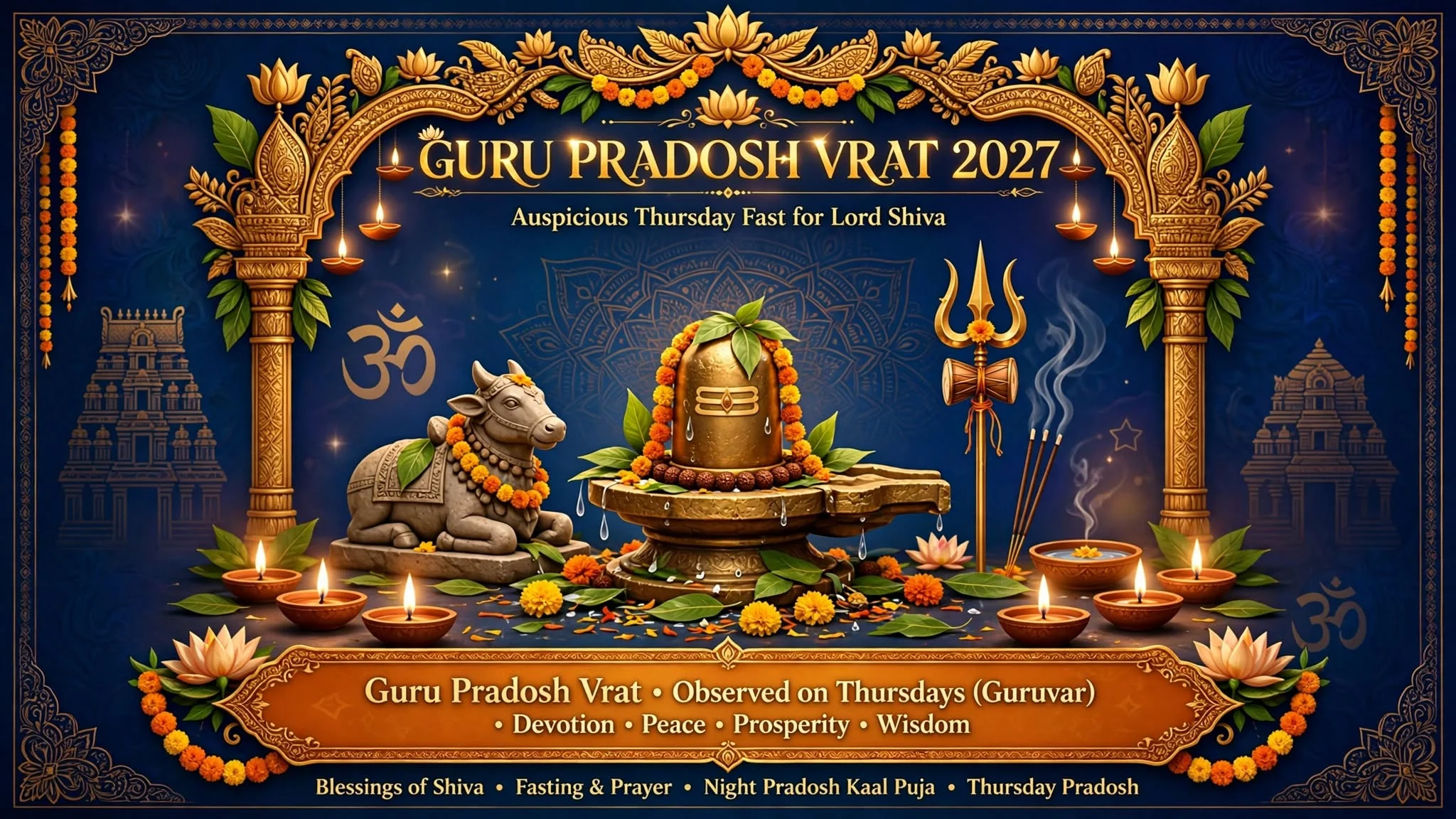
Guru Pradosh Vrat
Guru Pradosh Vrat, also known as Guruvara Pradosham or Brihaspati Pradosham, is a sacred bimonthly Hindu fasting observance occurring when the Trayodashi tithi (thirteenth lunar day) coincides with a Thursday (Guruvara) during the twilight Pradosha Kaal period.
View Festival Guide
Saturday, Jul 3, 2027
Anvadhan
Anvadhan (अन्वाधान) is an ancient, highly revered Vedic ritual and spiritual observance in Sanatana Dharma performed on the day immediately preceding the New Moon (Amavasya) or Full Moon (Purnima). Rooted in the pristine traditions of the Shrauta and Grihya Sutras, Anvadhan literally translates to 'the solemn placing and replenishment of sacred fuel wood into the consecrated Vedic fires'. In traditional Vedic ritualism, householders (Grihasthas) and priests who maintain the sacred Agnihotra fires perform Anvadhan to prepare the sacrificial altars for the grand Darsha Yajna (New Moon sacrifice) or Paurnamasa Yajna (Full Moon sacrifice) scheduled for the following day.
View Festival Guide

Saturday, Jul 3, 2027
Darsha Amavasya
Darsha Amavasya is a significant new moon observance in the Hindu calendar designating the specific night when the Moon is completely invisible to the human eye, having fully merged into the conjunction of the Sun.
View Festival Guide