




Vijaya Ekadashi is an eminently sacred Hindu fasting observance celebrated on the eleventh day (Ekadashi tithi) of the Krishna Paksha (waning moon fortnight) during the lunar month of Phalguna according to the North Indian Purnimanta calendar (corresponding to Magha Krishna Paksha in the Amanta calendar followed in southern and western India). The word 'Vijaya' signifies unconquerable triumph, victory, and overcoming formidable adversaries. Dedicated to Lord Vishnu in His venerable manifestation as Sri Narayana, this holy Ekadashi is revered across Sanatana Dharma as the supreme vow for eradicating insurmountable hurdles, dissolving profound karmic obstacles, and ensuring definitive triumph in righteous endeavors.
Vijaya Ekadashi 2027: Date, Puja Timings, Rituals & Stories
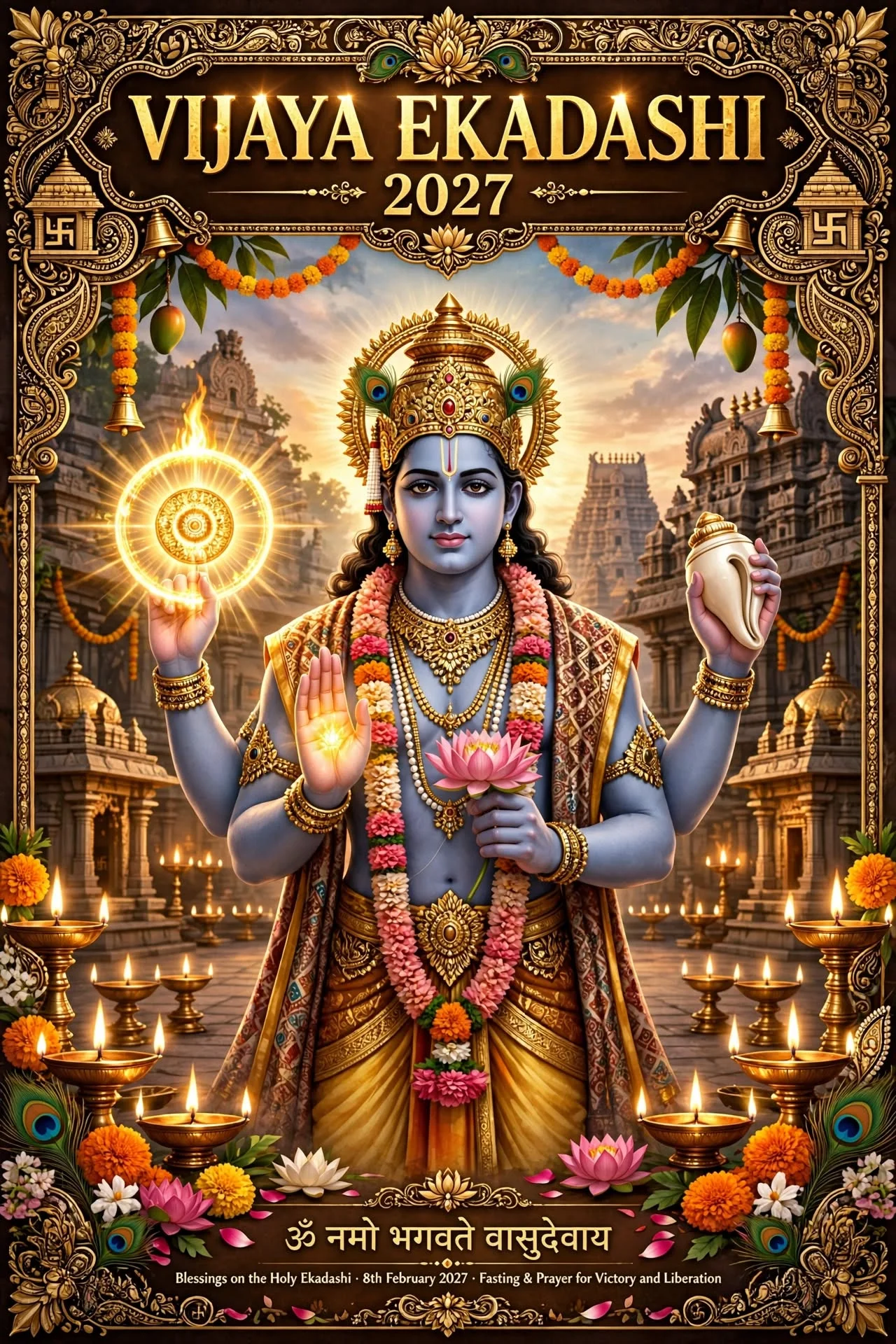
Vijaya Ekadashi Timings & Panchang
Important festival dates and auspicious timings
Usha Arghya (Sunrise)
06:58 am
Sandhya Arghya (Sunset)
06:12 pm
Start Date
Wednesday, 17 Feb 2027
Puja Muhurat
08:19 pm – 05:32 pm
Vijaya Ekadashi
The antiquity and religious sanction of Vijaya Ekadashi are extolled in the Skanda Purana (Brahma Khanda) and the Padma Purana (Uttara Khanda). In these holy texts, Lord Brahma reveals the sublime merits of this vrat to Sage Narada, and Lord Sri Krishna expounds its supreme potency to King Yudhishthira during the Mahabharata era. Scriptural tradition records that whoever observes this sacred fast with pure devotion, disciplined restraint, and unwavering faith inherits the fruits of performing grand Vedic sacrifices like the Ashwamedha Yajna.
A legendary cornerstone of Vijaya Ekadashi is its direct association with Maryada Purushottama Lord Sri Rama. When Lord Rama and the Vanara army stood halted on the shores of the vast southern ocean seeking to reach Lanka and rescue Goddess Sita, Sage Bakadalbhya advised Lord Rama to observe the Vijaya Ekadashi Vrat along with His commanders. Through the flawless observance of this vow atop a consecrated sacred water pot (Kalash), the roaring ocean yielded, the celestial Setu was constructed, and Lord Rama achieved resounding victory over the demon king Ravana.
Devotees observe Vijaya Ekadashi through rigorous dawn-to-dusk fasting (either complete waterless Nirjala or fruit-based Phalahari), performing the elaborate Shodashopachara worship of Lord Vishnu, reciting the sacred Vishnu Sahasranama, and observing a night-long devotional vigil (Jagaran). The fast culminates on Dvadashi (the twelfth day) with the ritual donation of a consecrated grain-filled urn to a worthy Brahmin, bringing supreme spiritual merit, inner peace, and triumph over external and internal adversaries.
Why is Vijaya Ekadashi Celebrated?
Vijaya Ekadashi is celebrated to invoke the invincible grace of Lord Vishnu to conquer insurmountable obstacles, eliminate personal adversities, and attain triumph (Vijaya) in righteous life pursuits.
The festival commemorates the supreme observance undertaken by Lord Sri Rama upon the advice of Sage Bakadalbhya on the seashore before bridging the ocean to Lanka, demonstrating that even divine incarnations honor Vedic vows to establish righteousness (Dharma).
Devotees observe this sacred day to purge severe accumulated sins (Papam), cleanse psychic impressions, attain peace of mind, and secure spiritual liberation (Moksha) along with worldly victory.
Scriptural Chronicles and Sacred Lore of Vijaya Ekadashi
Lord Brahma Expounds Vijaya Ekadashi to Sage Narada
The scriptural origin of Vijaya Ekadashi is enshrined in the Skanda Purana (Brahma Khanda) and the Padma Purana (Uttara Khanda). Sage Narada approached Lord Brahma, the creator of the universe, with folded hands and enquired: 'O Divine Father, please enlighten me about that sacred vow occurring in the dark fortnight of Phalguna which bestows instant victory over all obstacles and cleanses the mortal being of accumulated sins.'
Lord Brahma replied with great joy: 'O Narada, listen attentively to the sacred history of Vijaya Ekadashi. This Ekadashi possesses the supreme power to annihilate even the heaviest heaps of sins. In ancient times, neither gods nor sages knew of a more potent day for achieving victory in righteous battles. Whoever listens to or observes this fast with disciplined faith attains glory both in this world and the highest abode of Vaikuntha.'
Lord Sri Rama's Ocean Crossing and the Counsel of Sage Bakadalbhya
The celebrated historical narrative involves Lord Sri Rama during the Treta Yuga. Following the abduction of Goddess Sita by the ten-headed demon king Ravana, Lord Rama and Lakshmana marched southward with the Vanara army led by Sugriva, Angada, and Hanuman. Reaching the vast and turbulent shores of the Indian Ocean, the army encountered a seemingly impassable barrier.
Seeing the vast waters churning with ferocious marine creatures and impassable depths, Lord Rama consulted Lakshmana, saying: 'O brother, what virtuous vow or austere measure can enable this vast army to cross this roaring sea without suffering destruction?' Lakshmana suggested: 'O Lord, nearby resides the venerable sage Bakadalbhya, whose hermitage overlooks this coast. Being a seer of past, present, and future, he will surely guide our path.'
Lord Rama approached Sage Bakadalbhya's ashram with deep reverence and bowed before him. The enlightened sage recognized Lord Rama as the supreme Supreme Being in mortal form and said: 'O Rama, although You are the omnipotent Lord of all creation, You walk this earth to demonstrate ideal human conduct. On the upcoming Phalguna Krishna Ekadashi, observe the rigorous vow of Vijaya Ekadashi. Prepare a sacred pot made of gold, silver, copper, or unblemished clay, fill it with fragrant holy water, place seven grains beneath it, decorate it with mango leaves, and install a golden idol of Lord Narayana atop it. Observe an unbroken fast with night vigil. By the efficacy of this holy rite, You will conquer the turbulent sea, vanquish Ravana, and rescue Devi Sita with triumph.' Lord Rama faithfully observed this vow along with His entire army, leading to the miraculous bridge construction and victorious return.
Esoteric Dimensions and Karmic Merits of Vijaya Ekadashi
Triumph Over Inner Enemies (Shadripu Vijaya)
While worldly lore highlights external victory over physical adversaries, the higher spiritual meaning of 'Vijaya' is victory over the six internal enemies of the soul: Kama (lust), Krodha (anger), Lobha (greed), Moha (delusion), Mada (arrogance), and Matsarya (jealousy).
By subduing bodily urges through fasting and anchoring the consciousness in the holy name of Lord Narayana, the spiritual practitioner conquers these subtle afflictions and secures unshakeable inner peace.
The Mystical Symbolism of the Kalash and Seven Grains
The core ritual of Vijaya Ekadashi involves consecrating an earthen, copper, or silver Kalash (water pot) filled with scented waters and mango leaves, placed over Sapta-Dhanya (seven sacred grains: barley, wheat, rice, sesame, moong, gram, and millet).
The Kalash represents the cosmos and the human body (Pinda), while the pure water symbolizes divine consciousness. The seven grains represent the seven primary bodily tissues (Dhatus) and agricultural abundance. Installing Lord Narayana atop the Kalash sanctifies the practitioner's total physical and metaphysical being.
Annihilation of Chronic Karmic Obstacles (Prarabdha Shuddhi)
The Skanda Purana declares that severe negative karmas accumulated across multiple lifetimes dissolve like darkness before the rising sun when Vijaya Ekadashi is observed with sincerity.
For individuals suffering from persistent failures in education, career, business, or spiritual sadhana despite sincere efforts, this vrat acts as a divine catalyst to break stagnation and open pathways of success.
Attainment of Vaikuntha and Ultimate Liberation
Fasting on Ekadashi harmonizes the lunar rhythms that govern biological fluids and mental states. On the eleventh tithi, the mind is naturally inclined toward higher contemplation.
Comprehensive Ritual Observance and Guide for Vijaya Ekadashi
Dashami Preparations and Purificatory Vow
The observance begins on Dashami (the tenth day). Devotees consume a single light, pure vegetarian sattvic meal before sunset, avoiding grains like lentils, heavy oils, and garlic/onion.
Devotees maintain celibacy, brush teeth with botanical twigs (Datan), rinse their mouth thoroughly, and sleep with a calm mind, preparing for the sacred dawn vigil.
Ekadashi Dawn Awakening, Snana, and Sankalpa
Wake up during Brahma Muhurta (approximately 90 minutes before sunrise). Take a holy bath in a sacred river, lake, or with clean water infused with holy Gangajal and Tulsi leaves.
Wear fresh yellow or white traditional clothes. Sit facing East before the altar, hold water, rice grains, flowers, and a coin in your right hand, and recite the solemn Sankalpa vow to observe the Vijaya Ekadashi fast for the pleasure of Lord Sri Hari Vishnu.
Installation of the Sacred Vijaya Kalash and Shodashopachara Worship
Spread clean sand or earth on a wooden stool and arrange the seven sacred grains (Sapta-Dhanya). Place a clean unblemished Kalash filled with scented water, supari, and a coin.
Adorn the rim of the Kalash with five fresh mango or Ashoka leaves and place a coconut or a copper lid containing rice upon it. Reverently install a golden, brass, or stone murti of Lord Vishnu atop the pot. Perform full Shodashopachara worship with Chandan, Akshata, Tulsi leaves, incense, deepa, and Naivedya.
Ratri Jagaran, Dvadashi Puja, and Charitable Parana
Spend the day reciting the Vishnu Sahasranama, Bhagavad Gita, and Vijaya Ekadashi Vrat Katha. At night, observe Ratri Jagaran by singing devotional bhajans and chanting the Maha-Mantra without sleeping.
Vijaya Ekadashi Puja Vidhi (Step by Step)
- 1
Brahma Muhurta Awakening and Purificatory Snana
Wake before dawn during Brahma Muhurta. Recite the Pratah Smarana stotras of Lord Vishnu and take a purificatory bath in clean water mixed with sacred Gangajal, chanting: 'Gange Cha Yamune Chaiva Godavari Saraswati Narmade Sindhu Kaveri Jalesmin Sannidhim Kuru'.
- 2
Solemn Vrat Sankalpa
Sit facing East upon a clean woolen or Kusha asana. Take holy water, white unbroken rice (akshata), betel nut, and a copper coin in your right palm. Recite the formal Sankalpa vow committing to an unbroken fast on Vijaya Ekadashi for the eradication of all sins and attainment of divine victory.
- 3
Preparation of the Sapta-Dhanya Platform
Clean the puja altar and drape a wooden chowki with a fresh yellow silk cloth. Spread a layer of clean earth or sand and neatly arrange the seven sacred grains (Sapta-Dhanya: barley, wheat, rice, sesame, moong, gram, and millet) to form a sacred foundation.
- 4
Consecration and Sthapana of the Sacred Kalash
Place a spotless gold, silver, copper, or clay Kalash upon the grain platform. Fill the pot with clean scented water, a pinch of sandalwood, a betel nut, and a sacred coin. Place five fresh mango leaves or Ashoka leaves across its mouth.
Vijaya Ekadashi Puja Samagri List
Kalash and Sapta-Dhanya Foundation Items
Special foundational elements required for setting up the Vedic Vijaya Kalash platform.
- Seven sacred grains (Sapta-Dhanya: barley, wheat, rice, sesame, moong, gram, and millet) - 100 grams each
- Clean copper, brass, or unbaked earthen Kalash with lid
- Five fresh mango or Ashoka tree leaves
- Clean wooden stool (Chowki) draped in pure yellow unstitched silk cloth
- Whole unbroken coconut wrapped in sacred red thread (Kalava/Mauli)
Deity Consecration and Fragrance Essentials
Aromatic pastes, holy waters, and ceremonial garments for Lord Vishnu.
- Idol of Lord Vishnu (or Shaligram Shila)
- Panchamrita ingredients (cow milk, curd, honey, ghee, sugar) and holy Gangajal
- Pure yellow sandalwood paste (Gopi Chandan) and Ashtagandha
- Fresh Tulsi leaves (harvested on Dashami, never plucked on Ekadashi)
- Garland of fresh yellow marigolds and lotus flowers
Naivedya, Aarti, and Dana (Donation) Items
Feast offerings, lights, and charitable items distributed on Dvadashi morning.
- Pure cow ghee lamp with cotton wicks and Bhimseni camphor for Aarti
Mantras and Prayers for Vijaya Ekadashi
Vijaya Ekadashi Vrat Rules and Fasting Guidelines
Dietary and Fasting Discipline
Strict dietary guidelines mandated for observing the Vijaya Ekadashi Vrat:
- Devotees observe either a waterless (Nirjala) fast or consume only fruits, milk, and water (Phalahari) throughout the day.
- Complete abstention from all cereals, grains, rice, wheat, corn, pulses, beans, onions, and garlic is mandatory.
- Do not consume food prepared with common sea salt; use sendha namak (rock salt) sparingly if consuming phalahar.
- Do not pluck Tulsi leaves on Ekadashi tithi; harvest required leaves on Dashami afternoon.
Behavioral and Spiritual Conduct
Ethical and spiritual observances during the twenty-four hours of Ekadashi:
- Practice strict celibacy (Brahmacharya), maintain truthful speech, and avoid anger, gossip, and harsh language.
- Do not sleep during the daytime on Ekadashi, as daytime sleeping dissipates accumulated spiritual energy.
- Engage in unbroken chanting of 'Om Namo Bhagavate Vasudevaya' or the Hare Krishna Maha-Mantra.
- Observe Ratri Jagaran by participating in devotional singing, listening to katha, or silent meditation.
Dvadashi Parana Regulations
Rules for properly concluding the fast on Dvadashi (the twelfth day):
- Parana must strictly be completed after sunrise during the prescribed Dvadashi Parana muhurat window.
Dos and Don'ts of Vijaya Ekadashi
Good Practices (Do's)
- Wake early during Brahma Muhurta and take a purificatory bath with clean water mixed with Gangajal.
- Make a formal Sankalpa to observe the Vijaya Ekadashi Vrat with devotion and mental purity.
- Consecrate a sacred Kalash placed over seven grains (Sapta-Dhanya) with a murti of Lord Vishnu atop it.
- Offer fresh yellow flowers, Tulsi leaves, and yellow sandalwood paste to Lord Vishnu.
- Recite the sacred Vishnu Sahasranama, Bhagavad Gita, and Vijaya Ekadashi Vrat Katha.
Vijaya Ekadashi Across Regions
| Region | Local Name |
|---|---|
| Ayodhya and Uttar Pradesh (North India) | Sri Rama Vijaya Utsav & Sarayu Snana |
| Rameshwaram and Tamil Nadu (South India) | Setu Snanam and Rama Puja |
| Gujarat and Western India | Dwarkadhish Ekadashi Mahotsav |
| Odisha (Puri Jagannath Temple) | Mahaprabhu Ekadashi Besha |
Vijaya Ekadashi FAQs
What is Vijaya Ekadashi?
Vijaya Ekadashi is the sacred Hindu fasting day observed on the Krishna Paksha Ekadashi of Phalguna month (Purnimanta) or Magha month (Amanta), dedicated to Lord Vishnu for attaining victory over obstacles and spiritual liberation.
Why is this Ekadashi called 'Vijaya'?
The word 'Vijaya' means supreme victory. According to scriptures, observing this Ekadashi bestows triumph over formidable worldly challenges, inner vices (lust, anger, greed), and chronic karmic impediments.
How is Lord Sri Rama connected to Vijaya Ekadashi?
In the Skanda Purana, when Lord Rama sought to cross the ocean to rescue Sita from Lanka, Sage Bakadalbhya advised Him to observe Vijaya Ekadashi with His army. By observing this vow, the ocean parted, the bridge was constructed, and Lord Rama attained victory over Ravana.
Upcoming Festivals
View All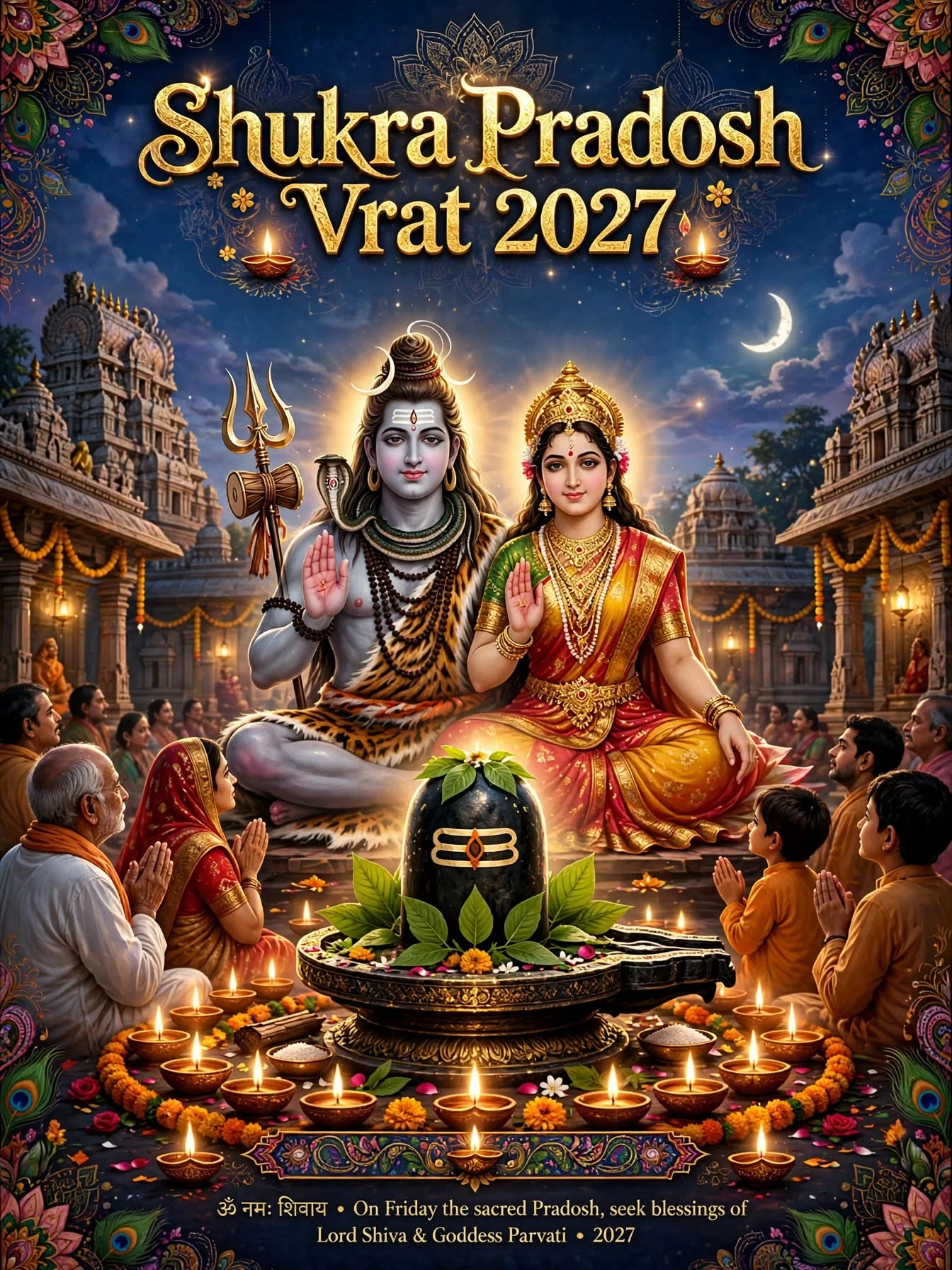
Friday, Mar 5, 2027
Shukra Pradosh Vrat
Shukra Pradosh Vrat is an exceedingly auspicious and spiritually elevating bi-monthly Hindu fasting observance dedicated to Lord Shiva and Goddess Parvati. Occurring on the thirteenth day (Trayodashi tithi) of either the waxing (Shukla) or waning (Krishna) lunar fortnight when it coincides with a Friday (Shukravara), this sacred vow is lauded in Vedic and Puranic literature for bestowing conjugal harmony, material abundance, refined artistic faculties, and liberation from deep-seated planetary afflictions.
View Festival Guide
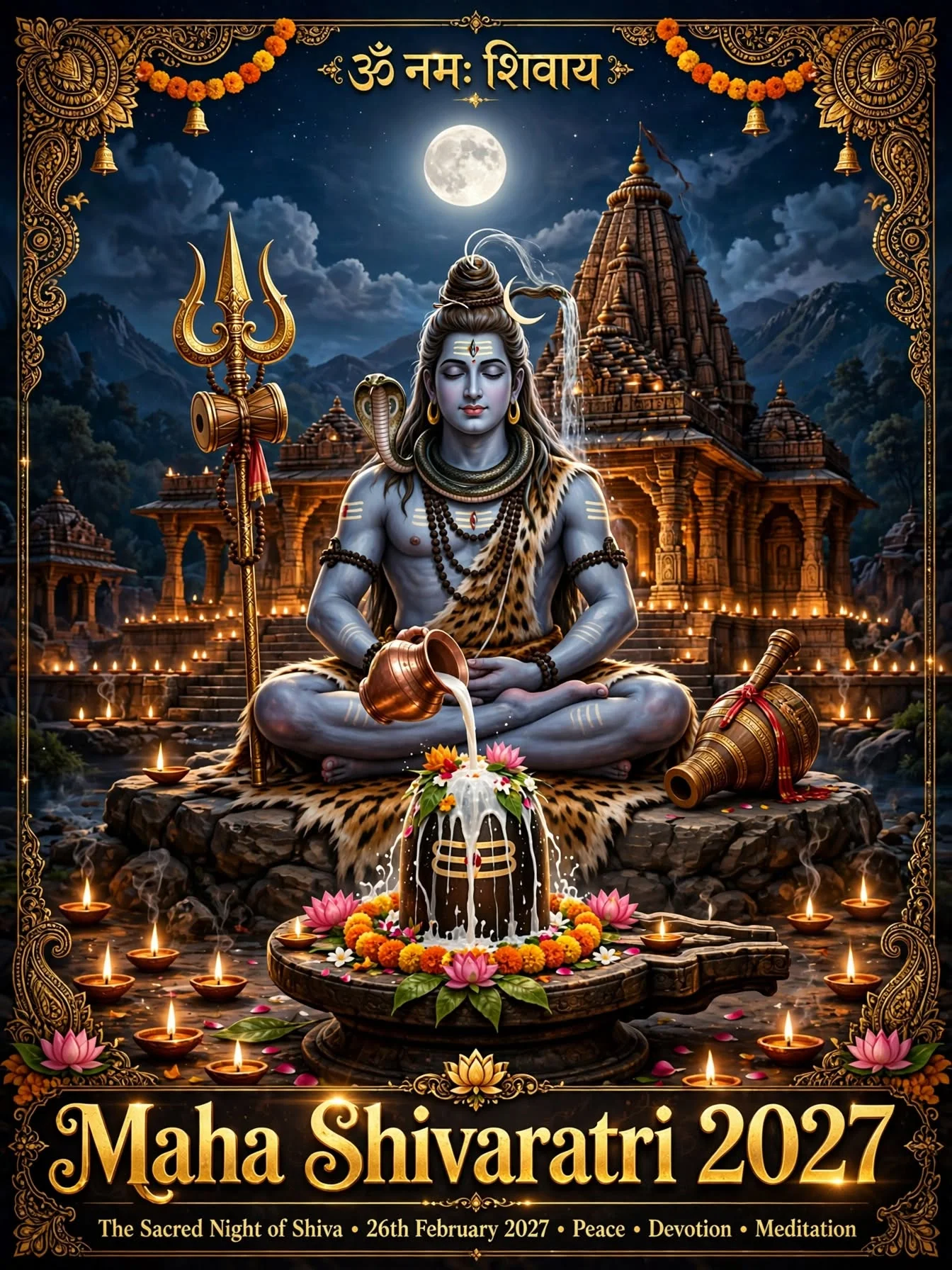
Saturday, Mar 6, 2027
Maha Shivaratri
Maha Shivaratri, literally translated as 'The Great Night of Shiva', is the paramount and most spiritually profound festival dedicated to Lord Shiva in Sanatana Dharma. Celebrated on the fourteenth day (Chaturdashi tithi) of the Krishna Paksha (waning moon fortnight) during the lunar month of Phalguna according to the North Indian Purnimanta calendar (corresponding to Magha Krishna Chaturdashi in the South Indian and Western Indian Amanta calendar), this sacred night represents the pinnacle of Shaivite spiritual devotion, cosmic alignment, and yogic transformation.
View Festival Guide

Sunday, Mar 7, 2027
Darsha Amavasya
Darsha Amavasya is a significant new moon observance in the Hindu calendar designating the specific night when the Moon is completely invisible to the human eye, having fully merged into the conjunction of the Sun.
View Festival Guide
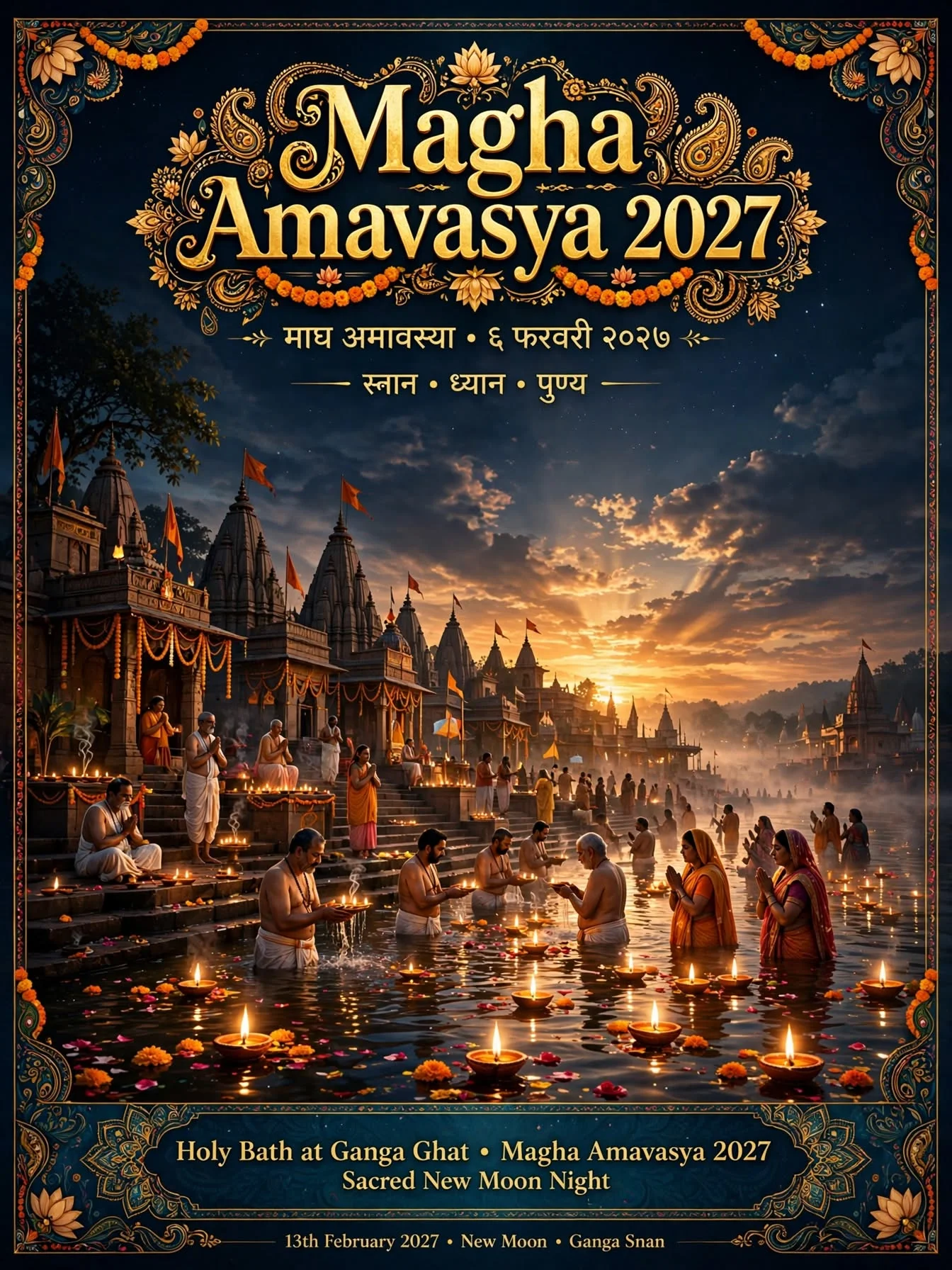
Monday, Mar 8, 2027
Magha Amavasya
Magha Amavasya, celebrated with supreme spiritual reverence throughout India, is the sacred New Moon day (Amavasya tithi) occurring during the holy lunar month of Magha according to the Hindu calendar (specifically marking the culmination of Magha in the Amanta calendar followed in Maharashtra, Gujarat, Karnataka, Andhra Pradesh, and Tamil Nadu, corresponding to the new moon preceding Phalguna). Revered as one of the most spiritually charged junctures in Sanatana Dharma, this sacred day is widely observed as 'Mauni Amavasya'—the holy day of complete ascetic silence (Mauna Vrata), deep contemplation, ancestral redemption, and sacred holy bathing.
View Festival Guide
Monday, Mar 8, 2027
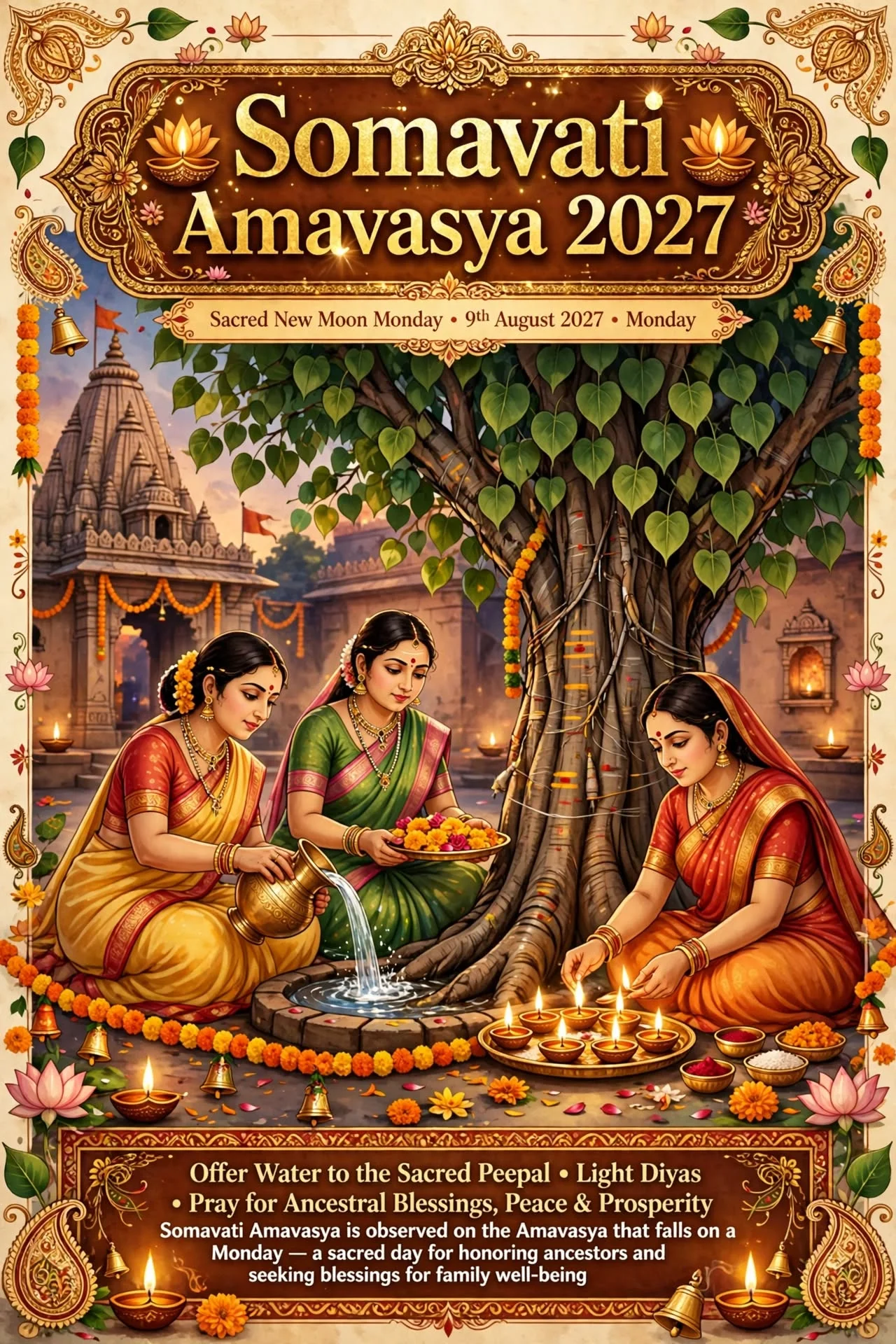
Somavati Amavasya
Somavati Amavasya is an exceedingly rare, sacred, and astrologically exalted Hindu fasting and pilgrimage observance that occurs when the New Moon day (Amavasya tithi) coincides with a Monday (Somavara). In Vedic tradition, Monday is governed by Soma (the Moon God / Chandra Deva) and is supremely sacred to Lord Shiva, who adorns the crescent moon upon His crown as Chandrashekhara. When the quiet, contemplative energy of Amavasya merges with the gentle, nectarine cooling rays of Monday, it creates an extraordinary cosmic alignment that is lauded across Sanatana Dharma as the 'King of all Amavasyas'.
View Festival Guide

Tuesday, Mar 9, 2027
Ishti
Ishti is a foundational Vedic ritual observance appearing prominently in Hindu Panchangs on the Pratipada tithi (the first lunar day) following either Amavasya (new moon) or Purnima (full moon), marking the prescribed performance day for the fortnightly Vedic Darsha-Purnamasa sacrifices.
View Festival Guide

Tuesday, Mar 9, 2027
Chandra Darshana
Chandra Darshana is a revered monthly Hindu observance dedicated to sighting, venerating, and offering oblation to the delicate waxing crescent Moon immediately following the new moon (Amavasya), typically occurring during the twilight of Shukla Paksha Pratipada or Dwitiya.
View Festival Guide

Wednesday, Mar 10, 2027
Phulera Dooj
Phulera Dooj (फुलेरा दूज) is a wonderfully joyous, vibrant, and spiritually sweet Hindu festival celebrated on the second day (Dwitiya tithi) of the Shukla Paksha (waxing moon fortnight) in the holy month of Phalguna according to the traditional Hindu calendar. Dedicated to the supreme divine couple, Bhagavan Sri Krishna and Sri Radha Rani, this radiant festival heralds the arrival of the spring festival of colors (Holi) across the sacred land of Braj (Vrindavan, Mathura, Barsana, Nandgaon, and Govardhan). The word 'Phulera' is derived from 'Phool' (blossoming flowers), and on this day, the divine realm of Braj is enveloped in an enchanting floral ecstasy.
View Festival Guide