




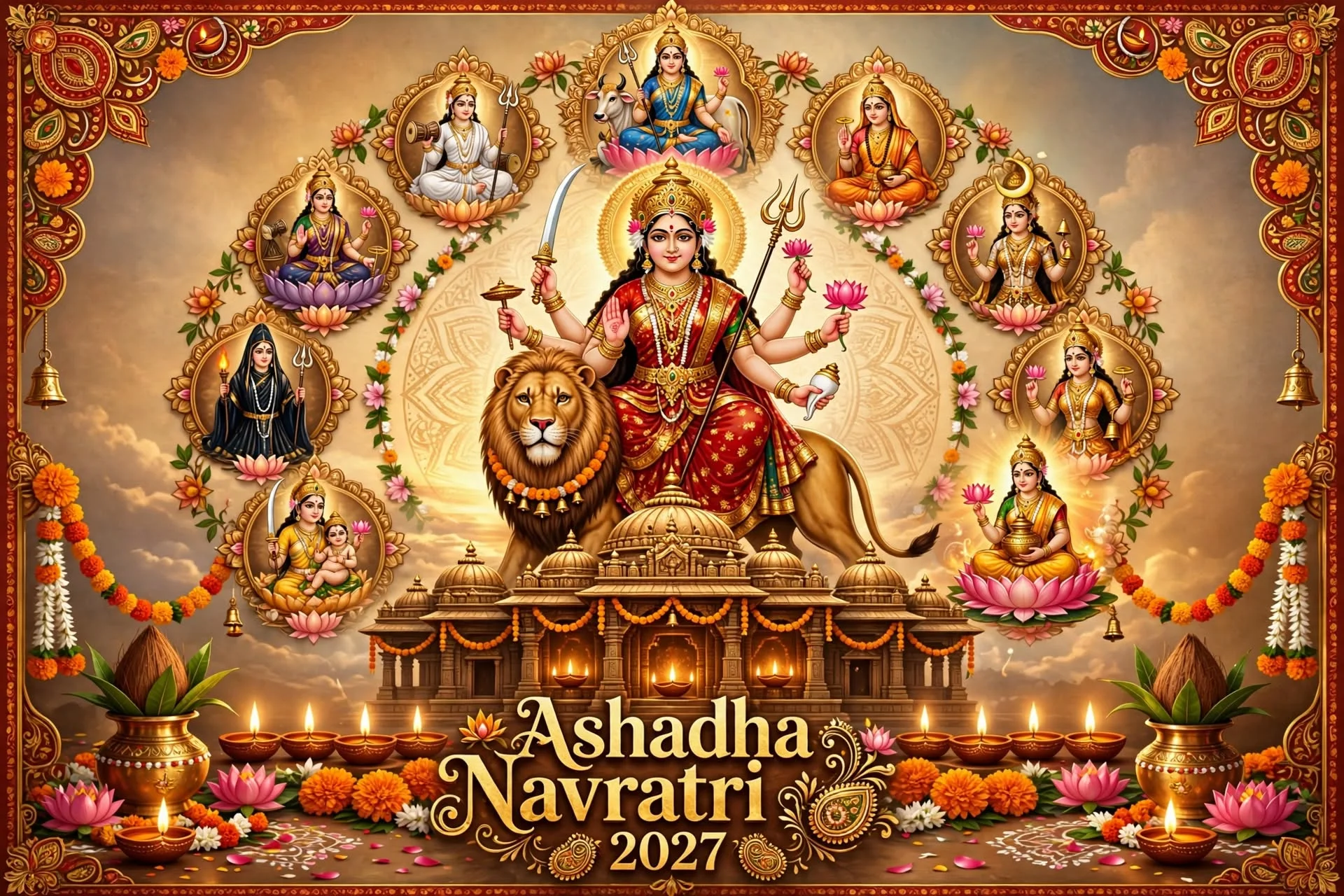
Ashadha Navratri, prominently revered across Shakta and Tantric traditions as Ashadha Gupta Navratri or Varahi Navratri, is a sacred nine-night festival commencing on the Pratipada (first lunar day) and culminating on the Navami (ninth lunar day) of the Shukla Paksha in the Hindu lunar month of Ashadha (occurring in July). While Sharad Navratri (autumn) and Chaitra Navratri (spring) are widely celebrated as public socio-cultural festivals, the two secret or 'Gupta' Navratris—observed in the months of Magha and Ashadha—are esoteric, contemplative periods primarily dedicated to intensive Shakta Sadhana, internal Kundalini awakening, and deep Tantric communion with the Supreme Divine Mother.
Ashadha Navratri 2027: Date, Puja Timings, Rituals & Stories
Ashadha Navratri Timings & Panchang
Important festival dates and auspicious timings
Usha Arghya (Sunrise)
05:28 am
Sandhya Arghya (Sunset)
07:23 pm
Start Date
Sunday, 4 Jul 2027
Puja Muhurat
12:06 pm – 08:31 am
Ashadha Navratri
The presiding cosmological energy of Ashadha Gupta Navratri is concentrated upon the ten cosmic wisdom goddesses known as the Dasha Mahavidyas: Kali (the force of eternal time and dissolution), Tara (the celestial savior and guide), Tripura Sundari / Shodashi (supreme beauty and transcendental awareness), Bhuvaneshwari (sovereign of the manifested cosmos), Bhairavi (ferocious transformative radiance), Chhinnamasta (self-decapitating mastery over desire), Dhumavati (the primordial void and crone wisdom), Bagalamukhi (paralyzer of negative forces and speech), Matangi (creative arts and ministerial power), and Kamala (auspicious wealth and lotus consciousness). Among these, Goddess Varahi, the boar-headed commander-in-chief (Dandanatha) of the divine army of Lalita Maha Tripura Sundari, is accorded paramount veneration during this Ashadha cycle.
Spiritual seekers, initiates, and householders observe Ashadha Navratri through profound inner austerity, ritual silence (Mauna), continuous recitation of the Devi Mahatmya (Durga Saptashati), Sri Suktam, and secret seed mantras. By establishing the sacred Kalash (Ghatasthapana) and maintaining an unextinguished ceremonial flame (Akhanda Jyoti) for nine days, practitioners seek the eradication of internal psychic impurities, protection against external negative energies, spiritual illumination, and the ultimate realization of the Divine Mother as the immanent essence of all creation.
Why is Ashadha Navratri Celebrated?
The observance of Ashadha Gupta Navratri is expounded in core Shakta scriptures including the Devi Bhagavata Purana, Markandeya Purana, and the sacred Lalita Upakhyana of the Brahmanda Purana.
According to the Devi Bhagavata Purana, Lord Vishnu was once locked in an unyielding cosmic duel with the formidable asuras Madhu and Kaitabha, who had emerged from the earwax of the reclining Lord during cosmic dissolution. Seeing that masculine physical strength alone could not subdue the demons born of Tamas, Lord Brahma praised Goddess Mahamaya (Yoga Nidra), imploring Her to withdraw from Vishnu's senses so that the preserver could awaken and channel Her supreme feminine potency (Shakti) to restore cosmic equilibrium. The nine nights of Ashadha commemorate this cosmic activation of dynamic primordial Shakti.
Furthermore, the Lalita Upakhyana describes how Goddess Varahi led the cosmic vanguard against the tyrannical demon Bhandasura, dismantling his illusory war machines and shattering the chains of ignorance. Devotees celebrate this week to invoke Varahi's fierce grace to neutralize obstacles, destroy negative planetary influences, and achieve mastery over the sensory mind.
- Worshiping the Dasha Mahavidyas to attain esoteric spiritual wisdom, mental fortitude, and liberation.
- Propitiating Goddess Varahi, the divine protector and general of the Sri Chakra forces, for absolute victory over adversities.
- Conducting uninterrupted recitation (Akhanda Patha) of the 700 verses of the sacred Durga Saptashati.
- Harmonizing the inner biological chakras with the macrocosmic rhythms of the monsoon seasonal transition.
- Purifying the subconscious mind through strict fasting, mantra japa, and the traditional Kanya Puja of nine young maidens.
Scriptural Foundations in the Devi Bhagavata Purana and Lalita Upakhyana
The Dialogue of Vyasa and King Janamejaya in the Devi Bhagavata
In the third skandha of the Srimad Devi Bhagavata Purana, Maharishi Veda Vyasa instructs King Janamejaya regarding the cosmic cycle of four annual Navratris. Vyasa explains that the universe undergoes four major seasonal equinoctial and solstitial transitions every year, creating subtle shifts in the flow of Prana throughout living beings.
Vyasa states: 'O King, the two Navratris falling in the bright halves of Ashadha and Magha are classified as Gupta (hidden or secret) Navratris. They are the treasured sanctuaries of yogis, ascetics, and genuine seekers of truth. While householders revel in external festivities during Sharad and Chaitra, the wise withdraw their senses during Ashadha to worship the transcendent Mahavidyas in profound secrecy, for spiritual power concealed within produces boundless results.'
The Battle of Goddess Varahi Against the Forces of Bhandasura
The Brahmanda Purana records the epic confrontation between Lalita Tripura Sundari and the demon Bhandasura, who had manifested from the ashes of Kama Deva burned by Shiva's third eye. Bhandasura cast a catastrophic spell of inertia, despair, and paralysis across all three worlds, depriving gods and humans of spiritual motivation.
To vanquish him, the Supreme Goddess dispatched Her chief commander, Goddess Dandanatha Varahi, seated upon Her grand chariot Kiri-Chakra (drawn by fierce boars). Wielding the plough (Hala) to uproot ignorance and the pestle (Musala) to crush egoic delusions, Varahi annihilated the commander Vishukra and his demonic hordes on the fifth and ninth nights of Ashadha, restoring vitality and divine order to the cosmos.
The Tradition of Gupta Sadhana in Shakta Pithas
Historically, ancient Tantric and Shakta monasteries across the fifty-one Shakta Pithas—most notably Kamakhya in Assam, Tarapith in Bengal, Vindhyachal in Uttar Pradesh, and the Varahi temples of Odisha and Tamil Nadu—observed Ashadha Navratri behind closed sanctum doors. Monks and initiates practiced intense night vigils (Nisha Puja), consecrated Yantras, and offered oblations of black sesame, red hibiscus, and herbal extracts into sacred Homa fires, transmitting unbroken oral lineages of esoteric knowledge across millennia.
The Dasha Mahavidyas, Tantric Metaphysics, and Internal Transformation
The Esoteric Symbolism of 'Gupta' (The Power of Inward Secrecy)
In Sanskrit, 'Gupta' denotes that which is hidden, guarded, and internalized. In yogic philosophy, spiritual energy (Shakti) dissipates when constantly displayed for external social approval or vanity. Just as a seed must remain buried deep in the dark moist soil to germinate into a mighty banyan tree, spiritual sadhana must be nurtured in sacred secrecy to awaken its profoundest fruits.
Ashadha Gupta Navratri instructs seekers to withdraw from performative religiosity and practice Pratyahara (sensory internalization), cultivating an intimate, silent relationship with the Divine Mother within the sanctum of the spiritual heart (Hridaya Guha).
The Dasha Mahavidyas: Deconstructing Spiritual Illusions
The ten Mahavidyas worshiped during Ashadha Navratri embody the comprehensive spectrum of cosmic reality, including aspects that conventional human consciousness rejects. Kali represents eternal time and radical destruction of attachment; Dhumavati portrays poverty, widowhood, and the unmanifest cosmic void; Bagalamukhi embodies the sudden paralysis of all mental chatter and hostile intentions.
By worshiping these fierce and sublime manifestations together, the sadhaka transcends dualistic judgments of good and bad, pure and impure, learning to perceive the non-dual presence of the Divine Mother in every facet of existence.
Goddess Varahi and the Subjugation of Animalistic Instincts
Varahi, bearing the boar head and feminine body, represents the divine power of deep instinctual wisdom. The boar digs into the darkest mud to unearth hidden treasures (just as Lord Varaha rescued the Earth from the cosmic depths). Symbolically, Varahi empowers the practitioner to delve fearlessly into the muddy depths of their subconscious mind, rooting out buried resentments, fears, and animalistic desires, transmuting them into spiritual gold.
Daily Ritual Guidelines, Ghatasthapana, and Kanya Puja
Ghatasthapana and Sowing the Sacred Barley (Jawara)
On the Pratipada tithi of Ashadha Shukla Paksha, devotees rise during Brahma Muhurta, cleanse their homes, and prepare the puja altar facing East or North. An earthen tray filled with clean river soil is prepared, and unpolished barley (Jau) seeds are sown, symbolizing fertile creation.
A copper or silver Kalash filled with pure water, Gangajal, coins, betel nuts, and medicinal herbs is placed in the center, crowned with mango leaves and a red silk-wrapped coconut (Shriphal), formally invoking Goddess Durga and the Mahavidyas to abide in the sanctum for nine days.
Akhanda Jyoti and Daily Recitation of the Chandi Patha
A ceremonial brass lamp filled with pure cow ghee or sesame oil is consecrated and lit as the Akhanda Jyoti, tended day and night without allowing the flame to extinguish throughout the nine nights. Devotees recite the Kavacham, Argala Stotram, Keelakam, and the thirteen chapters of the Durga Saptashati every day, or perform systematic Navarna Mantra japa ('Om Aim Hreem Kleem Chamundayai Viche') using a rudraksha or lotus-seed rosary.
Maha Navami Homa and Kanya Pujan
On the ninth day (Maha Navami), a ceremonial sacred fire (Homa) is conducted, offering ghee, sweet rice pudding (Kheer), lotus seeds, and herbal samagri while reciting the 700 verses of the Saptashati. Nine young pre-pubescent girls (representing the nine divine Shaktis) and one young boy (representing Batuka Bhairava) are invited, their feet are reverently washed, and they are offered halwa, puri, black chickpeas, red chunris, and dakshina before concluding the fast.
Ashadha Navratri Puja Vidhi (Step by Step)
- 1
Brahma Muhurta Snana and Shuddhi (Ablution and Purification)
Wake up during Brahma Muhurta, take a holy bath with water consecrated with Gangajal, wear clean red or yellow unstitched clothing, and sprinkle holy water across the worship space reciting the Pavitra mantra.
- 2
Vedi Nirmana and Jau Vapana (Preparing Altar and Sowing Barley)
Spread clean river soil on a square earthen or brass tray, sow sacred barley (Jau) seeds evenly, sprinkle with water, and place the consecrated platform in the north-east corner.
- 3
Ghatasthapana / Kalash Sthapana (Consecration of Sacred Pot)
Place a brass or copper Kalash filled with Gangajal, scented water, a silver coin, supari, and sacred herbs upon the earthen tray. Place mango leaves around its rim and seat a coconut wrapped in red mauli and chunri on top.
- 4
Akhanda Jyoti Prajvalana (Lighting the Eternal Lamp)
Consecrate and light a large cow-ghee or sesame-oil lamp, taking a solemn vow that its flame shall remain uninterruptedly burning for the nine nights as a symbol of divine cosmic consciousness.
- 5
Ashadha Navratri Puja Samagri List
Kalash and Ghatasthapana Materials
- Clean river clay or soil tray and unpolished organic barley seeds (Jau)
- Brass, copper, or silver Kalash with matching metal lid
- Unbroken Gangajal or pure spring water in generous quantity
- Five fresh sacred tree leaves (Pancha Pallava: mango, peepal, banyan, ashoka, gular)
- Clean whole coconut with husk (Shriphal) wrapped in red mauli (sacred thread)
- Silver coin, whole betel nut (Supari), and raw turmeric root
Deity Adornments and Floral Offerings
- Consecrated idol of Goddess Durga / Sri Yantra / Varahi Murti
- Red silk cloth for altar covering and red Chunri with golden embroidery for the Goddess
- Pure Malayagiri red sandalwood paste, Kumkum, Haldi, and Ashtagandha
- Abundant fresh red hibiscus flowers (Jaba pushpa), red roses, and Bilva leaves
- Large brass Akhanda Jyoti lamp with pure cow ghee and thick cotton wicks
- Pure natural camphor (Bhimseni Karpura) and aromatic guggulu incense
Naivedya and Homa Ingredients
- Fresh cow milk, curd, wild honey, pure ghee, and raw sugar for Panchamrita
Mantras and Prayers for Ashadha Navratri
Ashadha Navratri Vrat Rules and Fasting Guidelines
Dietary Code and Fasting Injunctions
Devotees observe fasting according to their spiritual resolve and health status for the entire nine days. Fasting regimens range from drinking only milk and water (Dugdha-Ahar), eating once daily after sunset (Eka-Bhukta), or subsisting on fruits, nuts, buckwheat flour (Kuttu), water chestnut flour (Singhara), and tapioca pearls (Sabudana). All dishes are cooked strictly using pure rock salt (Sendha Namak), avoiding common sea salt, grains, pulses, and turmeric in specific orthodox Shakta lineages.
- Total prohibition of all cereals, rice, wheat, corn, lentils, beans, onions, and garlic.
- Strict abstinence from non-vegetarian food, alcohol, tobacco, and processed packaged foods.
- Consumption of food should be preceded by daily offering to the Akhanda Jyoti and the Goddess.
Yogic Discipline and Conduct
Because Ashadha Navratri is a period of esoteric sadhana, seekers observe Brahmacharya (sexual abstinence), sleep on a clean floor mat or wooden bed, practice partial silence (Mauna) during the forenoon hours, avoid shaving or cutting hair and nails, and refrain completely from anger, gossip, and falsehood.
Dos and Don'ts of Ashadha Navratri
Good Practices (Do's)
- Wake up during Brahma Muhurta, cleanse the altar, and perform Ghatasthapana on Pratipada tithi.
- Keep an unextinguished Akhanda Jyoti (sacred lamp) burning with pure ghee or sesame oil for nine days.
- Recite the Durga Saptashati, Devi Kavacham, and Navarna Mantra with devotional absorption.
- Wear clean, unstitched red or yellow clothing while performing worship.
- Perform Kanya Pujan on Ashtami or Navami, treating young girls as living embodiments of the Goddess.
Ashadha Navratri Across Regions
| Region | Local Name |
|---|---|
| Assam and Bengal | Kamakhya and Tarapith Gupta Sadhana |
| Tamil Nadu and Karnataka | Varahi Navaratri / Ashadha Navaratri |
| North India (Himachal Pradesh, Uttar Pradesh, Rajasthan) | Gupta Navratri and Kanya Pujan |
Ashadha Navratri FAQs
Why is Ashadha Navratri called 'Gupta' (Secret) Navratri?
It is called Gupta Navratri because its observance is traditionally focused on inward, private, and esoteric spiritual sadhana rather than public social festivities. The spiritual merits and mantras practiced in secrecy during this time are believed to bear profound fruit.
Who are the Dasha Mahavidyas worshiped during this Navratri?
The Dasha Mahavidyas are the ten primary wisdom goddesses of Shakta philosophy: Kali, Tara, Tripura Sundari (Shodashi), Bhuvaneshwari, Bhairavi, Chhinnamasta, Dhumavati, Bagalamukhi, Matangi, and Kamala.
Why is Goddess Varahi specially venerated during Ashadha Navratri?
Goddess Varahi is the commander-in-chief of Goddess Lalita Tripura Sundari's celestial forces. Ashadha Shukla Paksha is considered Her prime manifest period, when Her grace is invoked to root out deep subconscious fears, negative karma, and planetary afflictions.
Upcoming Festivals
View All
Sunday, Jul 4, 2027
Ishti
Ishti is a foundational Vedic ritual observance appearing prominently in Hindu Panchangs on the Pratipada tithi (the first lunar day) following either Amavasya (new moon) or Purnima (full moon), marking the prescribed performance day for the fortnightly Vedic Darsha-Purnamasa sacrifices.
View Festival Guide
Sunday, Jul 4, 2027
Jyeshtha Amavasya
Jyeshtha Amavasya is the sacred new moon tithi that marks the culmination of the Krishna Paksha in the Hindu lunar month of Jyeshtha according to the Amavasyanta calendar, transitioning into the sacred monsoon month of Ashadha in the Gregorian calendar month of July. In Hindu cosmology, Amavasya is governed by the Pitrus (ancestral souls) and Aryaman, the presiding solar deity of ancestral realms. As the sun and moon align in perfect celestial conjunction, cosmic spiritual energies become inward-flowing, rendering this day uniquely potent for ancestral veneration, planetary purification, and austere introspective sadhana.
View Festival Guide

Monday, Jul 5, 2027
Chandra Darshana
Chandra Darshana is a revered monthly Hindu observance dedicated to sighting, venerating, and offering oblation to the delicate waxing crescent Moon immediately following the new moon (Amavasya), typically occurring during the twilight of Shukla Paksha Pratipada or Dwitiya.
View Festival Guide
Monday, Jul 5, 2027
Jagannath Rathyatra
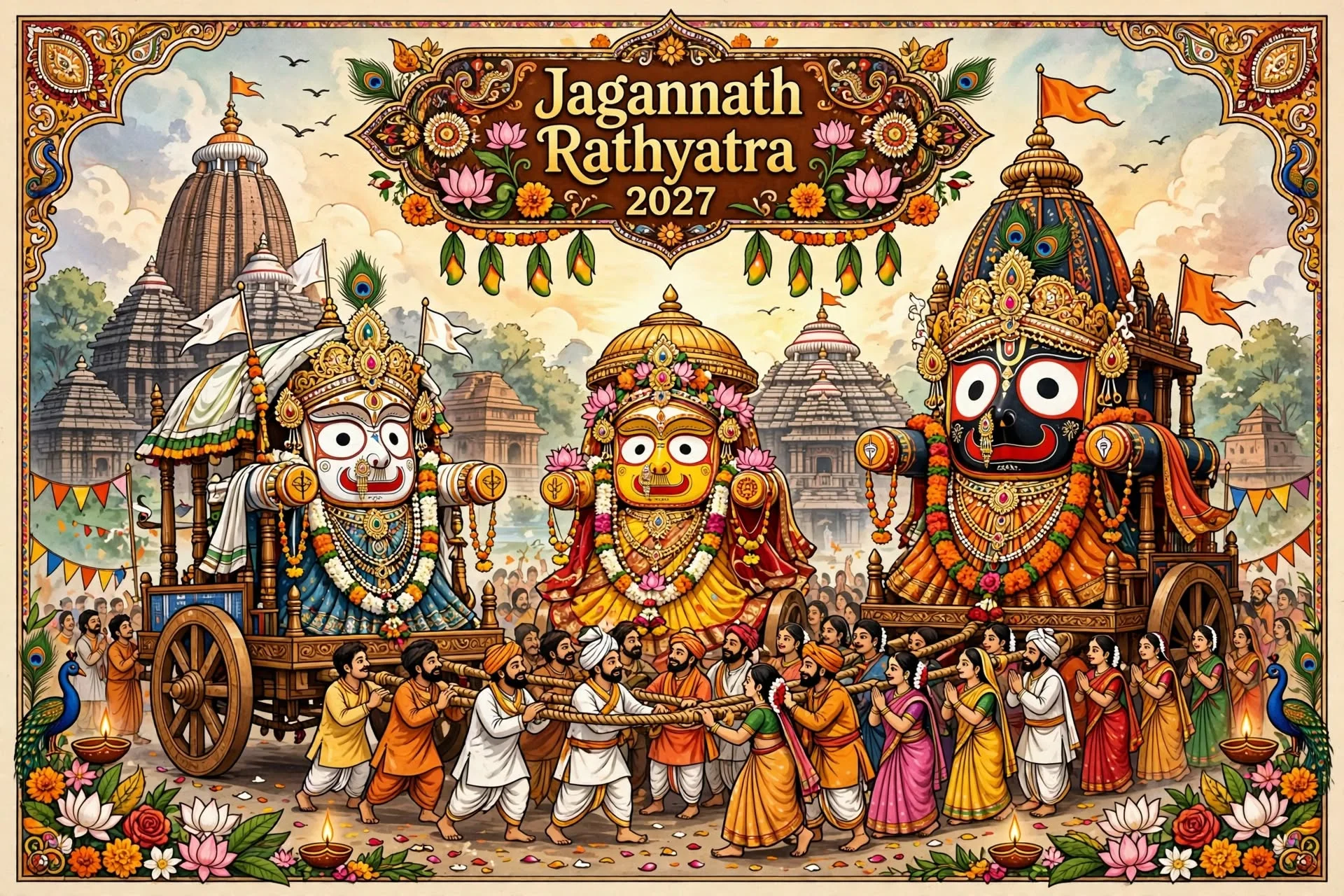
Jagannath Rathyatra, celebrated with cosmic majesty on the Dwitiya tithi (second lunar day) of Shukla Paksha in the Hindu month of Ashadha (occurring in July), is one of the most ancient, grandest, and spiritually celebrated chariot festivals on earth. Originating from the sacred coastal city of Puri (Srikshetra / Jagannath Puri) in Odisha, this monumental nine-day event marks the celestial journey of Bhagwan Jagannath—the Lord of the Universe and an affectionate manifestation of Lord Sri Krishna—accompanied by His elder brother Lord Balabhadra (Balarama) and His younger sister Devi Subhadra, from their magnificent 12th-century shrine (Srimandir) to their ancestral garden abode at the Gundicha Temple, situated three kilometers away.
View Festival Guide
Wednesday, Jul 14, 2027
Devshayani Ekadashi
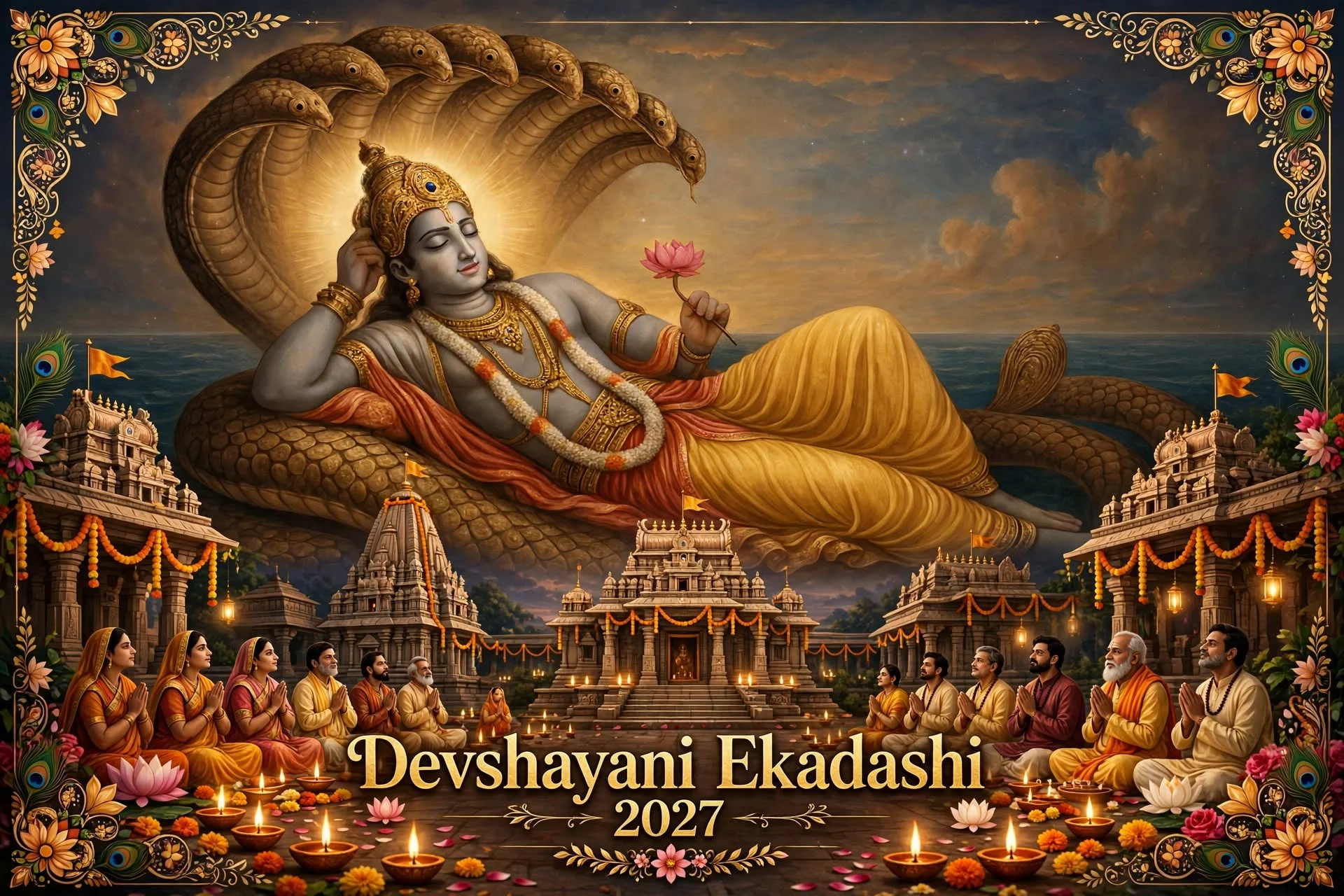
Devshayani Ekadashi, also reverently celebrated as Ashadhi Ekadashi, Padma Ekadashi, or Hari Shayani Ekadashi, falls on the eleventh lunar day (Ekadashi) of the Shukla Paksha (waxing phase of the moon) in the sacred Hindu month of Ashadha. This sanctified tithi marks the celestial moment when Bhagwan Vishnu, the cosmic preserver, enters an epoch of four months of cosmic meditative slumber (Yoga Nidra) upon the coils of the thousand-headed serpent Adishesha in the Kshirasagara (Cosmic Ocean of Milk).
View Festival Guide
Thursday, Jul 15, 2027
Guru Pradosh Vrat
Guru Pradosh Vrat, also known as Guruvara Pradosham or Brihaspati Pradosham, is a sacred bimonthly Hindu fasting observance occurring when the Trayodashi tithi (thirteenth lunar day) coincides with a Thursday (Guruvara) during the twilight Pradosha Kaal period.
View Festival Guide
Friday, Jul 16, 2027
Jayaparvati Vrat
Jayaparvati Vrat, also known as Gauri Vrat or Jaya-Vijaya Vrata, is an ancient, highly revered five-day spiritual observance commencing on the Trayodashi tithi (thirteenth lunar day) of Shukla Paksha in the holy Hindu month of Ashadha (occurring in July) and concluding on Krishna Tritiya. Celebrated with immense piety and joy across Western India—predominantly in Gujarat and parts of Rajasthan and Maharashtra—the vrata is dedicated to Goddess Parvati (in Her victorious aspect as Jaya) and Lord Shiva. It is observed primarily by unmarried maidens praying for a virtuous, long-lived, and loving husband, as well as by married women seeking enduring marital bliss (Akhanda Saubhagya), domestic peace, and the welfare of their family lineage.
View Festival Guide
Saturday, Jul 17, 2027
Kokila Vrat
Kokila Vrat is a rare, mystical, and deeply revered Hindu fasting observance celebrated on the Purnima (full moon day) of the Hindu lunar month of Ashadha, often extending into the sacred monsoon month of Shravana (falling in July). Dedicated to Goddess Parvati (in Her form as Sati) and Lord Shiva, this sanctified vrata derives its name from 'Kokila' (the Indian cuckoo bird), commemorating the poignant cosmological epoch when Goddess Sati incarnated as a divine cuckoo bird for ten thousand celestial years in the sacred groves of Nandanavana to perform austere, single-minded penance to reunite with Lord Shiva.
View Festival Guide