




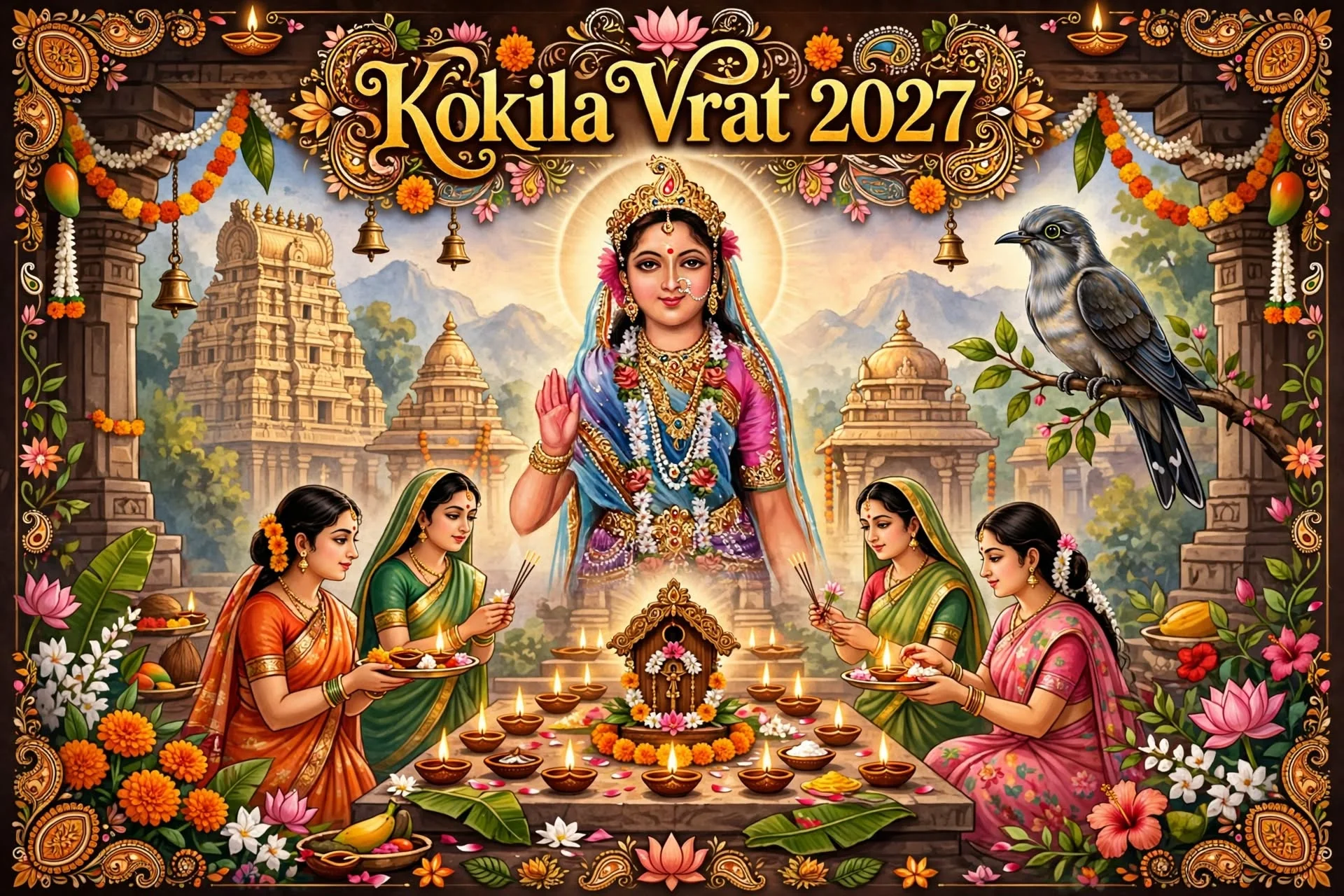
Kokila Vrat is a rare, mystical, and deeply revered Hindu fasting observance celebrated on the Purnima (full moon day) of the Hindu lunar month of Ashadha, often extending into the sacred monsoon month of Shravana (falling in July). Dedicated to Goddess Parvati (in Her form as Sati) and Lord Shiva, this sanctified vrata derives its name from 'Kokila' (the Indian cuckoo bird), commemorating the poignant cosmological epoch when Goddess Sati incarnated as a divine cuckoo bird for ten thousand celestial years in the sacred groves of Nandanavana to perform austere, single-minded penance to reunite with Lord Shiva.
Kokila Vrat 2027: Date, Puja Timings, Rituals & Stories
Kokila Vrat Timings & Panchang
Important festival dates and auspicious timings
Usha Arghya (Sunrise)
05:34 am
Sandhya Arghya (Sunset)
07:20 pm
Start Date
Saturday, 17 Jul 2027
Puja Muhurat
04:35 pm – 06:48 pm
Kokila Vrat
Predominantly observed by married women praying for uninterrupted marital bliss (Akhanda Saubhagya), domestic joy, and the protection of their husbands, as well as by unmarried maidens seeking virtuous and faithful spouses, Kokila Vrat is celebrated with profound ritual austerity. The central sacramental feature of the observance involves sculpting a miniature effigy of a cuckoo bird out of pure river clay, fragrant sandalwood paste, unbaked grain dough, or mashed wild berries, which is then consecrated upon the domestic altar as the living embodiment of Devi.
The observance requires rising during Brahma Muhurta, performing ceremonial ablutions with water infused with medicinal forest herbs, and adhering to an uncompromising salt-free fast (Alona). Devotees listen attentively to the songs of natural cuckoo birds echoing through the monsoon canopy; according to scripture, hearing the authentic melodious call of a cuckoo bird before breaking the day's fast is hailed as a divine omen of impending happiness, spiritual rejuvenation, and the fulfillment of all righteous desires.
Why is Kokila Vrat Celebrated?
The observance of Kokila Vrat is detailed in the sacred Puranic dialogues found in the Bhavishya Purana, Skanda Purana (Kashi Khanda), and the Shiva Purana.
According to the Bhavishya Purana, when Goddess Sati attended the royal sacrifice (Daksha Yajna) uninvited by Her father Prajapati Daksha, She was subjected to intolerable insults against Her husband, Lord Shiva. Before immolating Herself in the yogic sacrificial fire, Sati realized that in Her fury, She had briefly disregarded Lord Shiva's gentle counsel advising Her not to attend the sacrifice. Because She had momentarily deviated from absolute obedience to Her divine consort, She was ordained to endure a penance of ten thousand celestial years in the physical form of a cuckoo bird (Kokila) in the enchanted forest of Nandanavana.
Throughout those ten millennia as a cuckoo, the Goddess subsisted solely on tree sap and fallen leaves, chanting the sacred five-syllable Panchakshari mantra of Lord Shiva without interruption. Impressed by Her unwavering devotion, Lord Shiva appeared on Ashadha Purnima, absolved Her of the bird form, and granted Her the boon of being reborn as Parvati, daughter of King Himavat, to be reunited with Him forever in eternal divine matrimony.
- Commemorating Goddess Sati's ten-thousand-year penance as a celestial cuckoo bird in Nandanavana.
- Attaining the divine grace of Lord Shiva and Goddess Parvati for unbroken marital happiness and longevity of spouse.
- Dispelling marital discord, emotional estrangement, and the adverse karmic effects of past disrespect toward loved ones.
- Purifying bodily humors and calming the mind through the consumption of herbal baths and salt-free food.
- Fostering intimate ecological communion with nature and the sacred avian life of the monsoon season.
Scriptural Origins in the Bhavishya Purana and the Legend of Sati's Penance
Daksha Yajna and Sati's Departure from Shiva's Abode
In the Uttara Parva of the Bhavishya Purana, Sage Narada asks Lord Shiva about the vrata that has the power to restore broken marriages, cure deep-seated physical infirmities, and grant auspiciousness to devoted women. Lord Shiva lovingly recounts the secret narrative of His own eternal consort, Sati.
When Prajapati Daksha initiated his vast horse sacrifice, intentionally excluding Shiva, Sati pleaded with Shiva to attend. Shiva gently cautioned Her that visiting an assembly where one's husband is publicly despised invites spiritual calamity. Overcome by filial longing, Sati insisted on going. Arriving at the sacrificial grounds, She witnessed Her father's open blasphemy against Mahadeva. Stricken with agony and realizing the wisdom of Shiva's warning, She discarded Her mortal body in the mystic fire of Yoga.
The Ten Thousand Years in the Groves of Nandanavana
Before entering the fire, Sati acknowledged that Her momentary willfulness required an expiatory penance (Prayaschitta). Lord Shiva ordained that Her subtle soul reside in the form of a female cuckoo bird in the celestial garden of Nandanavana, where She would sing solely the glory of Shiva's name.
For ten thousand celestial years, the divine cuckoo perched upon mango and jambu branches, uttering sweet melodies imbued with the Om Namah Shivaya mantra. She endured scorching summer heat and torrential monsoon rains, oblivious to bodily hunger, seeking only the vision of the Blue-Throated Lord.
The Manifestation on Ashadha Purnima and the Boon of Rebirth
On the auspicious full moon night of Ashadha, as the monsoon clouds filled the skies, Lord Shiva manifested before the singing cuckoo in His resplendent Ardhanarishwara form. Gently touching the bird with His trident, He said: 'O Devi, your penance has reached its perfection. You shall now be born as the daughter of the mountain king Himavat and become My eternal consort, Parvati.'
Shiva declared that any human woman who sculpts an effigy of a cuckoo and worships it with devotion on Ashadha Purnima will be endowed with eternal marital harmony, radiant health, and spiritual liberation.
The Song of the Soul, Transformation of Guilt, and Ecological Devotion
The Cuckoo as the Symbol of the Awakening Soul (Jivatman)
In Indian poetic and spiritual tradition, the cuckoo (Kokila) is the harbinger of love, spring, and longing. The sweet, penetrating call of the cuckoo represents the cry of the individual soul (Jivatman) longing for conscious union with the Supreme Self (Paramatman).
In Kokila Vrat, the devotee identifies with the cuckoo's unadorned, pure devotion. Stripped of human vanity, pride of beauty, and social pretension, the seeker calls out to the Divine through sincere mantra chanting, knowing that genuine longing never goes unanswered by the compassionate Lord.
Expiation of Subtle Transgressions (Prayaschitta Tattva)
The narrative of Sati teaches that even subtle disrespect, stubbornness, or emotional discord within intimate relationships generates negative karmic ripples. However, Sanatana Dharma never condemns the soul to eternal punishment.
Through Kokila Vrat, the practitioner consciously undertakes humble self-examination, actively forgiving past wrongs, letting go of pride, and re-establishing harmonious emotional resonance with their life partner and family.
Ecological Reverence for Avian and Forest Life
Kokila Vrat enshrines the profound ecological consciousness of Vedic culture. By making the bird an object of divine worship, ancient rishis taught humanity to recognize the sacred divine presence in every living creature.
Devotees feed wild birds, preserve nesting trees like mango and peepal, and cultivate an attitude of protection toward all winged beings during the sensitive monsoon breeding season.
Ritual Protocols, Crafting the Cuckoo Murti, and the Cuckoo Call
Morning Herbal Bath and Crafting the Kokila Murti
On Ashadha Purnima, devotees wake up during Brahma Muhurta, taking a bath with water infused with seven sacred earth clays (Sapta Mrittika), amla powder, and fragrant sandalwood. Wearing auspicious yellow or red silk garments, the devotee prepares a clean wooden pedestal.
Using clean river clay, mashed wild berries, or grain flour kneaded with pure cow ghee and turmeric, the devotee carefully sculpts a small, beautiful effigy of a cuckoo bird. The bird's eyes are decorated with small black peppercorns or silver foil, its beak is anointed with vermilion, and it is placed reverently upon a bed of fresh green leaves.
The Shodashopachara Worship of the Cuckoo and Lord Shiva
Beside the cuckoo effigy, a Shiva Lingam or idol of Uma-Maheshwara is installed. Devotees perform a complete sixteen-step worship (Shodashopachara), offering Panchamrita, fragrant bilva leaves, red hibiscus flowers, sweet fruits, and fragrant incense to both the cuckoo and Lord Shiva.
The Kokila Vrata Katha is read aloud in the company of family members, followed by the recitation of the Shiva Mahimna Stotram and Gauri Ashtakam.
The Awaiting of the Cuckoo's Call and Breaking the Fast
Devotees maintain a strict fast throughout the day. Traditionally, the observer sits quietly in nature or in the home courtyard, listening attentively for the natural, melodious call of an Indian cuckoo from the trees. If a cuckoo's voice is heard, the devotee offers a mental prostration, thanks Goddess Gauri, and concludes the fast with a single meal of unsalted fruits, milk, or sweet wheat bread. If a wild bird cannot be heard in modern urban settings, the ritual sound is symbolically simulated or concluded after evening moonrise prayers.
Kokila Vrat Puja Vidhi (Step by Step)
- 1
Brahma Muhurta Snana (Herbal Morning Ablution)
Rise before sunrise on Ashadha Purnima, take a purifying bath with water mixed with amla powder, turmeric, and Gangajal, wearing clean unstitched red or yellow traditional clothing.
- 2
Kokila Pratima Nirmana (Crafting the Cuckoo Effigy)
Sculpt a small, graceful miniature model of a cuckoo bird using river clay, wheat dough, or fragrant sandalwood paste, placing small black peppercorns for its eyes and red kumkum on its beak.
- 3
Altar Sthapana and Asana (Consecrating the Altar)
Cover a clean wooden chowki with fresh red silk fabric, spread fresh green mango or betel leaves, and seat the sculpted cuckoo bird alongside a Shiva Lingam or murti of Lord Shiva and Parvati.
- 4
Sankalpa (Taking the Sacred Kokila Vow)
Take clean water, unbroken rice grains (akshata), and a flower in your right hand, reciting the formal Sanskrit Sankalpa pledging to observe Kokila Vrat for marital bliss and spiritual purification.
- 5
Kokila Vrat Puja Samagri List
Effigy Crafting and Earth Materials
- Clean river clay (Mitti), fine wheat flour, or pure sandalwood paste for sculpting the cuckoo
- Small whole black peppercorns (Kali Mirch) or silver foil for the bird's eyes
- Fresh green mango leaves, betel leaves (Paan), and whole areca nuts (Supari)
- Wooden chowki (pedestal) draped in clean red or yellow silk fabric
Deity Offerings and Floral Samagri
- Consecrated Shiva Lingam or brass murti of Uma-Maheshwara
- Fresh trifoliate Bilva leaves (Belpatra) and fresh red hibiscus flowers (Jaba pushpa)
- Organic Kumkum, turmeric powder, Malayagiri sandalwood paste, and Bhasma (sacred ash)
- Pure cow ghee lamp with cotton wicks, natural camphor, and fragrant dhoop sticks
Food and Naivedya Items
- Fresh raw cow milk, curd, wild honey, pure cow ghee, and raw sugar for Panchamrita
- Assorted fresh wild berries (Ber, Jamun), ripe bananas, apples, and pomegranate
- Sweet rice pudding (Kheer) cooked with cow milk, cardamom, and saffron without salt
- Soaked almonds, raisins, cashews, and lotus seeds (Makhana)
Mantras and Prayers for Kokila Vrat
Kokila Vrat Vrat Rules and Fasting Guidelines
Fasting Injunctions and Dietary Protocol
Devotees observe a strict fast on Kokila Vrat, refraining from consuming common salt or any salty ingredients throughout the day (Alona Vrata). Food is taken only once, after listening to the natural cuckoo's call or after performing evening prayers to the full moon. The meal must be purely sattvic, consisting of cow milk, sweet curd, unsalted wheat bread, and seasonal fruits.
- Strict prohibition of all forms of salt, grains other than wheat, lentils, onions, and garlic.
- Abstinence from alcohol, tobacco, non-vegetarian food, and packaged commercial snacks.
- Consumption of food is permitted only after completing full worship and listening to the cuckoo's song or moonrise prayers.
Mental Purity and Conduct
Devotees maintain sweet and gentle speech throughout the day, emulating the harmonious melody of the cuckoo bird. Anger, spite, criticism of one's spouse, and familial arguments are strictly avoided, cultivating an atmosphere of forgiveness and loving kindness.
Dos and Don'ts of Kokila Vrat
Good Practices (Do's)
- Wake up during Brahma Muhurta and take an herbal bath with Gangajal and amla water.
- Sculpt a small effigy of a cuckoo bird using river clay, wheat dough, or sandalwood paste.
- Worship the cuckoo bird and Lord Shiva together with fresh Bilva leaves and red flowers.
- Observe a salt-free fast (Alona) throughout the day with devotion and patience.
- Speak with sweetness, affection, and gentleness, emulating the melodious call of the cuckoo.
Kokila Vrat Across Regions
| Region | Local Name |
|---|---|
| North India (Uttar Pradesh, Bihar, Madhya Pradesh) | Kokila Vrat and Purnima Snana |
| Gujarat and Maharashtra | Kokila Vrat / Ashadha Purnima Vrat |
| South India (Andhra Pradesh, Karnataka) | Kokila Vrata / Ashadha Pournami |
Kokila Vrat FAQs
Why is the festival named Kokila Vrat?
The festival is named after the Indian cuckoo bird (Kokila) because Goddess Sati lived in the form of a divine cuckoo bird for ten thousand celestial years in Nandanavana, performing austere penance to reunite with Lord Shiva.
What is the primary spiritual purpose of observing Kokila Vrat?
The primary purpose is to invoke the grace of Goddess Parvati and Lord Shiva for lifelong marital fidelity, health, domestic peace, and the long life of one's spouse (Akhanda Saubhagya).
How is the cuckoo effigy crafted for worship?
The effigy is sculpted using clean river clay, unbaked wheat dough mixed with ghee, or fragrant sandalwood paste. Small black peppercorns are used for its eyes, and vermilion is applied to its beak.
Upcoming Festivals
View All
Saturday, Jul 17, 2027
Karka Sankranti
Karka Sankranti, occurring in mid-July, is an astronomically and spiritually momentous date marking the celestial ingress (transit) of the Sun (Surya Deva) into the zodiac sign of Cancer (Karka Rashi). In the Vedic astronomical calendar, this transit represents the pivotal turning point known as the commencement of Dakshinayana—the six-month period when the Sun moves southward along the celestial sphere, concluding the northern transit (Uttarayana).
View Festival Guide
Sunday, Jul 18, 2027
Ashadha Purnima
Ashadha Purnima is the radiant full moon tithi culminating the Shukla Paksha of the Hindu lunar month of Ashadha (occurring in July). Illuminating the mid-monsoon night sky with celestial brilliance, this sacred tithi represents one of the most auspicious spiritual junctures in Sanatana Dharma, Buddhism, and Jainism. As the full moon reaches its astrological peak in the constellations of Purva Ashadha and Uttara Ashadha, cosmic lunar and solar forces align to produce an atmosphere of profound mental clarity, devotional receptivity, and spiritual illumination.
View Festival Guide

Sunday, Jul 18, 2027
Anvadhan
Anvadhan (अन्वाधान) is an ancient, highly revered Vedic ritual and spiritual observance in Sanatana Dharma performed on the day immediately preceding the New Moon (Amavasya) or Full Moon (Purnima). Rooted in the pristine traditions of the Shrauta and Grihya Sutras, Anvadhan literally translates to 'the solemn placing and replenishment of sacred fuel wood into the consecrated Vedic fires'. In traditional Vedic ritualism, householders (Grihasthas) and priests who maintain the sacred Agnihotra fires perform Anvadhan to prepare the sacrificial altars for the grand Darsha Yajna (New Moon sacrifice) or Paurnamasa Yajna (Full Moon sacrifice) scheduled for the following day.
View Festival Guide
Sunday, Jul 18, 2027
Vyasa Puja
Vyasa Puja is the paramount ritual celebration and liturgical solemnity observed on the Purnima (full moon day) of the Hindu lunar month of Ashadha (occurring in July), dedicated exclusively to Maharishi Krishna Dvaipayana Veda Vyasa—the immortal compiler of the four Vedas, author of the eighteen Mahapuranas, the monumental 100,000-verse Mahabharata, and the profound Brahma Sutras. While commonly celebrated in conjunction with Guru Purnima, Vyasa Puja specifically refers to the formal, highly codified liturgical ritual of worshiping the Vyasa Peetha (the sacred seat of scriptural authority) and honoring the unbroken Guru Parampara (lineage of enlightened masters) from Lord Narayana and Lord Sadashiva down to one's living spiritual preceptor.
View Festival Guide
Sunday, Jul 18, 2027
Guru Purnima
Guru Purnima, celebrated on the full moon day (Purnima) in the Hindu lunar month of Ashadha, is one of the most sacred and venerable festivals across Sanatana Dharma, Buddhism, and Jainism. Dedicated to the eternal lineage of spiritual preceptors (Guru Parampara), this day honors the divine principle that dispels the darkness of ignorance (Gu) and illumines the radiance of self-realization and wisdom (Ru).
View Festival Guide

Monday, Jul 19, 2027
Ishti
Ishti is a foundational Vedic ritual observance appearing prominently in Hindu Panchangs on the Pratipada tithi (the first lunar day) following either Amavasya (new moon) or Purnima (full moon), marking the prescribed performance day for the fortnightly Vedic Darsha-Purnamasa sacrifices.
View Festival Guide
Wednesday, Jul 21, 2027
Jayaparvati Vrat
Jayaparvati Vrat, also known as Gauri Vrat or Jaya-Vijaya Vrata, is an ancient, highly revered five-day spiritual observance commencing on the Trayodashi tithi (thirteenth lunar day) of Shukla Paksha in the holy Hindu month of Ashadha (occurring in July) and concluding on Krishna Tritiya. Celebrated with immense piety and joy across Western India—predominantly in Gujarat and parts of Rajasthan and Maharashtra—the vrata is dedicated to Goddess Parvati (in Her victorious aspect as Jaya) and Lord Shiva. It is observed primarily by unmarried maidens praying for a virtuous, long-lived, and loving husband, as well as by married women seeking enduring marital bliss (Akhanda Saubhagya), domestic peace, and the welfare of their family lineage.
View Festival Guide
Thursday, Jul 22, 2027
Gajanana Sankashti
Gajanana Sankashti, celebrated on the fourth lunar day (Chaturthi) of the Krishna Paksha in the holy Hindu month of Ashadha according to the Amavasyanta calendar, or Shravana Krishna Chaturthi in the Purnimanta calendar (occurring in late July), is an immensely powerful fasting day dedicated to Bhagwan Ganesha in His divine elephant-faced form of Gajanana. Revered across the Bhavishya Purana, Ganesha Purana, and Mudgala Purana, the word 'Sankashti' originates from 'Sankata-Nashana', denoting the miraculous divine potency of this tithi to dissolve, uproot, and eradicate all insurmountable worldly crises, emotional anxieties, and spiritual obstacles.
View Festival Guide