




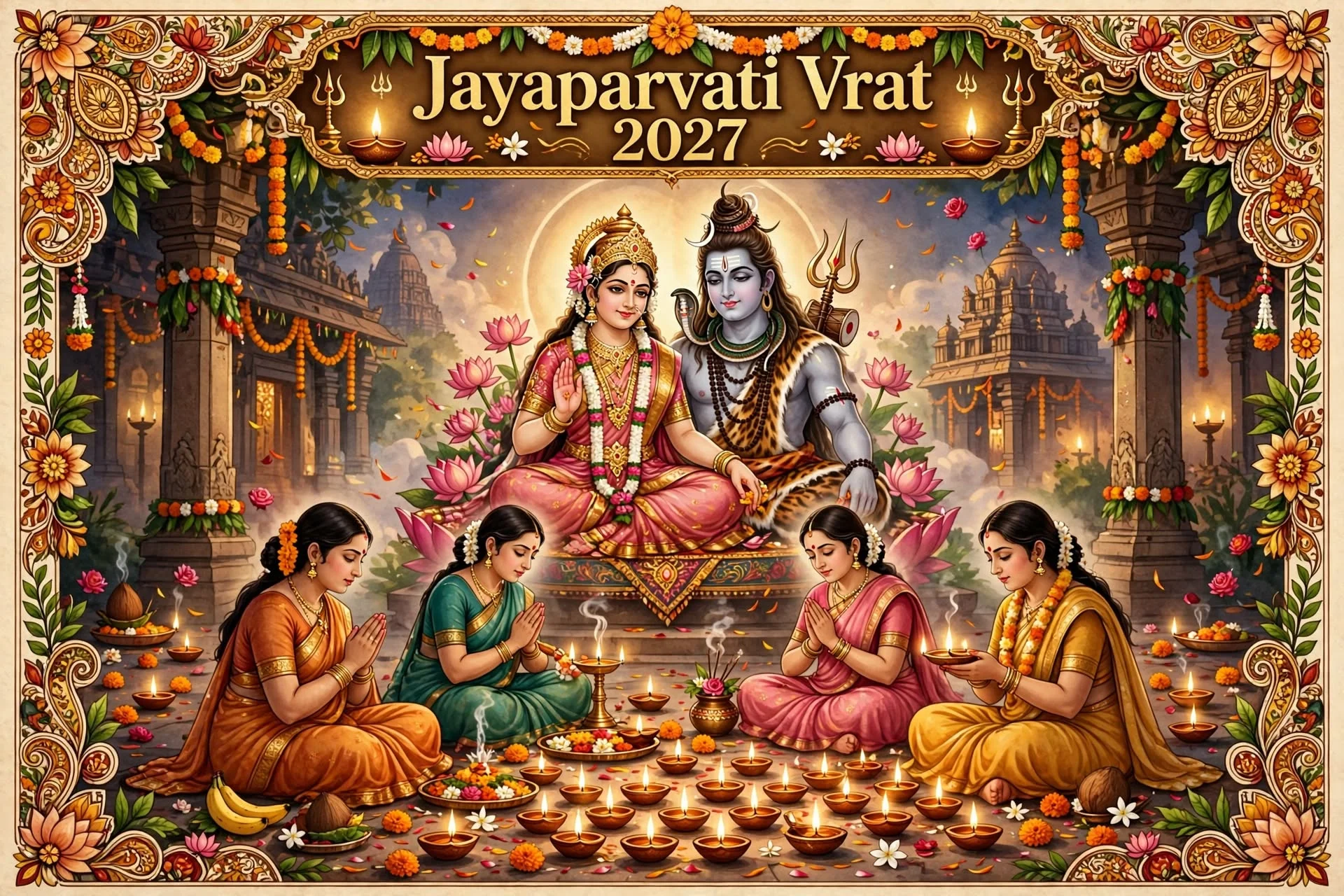
Jayaparvati Vrat, also known as Gauri Vrat or Jaya-Vijaya Vrata, is an ancient, highly revered five-day spiritual observance commencing on the Trayodashi tithi (thirteenth lunar day) of Shukla Paksha in the holy Hindu month of Ashadha (occurring in July) and concluding on Krishna Tritiya. Celebrated with immense piety and joy across Western India—predominantly in Gujarat and parts of Rajasthan and Maharashtra—the vrata is dedicated to Goddess Parvati (in Her victorious aspect as Jaya) and Lord Shiva. It is observed primarily by unmarried maidens praying for a virtuous, long-lived, and loving husband, as well as by married women seeking enduring marital bliss (Akhanda Saubhagya), domestic peace, and the welfare of their family lineage.
Jayaparvati Vrat 2027: Date, Puja Timings, Rituals & Stories
Jayaparvati Vrat Timings & Panchang
Important festival dates and auspicious timings
Usha Arghya (Sunrise)
05:34 am
Sandhya Arghya (Sunset)
07:21 pm
Start Date
Friday, 16 Jul 2027
Puja Muhurat
02:40 pm – 04:35 pm
Jayaparvati Vrat
The hallmark of Jayaparvati Vrat is the rigorous observance of 'Alona' (or Alavan)—a total, uncompromising fast from common salt and all salty ingredients for five consecutive days. In Vedic and Ayurvedic understanding, salt stimulates bodily passion, restlessness (Rajas), and emotional attachment; by voluntarily abstaining from salt, devotees cultivate profound mastery over the tongue (Rasana Indriya), calm physical desires, and align their mental faculties with pure sattvic consciousness. Devotees subsist on a single daily meal consisting purely of unsalted milk products, wheat bread (Roti/Puri cooked without salt), dry fruits, and unseasoned fruits.
Another central ritual of Jayaparvati Vrat is the sowing and nurturing of 'Jawara'—wheat or barley seeds sown in small earthen bowls on the first morning. Over the five days, the tender green wheatgrass shoots grow tall upon the puja altar, symbolizing fertile life, spiritual rejuvenation, and agricultural abundance. Accompanying the Jawara are the handcrafted 'Nagla'—delicate necklaces fashioned from raw unspun cotton threads decorated with auspicious red vermilion (Kumkum) dots, placed with deep reverence over the sprouting shoots and offered to Goddess Gauri.
Why is Jayaparvati Vrat Celebrated?
The observance of Jayaparvati Vrat is grounded in sacred Puranic narratives documented in the Bhavishya Purana and Padma Purana, illustrating the supreme power of austere devotion to reverse incurable suffering and conquer untimely death.
According to the Bhavishya Purana, an illustrious, pious Brahmin named Kaundinya and his devoted wife Anasuya lived in the holy city of Kashi. While blessed with wealth and spiritual knowledge, they were deeply aggrieved by childlessness. Performing severe austerities to propitiate Lord Shiva, the Lord appeared and granted them a son, but warned that the boy would possess a lifespan of only sixteen years. When their son, named Vijaya, came of age, he fell victim to an aggressive and incurable affliction of leprosy on the eve of his sixteenth year.
Desperate to save her husband's life, his devoted wife Vijaya sought counsel from Sage Narada, who revealed the secret Jayaparvati Vrat. She observed the five-day saltless fast with absolute fidelity, worshiping Goddess Jaya and Lord Shiva with bilva leaves and cotton Nagla. Moved by her pure sacrifice, Goddess Parvati manifested, completely cured Vijaya of his leprosy, extended his lifespan by a hundred years, and blessed the couple with divine offspring. Ever since, women observe Jayaparvati Vrat to overcome adversities and safeguard the lives of their loved ones.
- Propitiating Goddess Parvati (Jaya) and Lord Shiva for marital longevity, health, and domestic harmony.
- Cultivating self-control, spiritual dispassion, and biological purification through the five-day salt-free (Alona) diet.
- Honoring agricultural fertility and vital green life through the ritual germination of wheatgrass (Jawara).
- Averting untimely death (Apmrityu), severe chronic ailments, and marital discord through sincere penance.
- Observing the climactic fifth night vigil (Jagaran) celebrated with devotional Garba, storytelling, and bhajans.
Puranic Origins in the Bhavishya Purana and the Deliverance of Vijaya
The Dialogue between Lord Krishna and King Yudhishthira
In the Uttara Parva of the Bhavishya Purana, King Yudhishthira inquires of Lord Sri Krishna: 'O Madhava, please reveal a vrata that is especially auspicious for women, one that dispels premature widowhood, grants righteous progeny, cures incurable bodily diseases, and bestows eternal heavenly blessings.'
Lord Krishna narrates the ancient history of Jayaparvati Vrat, revealing that this fast was originally performed by Goddess Parvati Herself to obtain Lord Shiva as Her consort, and later revealed to humanity through the historical deliverance of the young Brahmin Vijaya.
The Curse of Untimely Death and the Pilgrimage of Vijaya
Vijaya, the son of the righteous Kaundinya, had reached his fifteenth year when his parents arranged his marriage to a virtuous maiden. However, knowing his ordained short lifespan, Vijaya resolved to spend his remaining months visiting the sacred Shiva tirthas across India. While meditating in a deep forest hermitage, a venomous snake bit his toe, and a debilitating disease of leprosy afflicted his limbs.
His young bride, refusing to abandon him, prayed fervently at a nearby Shiva shrine. Sage Narada appeared before her, explaining: 'Do not despair, O daughter! The thirteenth day of Ashadha Shukla Paksha is approaching. Observe the Jayaparvati Vrat for five days without consuming salt. Sow the wheatgrass, craft the cotton Nagla, and worship Lord Shiva and Goddess Jaya day and night.'
The Divine Manifestation and the Boon of Longevity
The young bride followed Narada's instructions with unwavering devotion. She abstained from all salt, slept on the bare earth, and tended the sprouting Jawara with tears of devotion while chanting the Shiva Panchakshari and Gauri mantras. On the fifth night, as she kept a joyful vigil singing praises of the Divine Mother, Lord Shiva and Goddess Parvati appeared before the couple in radiant celestial light.
Goddess Parvati touched Vijaya with Her lotus hand, instantly dissolving the leprosy and restoring his youth and radiant health. The Lord granted them unbroken companionship for a hundred years, declaring that any woman who faithfully observes this vrata will never suffer premature separation from her husband.
The Tapas of Taste, Vegetative Symbology, and Feminine Resilience
The Spiritual Alchemy of the Salt-Free (Alona) Discipline
Salt (Lavana) is recognized in Vedic philosophy as the quintessential stimulator of the five senses. In Ayurvedic medicine, excessive salt heats the blood, accelerates emotional agitation (Rajo Guna), and reinforces sensual craving. By undertaking the Alona vrata for five days, the devotee willingly undertakes sensory tapasya.
Subjugating the palate (Jihva Jaya) is revered as the first and most challenging step in conquering the mind. The physical lightness and mental clarity achieved during these five days enable the aspirant to redirect their prana toward spiritual meditation and emotional equilibrium.
Jawara: The Vegetative Miracle of Life and Growth
The rapid growth of the wheatgrass (Jawara) over five days represents the living presence of Annapurna and Prakriti. As the dark grains burst through the soil into tender, vibrant emerald shoots, devotees are reminded that life continually overcomes decay and despair.
Tending the Jawara requires constant care, gentle watering, and shelter from intense heat, mirroring the patient, loving dedication required to nurture a family, marriage, and spiritual sadhana.
The Cotton Nagla: The Thread of Unbroken Karma and Grace
The Nagla, fashioned from raw unspun white cotton and stamped with round vermilion dots, represents the unbroken thread of divine protection (Sutra). The white cotton signifies the purity of human intention, while the red kumkum represents the active grace of Goddess Shakti protecting the home from malefic influences.
Day-to-Day Observance Schedule, Alona Meals, and Jagaran
Day 1 (Ashadha Shukla Trayodashi): Sowing Jawara and Initial Vows
The vrata begins on Ashadha Shukla Trayodashi. Devotees awake at dawn, perform a purifying holy bath, and gather in the domestic shrine. A shallow earthen plate or bowl (Kodal) is filled with river soil and cow dung wash, and wheat or barley seeds are sown evenly.
The altar is decorated with murtis of Lord Shiva and Goddess Parvati. Devotees take the formal Sankalpa to observe the Alona fast for five days, offering fresh flowers, incense, and the first cotton Nagla to the deities and the sown earth.
Days 2 to 4: The Saltless Fast and Daily Nurturing
For the subsequent three days, devotees water the growing Jawara daily and perform morning and evening aartis. Daily food is consumed only once in the afternoon, consisting strictly of unseasoned milk, sweet curd, unsalted puris made of wheat flour fried in ghee, unseasoned fruits, and sweets like mawa peda or kheer.
Girls gather in neighborhood courtyards to sing traditional Jayaparvati folk songs, sharing in communal joy and reinforcing values of family harmony.
Day 5: The Grand Jagaran and Conclusion on Krishna Tritiya
The fifth day (Ashadha Krishna Dwitiya into Tritiya) is the climax of the festival. Devotees observe an all-night vigil (Jagaran), remaining awake throughout the night singing Garba, bhajans, and enacting sacred Puranic plays. On the following morning, final worship is offered, the tall green Jawara are respectfully immersed in a nearby river or placed beneath a holy banyan/peepal tree, and the fast is joyfully broken by consuming normal salt-seasoned food shared with family.
Jayaparvati Vrat Puja Vidhi (Step by Step)
- 1
Pratah Snana and Shuddhi (Morning Purification)
Wake up early before sunrise on Ashadha Shukla Trayodashi, take a purifying bath with Gangajal-infused water, and wear fresh traditional auspicious attire (yellow, pink, or red).
- 2
Jawara Ropana (Sowing the Sacred Wheatgrass)
Take a clean earthen saucer (Kodal), fill it with fertile soil and a little cow dung ash, sprinkle pure water, and sow wheat or barley grains while chanting the Gauri Gayatri Mantra.
- 3
Sankalpa (Taking the Five-Day Saltless Vow)
Sit on a clean wool or kusha asana, hold water, akshata, and a flower in your right hand, and recite the solemn Sanskrit Sankalpa pledging to observe the five-day Jayaparvati Alona Vrata.
- 4
Shiva-Parvati Avahana and Sthapana (Invoking the Divine Couple)
Clean the puja altar, set up a wooden chowki covered in red silk, and install consecrated idols of Lord Shiva and Goddess Parvati, welcoming their divine presence with flowers.
- 5
Panchamrita Snana (Holy Nectar Bath)
Jayaparvati Vrat Puja Samagri List
Jawara Sowing and Earth Materials
- Shallow earthen plate, saucer, or clay pot (Kodal / Mitti ka Patra)
- Clean fertile garden soil or river sand and dry cow dung powder
- Unpolished whole wheat grains (Gehun) or barley seeds (Jau)
- Small brass watering jug or sprinkler for daily moisture
Deity Adornments and Nagla Materials
- Consecrated metal idols or framed portrait of Lord Shiva and Goddess Parvati
- Raw unspun white cotton (Kacha Soot) for crafting the Nagla necklaces
- Organic red Kumkum, turmeric powder, and fragrant white sandalwood paste
- Fresh trifoliate Bilva leaves (Belpatra), red hibiscus flowers, and marigold garlands
- Pure cow ghee lamp with cotton wicks, natural camphor, and aromatic incense sticks
Alona Naivedya (Unsalted Food Ingredients)
- Pure wheat flour, cow ghee, and raw cane sugar for preparing unsalted sweet puris
- Fresh raw cow milk, homemade sweet curd, and unsalted mawa/khoya sweets (Peda)
- Assorted dry fruits: almonds, cashews, raisins, and dried dates (Kharek)
- Fresh seasonal fruits: bananas, apples, pomegranate, and sweet mangoes
Mantras and Prayers for Jayaparvati Vrat
Jayaparvati Vrat Vrat Rules and Fasting Guidelines
The Five-Day Alona (Salt-Free) Dietary Code
The primary vow of Jayaparvati Vrat is the strict avoidance of common salt (and even rock salt in traditional orthodox practice) for five continuous days. Devotees consume a single meal a day (Eka-Bhukta) during the afternoon. Foods consumed must be unseasoned: boiled milk, curd, unsalted puris, unseasoned roasted makhana, and fresh fruits. Grains other than wheat (such as rice, lentils, and pulses) are traditionally avoided by many observers.
- Total, absolute prohibition of all forms of salt, salty snacks, pickles, and spices for five days.
- Abstinence from grains other than wheat; no lentils, beans, onions, garlic, or vegetables cooked with salt.
- Meals must be consumed only once per day before sunset, spending the rest of the day in water-only fasting.
Purity and Vigil Guidelines
Devotees sleep on a clean floor mat, avoid daytime sleeping, practice sweet and gentle speech, and maintain physical and emotional chastity (Brahmacharya). On the fifth night, observing the Jagaran without sleeping is considered vital to unlock the full spiritual power of the vrata.
Dos and Don'ts of Jayaparvati Vrat
Good Practices (Do's)
- Sow wheat or barley seeds (Jawara) with devotion on the first morning and water them gently daily.
- Craft cotton Nagla decorated with Kumkum dots and offer them to Goddess Gauri.
- Strictly adhere to the salt-free (Alona) dietary protocol for all five days.
- Worship Lord Shiva and Goddess Parvati twice daily with Bilva leaves and ghee lamps.
- Participate in the joyous fifth-night vigil (Jagaran) singing bhajans and Garba.
Jayaparvati Vrat Across Regions
| Region | Local Name |
|---|---|
| Gujarat (Ahmedabad, Surat, Rajkot, Vadodara) | Gauri Vrat / Jayaparvati Vrat |
| Rajasthan | Jaya-Vijaya Vrata |
| Maharashtra | Ashadha Gauri Vrat |
Jayaparvati Vrat FAQs
Why is Jayaparvati Vrat observed without salt (Alona)?
Salt is considered a Rajasic ingredient that stimulates sensory desires and bodily passion. By fasting without salt for five days, devotees practice severe sensory control (Jihva Jaya), purifying the nervous system and cultivating spiritual fortitude.
What is Jawara in Jayaparvati Vrat?
Jawara refers to the wheat or barley seeds sown in earthen saucers on the first day of the fast. Over five days, they grow into tall green shoots, symbolizing agricultural fertility, vitality, and the nurturing presence of Mother Earth.
What are 'Nagla'?
Nagla are traditional handmade necklaces crafted from raw unspun white cotton thread and decorated with red vermilion (Kumkum) dots. They are offered as sacred adornments to the growing Jawara and Goddess Parvati.
Upcoming Festivals
View All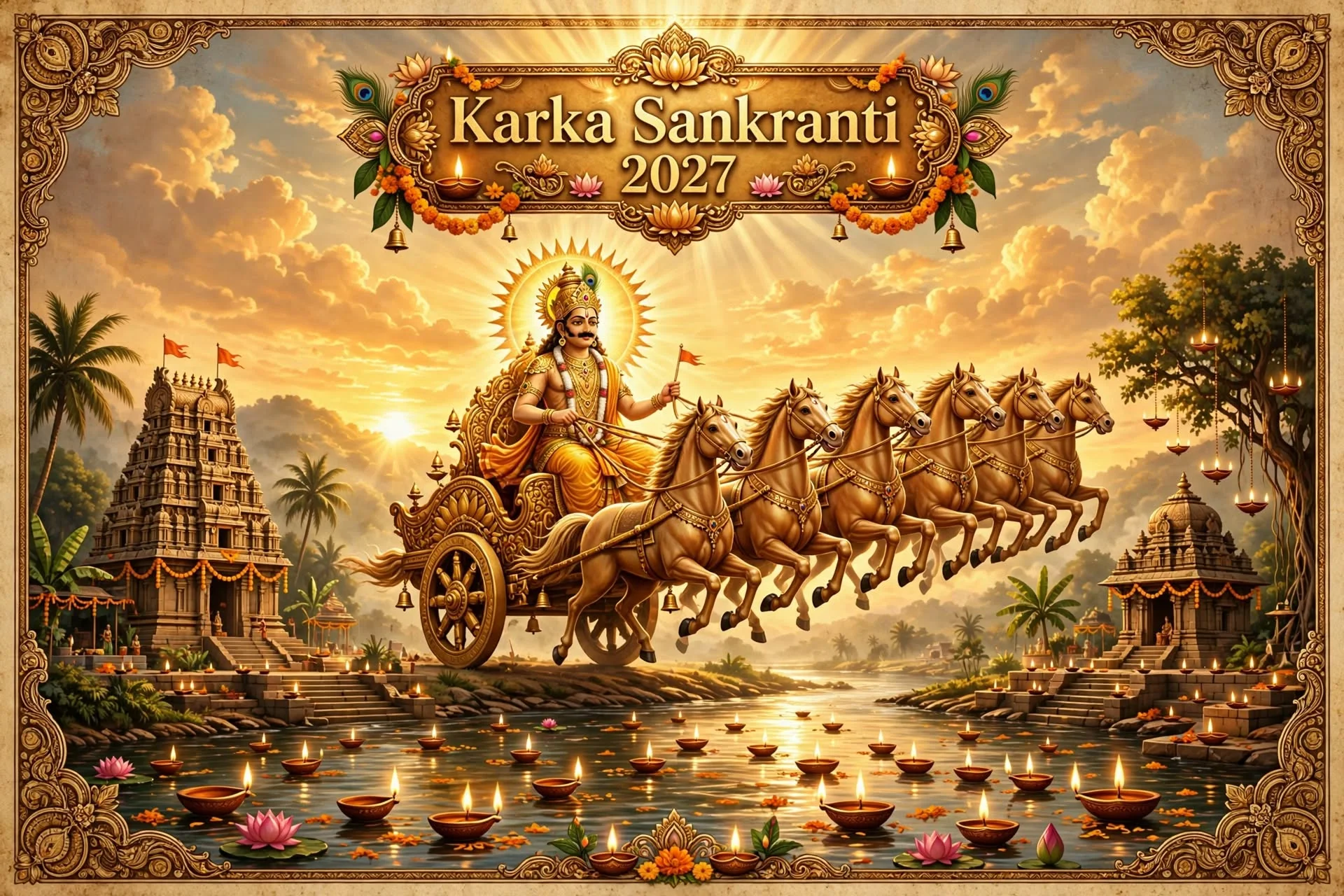
Saturday, Jul 17, 2027
Karka Sankranti
Karka Sankranti, occurring in mid-July, is an astronomically and spiritually momentous date marking the celestial ingress (transit) of the Sun (Surya Deva) into the zodiac sign of Cancer (Karka Rashi). In the Vedic astronomical calendar, this transit represents the pivotal turning point known as the commencement of Dakshinayana—the six-month period when the Sun moves southward along the celestial sphere, concluding the northern transit (Uttarayana).
View Festival Guide
Saturday, Jul 17, 2027
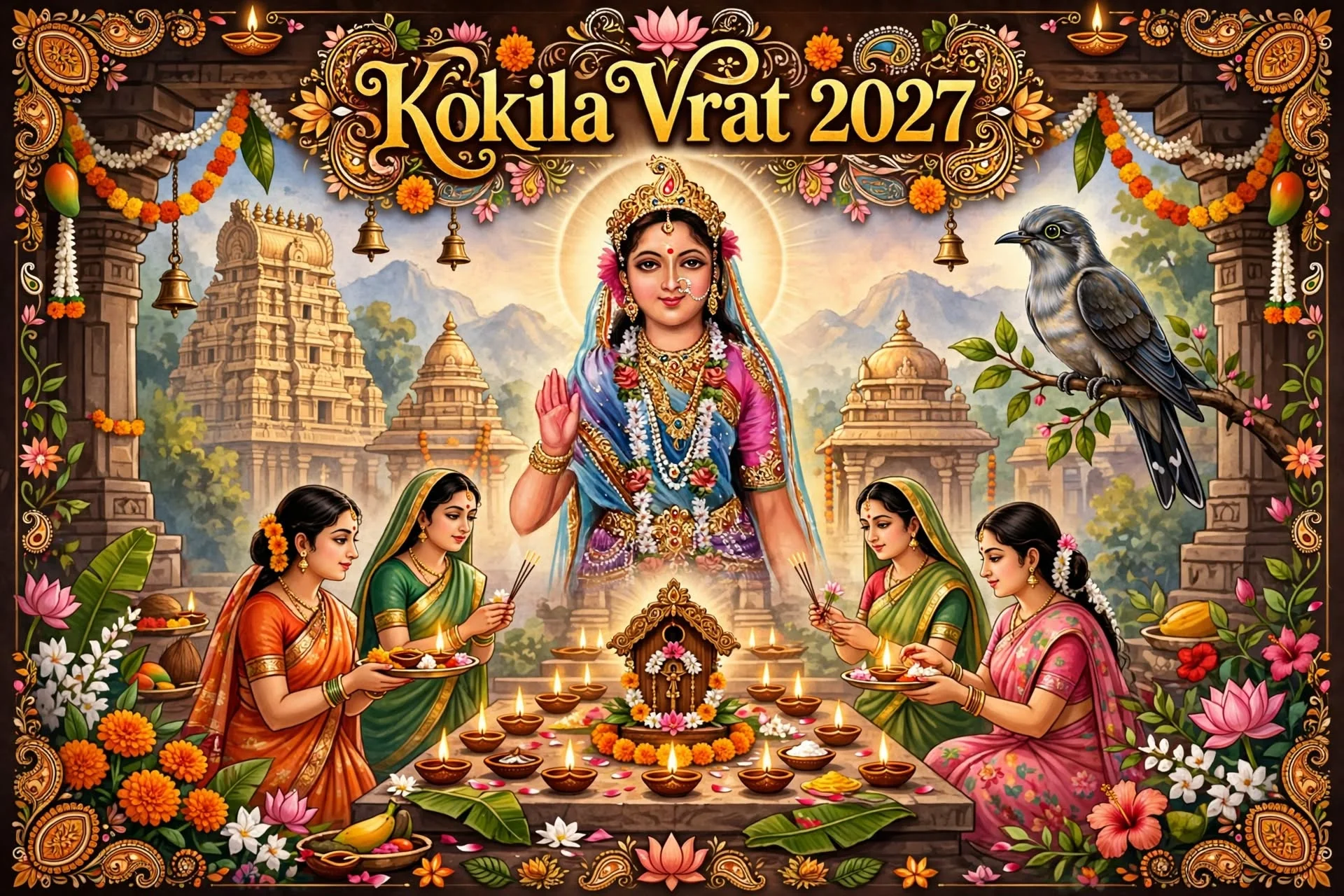
Kokila Vrat
Kokila Vrat is a rare, mystical, and deeply revered Hindu fasting observance celebrated on the Purnima (full moon day) of the Hindu lunar month of Ashadha, often extending into the sacred monsoon month of Shravana (falling in July). Dedicated to Goddess Parvati (in Her form as Sati) and Lord Shiva, this sanctified vrata derives its name from 'Kokila' (the Indian cuckoo bird), commemorating the poignant cosmological epoch when Goddess Sati incarnated as a divine cuckoo bird for ten thousand celestial years in the sacred groves of Nandanavana to perform austere, single-minded penance to reunite with Lord Shiva.
View Festival Guide

Sunday, Jul 18, 2027
Vyasa Puja
Vyasa Puja is the paramount ritual celebration and liturgical solemnity observed on the Purnima (full moon day) of the Hindu lunar month of Ashadha (occurring in July), dedicated exclusively to Maharishi Krishna Dvaipayana Veda Vyasa—the immortal compiler of the four Vedas, author of the eighteen Mahapuranas, the monumental 100,000-verse Mahabharata, and the profound Brahma Sutras. While commonly celebrated in conjunction with Guru Purnima, Vyasa Puja specifically refers to the formal, highly codified liturgical ritual of worshiping the Vyasa Peetha (the sacred seat of scriptural authority) and honoring the unbroken Guru Parampara (lineage of enlightened masters) from Lord Narayana and Lord Sadashiva down to one's living spiritual preceptor.
View Festival Guide

Sunday, Jul 18, 2027
Ashadha Purnima
Ashadha Purnima is the radiant full moon tithi culminating the Shukla Paksha of the Hindu lunar month of Ashadha (occurring in July). Illuminating the mid-monsoon night sky with celestial brilliance, this sacred tithi represents one of the most auspicious spiritual junctures in Sanatana Dharma, Buddhism, and Jainism. As the full moon reaches its astrological peak in the constellations of Purva Ashadha and Uttara Ashadha, cosmic lunar and solar forces align to produce an atmosphere of profound mental clarity, devotional receptivity, and spiritual illumination.
View Festival Guide

Sunday, Jul 18, 2027
Anvadhan
Anvadhan (अन्वाधान) is an ancient, highly revered Vedic ritual and spiritual observance in Sanatana Dharma performed on the day immediately preceding the New Moon (Amavasya) or Full Moon (Purnima). Rooted in the pristine traditions of the Shrauta and Grihya Sutras, Anvadhan literally translates to 'the solemn placing and replenishment of sacred fuel wood into the consecrated Vedic fires'. In traditional Vedic ritualism, householders (Grihasthas) and priests who maintain the sacred Agnihotra fires perform Anvadhan to prepare the sacrificial altars for the grand Darsha Yajna (New Moon sacrifice) or Paurnamasa Yajna (Full Moon sacrifice) scheduled for the following day.
View Festival Guide
Sunday, Jul 18, 2027
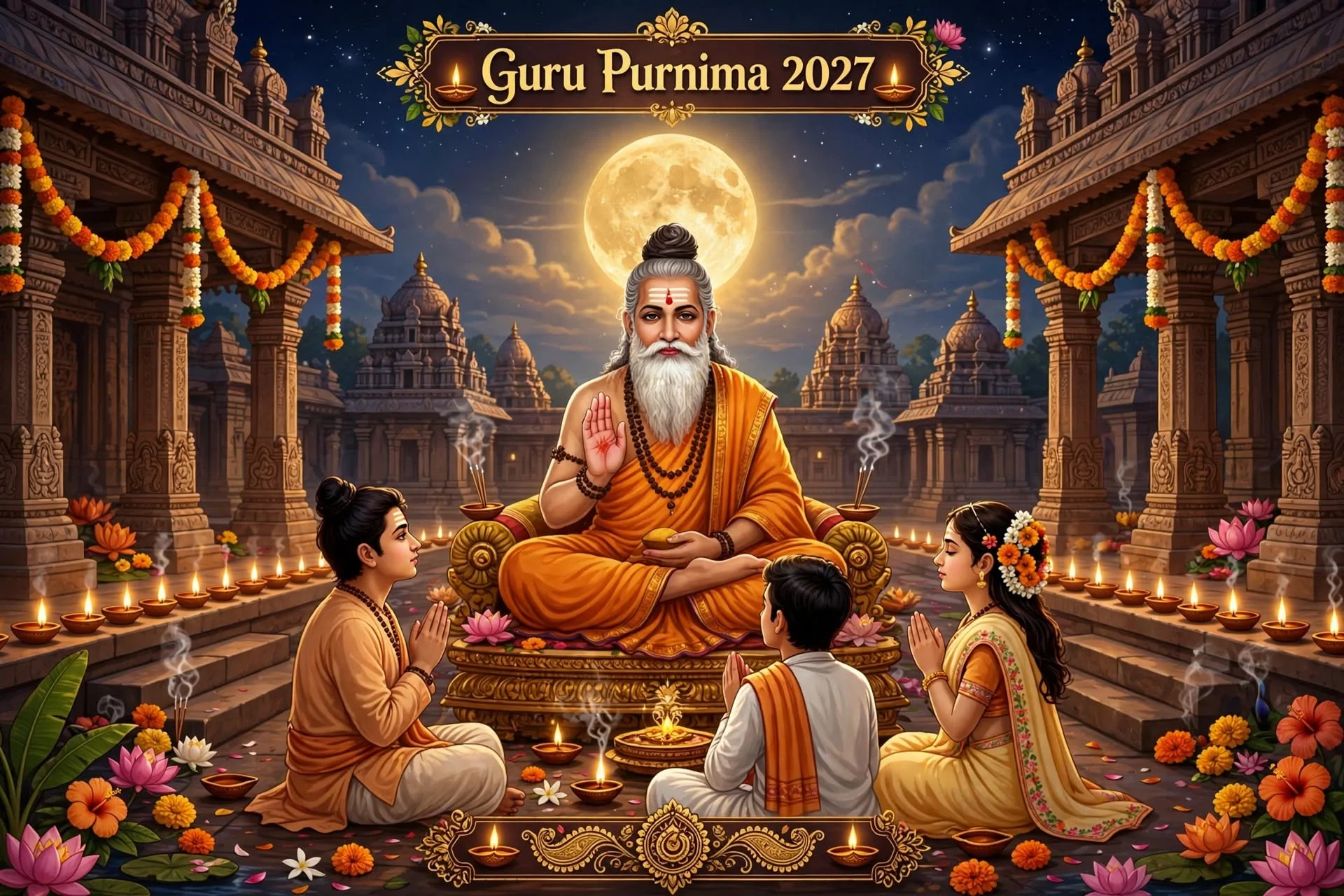
Guru Purnima
Guru Purnima, celebrated on the full moon day (Purnima) in the Hindu lunar month of Ashadha, is one of the most sacred and venerable festivals across Sanatana Dharma, Buddhism, and Jainism. Dedicated to the eternal lineage of spiritual preceptors (Guru Parampara), this day honors the divine principle that dispels the darkness of ignorance (Gu) and illumines the radiance of self-realization and wisdom (Ru).
View Festival Guide

Monday, Jul 19, 2027
Ishti
Ishti is a foundational Vedic ritual observance appearing prominently in Hindu Panchangs on the Pratipada tithi (the first lunar day) following either Amavasya (new moon) or Purnima (full moon), marking the prescribed performance day for the fortnightly Vedic Darsha-Purnamasa sacrifices.
View Festival Guide
Wednesday, Jul 21, 2027
Jayaparvati Vrat
Jayaparvati Vrat, also known as Gauri Vrat or Jaya-Vijaya Vrata, is an ancient, highly revered five-day spiritual observance commencing on the Trayodashi tithi (thirteenth lunar day) of Shukla Paksha in the holy Hindu month of Ashadha (occurring in July) and concluding on Krishna Tritiya. Celebrated with immense piety and joy across Western India—predominantly in Gujarat and parts of Rajasthan and Maharashtra—the vrata is dedicated to Goddess Parvati (in Her victorious aspect as Jaya) and Lord Shiva. It is observed primarily by unmarried maidens praying for a virtuous, long-lived, and loving husband, as well as by married women seeking enduring marital bliss (Akhanda Saubhagya), domestic peace, and the welfare of their family lineage.
View Festival Guide