




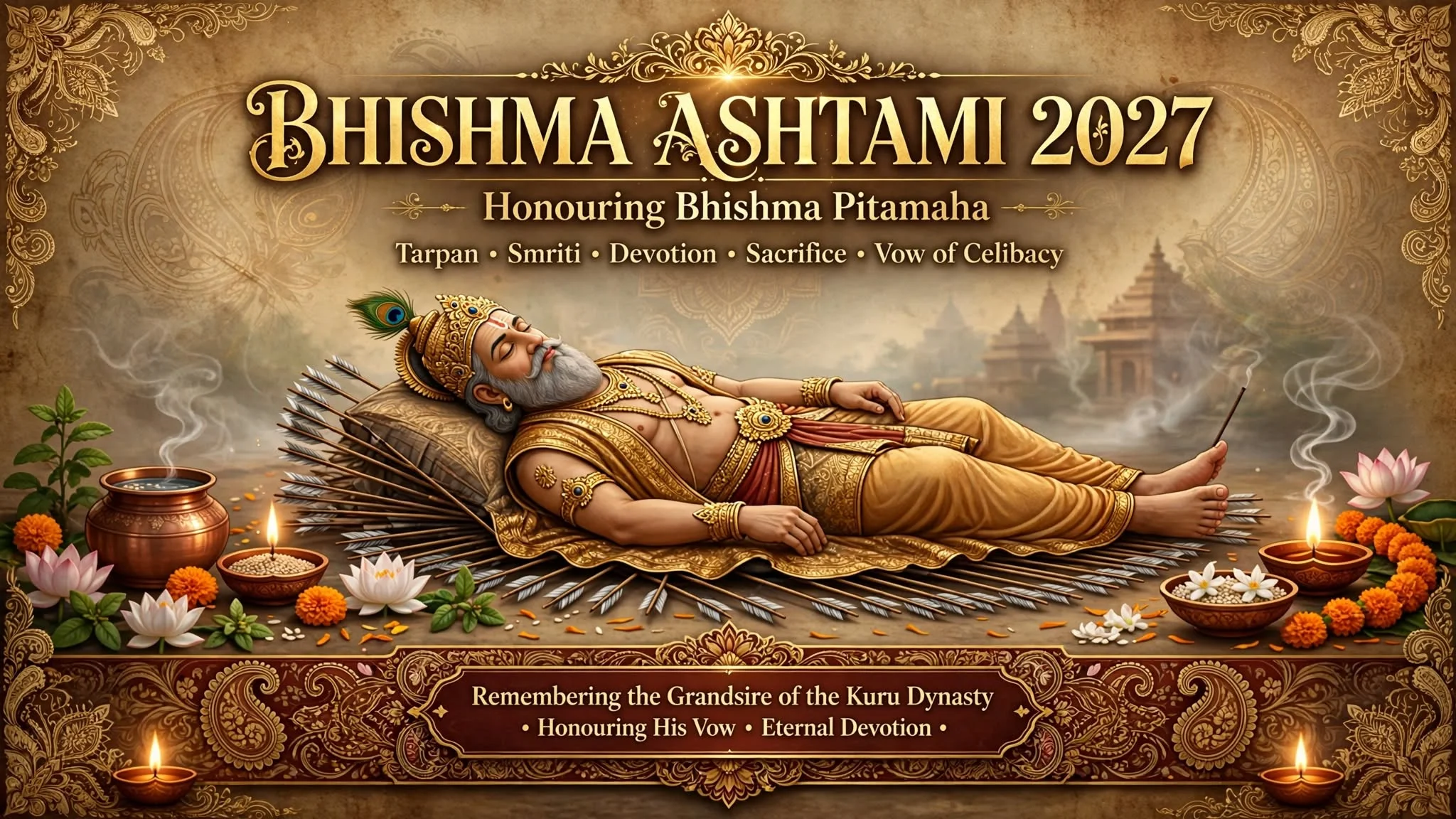
Bhishma Ashtami is a deeply solemn and historically revered Hindu observance occurring on the Ashtami tithi (eighth lunar day) of Shukla Paksha in the month of Magha (January–February), commemorating the voluntary departure (Maha-Samadhi / Ichha-Mrityu) of Pitamaha Bhishma, the venerable patriarch of the Mahabharata.
Bhishma Ashtami 2027: Date, Puja Timings, Rituals & Stories
Bhishma Ashtami Timings & Panchang
Important festival dates and auspicious timings
Usha Arghya (Sunrise)
07:01 am
Sandhya Arghya (Sunset)
06:10 pm
Start Date
Sunday, 14 Feb 2027
Puja Muhurat
02:07 am – 12:41 am
Bhishma Ashtami
Following the devastating Kurukshetra war, Grandfather Bhishma lay mortally wounded upon a heroic bed of arrows (Shara-Shayya) for fifty-eight agonizing days, consciously restraining his life-force through his boon of voluntary death until the Sun crossed the celestial equator into the auspicious northern trajectory (Uttarayana).
On Magha Shukla Ashtami, surrounded by Lord Krishna, the five Pandava brothers, and great celestial rishis, Bhishma delivered his monumental discourses on Raja Dharma, Moksha Dharma, and revealed the supreme Vishnu Sahasranama Stotram before consciously releasing his life-breath into the Supreme Brahman.
A unique and universal feature of Bhishma Ashtami is 'Bhishma Tarpana'—the sacred offering of water, barley, and black sesame seeds (Tilodaka) made by all Hindus, including those whose fathers and mothers are alive, honoring the lifelong bachelor patriarch whose ultimate sacrifice left him without biological progeny to perform his funeral rites.
Why is Bhishma Ashtami Celebrated?
Bhishma Ashtami is celebrated to venerate the supreme ideals of unshakeable righteousness (Dharma), filial sacrifice, truthfulness, and unwavering devotion to Lord Krishna embodied by Gangaputra Bhishma throughout his extraordinary earthly life.
According to the Mahabharata and the Padma Purana, offering water libations (Tarpana) to Bhishma on this tithi relieves practitioners of guilt from unfulfilled duties, neutralizes ancestral afflictions, and bestows righteous, obedient, and long-lived progeny.
- To honor the solemn anniversary of Pitamaha Bhishma's departure into the realm of the Vasus.
- To perform the universal Bhishma Tarpana, offering sacred water and black sesame to the childless patriarch.
- To recite or contemplate the Sri Vishnu Sahasranama Stotram, originally imparted by Bhishma from his bed of arrows.
- To obtain forgiveness for intentional and unintentional sins committed across the previous year through filial piety.
- To imbibe the virtues of self-control (Jitendriya), absolute truthfulness (Satyavrata), and moral courage.
Epic Narrative and Scriptural Authority of Bhishma Ashtami
The Bed of Arrows and the Wait for Uttarayana
In the Mahabharata (Bhishma and Anushasana Parvas), the legendary warrior Bhishma was felled on the tenth day of the great battle by Arjuna's piercing arrows, held upright on a bed formed entirely by the arrow shafts penetrating his armor. Because his father King Shantanu had granted him the rare boon of Ichha-Mrityu (the power to choose the exact moment of his death), Bhishma resolved not to leave his physical frame while the Sun traversed the southern celestial course (Dakshinayana).
For fifty-eight days and nights, the grand patriarch endured excruciating bodily pain with superhuman fortitude, sustained by the divine presence of Lord Krishna. Sages like Vyasa, Narada, and Asita gathered around him as he expounded the deepest principles of statecraft, ethics, and liberation to King Yudhishthira, delivering the timeless Thousand Names of Vishnu (Vishnu Sahasranama).
The Ascension and Lord Krishna's Eternal Decree
When the auspicious hour of midday arrived on Magha Shukla Ashtami, with the Sun well established in Uttarayana and the Moon in Rohini Nakshatra, Bhishma gathered his prana, closed his eyes, and fixed his mind exclusively upon the four-armed, lotus-eyed form of Sri Krishna. The arrows gently fell away as his soul burst forth through the crown of his head (Brahmarandhra) as a luminous meteor, returning to the celestial assembly of the eight Vasus.
Seeing that Bhishma had no biological sons due to his celebrated lifelong vow of celibacy (Bhishma Pratigya), the Pandavas wept inconsolably. Lord Krishna consoled them and pronounced an eternal divine decree recorded in the Padma Purana: 'Whoever among mankind, whether his father be alive or deceased, shall offer water and sesame unto Bhishma on Magha Shukla Ashtami, shall become cleansed of all sins and be blessed with noble children.' Since that ancient day, the universal rite of Bhishma Tarpana has been maintained across the Hindu world.
Source: Mahabharata (Anushasana Parva, Chapter 168), Padma Purana (Srishti Khanda), and Matsya Purana
Philosophical, Moral, and Devotional Foundations
The Paradigm of Righteous Surrender (Sharanagati)
Bhishma's life exemplifies the complex struggle between institutional duty and cosmic truth. Even while bound to defend the throne of Hastinapur, his soul was anchored in absolute surrender to Sri Krishna. His final departure demonstrates the ideal passing of a yogi: conscious, focused on the Divine, and detached from physical agony.
Reciting the Vishnu Sahasranama on Bhishma Ashtami tunes the devotee's mind to the very vibration that liberated the greatest warrior of the epic age.
The Universal Nature of Bhishma Tarpana
Under classical Hindu law (Smriti), a person whose father is alive is prohibited from performing general ancestral Shradh. Bhishma Tarpana represents the sole celebrated exception in the Shastras. Because Bhishma sacrificed his right to kingdom, marriage, and family for his father's happiness, the entire Hindu collective becomes his spiritual family.
Offering him a palmful of water acknowledges the universal debt owed to towering moral figures who sacrifice personal comfort for the collective good.
Cultivating the Five Heroic Virtues
- Satya (uncompromising truthfulness) in every circumstance.
- Brahmacharya (mastery over the senses and sensual desires).
- Pitri-Bhakti (absolute reverential devotion towards parents).
- Dharma-Nishtha (steadfast adherence to duty despite personal tragedy).
- Krishna-Bhakti (unwavering devotional absorption in the Supreme Lord).
Practical Protocol, Ritual Sequencing, and Temple Observance
Morning Ablution and The Sacred River Libation
Devotees wake before dawn during Brahma Muhurta, cleanse their homes, and take a purificatory bath in a flowing sacred river or at home using clean water infused with consecrated Gangajal.
Men and women don clean traditional white or light-colored cotton attire. Standing in the water or beside a clean copper basin facing South, devotees prepare for the universal libation.
Conducting the Sacred Bhishma Tarpana
Taking water mixed with black sesame seeds (Kala Til), barley, and a ring of Kusha grass (Pavitri) in both palms, the practitioner recites the two canonical Bhishma Tarpana mantras, identifying Bhishma by his lineage (Vaiyaghrapadya gotra, Sankritya pravara) and his mother (Ganga).
The water is released through the Pitru Tirtha (between the right thumb and forefinger) three distinct times, concluding with reverent prostrations.
Devotional Reading and Domestic Puja
Following the river or home tarpana, devotees assemble at the home altar. A portrait or Shaligram of Lord Krishna and an image of Bhishma are worshiped with yellow flowers, sandalwood paste, and ghee lamps.
Devotees chant the complete 1,000 names of the Sri Vishnu Sahasranama Stotram with meditative reverence, followed by the distribution of sattvic food and charitable gifts to the needy before breaking their fast.
Bhishma Ashtami Puja Vidhi (Step by Step)
- 1
Brahma Muhurta Jagaran and Purificatory Bath (Snana)
Wake before dawn during Brahma Muhurta. Proceed to a sacred river or add drops of holy Gangajal to your bathing water at home. Bathe silently, reflecting on the sacred sacrifice of Gangaputra Bhishma. Don clean white or unstitched traditional cotton clothing.
- 2
Surya Arghya Samarpan (Morning Solar Oblation)
Fill a pure copper lota with clean water, add red sandalwood paste, a red flower, and unbroken rice (Akshata). Face the rising Sun, raise the vessel above your forehead, and pour water in a continuous stream while chanting 'Om Suryaya Namah'.
- 3
Bhishma Ashtami Sankalpa (Solemn Vow)
Sit on a clean wool or kusha asana facing East. Take water, unbroken rice, black sesame seeds, and a white flower in your right palm. Recite the day's tithi (Magha Shukla Ashtami), your gotra, and resolve in your mind (Sankalpa) to perform Bhishma Tarpana and worship Lord Krishna for spiritual purification and ancestral peace.
- 4
Kusha Pavitri Dharana and Southward Alignment
Wear a ring made of sacred Kusha grass (Darbha Pavitri) on your right ring finger. Face South, the cosmic direction of Lord Yama and the ancestral realm. In front of you, place a clean bronze or copper tray (Tarpana Patra).
Bhishma Ashtami Puja Samagri List
Bhishma Tarpana Essentials
Specific botanical and sacred materials required for offering the filial water libations to Grandfather Bhishma.
- Pure Gangajal or water from a sacred pilgrimage river
- Kusha grass ring (Pavitri) and long fresh Kusha grass blades (Darbha)
- Whole unpolished black sesame seeds (Kala Til)
- Barley grains (Jau) and unbroken white rice (Akshata)
- Clean copper lota and wide bronze or copper tray (Tarpana Patra)
Altar and Lord Krishna Worship Articles
Sacred items required to worship Lord Krishna (the deliverer of Bhishma) and the domestic altar.
- Shaligram Shila, Lord Krishna idol, or picture depicting Bhishma on the arrow bed before Krishna
- Yellow cloth for the altar platform and white cloth for the deity
- Yellow sandalwood paste (Hari Chandan) and white sandalwood paste
- Fresh, unblemished Tulsi leaves and Manjari
- Fresh white flowers (jasmine, white lotus) and yellow marigolds
- Pure cow milk, curd, ghee, honey, and jaggery (Panchamrit)
Lighting, Incense, and Text Materials
- Brass lamps (Diyas) fueled with pure desi cow ghee and cotton wicks
Mantras and Prayers for Bhishma Ashtami
Bhishma Ashtami Vrat Rules and Fasting Guidelines
Universal Eligibility and Conduct
Unlike ordinary ancestral Shraddha, the Shastras explicitly permit and encourage every individual to offer Bhishma Tarpana regardless of whether their parents are alive or deceased:
- Any person, regardless of varna or gotra, whose parents are living or departed, can and should offer Bhishma Tarpana.
- Fast from sunrise until the completion of the afternoon Tarpana, Vishnu Sahasranama chanting, and charity.
- Maintain strict celibacy (Brahmacharya), mental serenity, and filial respect towards elders and teachers.
- Strictly avoid all non-vegetarian items, alcohol, tobacco, onions, garlic, and stale leftovers.
Tarpana Timing and Regulations
- Tarpana must be performed during the daytime (Aparahna period, around midday), facing South.
- Always use unpolished black sesame seeds (Kala Til) and fresh Kusha grass during the libation.
- Recite both canonical Bhishma mantras clearly, pronouncing the gotra and pravara accurately.
- Do not consume food before offering the libations unless physically unwell.
Parana and Fast Completion
The fast is broken after completing the Vishnu Sahasranama recitation and presenting food and gifts to Brahmins, ascetics, or the poor. Devotees partake of the sanctified sweet rice kheer and a simple sattvic meal cooked with rock salt (sendha namak).
Dos and Don'ts of Bhishma Ashtami
Good Practices (Do's)
- Wake early during Brahma Muhurta, take a purificatory bath, and wear clean white or light cotton clothes.
- Perform Bhishma Tarpana using black sesame seeds and Kusha grass facing the South direction.
- Recite the two canonical Bhishma Tarpana mantras with reverence and devotion.
- Chant or listen attentively to the Sri Vishnu Sahasranama Stotram imparted by Bhishma.
- Worship Lord Sri Krishna with yellow sandalwood paste and fresh Tulsi leaves.
Bhishma Ashtami Across Regions
| Region | Local Name |
|---|---|
| Kurukshetra (Haryana) | Bhishma Kund & Ban Ganga Mela |
| Varanasi and Uttar Pradesh (Ganga Ghats) | Ganga Bhishma Tarpana |
| South India (Tamil Nadu, Karnataka, Andhra Pradesh) | Bheeshma Ashtami Tharpana |
| West Bengal and Odisha | Bhisma Ashtami Tila Tarpan |
Bhishma Ashtami FAQs
What is Bhishma Ashtami, and who was Bhishma?
Bhishma Ashtami commemorates the departure day of Grandfather Bhishma, the supreme celibate warrior and elder patriarch of the Kuru dynasty in the Mahabharata, who left his physical frame on Magha Shukla Ashtami through his boon of voluntary death (Ichha-Mrityu).
Can a person whose father is alive perform Bhishma Tarpana?
Yes. The Shastras explicitly state that Bhishma Tarpana is universal: anyone, regardless of whether their parents are alive or deceased, can and should offer water and sesame to Bhishma because he had no biological children to perform his funeral rites.
Why did Bhishma wait on a bed of arrows for 58 days?
Bhishma had the boon of Ichha-Mrityu and chose to wait until the Sun entered the auspicious northern course (Uttarayana). Departing during Uttarayana ensures that a self-realized soul avoids rebirth and attains the supreme celestial realms.
Upcoming Festivals
View All
Wednesday, Feb 17, 2027
Jaya Ekadashi
Jaya Ekadashi, also revered as Bhaimi Ekadashi, is a celebrated Vaishnava fasting festival observed on the Ekadashi tithi (eleventh lunar day) of Shukla Paksha in the month of Magha (January–February).
View Festival Guide
Thursday, Feb 18, 2027
Guru Pradosh Vrat
Guru Pradosh Vrat, also known as Guruvara Pradosham or Brihaspati Pradosham, is a sacred bimonthly Hindu fasting observance occurring when the Trayodashi tithi (thirteenth lunar day) coincides with a Thursday (Guruvara) during the twilight Pradosha Kaal period.
View Festival Guide
Saturday, Feb 20, 2027
Magha Purnima
Magha Purnima, widely celebrated as Maghi Purnima or Maha Maghi, is the culminating and most spiritually radiant full moon festival in the Hindu liturgical calendar, falling in the holy month of Magha (January–February).
View Festival Guide
Sunday, Feb 21, 2027
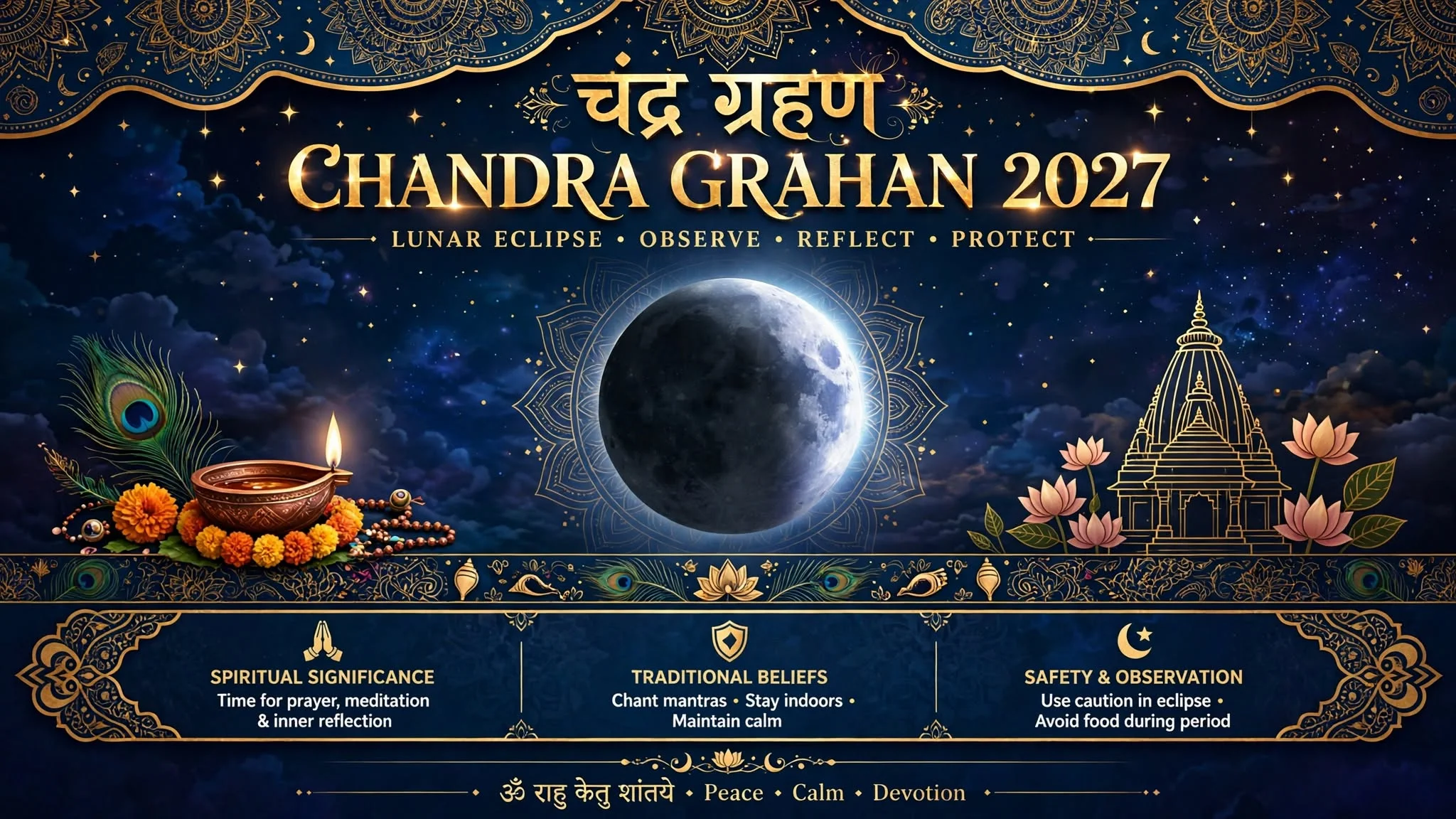
Chandra Grahan
Chandra Grahan (Lunar Eclipse) is a sacred cosmic and spiritual juncture (Parva Kaal) in Sanatana Dharma occurring exclusively on Purnima (the full moon day) when the Earth moves directly between the Sun and the Moon, casting its conical shadow across the lunar orb. In Vedic philosophy and Jyotisha, the Moon presides over the mind, subconscious emotions, and water elements (Chandrama Manaso Jatah - Rigveda Purusha Sukta). The temporary obscuration of the Moon by the shadowy nodes Rahu or Ketu induces profound subtle energetic shifts across terrestrial nature and human consciousness.
View Festival Guide

Sunday, Feb 21, 2027
Ishti
Ishti is a foundational Vedic ritual observance appearing prominently in Hindu Panchangs on the Pratipada tithi (the first lunar day) following either Amavasya (new moon) or Purnima (full moon), marking the prescribed performance day for the fortnightly Vedic Darsha-Purnamasa sacrifices.
View Festival Guide
Wednesday, Feb 24, 2027
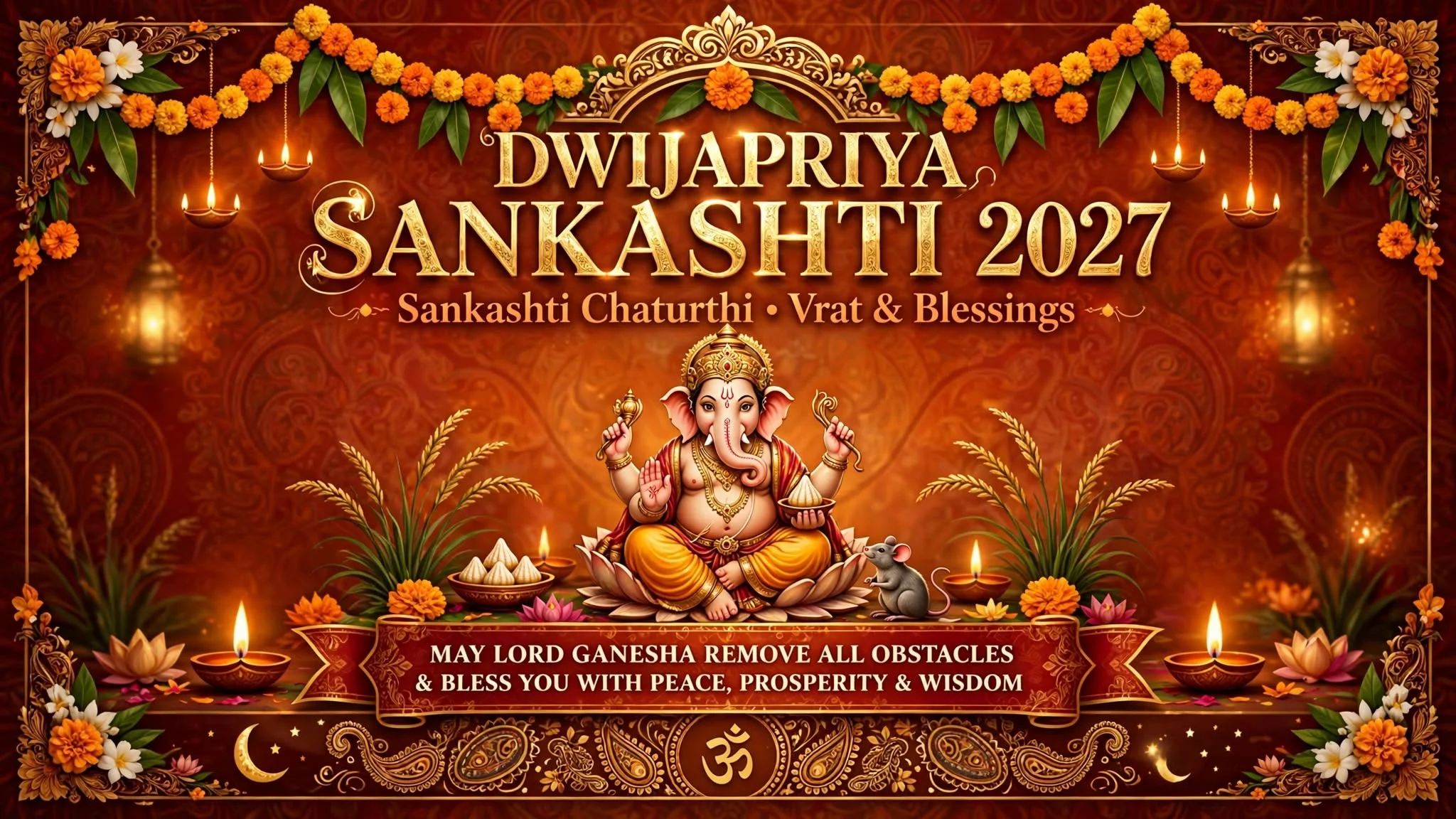
Dwijapriya Sankashti
Dwijapriya Sankashti Chaturthi is an auspicious monthly Hindu fasting observance dedicated to Lord Ganesha, celebrated on the fourth day (Chaturthi tithi) of the Krishna Paksha (waning moon phase) during the month of Phalguna according to the North Indian Purnimanta calendar (corresponding to Magha Krishna Paksha in the Amanta calendar followed in Maharashtra, Gujarat, Karnataka, Andhra Pradesh, and Tamil Nadu).
View Festival Guide
Thursday, Mar 4, 2027
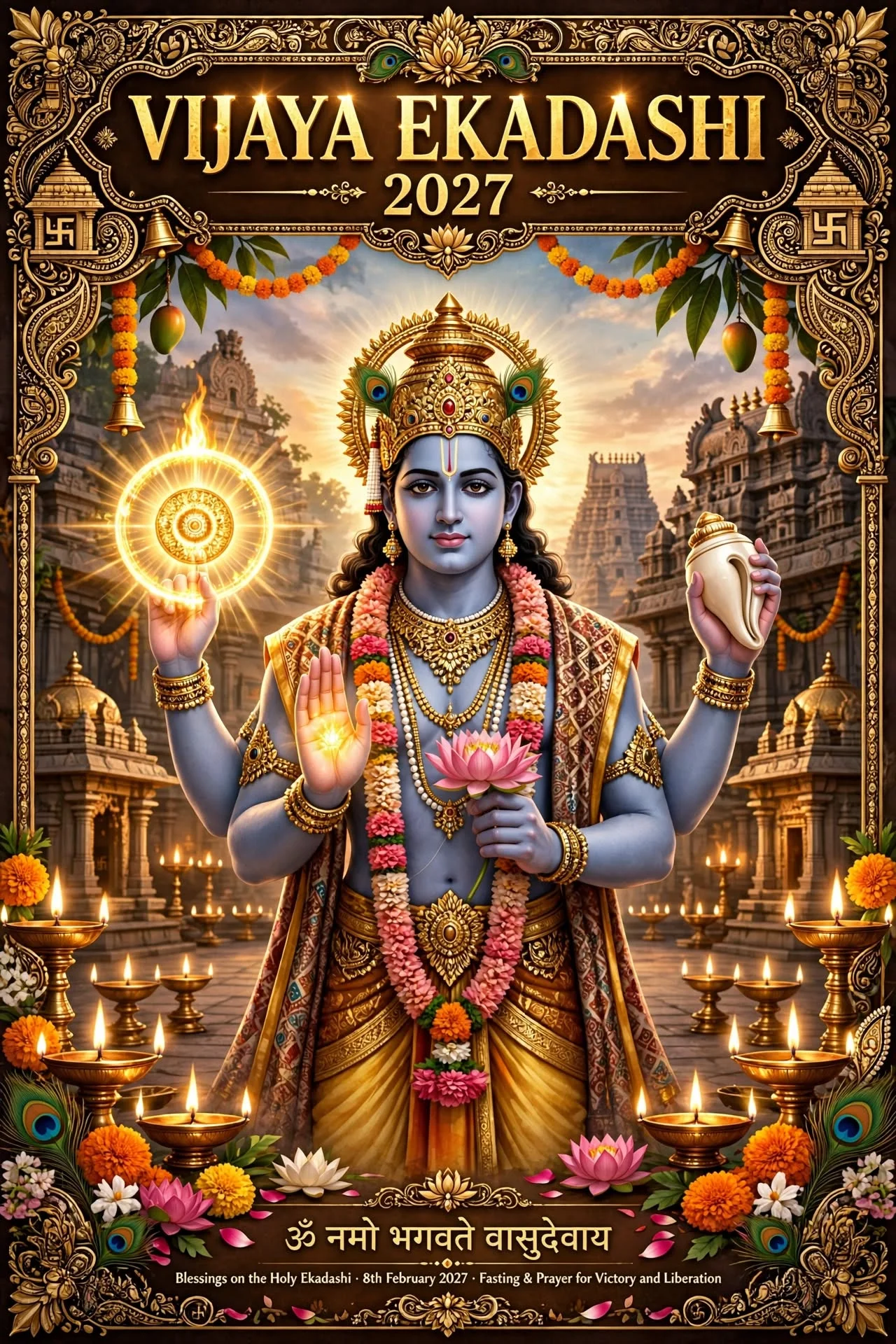
Vijaya Ekadashi
Vijaya Ekadashi is an eminently sacred Hindu fasting observance celebrated on the eleventh day (Ekadashi tithi) of the Krishna Paksha (waning moon fortnight) during the lunar month of Phalguna according to the North Indian Purnimanta calendar (corresponding to Magha Krishna Paksha in the Amanta calendar followed in southern and western India). The word 'Vijaya' signifies unconquerable triumph, victory, and overcoming formidable adversaries. Dedicated to Lord Vishnu in His venerable manifestation as Sri Narayana, this holy Ekadashi is revered across Sanatana Dharma as the supreme vow for eradicating insurmountable hurdles, dissolving profound karmic obstacles, and ensuring definitive triumph in righteous endeavors.
View Festival Guide
Friday, Mar 5, 2027
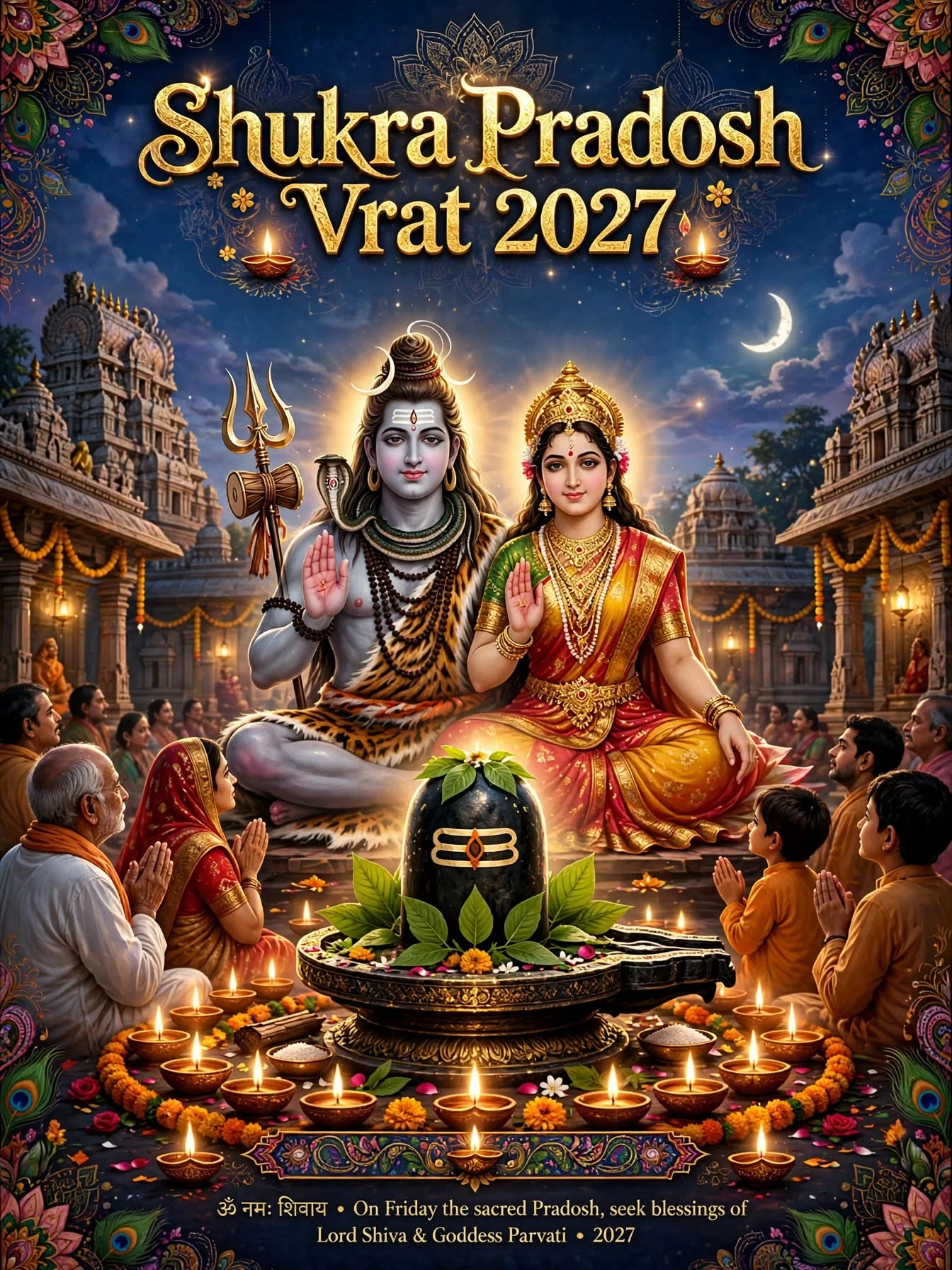
Shukra Pradosh Vrat
Shukra Pradosh Vrat is an exceedingly auspicious and spiritually elevating bi-monthly Hindu fasting observance dedicated to Lord Shiva and Goddess Parvati. Occurring on the thirteenth day (Trayodashi tithi) of either the waxing (Shukla) or waning (Krishna) lunar fortnight when it coincides with a Friday (Shukravara), this sacred vow is lauded in Vedic and Puranic literature for bestowing conjugal harmony, material abundance, refined artistic faculties, and liberation from deep-seated planetary afflictions.
View Festival Guide