




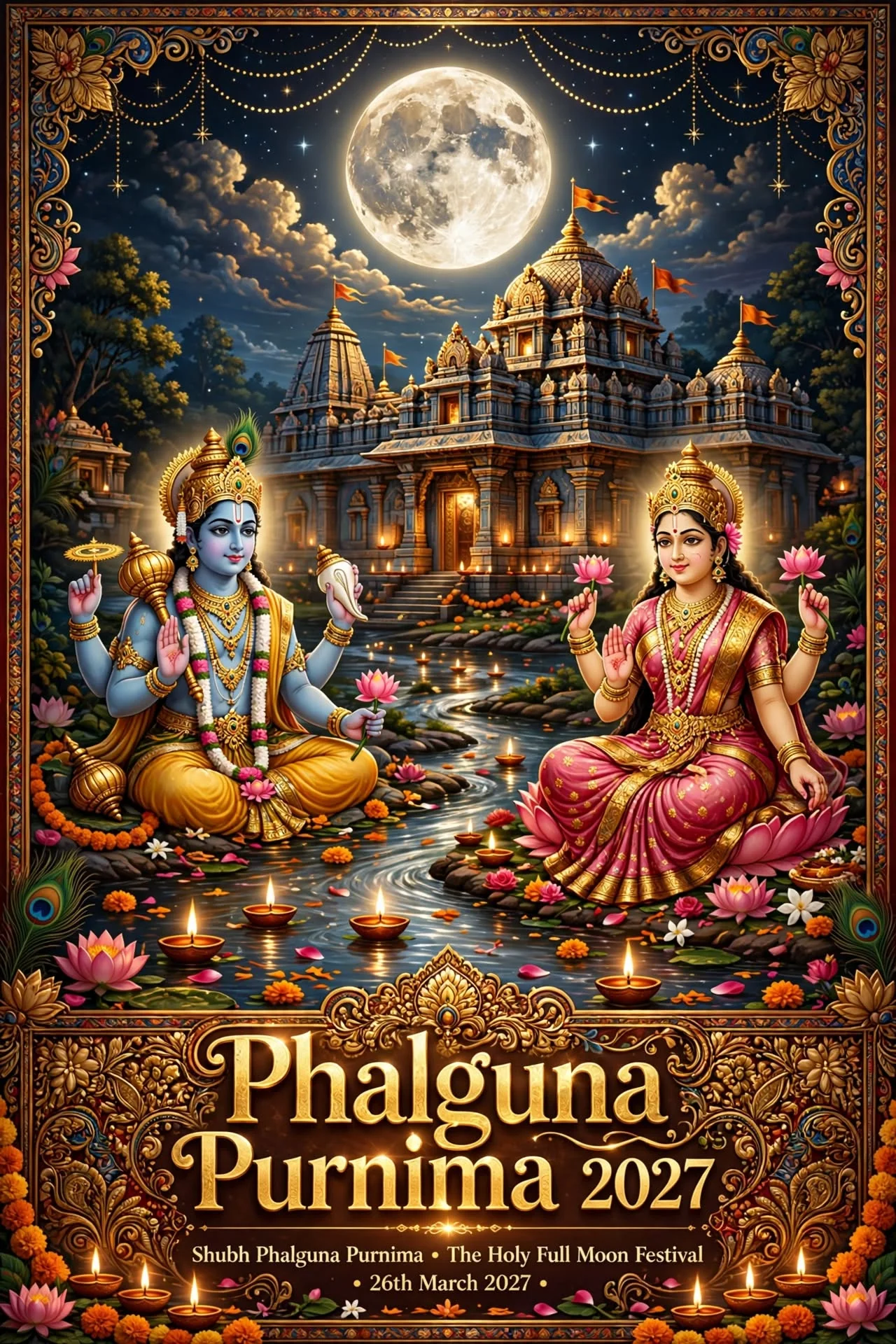
Phalguna Purnima is one of the most spiritually multifaceted, sacred, and joyously celebrated full moon days in the Hindu calendar, marking the magnificent culmination of the holy lunar month of Phalguna. Occurring on the final day of the Phalguna month in the Purnimanta calendar, this momentous full moon represents the harmonious convergence of several monumental religious observances: the sacred bonfire night of Holika Dahan, the divine advent day of Sri Chaitanya Mahaprabhu (Gaura Purnima), the glorious appearance day of Goddess Lakshmi (Lakshmi Jayanti), and the vibrant swing festivals (Dolotsava) celebrated across India.
Phalguna Purnima 2027: Date, Puja Timings, Rituals & Stories
Phalguna Purnima Timings & Panchang
Important festival dates and auspicious timings
Usha Arghya (Sunrise)
06:25 am
Sandhya Arghya (Sunset)
06:33 pm
Start Date
Sunday, 21 Mar 2027
Puja Muhurat
08:45 pm – 06:21 pm
Phalguna Purnima
The antiquity and profound theological significance of Phalguna Purnima are extolled in the Matsya Purana, the Vishnu Purana, the Skanda Purana, and the Srimad Bhagavatam. According to Puranic cosmology, it was on Phalguna Purnima that Goddess Lakshmi—the supreme goddess of wealth, fortune, light, and spiritual abundance—first manifested from the churning of the cosmic ocean of milk (Samudra Manthan) seated gracefully upon an effulgent pink lotus, choosing Lord Sri Hari Vishnu as Her eternal consort. Hence, worshipping Goddess Lakshmi alongside Lord Narayana on this night destroys all forms of poverty, debt, and misfortune.
Simultaneously, Phalguna Purnima is revered across eastern India and international Vaishnava communities as Gaura Purnima, commemorating the appearance of Sri Chaitanya Mahaprabhu in 1486 CE in Mayapur (Navadvipa, West Bengal), who inaugurated the worldwide congregational chanting of the holy names (Harinama Sankirtan). In Odisha and Bengal, it is celebrated as the grand finale of Dola Purnima (the swing festival of Lord Jagannath and Radha-Krishna), while in North and Central India, the night culminates in the sacred community bonfire of Holika Dahan celebrating the divine protection of Bhakta Prahlada.
Devotees observe Phalguna Purnima by maintaining an austere dawn-to-dusk fast, taking holy purificatory dips in sacred rivers, and conducting the elaborate Sri Satyanarayan Vrata Puja alongside special Lakshmi-Narayana archana. At dusk, families offer sacred milk-and-water Arghya to the rising full moon, participate in the community Holika Dahan fire, roast fresh ears of green wheat and barley (Holka) as prasad, and prepare festive delicacies like Gujiya, Malpua, and sweet Panjiri to welcome the colorful dawn of Holi.
Why is Phalguna Purnima Celebrated?
Phalguna Purnima is celebrated as Lakshmi Jayanti, honoring the cosmic emergence of Goddess Lakshmi from the churning of the Milk Ocean (Samudra Manthan) and Her divine marriage to Lord Vishnu.
The festival marks the sacred night of Holika Dahan, commemorating the miraculous deliverance of child-saint Bhakta Prahlada and the destruction of the demoness Holika by divine fire.
It celebrates Gaura Purnima—the divine advent day of Sri Chaitanya Mahaprabhu, the golden avatar who propagated the congregational chanting of the Hare Krishna Maha-Mantra.
Devotees observe this full moon to conduct Sri Satyanarayan Puja, offer lunar Arghya, clear negative karmic residues, and invite prosperity, health, and spiritual enlightenment.
Scriptural Chronicles and Sacred Lore of Phalguna Purnima
The Emergence of Goddess Lakshmi in the Samudra Manthan
The celebrated theological chronicle of Lakshmi Jayanti on Phalguna Purnima is expounded in the Srimad Bhagavatam (Canto 8, Chapter 8) and the Vishnu Purana (Book 1, Chapter 9). During the cosmic churning of the Milk Ocean (Ksheera Sagara) by Devas and Asuras, numerous divine beings and treasures emerged.
On Phalguna Purnima, Goddess Lakshmi suddenly manifested from the churning ocean, radiating celestial brilliance, holding a blooming pink lotus in Her hand, attended by celestial elephants pouring consecrated water from golden urns. Beholding Her supreme beauty and purity, gods and demons alike fell silent in adoration.
Goddess Lakshmi inspected all the assembled sages, gods, and kings, seeking one who was free from anger, desire, mortality, and pride. Discerning that only Lord Sri Hari Vishnu possessed all six divine opulences in full, She walked forward gracefully and placed the fragrant Vaijayanti garland around Lord Vishnu's neck, choosing Him as Her eternal lord and consort. Lord Vishnu seated Her upon His chest as 'Shrivatsa', establishing Her eternal presence as the dispenser of cosmic grace and abundance.
The Preservation of Bhakta Prahlada and Holika Dahan
In the Vishnu Purana and Srimad Bhagavatam (Canto 7), Phalguna Purnima is immortalized as the night when the demonic tyrant Hiranyakashipu sought to murder his five-year-old son Prahlada for his unwavering devotion to Lord Vishnu.
Hiranyakashipu commanded his sister Holika, who possessed a celestial fireproof shawl, to enter a roaring pyre holding Prahlada on her lap. However, when the fire was ignited, the protective shawl miraculously detached from Holika and wrapped around Prahlada. Holika was burned to ashes while Prahlada emerged unharmed, proving that divine grace shields true devotion from all earthly destruction.
The Divine Advent of Sri Chaitanya Mahaprabhu in Navadvipa
In the Chaitanya Charitamrita (Adi Lila, Chapter 13), Phalguna Purnima in the year 1486 CE marked the auspicious advent of Sri Chaitanya Mahaprabhu in Mayapur, West Bengal. Born under a neem tree to Jagannatha Mishra and Sachi Devi, He was heralded by a celestial lunar eclipse.
Esoteric, Devotional, and Cosmic Dimensions of Phalguna Purnima
Lakshmi Tattva: The Attainment of Spiritual and Material Wealth
In Vedic philosophy, Goddess Lakshmi is not merely the deity of physical currency; She represents the eightfold wealth (Ashta Lakshmi): spiritual knowledge (Vidya), progeny (Santana), courage (Dhairya), victory (Vijaya), grains (Dhanya), wealth (Dhana), fortune (Bhagya), and primordial grace (Adi).
Worshipping Lakshmi-Narayana on Her manifestation day destroys poverty (Daridrya), cleanses business and domestic spaces of negative energetic residues, and invites enduring sattvic prosperity.
Soma Tattva and the Full Moon's Rejuvenating Radiance
The Moon is the ruler of biological fluids, emotions, and the medicinal potency of all plant life (Soma). On Phalguna Purnima, the Moon reaches its absolute zenith of brightness and cooling radiance.
Offering sacred milk-water Arghya to the Full Moon balances the nervous system, alleviates emotional instability, and infuses human physiology with cooling vitality.
The Power of Pure Devotion (Prahlada and Chaitanya Tattva)
The dual celebration of Bhakta Prahlada's deliverance and Sri Chaitanya Mahaprabhu's advent makes Phalguna Purnima the ultimate festival of Prema Bhakti (unalloyed divine love).
It demonstrates that surrender to the holy name of God (Sharanagati) easily overcomes the most formidable earthly obstacles, granting the soul complete liberation and spiritual ecstasy.
The Agricultural Navanna Yajna (First Harvest Offering)
Phalguna Purnima marks the harvesting of the spring crops. Roasting newly harvested ears of green wheat and barley (Holka) in the consecrated Holika fire and sharing them as prasad honors Mother Earth and the Sun God.
This ancient agrarian rite sanctifies the community's food supply, ensuring abundance, health, and freedom from hunger.
Comprehensive Ritual Observance and Guide for Phalguna Purnima
Dawn Sanctification, Holy Snana, and Sankalpa
Rise early during Brahma Muhurta, take a purificatory bath in a flowing sacred river or in clean water infused with holy Gangajal and rose water. Wear clean traditional yellow or white attire.
Sit facing East before the altar and take a solemn Sankalpa vow holding water, unbroken white rice (akshata), flowers, and a coin, dedicating the day to fasting, Satyanarayan worship, and Lakshmi-Narayana archana.
Sri Satyanarayan Puja and Lakshmi Archana
Erect a traditional Satyanarayan mandap with banana stems, establish the consecrated Kalash, and install the Shaligram Shila or portrait of Lord Vishnu alongside Goddess Lakshmi.
Perform Shodashopachara puja with Panchamrita, apply red vermilion and yellow sandalwood, offer fresh lotus flowers and Tulsi leaves, and listen attentively to the Sri Satyanarayan Vrata Katha with family members. Distribute the traditional Panjiri / Sapad-Bhakshya prasad.
Evening Full Moon Arghya and Chaitanya Kirtan
At moonrise, fill a silver or copper lota with clean water, raw cow milk, white sandalwood, and white flowers. Stand facing the rising Full Moon and offer Arghya thrice while reciting the Chandra Gayatri Mantra.
Chant the Hare Krishna Maha-Mantra and sing hymns celebrating Sri Chaitanya Mahaprabhu's advent, filling the household with devotional joy.
Night Holika Dahan and Parana
During the post-Bhadra auspicious evening muhurat, participate in the community Holika Dahan bonfire. Circumambulate the fire clockwise three, five, or seven times, offering coconuts, batashas, and barley stalks.
Roast fresh stalks of green wheat and barley in the embers, distribute them as sacred prasad, and break your fast with the sanctified Satyanarayan prasad and a light sattvic vegetarian meal.
Phalguna Purnima Puja Vidhi (Step by Step)
- 1
Brahma Muhurta Jagaran and Morning Snana
Wake before dawn during Brahma Muhurta. Meditate upon Lord Sri Hari Vishnu and Goddess Lakshmi. Take a purificatory bath with clean water mixed with holy Gangajal, wearing fresh clean traditional yellow or white attire.
- 2
Pratah Sankalpa and Mandap Preparation
Sit facing East before the home mandir. Take water, unbroken rice (akshata), flowers, and a coin in your right palm and recite the formal Sankalpa vow to observe Phalguna Purnima with fasting, Satyanarayan puja, and Lakshmi worship.
- 3
Sri Satyanarayan Kalash Sthapana
Clean the puja altar and tie four banana stems to the corners. Establish a copper or brass Kalash filled with scented water, a coin, and betel nut, covered with mango leaves and a coconut wrapped in red thread.
- 4
Deepa Prajvalan and Achamana
Light an oil or pure cow-ghee lamp on the altar and burn sweet sandalwood incense. Perform Achamana by ceremonially sipping consecrated water thrice with the holy names of Vishnu and wash your hands.
- 5
Phalguna Purnima Puja Samagri List
Satyanarayan Mandap and Kalash Items
Specific botanical and sacred items required for erecting the Satyanarayan altar.
- Four small fresh banana plantain trees (Kadali Stambha) for altar corners
- Clean wooden platform (Chowki) draped in pure yellow unstitched silk cloth
- Copper or brass Kalash with pure water, five mango leaves, and unbroken coconut wrapped in red thread
- Shaligram Shila, idol of Lord Vishnu, and idol or portrait of Goddess Lakshmi
- Pure holy Gangajal bottle and copper lota
Abhisheka, Floral, and Lakshmi Puja Items
Aromatics, garlands, and lotus flowers for Lakshmi-Narayana.
- Panchamrita ingredients (cow milk, curd, ghee, honey, sugar) and rose water
- Pure Gopi Chandan paste, Kumkum, and natural rose attar (perfume)
- Fresh Tulsi leaves (harvested on the previous day)
- Fresh pink lotus blossoms and yellow marigold flower garlands
- Pure cow-ghee lamp, cotton wicks, and Bhimseni camphor for aarti
Prasad, Moon Arghya, and Holika Offerings
Traditional feast offerings, lunar libations, and bonfire items.
Mantras and Prayers for Phalguna Purnima
Phalguna Purnima Vrat Rules and Fasting Guidelines
Full Moon Fasting Discipline
Rules governing the Phalguna Purnima fast:
- Devotees observe fasting from sunrise until the sighting of the Full Moon and completion of the Satyanarayan Puja.
- All non-vegetarian food, alcohol, tobacco, garlic, onions, and heavy spices are strictly prohibited.
- Do not consume common sea salt during the daylight fasting hours; single phalahari servings may use rock salt (Sendha Namak).
- Do not leave the Satyanarayan Katha midway, and never refuse the consecrated Sapad-Bhakshya prasad.
Bhadra Kaal and Holika Timing
Injunctions regarding the evening bonfire:
- Ensure Holika Dahan is lit strictly after the expiration of Bhadra Kaal during the auspicious Pradosha Kaal.
- Never burn plastic, toxic chemicals, or green living trees in the Holika fire; use only dry wood and dried cow dung.
- Circumambulate the consecrated fire in a clockwise direction, never counter-clockwise.
Moonrise Arghya and Parana Rules
Concluding the fast at night:
- Check the local panchang for the exact moonrise hour and prepare the raw milk and water Arghya Kalash.
- Offer Arghya to the Full Moon facing East, prostrating in humility for peace and emotional stability.
Dos and Don'ts of Phalguna Purnima
Good Practices (Do's)
- Wake early during Brahma Muhurta, take a purificatory bath with holy Gangajal, and make a sincere Sankalpa.
- Conduct or participate in the sacred Sri Satyanarayan Vrata Katha with family members.
- Worship Goddess Lakshmi alongside Lord Vishnu with fresh pink lotus flowers, Kumkum, and Sri Suktam recitation.
- Offer Arghya to the rising Full Moon in the evening using water, raw milk, and white flowers.
- Participate in the Holika Dahan ceremony and roast green barley and wheat stalks as prasad.
Phalguna Purnima Across Regions
| Region | Local Name |
|---|---|
| West Bengal and Mayapur | Gaura Purnima & Dol Jatra |
| Odisha (Puri Jagannath Temple) | Dola Purnima & Raja Besha |
| Tamil Nadu and South India | Panguni Uthiram & Lakshmi Jayanti |
| North India (Uttar Pradesh, Bihar, Rajasthan) | Satyanarayan Vrata & Holika Dahan |
Phalguna Purnima FAQs
What is Phalguna Purnima?
Phalguna Purnima is the Full Moon day concluding the month of Phalguna, celebrating Lakshmi Jayanti (manifestation of Goddess Lakshmi), Holika Dahan, Gaura Purnima, and Dolotsava.
Why is Phalguna Purnima celebrated as Lakshmi Jayanti?
According to the Srimad Bhagavatam and Vishnu Purana, Goddess Lakshmi manifested from the churning of the Milk Ocean (Samudra Manthan) on this day and chose Lord Vishnu as Her eternal consort.
How is Sri Satyanarayan Puja performed on this day?
Devotees erect a banana-stem mandap, establish a Kalash, perform Panchamrita abhishekam of Lord Vishnu, offer Panjiri prasad, and listen to the five chapters of the Satyanarayan Katha.
Upcoming Festivals
View All
Monday, Mar 22, 2027
Holi
Holi, celebrated with incomparable exuberance, color, and spiritual fraternity, is one of the most ancient, glorious, and universally beloved festivals in Sanatana Dharma. Celebrated on the first day (Pratipada tithi) of the Krishna Paksha in the holy month of Chaitra according to the traditional Hindu calendar (occurring immediately after the night of Holika Dahan), this grand festival of colors—affectionately known as Dhulandi, Dhuleti, Rangwali Holi, and Vasantotsava—marks the triumphant arrival of spring (Rituraj Vasant), the rebirth of nature's vibrant beauty, and the profound social and spiritual renewal of human hearts.
View Festival Guide
Monday, Mar 22, 2027
Vasanta Purnima
Vasanta Purnima (also known as Vasantotsava Purnima or the Spring Full Moon) is an extraordinarily radiant, culturally celebrated, and spiritually elevating Hindu festival observed on the full moon day (Purnima tithi) of the lunar month of Phalguna according to the traditional Hindu calendar. Coinciding with the peak of the spring season (Rituraj Vasant), this glorious night represents the full flowering of natural beauty, romantic affection, aesthetic grace, and sublime divine devotion (Prema Bhakti) across Sanatana Dharma. Celebrated as the eve of the vibrant festival of colors and the sacred night of Holika Dahan, Vasanta Purnima serves as the crowning jewel of the spring festival cycle.
View Festival Guide

Monday, Mar 22, 2027
Anvadhan
Anvadhan (अन्वाधान) is an ancient, highly revered Vedic ritual and spiritual observance in Sanatana Dharma performed on the day immediately preceding the New Moon (Amavasya) or Full Moon (Purnima). Rooted in the pristine traditions of the Shrauta and Grihya Sutras, Anvadhan literally translates to 'the solemn placing and replenishment of sacred fuel wood into the consecrated Vedic fires'. In traditional Vedic ritualism, householders (Grihasthas) and priests who maintain the sacred Agnihotra fires perform Anvadhan to prepare the sacrificial altars for the grand Darsha Yajna (New Moon sacrifice) or Paurnamasa Yajna (Full Moon sacrifice) scheduled for the following day.
View Festival Guide

Tuesday, Mar 23, 2027
Ishti
Ishti is a foundational Vedic ritual observance appearing prominently in Hindu Panchangs on the Pratipada tithi (the first lunar day) following either Amavasya (new moon) or Purnima (full moon), marking the prescribed performance day for the fortnightly Vedic Darsha-Purnamasa sacrifices.
View Festival Guide
Wednesday, Mar 24, 2027
Bhai Dooj (Yama Dwitiya / Bhai Tika)
Bhai Dooj (also lovingly known as Holi Bhai Dooj or Chaitra Bhai Dooj) is an intensely affectionate, culturally sacred, and spiritually protective Hindu festival observed on the second day (Dwitiya tithi) of the Krishna Paksha in the month of Chaitra according to the traditional Hindu calendar. Occurring on the second day immediately following the vibrant festival of colors (Holi), this sacred observance mirrors the post-Diwali Bhai Dooj, serving to reaffirm, sanctify, and celebrate the pure, unconditional bond of love and protection between brothers and sisters across Sanatana Dharma.
View Festival Guide
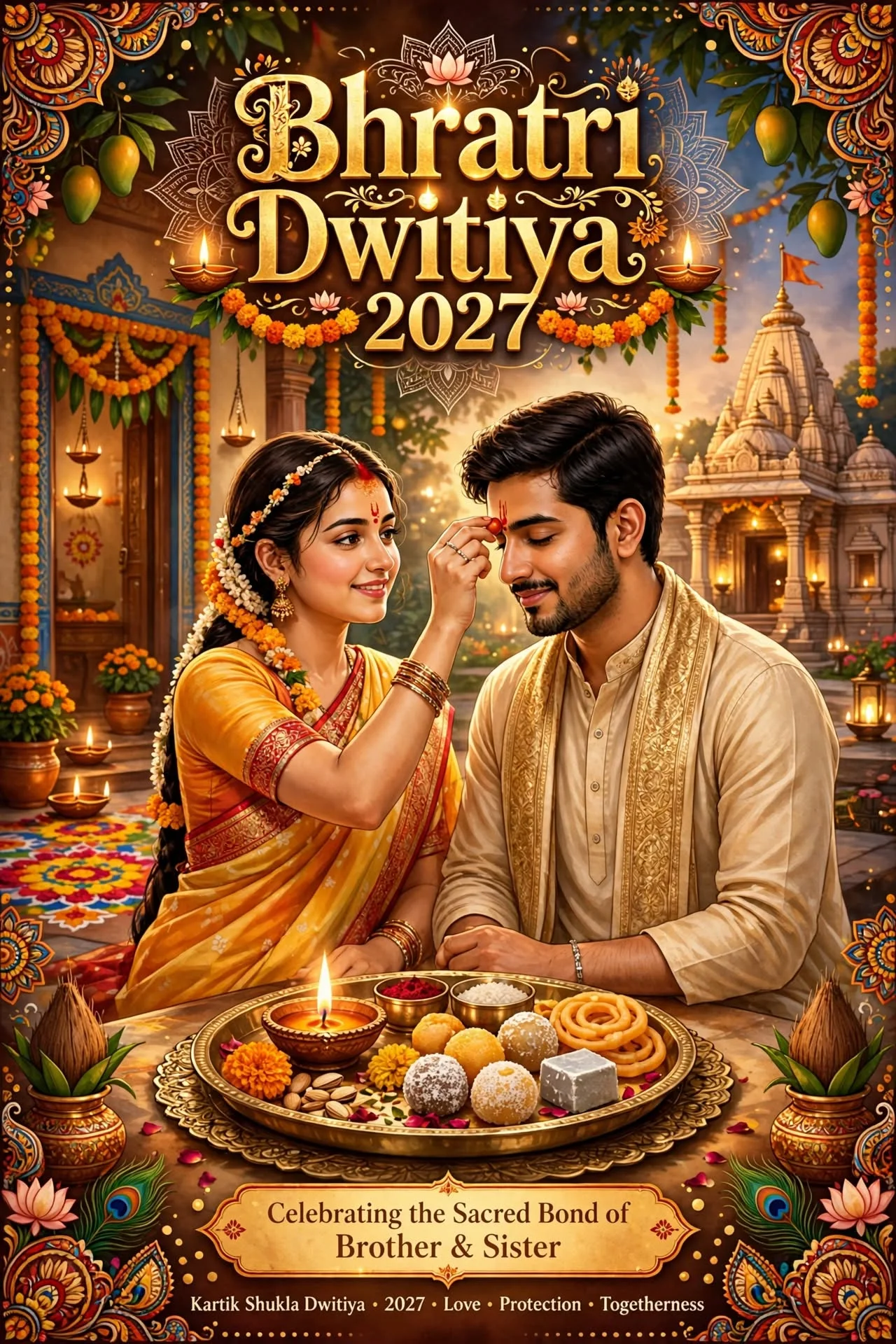
Wednesday, Mar 24, 2027
Bhratri Dwitiya
Bhratri Dwitiya (भ्रातृ द्वितीया), linguistically derived from the Sanskrit terms 'Bhratri' (brother) and 'Dwitiya' (the second lunar tithi), is a time-honored, deeply venerable, and emotionally uplifting Hindu festival that sanctifies and celebrates the sacred bond between brothers and sisters. Observed on the second day (Dwitiya tithi) of the lunar fortnight—most prominently celebrated following Holi in the month of Chaitra as well as following Diwali in the month of Kartika—Bhratri Dwitiya represents the classical, scriptural manifestation of the pan-Indian sibling festival known in regional vernaculars as Bhai Dooj, Bhai Phota (in Bengal), and Bhav Bij (in Maharashtra).
View Festival Guide
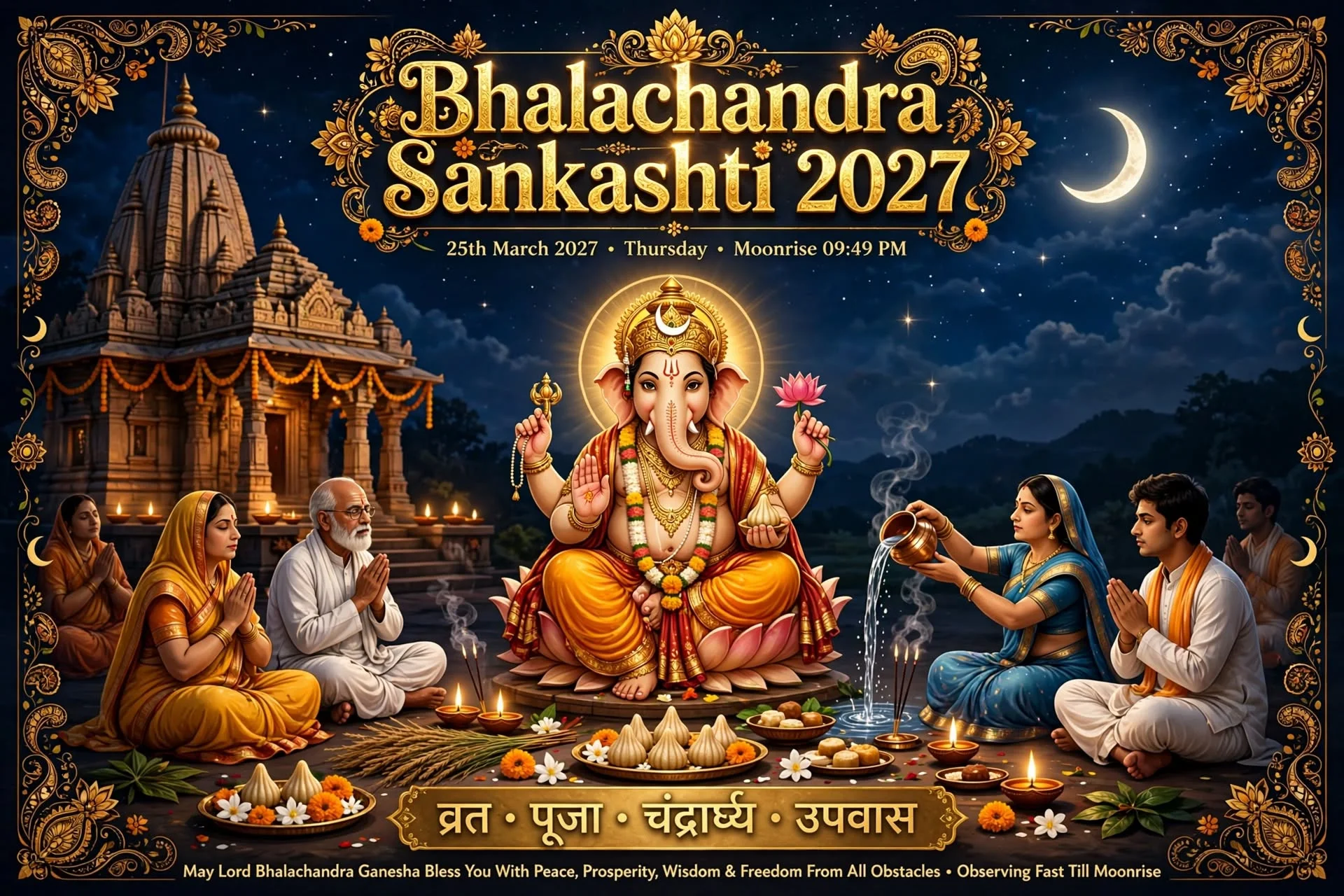
Thursday, Mar 25, 2027
Bhalachandra Sankashti
Bhalachandra Sankashti Chaturthi is an intensely sacred, spiritually liberating, and astrologically protective monthly Hindu fasting observance dedicated to Lord Ganesha, celebrated on the fourth day (Chaturthi tithi) of the Krishna Paksha (waning moon fortnight) during the lunar month of Chaitra according to the North Indian Purnimanta calendar (corresponding to Phalguna Krishna Chaturthi in the Amanta calendar followed in Maharashtra, Gujarat, Karnataka, Andhra Pradesh, and Tamil Nadu). The presiding divine manifestation venerated on this holy day is Bhalachandra Maha Ganapati—the 7th of the celebrated thirty-two classical iconographic forms of Lord Ganesha described in the sacred Mudgala Purana, and the 2nd of the legendary Ashta Vinayaka pilgrimage shrines situated at Pali in Maharashtra (Ballaleshwar / Bhalachandra).
View Festival Guide
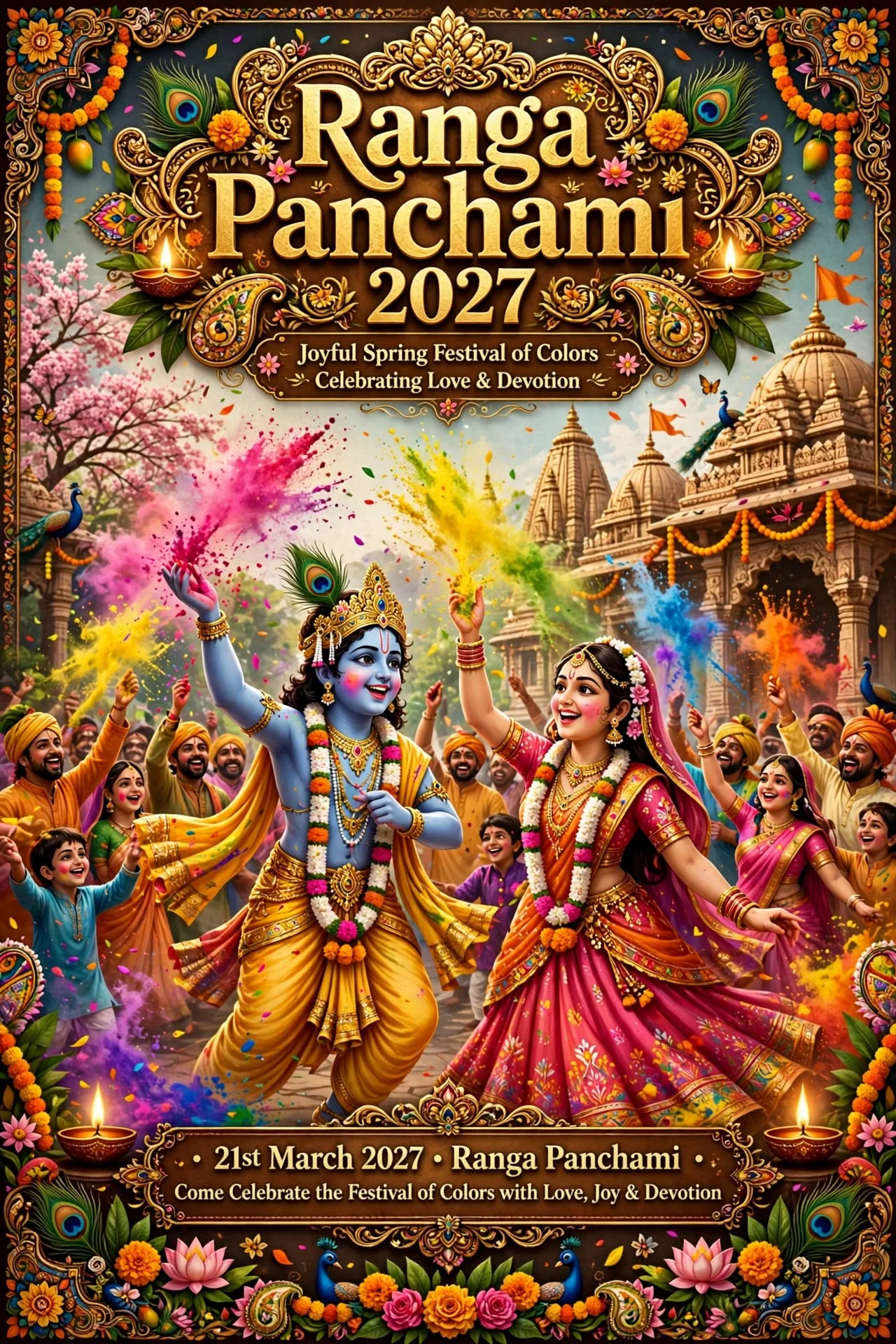
Saturday, Mar 27, 2027
Bhalachandra Sankashti
Bhalachandra Sankashti Chaturthi is an intensely sacred, spiritually liberating, and astrologically protective monthly Hindu fasting observance dedicated to Lord Ganesha, celebrated on the fourth day (Chaturthi tithi) of the Krishna Paksha (waning moon fortnight) during the lunar month of Chaitra according to the North Indian Purnimanta calendar (corresponding to Phalguna Krishna Chaturthi in the Amanta calendar followed in Maharashtra, Gujarat, Karnataka, Andhra Pradesh, and Tamil Nadu). The presiding divine manifestation venerated on this holy day is Bhalachandra Maha Ganapati—the 7th of the celebrated thirty-two classical iconographic forms of Lord Ganesha described in the sacred Mudgala Purana, and the 2nd of the legendary Ashta Vinayaka pilgrimage shrines situated at Pali in Maharashtra (Ballaleshwar / Bhalachandra).
View Festival Guide