




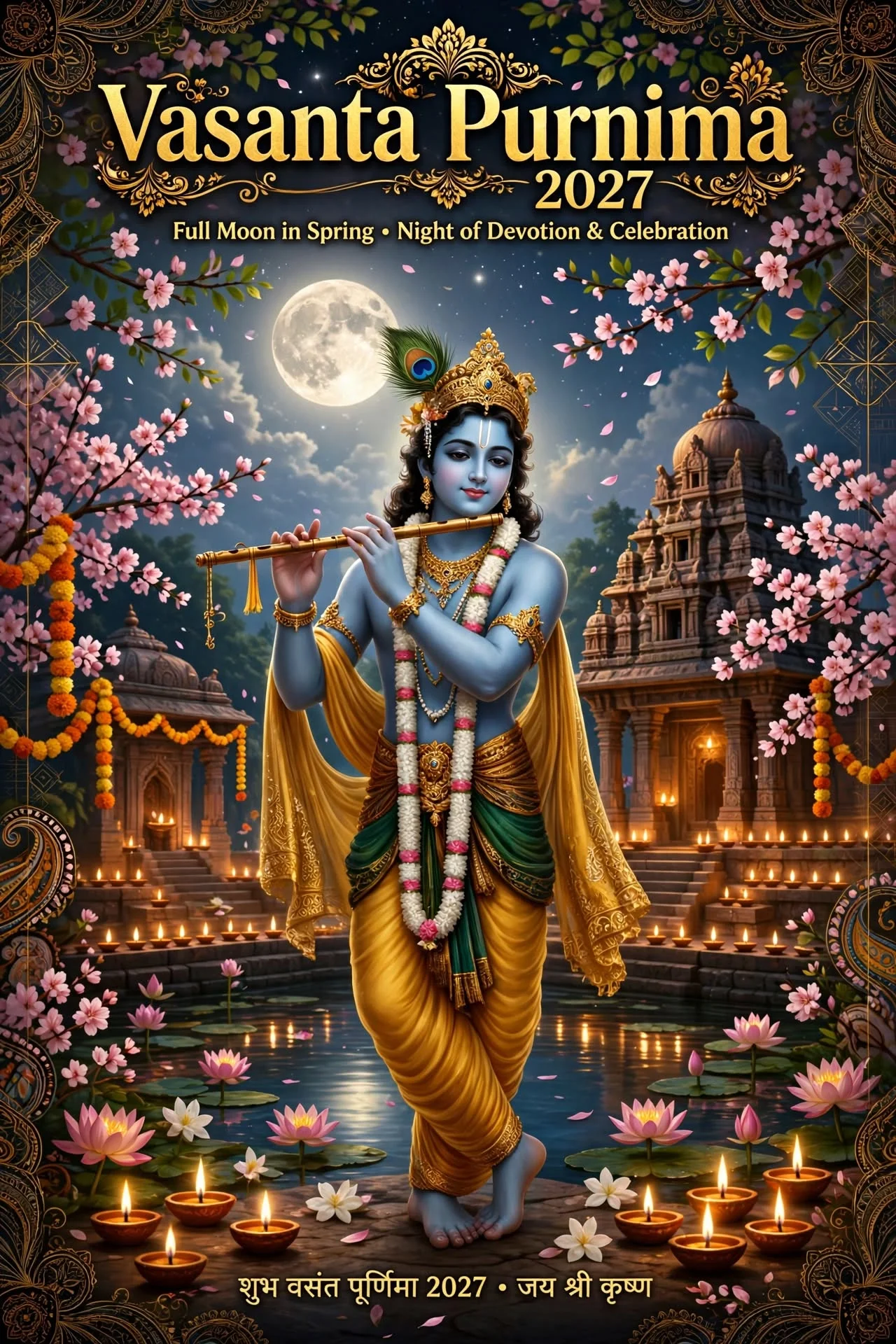
Vasanta Purnima (also known as Vasantotsava Purnima or the Spring Full Moon) is an extraordinarily radiant, culturally celebrated, and spiritually elevating Hindu festival observed on the full moon day (Purnima tithi) of the lunar month of Phalguna according to the traditional Hindu calendar. Coinciding with the peak of the spring season (Rituraj Vasant), this glorious night represents the full flowering of natural beauty, romantic affection, aesthetic grace, and sublime divine devotion (Prema Bhakti) across Sanatana Dharma. Celebrated as the eve of the vibrant festival of colors and the sacred night of Holika Dahan, Vasanta Purnima serves as the crowning jewel of the spring festival cycle.
Vasanta Purnima 2027: Date, Puja Timings, Rituals & Stories
Vasanta Purnima Timings & Panchang
Important festival dates and auspicious timings
Usha Arghya (Sunrise)
06:23 am
Sandhya Arghya (Sunset)
06:33 pm
Start Date
Monday, 22 Mar 2027
Puja Muhurat
06:21 pm – 04:13 pm
Vasanta Purnima
The antiquity and religious sanction of Vasanta Purnima are extensively documented in classical Sanskrit literature and Puranic treatises, including the Matsya Purana, the Bhavishya Purana (Uttara Parva), the Harivamsha, and the Ratnavali of Emperor Harsha. In ancient India, this day was celebrated as 'Madanotsava' or 'Kama Mahotsava'—the festival dedicated to Kamadeva (the God of Love) and his consort Rati, honoring the vital creative impulse that enlivens all flora and fauna. Simultaneously, in Vaishnava traditions, the festival is celebrated as 'Dolotsava' (the Swing Festival), where the deities of Sri Radha and Lord Krishna are placed on magnificent, flower-decked swings (Dola) and swung gently amid joyous kirtans and the showering of fragrant Abir and Gulal.
Vasanta Purnima is also revered with supreme sanctity as Gaura Purnima—the auspicious divine advent day of Sri Chaitanya Mahaprabhu (1486–1534 CE), the golden avatar of Lord Sri Krishna who inaugurated the congregational chanting of the Holy Names (Harinama Sankirtan) and democratized spiritual liberation across humanity. Millions of devotees worldwide, particularly within the Gaudiya Vaishnava community, observe strict day-long fasting, bathing in sacred rivers, and ecstatic night vigils on this full moon night.
Devotees observe Vasanta Purnima by rising before dawn to take holy dips in sacred rivers like the Ganga and Yamuna, worshipping Sri Satyanarayan with the recitation of the sacred Vrata Katha, performing loving swing seva (Dola Seva) for Radha-Krishna, and offering nighttime Arghya of milk and water to the full moon. The sacred day culminates with the community lighting of the Holika pyre, community kirtan, and feasting on spring delicacies like Gujiya, Malpua, and almond Thandai.
Why is Vasanta Purnima Celebrated?
Vasanta Purnima is celebrated to honor the full blossoming of spring (Ritu Vasant), celebrating nature's rebirth, agricultural fertility, and the divine creative pulse that animates creation.
The festival commemorates the celestial Swing Pastimes (Dolotsava) of Sri Radha and Lord Krishna in the bowers of Vrindavan, where the divine couple are showered with fragrant flowers and herbal gulal.
It celebrates Gaura Purnima—the divine appearance day of Sri Chaitanya Mahaprabhu, who propagated the Harinama Sankirtan movement and awakened pure divine love (Prema) in human hearts.
Devotees observe this sacred Full Moon to perform Sri Satyanarayan Puja, offer lunar Arghya, burn away karmic afflictions in the Holika fire, and attain peace, family harmony, and spiritual liberation.
Scriptural Chronicles and Sacred Lore of Vasanta Purnima
The Ancient Madanotsava and the Revival of Kamadeva
The classical history of Vasanta Purnima as Madanotsava is recorded in the Matsya Purana, the Bhavishya Purana, and the Natyashastra of Bharata Muni. When Kamadeva was reduced to ashes by the blazing third eye of Lord Shiva for disturbing His meditation, creation fell into an emotional and creative drought.
Moved by the heartfelt prayers of Kamadeva's consort Rati, Lord Shiva softened His wrath on Phalguna Purnima, declaring that Kamadeva would be reborn as a disembodied spiritual principle of pure, virtuous love (Ananga). The celestial gods, Gandharvas, and mortals celebrated the revival of love by dancing, spraying fragrant saffron water, and singing songs of joy under the full moon, establishing the enduring festival of Vasanta Purnima.
The Divine Dolotsava (Swing Festival) in the Padma Purana
In the Padma Purana (Patala Khanda) and the Garga Samhita, Vasanta Purnima is celebrated as the ecstatic Dolotsava (or Dola Yatra). In the blossoming forests of Vrindavan, the Sakhis constructed an ornate swing fashioned from blossoming jasmine vines and gold pillars.
Seating Sri Radha and Lord Krishna together upon the swing, the Gopis gently rocked them back and forth while singing sweet spring songs (Hori) and showering them with fragrant orange Palash and red rose petals. The Padma Purana declares: 'Whoever beholds Lord Govinda seated upon the swing on Phalguna Purnima achieves liberation and is never trapped in the cycle of mortal rebirth.'
The Divine Advent of Sri Chaitanya Mahaprabhu (Gaura Purnima)
On the evening of Phalguna Purnima in 1486 CE (corresponding to a lunar eclipse), in the holy town of Mayapur (Navadvipa, West Bengal), Sri Chaitanya Mahaprabhu manifested under a neem tree (earning the childhood name Nimai). He was born to Jagannatha Mishra and Sachi Devi as the combined incarnation of Radha and Krishna in the mood of Radharani.
Because a lunar eclipse occurred on that night, thousands of people in Navadvipa stood in the sacred waters of the Ganga chanting 'Hari Bol! Hare Krishna!' to ward off the eclipse, unknowingly celebrating the advent of the golden avatar. Sri Chaitanya revived Sanatana Dharma through the universal congregational chanting of the Hare Krishna Maha-Mantra, making Vasanta Purnima a cornerstone of global Vaishnavism.
Esoteric, Devotional, and Cosmic Dimensions of Vasanta Purnima
Sublimation of Material Desire into Divine Love (Prema)
Vasanta Purnima represents the divine alchemy of transforming lust (Kama) into unconditional divine love (Prema). In ordinary human life, spring often agitates sensual desires.
By directing this heightened emotional energy toward the worship of Radha-Krishna and Sri Chaitanya Mahaprabhu through kirtan and floral seva, the seeker purifies the heart and experiences profound transcendental bliss.
The Mystical Merits of Dolotsava (The Swing of the Soul)
The swinging of the deities upon the Dola symbolizes the gentle cosmic oscillation of creation between Prakriti (nature) and Purusha (consciousness).
Meditating upon the divine couple gently swaying on the swing steadies the oscillating mind, bringing emotional equilibrium, peace, and spiritual focus.
The Power of Harinama Sankirtan (The Yuga Dharma)
As the appearance day of Sri Chaitanya Mahaprabhu, Vasanta Purnima carries immense potency for mantra chanting. In the Kali Yuga, complex Vedic sacrifices and severe austerities are difficult to perform.
Chanting the holy names of God on this night dissolves the heaviest karmic baggage, cleanses the mirror of the mind (Ceto-Darpana-Marjanam), and awakens direct spiritual communion.
Soma Tattva and Lunar Rejuvenation
The full moon of spring radiates intense cooling, life-giving lunar rays (Soma Rasa). Offering Arghya to the moon on this night and absorbing its radiance cools excess internal heat, calms the nervous system, and enhances physical and mental beauty.
Comprehensive Ritual Observance and Guide for Vasanta Purnima
Dawn Holy Snana and Vrat Sankalpa
Rise early during Brahma Muhurta, proceed to a flowing sacred river or bathe at home with clean water infused with Gangajal and rose water. Wear clean traditional yellow, white, or saffron attire.
Sit facing East before the altar and take a formal Sankalpa vow holding water, unbroken white rice (akshata), flowers, and a coin, dedicating the day to fasting, Satyanarayan worship, and devotional service.
Sri Satyanarayan Puja and Vrata Katha
During the morning hours, erect a traditional Satyanarayan mandap using four fresh banana stems and a wooden chowki draped in yellow cloth. Install the Shaligram Shila or portrait of Lord Vishnu.
Perform Shodashopachara puja with Panchamrita, apply sandalwood paste, offer fresh Tulsi leaves, and listen attentively to the five chapters of the Sri Satyanarayan Vrata Katha with family members. Distribute the traditional Panjiri / Sapad-Bhakshya prasad.
Radha-Krishna Dolotsava (The Swing Festival)
In the afternoon, place the deities of Sri Radha-Krishna (or Laddu Gopal) upon a beautifully decorated floral swing. Gently swing the deities back and forth while singing sweet bhajans.
Shower the deities with fresh petals of rose, marigold, and fragrant white Abir and herbal Gulal, receiving the blessed flower petals as prasad of joy.
Evening Moon Arghya, Holika Dahan, and Parana
At moonrise, fill a silver or brass lota with clean water, raw cow milk, white sandalwood, and white flowers. Offer Arghya thrice to the rising full moon with reverence.
Participate in the night Holika Dahan ceremony, circumambulate the sacred fire, and conclude your fast by partaking of sanctified Charanamrita, Satyanarayan prasad, and a light sattvic vegetarian meal.
Vasanta Purnima Puja Vidhi (Step by Step)
- 1
Brahma Muhurta Jagaran and Morning Snana
Wake before dawn during Brahma Muhurta. Meditate upon Lord Sri Hari Vishnu and Sri Radha-Krishna. Take a purificatory bath with clean water mixed with holy Gangajal and rose water, donning clean traditional yellow or white attire.
- 2
Pratah Sankalpa and Mandap Preparation
Sit facing East before the altar upon a clean asana. Take water, unbroken rice (akshata), flowers, and a coin in your right palm and recite the formal Sankalpa vow to observe Vasanta Purnima with fasting, Satyanarayan puja, and devotion.
- 3
Sri Satyanarayan Kalash Sthapana
Clean the puja altar and tie four banana stems to the corners. Establish a copper or brass Kalash filled with scented water, a coin, and betel nut, covered with mango leaves and a coconut wrapped in red thread.
- 4
Deepa Prajvalan and Achamana
Light an oil or pure cow-ghee lamp on the altar and burn sweet sandalwood incense. Perform Achamana by ceremonially sipping consecrated water thrice with the holy names of Vishnu and wash your hands.
- 5
Vasanta Purnima Puja Samagri List
Satyanarayan Mandap and Kalash Items
Specific botanical and sacred items required for erecting the Satyanarayan altar.
- Four small fresh banana plantain trees (Kadali Stambha) for altar corners
- Clean wooden platform (Chowki) draped in pure yellow unstitched silk cloth
- Copper or brass Kalash with pure water, five mango leaves, and unbroken coconut wrapped in red thread
- Shaligram Shila, idol of Lord Vishnu, or portrait of Sri Satyanarayan
- Pure holy Gangajal bottle and copper lota
Abhisheka, Floral, and Swing Essentials
Aromatics, garlands, and swing decorations for Radha-Krishna.
- Panchamrita ingredients (cow milk, curd, ghee, honey, sugar) and rose water
- Pure Gopi Chandan paste, Kumkum, and natural rose attar (perfume)
- Fresh Tulsi leaves (harvested on the previous day)
- Garland of fresh yellow marigolds, roses, and fragrant white jasmine
- Miniature decorative wooden swing (Jhula) adorned with flowers and velvet cushions
- Dry organic Gulal and white Abir powder for floral Dolotsava
Prasad, Arghya, and Aarti Items
Traditional feast offerings and illuminants for concluding the puja.
Mantras and Prayers for Vasanta Purnima
Vasanta Purnima Vrat Rules and Fasting Guidelines
Fasting Discipline on Vasanta Purnima
Rules governing the Full Moon fast:
- Devotees observe fasting from sunrise until the sighting of the Full Moon and the completion of Satyanarayan Puja.
- All non-vegetarian items, alcohol, tobacco, garlic, onions, and heavy spices are strictly prohibited.
- Do not consume common sea salt during the daylight fasting hours; single phalahari servings may use rock salt (Sendha Namak).
- Do not leave the Satyanarayan Katha midway, and never refuse the consecrated Sapad-Bhakshya prasad.
Dolotsava and Floral Seva Etiquette
Rules for the swing festival and playing with colors:
- The swing (Jhula) must be decorated with clean, fresh blossoms; never use withered or artificial plastic flowers.
- Swing the deities gently and reverently with soft, rhythmic movements, never violently or abruptly.
- Use only safe, skin-friendly herbal Gulal and white Abir when offering colors to the deities.
- Collect the fallen flower petals from the swing as sanctified Nirmalya prasad.
Moonrise Arghya and Parana Rules
Concluding the fast at night:
- Check the local panchang for the exact moonrise hour and prepare the raw milk and water Arghya Kalash.
- Offer Arghya to the Full Moon facing East, prostrating in humility for peace and emotional stability.
Dos and Don'ts of Vasanta Purnima
Good Practices (Do's)
- Wake early during Brahma Muhurta, take a purificatory bath with holy Gangajal, and make a sincere Sankalpa.
- Conduct or participate in the sacred Sri Satyanarayan Vrata Katha with family members.
- Place Sri Radha-Krishna upon a flower-decked swing (Dolotsava) and gently swing them with devotion.
- Chant the Hare Krishna Maha-Mantra and sing hymns celebrating Sri Chaitanya Mahaprabhu.
- Offer Arghya to the rising Full Moon in the evening using water, raw milk, and white flowers.
Vasanta Purnima Across Regions
| Region | Local Name |
|---|---|
| West Bengal (Mayapur and Shantiniketan) | Gaura Purnima & Basanta Utsav |
| Odisha (Puri Jagannath Temple) | Dola Purnima & Raja Besha |
| Braj Bhoomi (Vrindavan, Mathura, Barsana) | Phalguni Purnima Dolotsav |
| North India (Uttar Pradesh, Bihar, Rajasthan) | Satyanarayan Vrata & Holika Dahan |
Vasanta Purnima FAQs
What is Vasanta Purnima?
Vasanta Purnima is the Full Moon festival of the spring month of Phalguna, celebrating the full blossoming of spring, the swing pastimes (Dolotsava) of Radha-Krishna, Gaura Purnima, and Holika Dahan.
What is the Dolotsava (Swing Festival)?
Dolotsava is the sacred tradition where deities of Sri Radha-Krishna or Lord Jagannath are placed upon flower-decked swings, swung gently, and showered with fragrant petals and herbal gulal.
Why is this day celebrated as Gaura Purnima?
It marks the divine appearance day of Sri Chaitanya Mahaprabhu (born 1486 CE in Mayapur, Bengal), the golden avatar of Krishna who inaugurated the congregational chanting of the Hare Krishna Maha-Mantra.
Upcoming Festivals
View All
Monday, Mar 22, 2027
Holi
Holi, celebrated with incomparable exuberance, color, and spiritual fraternity, is one of the most ancient, glorious, and universally beloved festivals in Sanatana Dharma. Celebrated on the first day (Pratipada tithi) of the Krishna Paksha in the holy month of Chaitra according to the traditional Hindu calendar (occurring immediately after the night of Holika Dahan), this grand festival of colors—affectionately known as Dhulandi, Dhuleti, Rangwali Holi, and Vasantotsava—marks the triumphant arrival of spring (Rituraj Vasant), the rebirth of nature's vibrant beauty, and the profound social and spiritual renewal of human hearts.
View Festival Guide
Monday, Mar 22, 2027
Phalguna Purnima
Phalguna Purnima is one of the most spiritually multifaceted, sacred, and joyously celebrated full moon days in the Hindu calendar, marking the magnificent culmination of the holy lunar month of Phalguna. Occurring on the final day of the Phalguna month in the Purnimanta calendar, this momentous full moon represents the harmonious convergence of several monumental religious observances: the sacred bonfire night of Holika Dahan, the divine advent day of Sri Chaitanya Mahaprabhu (Gaura Purnima), the glorious appearance day of Goddess Lakshmi (Lakshmi Jayanti), and the vibrant swing festivals (Dolotsava) celebrated across India.
View Festival Guide

Monday, Mar 22, 2027
Anvadhan
Anvadhan (अन्वाधान) is an ancient, highly revered Vedic ritual and spiritual observance in Sanatana Dharma performed on the day immediately preceding the New Moon (Amavasya) or Full Moon (Purnima). Rooted in the pristine traditions of the Shrauta and Grihya Sutras, Anvadhan literally translates to 'the solemn placing and replenishment of sacred fuel wood into the consecrated Vedic fires'. In traditional Vedic ritualism, householders (Grihasthas) and priests who maintain the sacred Agnihotra fires perform Anvadhan to prepare the sacrificial altars for the grand Darsha Yajna (New Moon sacrifice) or Paurnamasa Yajna (Full Moon sacrifice) scheduled for the following day.
View Festival Guide

Tuesday, Mar 23, 2027
Ishti
Ishti is a foundational Vedic ritual observance appearing prominently in Hindu Panchangs on the Pratipada tithi (the first lunar day) following either Amavasya (new moon) or Purnima (full moon), marking the prescribed performance day for the fortnightly Vedic Darsha-Purnamasa sacrifices.
View Festival Guide
Wednesday, Mar 24, 2027
Bhai Dooj (Yama Dwitiya / Bhai Tika)
Bhai Dooj (also lovingly known as Holi Bhai Dooj or Chaitra Bhai Dooj) is an intensely affectionate, culturally sacred, and spiritually protective Hindu festival observed on the second day (Dwitiya tithi) of the Krishna Paksha in the month of Chaitra according to the traditional Hindu calendar. Occurring on the second day immediately following the vibrant festival of colors (Holi), this sacred observance mirrors the post-Diwali Bhai Dooj, serving to reaffirm, sanctify, and celebrate the pure, unconditional bond of love and protection between brothers and sisters across Sanatana Dharma.
View Festival Guide
Wednesday, Mar 24, 2027
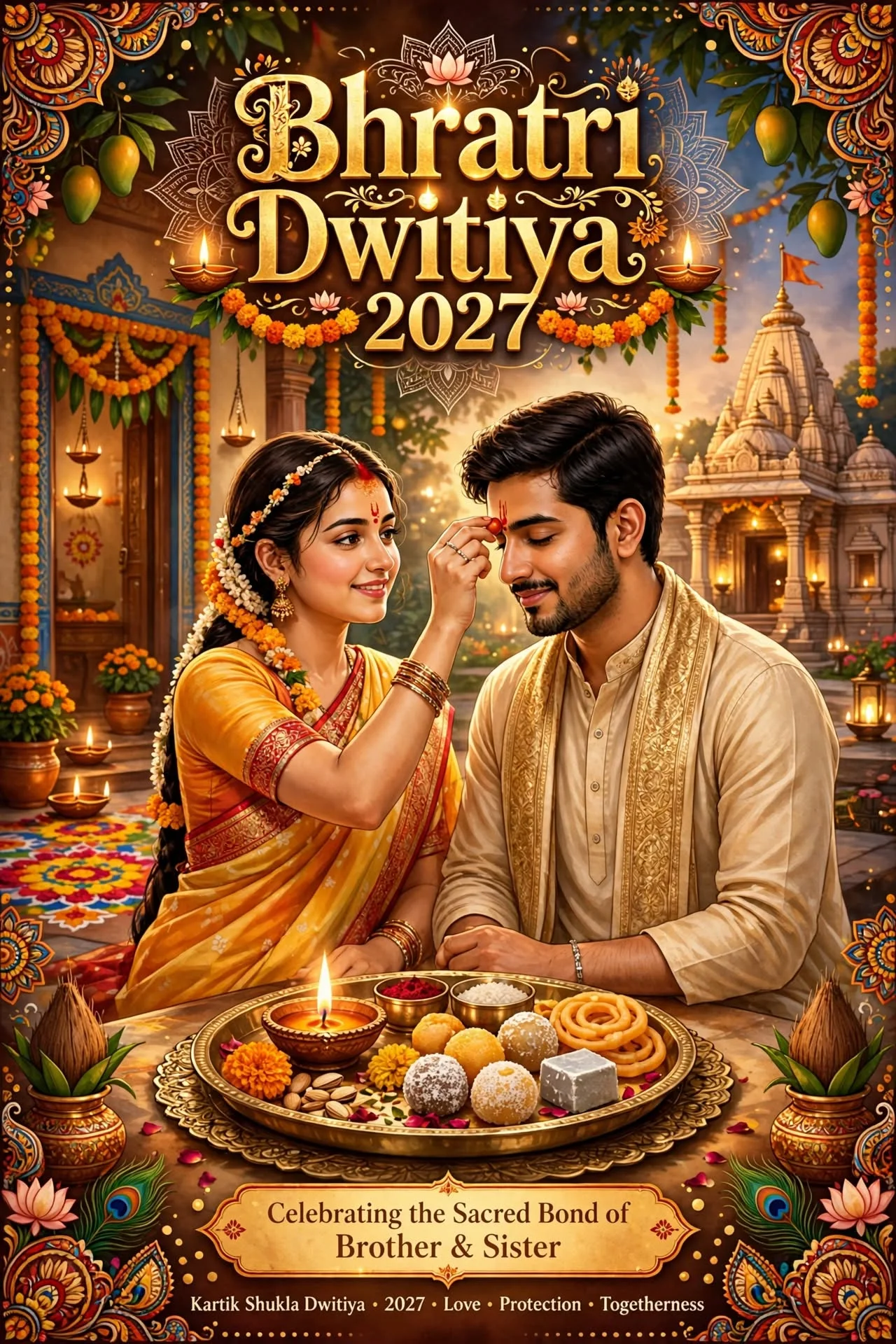
Bhratri Dwitiya
Bhratri Dwitiya (भ्रातृ द्वितीया), linguistically derived from the Sanskrit terms 'Bhratri' (brother) and 'Dwitiya' (the second lunar tithi), is a time-honored, deeply venerable, and emotionally uplifting Hindu festival that sanctifies and celebrates the sacred bond between brothers and sisters. Observed on the second day (Dwitiya tithi) of the lunar fortnight—most prominently celebrated following Holi in the month of Chaitra as well as following Diwali in the month of Kartika—Bhratri Dwitiya represents the classical, scriptural manifestation of the pan-Indian sibling festival known in regional vernaculars as Bhai Dooj, Bhai Phota (in Bengal), and Bhav Bij (in Maharashtra).
View Festival Guide
Thursday, Mar 25, 2027
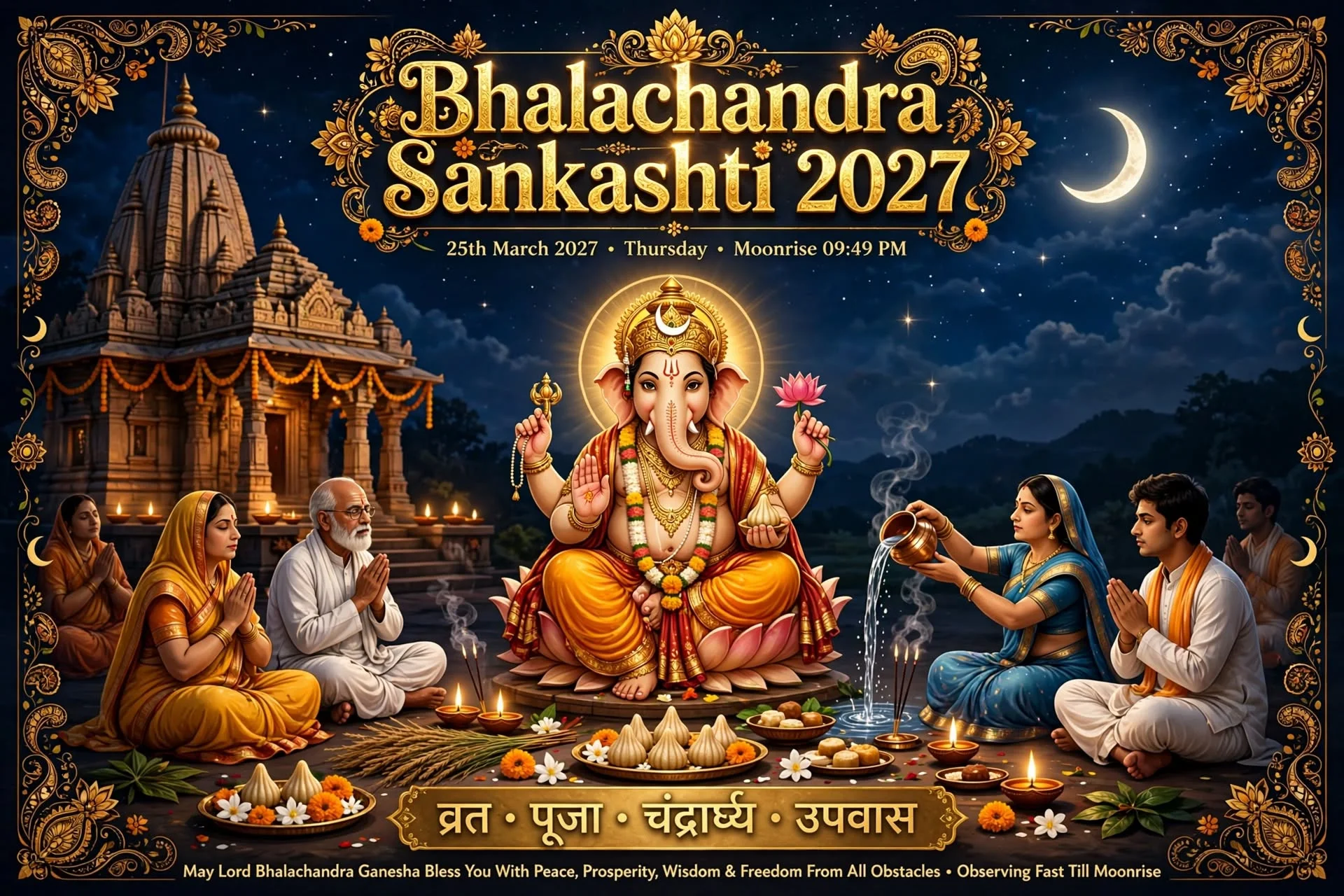
Bhalachandra Sankashti
Bhalachandra Sankashti Chaturthi is an intensely sacred, spiritually liberating, and astrologically protective monthly Hindu fasting observance dedicated to Lord Ganesha, celebrated on the fourth day (Chaturthi tithi) of the Krishna Paksha (waning moon fortnight) during the lunar month of Chaitra according to the North Indian Purnimanta calendar (corresponding to Phalguna Krishna Chaturthi in the Amanta calendar followed in Maharashtra, Gujarat, Karnataka, Andhra Pradesh, and Tamil Nadu). The presiding divine manifestation venerated on this holy day is Bhalachandra Maha Ganapati—the 7th of the celebrated thirty-two classical iconographic forms of Lord Ganesha described in the sacred Mudgala Purana, and the 2nd of the legendary Ashta Vinayaka pilgrimage shrines situated at Pali in Maharashtra (Ballaleshwar / Bhalachandra).
View Festival Guide
Saturday, Mar 27, 2027
Bhalachandra Sankashti
Bhalachandra Sankashti Chaturthi is an intensely sacred, spiritually liberating, and astrologically protective monthly Hindu fasting observance dedicated to Lord Ganesha, celebrated on the fourth day (Chaturthi tithi) of the Krishna Paksha (waning moon fortnight) during the lunar month of Chaitra according to the North Indian Purnimanta calendar (corresponding to Phalguna Krishna Chaturthi in the Amanta calendar followed in Maharashtra, Gujarat, Karnataka, Andhra Pradesh, and Tamil Nadu). The presiding divine manifestation venerated on this holy day is Bhalachandra Maha Ganapati—the 7th of the celebrated thirty-two classical iconographic forms of Lord Ganesha described in the sacred Mudgala Purana, and the 2nd of the legendary Ashta Vinayaka pilgrimage shrines situated at Pali in Maharashtra (Ballaleshwar / Bhalachandra).
View Festival Guide