




Sheetala Ashtami (शीतला अष्टमी), also revered across northern and western India as the grand culmination of the Basoda festival, is an ancient, highly revered, and epidemiologically profound Hindu festival observed on the eighth day (Ashtami tithi) of the Krishna Paksha in the month of Chaitra. Dedicated to Goddess Sheetala (the divine mother who presides over cooling energy, physical immunity, and protection against fevers, poxes, and epidemic illnesses), this sacred festival marks the annual observance of 'Basoda'—the unique ritual of consuming strictly cold, stale food (Baasi Bhojan) and refraining from lighting the domestic cooking fire.
Sheetala Ashtami (Basoda) 2027: Date, Puja Timings, Rituals & Stories
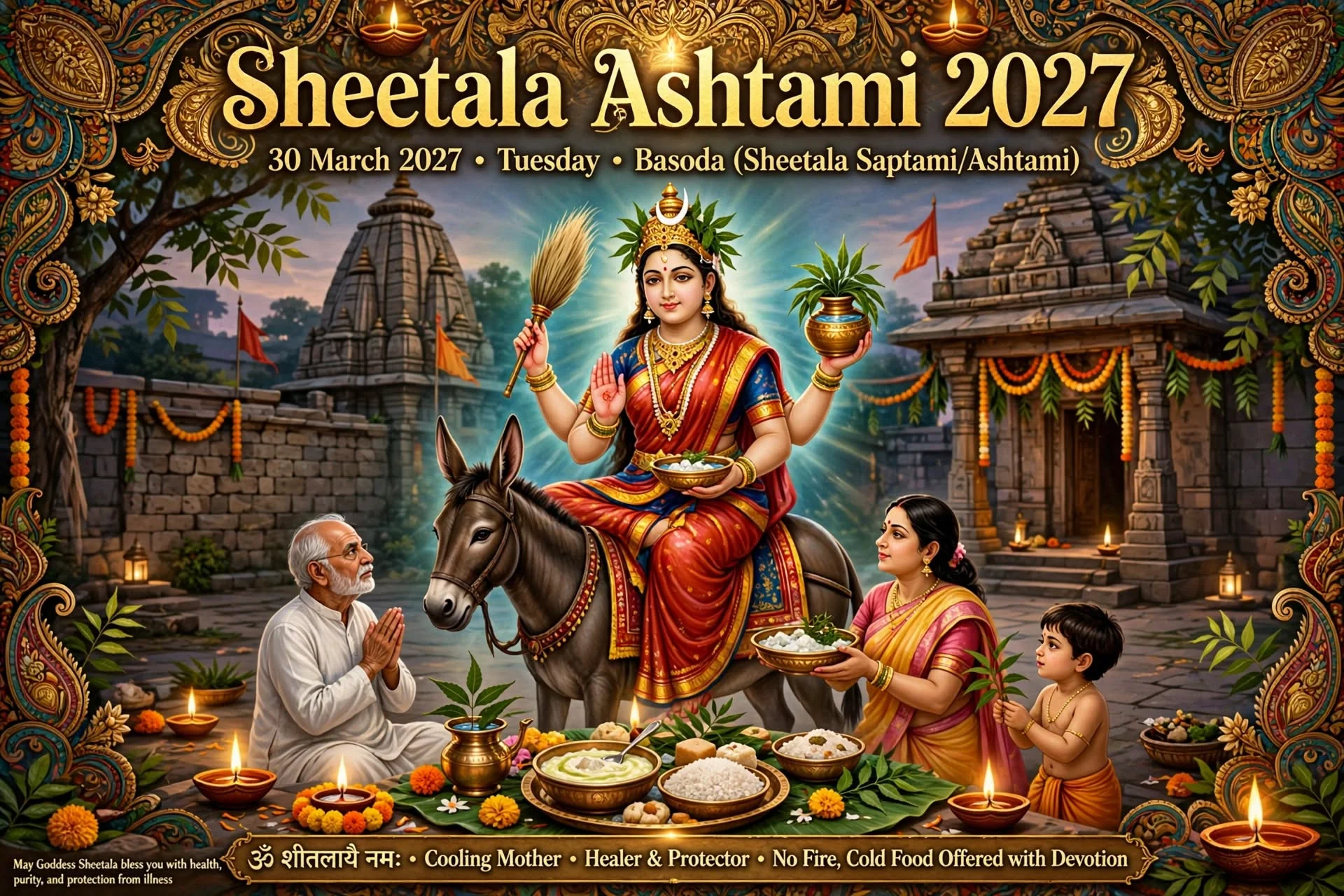
Sheetala Ashtami (Basoda) Timings & Panchang
Important festival dates and auspicious timings
Usha Arghya (Sunrise)
06:14 am
Sandhya Arghya (Sunset)
06:38 pm
Start Date
Tuesday, 30 Mar 2027
Puja Muhurat
05:11 pm – 07:40 pm
Sheetala Ashtami (Basoda)
The antiquity and religious sanction of Sheetala Ashtami are deeply anchored in the Skanda Purana, the Bhavishya Purana, and the Padma Purana. In the Skanda Purana, the celebrated 'Sheetalashtakam' hymn, revealed directly by Lord Shiva to the gods, extols Goddess Sheetala as the supreme healer. The Goddess is iconographically envisioned seated upon a donkey (Rasabha), holding a sacred broom (Marjani) in one hand to sweep away diseases and physical impurities, a winnowing fan (Shurpa) in the other to separate health from illness, a small pot of holy cooling water (Amrita Kalash) to pacify fevers, and neem leaves that possess powerful antiseptic and healing properties.
The hallmark practice of Sheetala Ashtami is the observance of 'Basoda' (derived from the Hindi word 'Baasi', meaning cooked on the previous day). On the eve of the festival (Saptami tithi), women prepare a rich variety of festive dishes: sweet yellow rice flavored with saffron and jaggery (Meethe Chawal), Bajra (pearl millet) rotis, curd, Rabdi, Poori, and fried Pakodis. On the morning of Ashtami, the household kitchen stove (Chulha) is cleaned, decorated, and kept completely unlit. The entire household abstains from cooking fresh food, offering the cold food prepared the night before to Goddess Sheetala before consuming it as consecrated prasad.
Devotees observe Sheetala Ashtami by rising before dawn to take a purificatory bath with cold water, proceeding to a neighborhood Sheetala Mata temple or Peepal tree carrying brass lotas filled with cold water, unboiled milk, neem twigs, curd, and cold food. Mothers pray with deep maternal devotion for the health, vitality, and protection of their children against chickenpox, smallpox, measles, and seasonal heatstroke, honoring the wise Ayurvedic transition from the cool spring to the blazing heat of summer.
Why is Sheetala Ashtami (Basoda) Celebrated?
Sheetala Ashtami is celebrated to propitiate Goddess Sheetala, the divine mother who bestows cooling energy, relieves acute physical fevers, and protects families from epidemic diseases like poxes and measles.
The festival honors the ancient Ayurvedic wisdom of giving the digestive system and the domestic hearth a complete rest before the onset of intense summer heat by consuming cold, probiotic-rich foods (Basoda).
It commemorates the teachings of the Skanda Purana, where Lord Shiva expounds the Sheetalashtakam, declaring that sincere worship of Sheetala Mata shields children from premature death and physical ailments.
Mothers observe this sacred day with maternal vows (Vrats) to seek divine immunity, longevity, and robust health for their children and households.
Scriptural Chronicles and Sacred Lore of Sheetala Ashtami
Lord Shiva Reveals the Sheetalashtakam in the Skanda Purana
The primary theological exposition of Goddess Sheetala is found in the Skanda Purana (Maheshwara Khanda). When the earth was gripped by terrifying epidemics of burning fevers and eruptive skin boils that baffled all celestial remedies, the Devas approached Lord Shiva on Mount Kailash.
Lord Shiva revealed the divine manifestation of Goddess Sheetala—an aspect of Goddess Parvati embodying absolute cooling grace. Shiva proclaimed the sacred eight-verse hymn 'Sheetalashtakam' ('Vandeham Sheetalam Devim Rasabhastham Digambaram...'). He explained that Sheetala Mata wields the broom to cleanse the environment, the winnowing basket to sift impurities, and the pot of nectar to cool burning fevers.
Lord Shiva declared: 'Whoever recites this Sheetalashtakam with devotion and offers cold, unheated food to the Goddess on Chaitra Krishna Ashtami shall see their children shielded from all eruptive fevers, boils, and eye diseases for a whole year.'
The Legend of the Pious Old Woman and the Scorched Village
In Puranic and folklore tradition, a popular legend narrates that Goddess Sheetala once disguised Herself as an impoverished, elderly woman with burning boils across Her body and walked through a village on Chaitra Krishna Ashtami to test the compassion of the inhabitants.
Every household was busy cooking hot spicy food on blazing hearths, and when the elderly woman asked for shelter and cool water, people chased Her away, fearing contagion. Finally, an impoverished, pious potter woman welcomed Her into her modest hut, washed Her wounds with cold water, applied cooling curd and neem paste, and served Her cold sweet rice porridge (Meethe Chawal) prepared the previous day.
Soothing relief washed over the Goddess. Soon after, a sudden fire broke out, burning every house in the village to ashes except the humble hut of the potter woman. When the astonished villagers realized that the old woman was Goddess Sheetala Herself, they fell at Her feet in deep remorse. The Goddess decreed that whoever honors Her by keeping their hearth cold and offering cold food on this day shall remain protected from fire, fevers, and poverty.
Esoteric, Ayurvedic, and Climatic Dimensions of Sheetala Ashtami
Ayurvedic Transition to Summer (Ritucharya Wisdom)
In classical Ayurveda (Charaka Samhita), Chaitra marks the transition from Vasant Ritu (spring) to Grishma Ritu (summer). As ambient temperatures rise, the body's internal fire (Pitta dosha) easily becomes aggravated, manifesting as fevers, skin eruptions, and dehydration.
Consuming cooling, fermented, and probiotic-rich foods like cold sweet rice, curd, and Rabdi cools the gastrointestinal tract, repopulates beneficial gut flora, and prepares the human organism for the blazing heat of summer.
The Botanical Power of the Sacred Neem (Azadirachta indica)
The veneration of neem twigs during Sheetala Ashtami is an ancient epidemiological safeguard. Neem is scientifically recognized as one of the most powerful natural antiviral, antibacterial, and blood-purifying plants on earth.
Hanging neem branches outside doorways, bathing with neem-infused water, and offering neem to Goddess Sheetala effectively sanitized households during historical pox epidemics.
Extinguishing the Domestic Fire: Giving Nature a Rest
Not lighting the kitchen fire (Chulha) for an entire day is an act of deep reverence toward Agni Deva and Mother Nature. It provides mothers and homemakers a mandatory holiday from daily kitchen labor.
Metaphysically, keeping the stove cold symbolizes the pacification of internal and external fires of anger, agitation, and burning desires.
The Symbolism of the Donkey (Rasabha Vahana)
Goddess Sheetala rides a donkey (Rasabha)—an animal renowned for patient endurance, humility, and carrying heavy burdens without complaint.
This symbolism teaches that enduring life's physical illnesses and spiritual trials with patient endurance and humility is essential for ultimate physical and spiritual healing.
Comprehensive Ritual Observance and Guide for Sheetala Ashtami
Eve Preparation: Cooking the Basoda Feast on Saptami
On the evening of Saptami (the seventh tithi preceding Ashtami), clean the kitchen thoroughly and prepare the entire Basoda meal before midnight: sweet yellow rice (Meethe Chawal), Bajra rotis, Poori, fried Besan Pakodis, Rabdi, and curd.
Extinguish the kitchen fire completely before midnight. No fresh cooking or boiling of water is permitted on Ashtami day.
Dawn Cold Bath and Temple Procession
Rise early during Brahma Muhurta, take a purificatory bath with fresh, unheated cold water, and don clean traditional clothing (avoiding black).
Prepare a brass puja thali with cold water, unboiled milk, curd, roli, turmeric, unbroken rice, fresh neem leaves, and portions of all cold food items prepared the previous evening.
Temple Worship and Sheetalashtakam Chanting
Visit a neighborhood Sheetala Mata temple or a sacred Peepal/Neem tree. Bathe the idol with cold water and milk, apply turmeric and roli, and offer fresh neem twigs and the cold food prasad.
Light an earthen lamp with a cold wick (traditionally without igniting fire, or offering unlit lamps in strict traditions), and recite the celebrated Sheetalashtakam hymn with family members, praying for children's immunity.
Partaking of Baasi Bhojan and Family Sharing
Return home and apply a tilak of turmeric and curd upon the household hearth (Chulha) and upon children's foreheads.
The entire family consumes the consecrated cold food (Baasi Bhojan) throughout the day, sharing portions with cows, dogs, and domestic helpers, spending the day in peace and quietude.
Sheetala Ashtami (Basoda) Puja Vidhi (Step by Step)
- 1
Brahma Muhurta Jagaran and Sheetala Snana
Wake before dawn during Brahma Muhurta. Meditate upon Goddess Sheetala and take a purificatory bath using unheated cold water infused with a few fresh neem leaves and Gangajal, wearing clean traditional attire.
- 2
Assembling the Basoda Puja Thali
Arrange a brass thali containing portions of all cold food prepared the previous evening: sweet yellow rice, Bajra roti, Poori, curd, Rabdi, fried pakodis, fresh neem twigs, turmeric paste, red roli, and akshata.
- 3
Cold Water Lota Preparation
Fill a clean brass or copper lota with fresh cold water, a few drops of unboiled raw cow milk, a pinch of sugar, and fresh neem leaves for offering to the Goddess.
- 4
Proceeding to the Sheetala Mata Temple or Neem Tree
Walk quietly to a nearby Sheetala Mata temple or a sacred mature Neem / Peepal tree, maintaining a peaceful, prayerful mindset.
- 5
Cold Water and Milk Abhisheka
Sheetala Ashtami (Basoda) Puja Samagri List
Cold Food (Basoda) Offerings
Traditional food items cooked on the eve (Saptami) and offered cold on Ashtami.
- Sweet yellow rice (Meethe Chawal) flavored with turmeric, jaggery, and dry fruits
- Bajra (pearl millet) rotis or wheat flour Pooris
- Fresh homemade cow-milk curd and sweetened Rabdi
- Besan Pakodis or Gulgule (fried sweet dumplings)
- Boiled gram or lentils prepared without hot spices
Botanical and Cooling Ingredients
Healing herbs and water vessels for the Goddess.
- Fresh green Neem twigs with leaves (at least 5 bunches)
- Fresh unboiled raw cow milk (250 ml) and clean cold water in a brass lota
- Pure turmeric powder (Haldi) and red Kumkum / Roli
- Unbroken white rice grains (Akshata) - 50 grams
- Fresh yellow marigold flowers and white Kaner flowers
Altar and Domestic Cleansing Items
Items for home hearth and temple rituals.
- Brass or copper puja thali
- Clay miniature broom or fan (symbolic offering)
Mantras and Prayers for Sheetala Ashtami (Basoda)
Sheetala Ashtami (Basoda) Vrat Rules and Fasting Guidelines
Strict Basoda (Cold Food) Injunctions
Core scriptural and culinary rules governing Sheetala Ashtami:
- No cooking fire (Chulha/stove) may be lit inside the household on Sheetala Ashtami; lighting fire is strictly forbidden.
- All meals must be cooked completely on the preceding day (Saptami) and consumed cold.
- Do not consume hot water, freshly boiled tea, fresh milk, or freshly reheated food.
- The kitchen stove must be cleaned on Saptami evening, smeared with turmeric and curd, and left unlit throughout Ashtami.
Hygienic and Behavioral Injunctions
Rules for personal hygiene and conduct:
- Bathe only with fresh, unheated cold water; never use hot water for bathing on this day.
- Do not cut hair, shave, or trim nails on Sheetala Ashtami.
- Do not wash clothes or engage in heavy domestic sewing/tailoring labor.
- Maintain pure peaceful conduct, refraining from anger, domestic disputes, and harsh speech.
Sharing and Charity Regulations
Rules for food distribution:
- Offer the first portions of the cold food to Goddess Sheetala before personal consumption.
- Share portions of sweet rice, curd, and bajra rotis with cows, stray dogs, and birds.
Dos and Don'ts of Sheetala Ashtami (Basoda)
Good Practices (Do's)
- Prepare all festive food on Saptami evening so it can be consumed cold on Ashtami.
- Keep the household kitchen stove completely cold and unlit throughout the day.
- Take a purificatory bath with cold water infused with fresh neem leaves and Gangajal.
- Visit a Sheetala Mata temple or Neem tree, offering cold water, milk, curd, and Baasi food.
- Recite the sacred Sheetalashtakam hymn revealed by Lord Shiva for children's immunity.
Sheetala Ashtami (Basoda) Across Regions
| Region | Local Name |
|---|---|
| Rajasthan (Jaipur, Chaksu, Jodhpur) | Sheetala Ashtami & Basoda Mela |
| Haryana and Punjab (Gurugram Sheetala Mandir) | Sheetala Mata Mela |
| Uttar Pradesh and Delhi NCR | Basoda Ashtami & Baasi Kora |
| Madhya Pradesh (Malwa) | Sheetala Ashtami Pujan |
Sheetala Ashtami (Basoda) FAQs
What is Sheetala Ashtami?
Sheetala Ashtami is the sacred Hindu festival observed on Chaitra Krishna Ashtami dedicated to Goddess Sheetala, the deity of cooling energy and protection against fevers and poxes, celebrated by observing the cold food custom (Basoda).
What is 'Basoda'?
'Basoda' is derived from 'Baasi' (cooked the previous day). It refers to the tradition where no fire is lit in the kitchen on Ashtami, and the entire family consumes strictly cold food prepared on Saptami.
What implements does Goddess Sheetala hold?
Goddess Sheetala holds a broom (to sweep away disease), a winnowing fan (to separate purity from impurity), a pot of cooling nectar (to pacify burning fevers), and neem leaves (for healing).
Upcoming Festivals
View All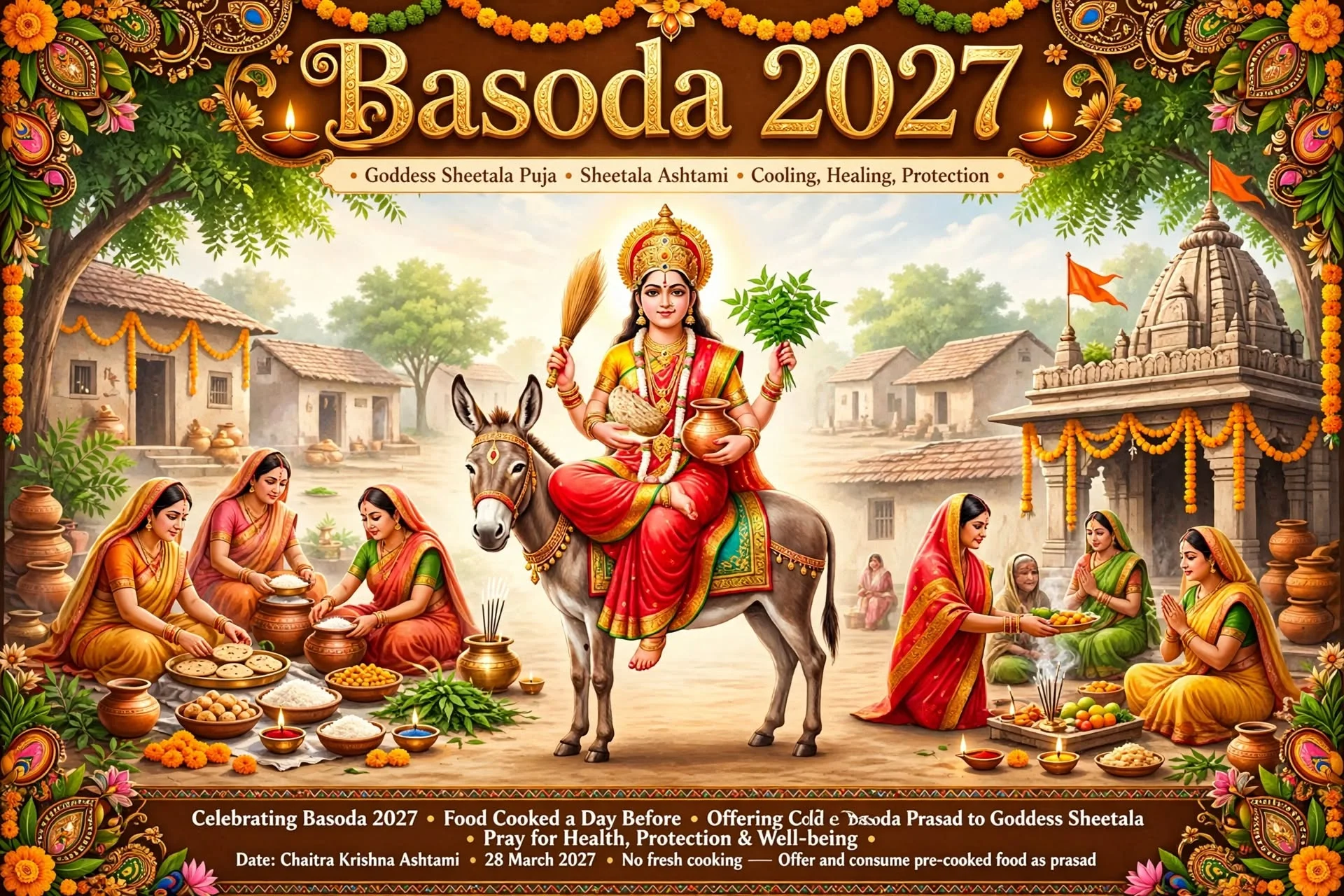
Tuesday, Mar 30, 2027
Basoda
Basoda (बासोड़ा), also revered across northern and western India as Sheetala Basoda or Baasi Kora, is an ancient, culturally unique, and epidemiologically profound Hindu festival observed on the seventh or eighth day (Saptami or Ashtami tithi) of the Krishna Paksha in the month of Chaitra. Dedicated to Goddess Sheetala (the divine mother presiding over cooling energy, hygiene, and protection against burning fevers and epidemic poxes), the term 'Basoda' is derived from the Hindi word 'Baasi', which translates to 'cooked on the previous day / cold'. On this consecrated day, millions of households strictly refrain from lighting the domestic cooking stove, consuming exclusively cold, stale food prepared on the preceding evening.
View Festival Guide

Friday, Apr 2, 2027
Papamochani Ekadashi
Papamochani Ekadashi holds a revered position in the Hindu calendar as the final Ekadashi of the lunar year. Falling during the Krishna Paksha of the closing lunar month (Phalguna in Purnimanta systems and Chaitra in Amanta systems), its name literally translates to 'the dissolver of sins' (Papa meaning sins, and Mochani meaning liberator). The sacred observance serves as an auspicious spiritual purge, offering devotees a divine opportunity to cleanse conscious and unconscious transgressions before entering the new spiritual cycle of Chaitra.
View Festival Guide

Sunday, Apr 4, 2027
Ravi Pradosh Vrat
Ravi Pradosh Vrat is an exceptionally sacred fasting day observed on the thirteenth lunar day (Trayodashi) that coincides with a Sunday (Ravivara). Dedicated to Lord Shiva, the cosmic dissolver of sorrow, this bimonthly vow unites the healing radiance of Surya Bhagavan with the boundless compassion of Mahadeva. Observed during the twilight Sandhya period, it is believed to banish physical ailments, clear karmic obstructions, and bestow vitality and longevity.
View Festival Guide

Tuesday, Apr 6, 2027
Darsha Amavasya
Darsha Amavasya is a significant new moon observance in the Hindu calendar designating the specific night when the Moon is completely invisible to the human eye, having fully merged into the conjunction of the Sun.
View Festival Guide

Tuesday, Apr 6, 2027
Anvadhan
Anvadhan (अन्वाधान) is an ancient, highly revered Vedic ritual and spiritual observance in Sanatana Dharma performed on the day immediately preceding the New Moon (Amavasya) or Full Moon (Purnima). Rooted in the pristine traditions of the Shrauta and Grihya Sutras, Anvadhan literally translates to 'the solemn placing and replenishment of sacred fuel wood into the consecrated Vedic fires'. In traditional Vedic ritualism, householders (Grihasthas) and priests who maintain the sacred Agnihotra fires perform Anvadhan to prepare the sacrificial altars for the grand Darsha Yajna (New Moon sacrifice) or Paurnamasa Yajna (Full Moon sacrifice) scheduled for the following day.
View Festival Guide

Tuesday, Apr 6, 2027
Phalguna Amavasya
Phalguna Amavasya marks a profound and sacred transition in the Hindu calendar. As the final Amavasya of the lunar year according to the Purnimanta system, it represents the conclusion of the winter season and the cosmic completion of the annual lunar journey. Occurring on the dark new moon night in the month of Phalguna, it provides devotees with a supreme spiritual opportunity to express gratitude to ancestors, perform charitable acts, and cleanse lingering karmic impurities before the dawn of the New Year.
View Festival Guide

Wednesday, Apr 7, 2027
Ugadi
Ugadi, derived from the Sanskrit terms 'Yuga' (era) and 'Aadi' (beginning), marks the glorious commencement of the New Year for the people of Andhra Pradesh, Telangana, and Karnataka. Celebrated on the first day of the waxing moon (Shukla Paksha Pratipada) in the sacred month of Chaitra, it heralds the advent of the new astronomical cycle, the arrival of the rejuvenating spring season (Vasanta Ritu), and the eternal rhythm of cosmic creation inaugurated by Lord Brahma.
View Festival Guide

Wednesday, Apr 7, 2027
Nutan Varsh Prarambha
Nutan Varsh Prarambha marks the glorious beginning of the Hindu New Year on the first day of the waxing moon (Shukla Paksha Pratipada) in the month of Chaitra. Celebrated across India under diverse regional names such as Ugadi, Gudi Padwa, and Cheti Chand, this sacred dawn signifies not merely a calendar shift, but the cosmic anniversary of creation itself. According to Vedic tradition, it was on this radiant morning that Lord Brahma initiated the cosmic cycle of time, creation, and mortal existence.
View Festival Guide