




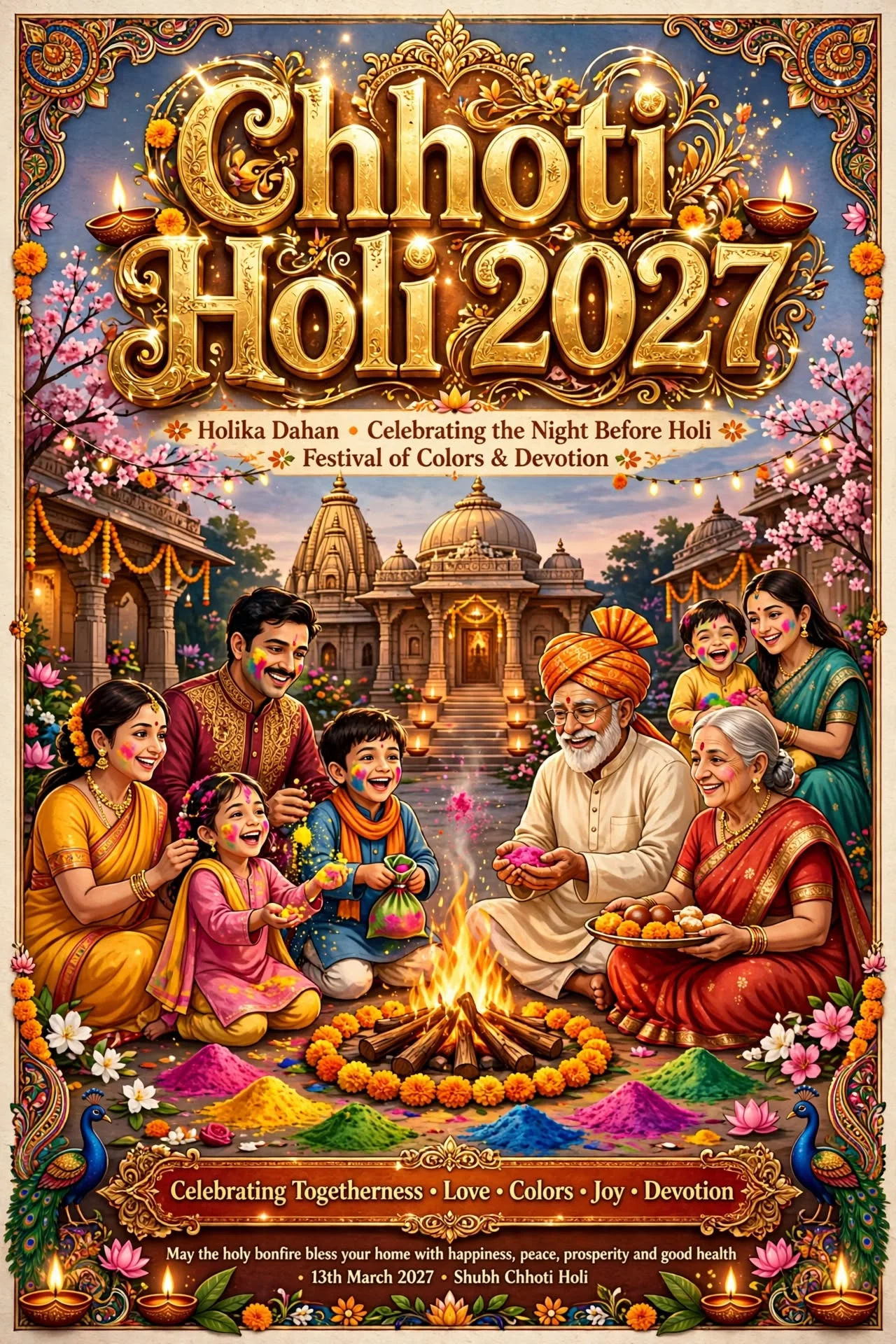
Chhoti Holi, celebrated with boundless excitement and devotion across North, Central, and Western India, is the auspicious festival observed on the fourteenth and fifteenth tithis (Chaturdashi merging into Purnima) of the Shukla Paksha in the month of Phalguna. Serving as the divine prelude to the grand festival of colors (Dhulandi or Badi Holi), Chhoti Holi is universally centered around the sacred ritual of assembling, consecrating, and lighting the community bonfire known as Holika Dahan. It commemorates the eternal victory of pure devotion, righteousness, and truth over demonic arrogance, persecution, and darkness.
Chhoti Holi 2027: Date, Puja Timings, Rituals & Stories
Chhoti Holi Timings & Panchang
Important festival dates and auspicious timings
Usha Arghya (Sunrise)
06:22 am
Sandhya Arghya (Sunset)
06:34 pm
Start Date
Tuesday, 23 Mar 2027
Puja Muhurat
04:13 pm – 02:28 pm
Chhoti Holi
The religious and theological bedrock of Chhoti Holi is enshrined in the Srimad Bhagavatam (Canto 7), the Vishnu Purana (Book 1, Chapters 17-20), and the Narada Purana. The festival immortalizes the legendary trial of the child-saint Bhakta Prahlada, son of the tyrannical demon king Hiranyakashipu. When Prahlada refused to worship his father as God, Hiranyakashipu commanded his demoness sister Holika—who possessed a celestial fireproof mantle—to sit inside a roaring fire with Prahlada on her lap. However, by the grace of Lord Narayana, the divine mantle flew from Holika and wrapped Prahlada, reducing Holika to ashes and preserving the pure child untouched by flames.
During the daylight hours of Chhoti Holi, communities gather dry wood, fallen branches, logs, and traditional dried cow dung cakes (Uple / Badkula) at village crossroads, town squares, and neighborhood open grounds to build the pyramidal Holika pyre. Women perform the elaborate 'Holika Pujan' during the afternoon, offering water, sacred red thread (Mauli), turmeric, Kumkum, unbroken rice, batashas, and garlands made of miniature cow-dung toys (Gulari), praying for the health, longevity, and spiritual protection of their children and families.
At dusk or late night—during the specific auspicious muhurat following the conclusion of the inauspicious Bhadra period—the community gathers around the pyre for Holika Dahan. Priests chant Vedic fire hymns, and the bonfire is lit. Devotees circumambulate the roaring flames, roast fresh ears of green wheat and barley (Holka / Baali) in the consecrated embers, and bring home the sanctified ash (Holika Bhasma) as a potent protective talisman that dispels negativity, disease, and evil eye.
Why is Chhoti Holi Celebrated?
Chhoti Holi is celebrated to commemorate the miraculous deliverance of the child-saint Bhakta Prahlada and the fiery destruction of the demoness Holika, affirming that God forever protects His surrendered devotees.
The festival symbolizes the incineration of negative human tendencies—ego, jealousy, anger, hatred, and lust—into the sacred fire, purging the community's collective consciousness before the joyful color revelry.
It provides an opportunity for mothers and householders to perform traditional Holika Pujan, praying for the longevity, vitality, and safety of their children against evil forces and physical illnesses.
The roasting of newly harvested wheat and barley ears (Holka) honors agricultural abundance and Mother Nature, offering the first harvest to Agni Deva and sharing it as blessed prasad.
Scriptural Chronicles and Sacred Lore of Chhoti Holi
The Legend of Bhakta Prahlada and Demoness Holika
The foundational chronicle of Chhoti Holi is detailed in the Srimad Bhagavatam (Canto 7) and the Vishnu Purana. The demon king Hiranyakashipu, intoxicated by a boon granted by Lord Brahma that made him almost invincible, declared himself the supreme God and banned the worship of Lord Vishnu throughout his empire.
However, his own young son, Prahlada, having absorbed divine wisdom from Sage Narada while in his mother Kayadhu's womb, remained a steadfast devotee of Lord Narayana. Enraged by his son's defiance, Hiranyakashipu subjected Prahlada to horrific tortures: throwing him off cliffs, trampling him with rogue elephants, and throwing him into pits of venomous vipers. Prahlada emerged unharmed, protected by the continuous chanting of 'Om Namo Bhagavate Vasudevaya'.
Finally, Hiranyakashipu summoned his sister Holika, who possessed a celestial cloth (or boon) that rendered her immune to fire. Holika lured Prahlada onto her lap and sat in the center of a roaring pyre. As the flames rose, a divine gust of wind sent by Lord Vishnu lifted the protective shawl from Holika and wrapped it securely around Prahlada. Holika was incinerated into ashes, while Prahlada emerged radiant and smiling, vindicating that divine grace shields true devotion from all earthly destruction.
The Legend of Demoness Dhundha in the Bhavishya Purana
In the Bhavishya Purana (Uttara Parva), King Yudhishthira asks Lord Sri Krishna about the ancient custom of lighting bonfires on Phalguna Purnima. Lord Krishna narrates the legend of King Raghu of Ayodhya, whose kingdom was terrorized by an ogre named Dhundha (or Dhondha) who preyed on young children.
Dhundha had attained an ascetic boon making her invulnerable to gods, men, weapons, and seasonal heat or cold, but she remained vulnerable to the playful shouts, clamor, and laughter of young boys. Advised by the royal sage Vasishtha, the youth of Ayodhya gathered dry wood, built a massive community fire on Phalguna Purnima, beat drums, shouted joyful war cries, and threw consecrated mustard seeds into the flames. Frightened and overwhelmed by the combined heat, purity, and collective joy, the demoness fled and was destroyed.
Esoteric, Social, and Agricultural Dimensions of Chhoti Holi
Triumph of Prema Bhakti Over Asuric Hubris
Hiranyakashipu represents arrogant intellectual materialism, while Prahlada represents unadulterated divine love (Bhakti). The bonfire of Chhoti Holi demonstrates that no weapon, fire, or political tyranny can extinguish the flame of pure devotion.
The festival inspires seekers to remain steadfast in moral integrity, knowing that divine providence inevitably dismantles the structures of oppression.
Purification of Societal and Environmental Energies
As winter yields to spring, sudden temperature fluctuations trigger viral infections, lethargy, and bacterial growth in the environment. Burning dried cow dung cakes, camphor, mustard seeds, and neem leaves in the massive community bonfire sanitizes the local atmosphere.
The collective heat and natural antiseptic smoke destroy airborne pathogens, rejuvenating community health and clearing negative energetic residues.
Agricultural Celebration and Offering of First Fruits (Navanna Yajna)
In Vedic agrarian culture, Chhoti Holi is celebrated as Navanna Parva (the festival of the new harvest). The word 'Holi' is linguistically linked to 'Holka'—the Sanskrit term for roasted green ears of grain.
Farmers bring newly harvested stalks of wheat, barley, and gram to roast in the consecrated fire. Offering these first grains to Agni Deva and sharing them as prasad sanctifies the food supply and honors nature's bounty.
Holika Bhasma as a Sacred Protective Shield
The residual ash collected from the Holika pyre the following morning is revered as 'Holika Bhasma'. Applying this sanctified ash upon the brow or throat is believed to ward off psychic negativity, evil eye (Nazar), nightmares, and chronic ailments.
Practical Worship Manual and Guide for Chhoti Holi
Morning Altar Cleansing and Assembling the Pyre
Rise early during Brahma Muhurta, bathe in clean water mixed with Gangajal, and don clean traditional clothing. Cleanse the home mandir and worship Lord Vishnu and Lord Ganesha.
In the neighborhood, contribute dry fallen wood, logs, and traditional cow dung cakes (Badkula) to the community pyre. Place a green branch of the castor (Arandi) or Semal tree in the center to represent Prahlada.
Afternoon Holika Pujan (Women's Traditional Worship)
During the afternoon before sunset, women and householders gather near the Holika pyre carrying a thali filled with water, roli, akshata, turmeric, sweet batashas, jaggery, raw cotton thread, and garlands of dried cow dung cakes (Gulari).
Offer water, apply tilak, place the flower and cow dung garlands on the pyre, and wind raw cotton thread around the wood while making three, five, or seven circumambulations, praying for the health and prosperity of family members.
Ascertaining the Auspicious Holika Dahan Muhurat
Consult your regional Panchang to determine the exact Holika Dahan muhurat. Ensure the fire is lit during Pradosha Kaal strictly after the end of Bhadra (Bhadra Mukha and Bhadra Punchha must be avoided).
Lighting Holika during Bhadra is strictly prohibited in Shastras, as it is believed to bring misfortune to the ruler and the community.
Night Bonfire Lighting, Grain Roasting, and Community Joy
At the auspicious hour, the community priest lights the pyre chanting Vedic fire mantras. As the fire blazes, devotees shower akshata, coconuts, and batashas into the flames.
Roast fresh stalks of green wheat and barley (Baali) in the flames, distribute the roasted grains as prasad, embrace friends and family in brotherhood, and celebrate the victory of light.
Chhoti Holi Puja Vidhi (Step by Step)
- 1
Brahma Muhurta Jagaran and Morning Snana
Wake before dawn during Brahma Muhurta. Meditate upon Lord Sri Hari Vishnu and take a purificatory bath in clean water mixed with holy Gangajal, wearing clean traditional attire.
- 2
Pratah Sankalpa and Household Vishnu Puja
Sit facing East before the home mandir. Light a pure cow-ghee lamp, apply sandalwood paste to Lord Vishnu, offer Tulsi leaves and sweets, and make a formal Sankalpa vow to celebrate Chhoti Holi with devotion, love, and righteousness.
- 3
Assembling the Badkula (Cow Dung Toys) and Offerings
Assemble the traditional Badkula (garlands made of sun-dried cow-dung cakes, stars, moons, and toy shields crafted weeks earlier), raw white cotton thread (Kacha Sutra), sweet batashas, and turmeric.
- 4
Proceeding to the Community Holika Pyre
Carry a brass thali containing a water lota, roli, akshata, turmeric paste, fresh flowers, batashas, unbroken coconut, and the Badkula garland to the consecrated community Holika pyre.
- 5
Chhoti Holi Puja Samagri List
Holika Pujan and Threading Items
Traditional items used for the daytime worship and winding around the pyre.
- Copper or brass lota filled with clean water and Gangajal
- Garlands of miniature sun-dried cow dung cakes (Badkula / Gulari)
- Unspun raw white cotton thread (Kacha Sutra) - 1 spool
- Sacred red roli (Kumkum) and turmeric powder (Haldi)
- Unbroken white rice grains (Akshata) and fresh marigold flowers
Naivedya and Pyre Offerings
Sweets, grains, and fruits offered into the Holika bonfire.
- Sweet sugar batashas (250 grams) and raw jaggery (Gur)
- Unbroken whole dry coconut (Shreephal) wrapped in sacred thread
- Fresh stalks of green wheat and barley (Baali) - 5 bunches
- Whole black gram and black sesame seeds (Kala Til)
- Bhimseni camphor for lighting and sandalwood incense sticks
Home Mandir and Festive Feast Essentials
Ingredients for home deity worship and traditional festival meals.
- Pure cow ghee lamp and cotton wicks for evening mandir aarti
Mantras and Prayers for Chhoti Holi
Chhoti Holi Vrat Rules and Fasting Guidelines
Bhadra Kaal Injunctions
Strict astrological rules governing Holika Dahan timing:
- Holika Dahan must NEVER be performed during Bhadra Kaal (the astrological shadow period).
- Lighting the fire during Bhadra Mukha is strictly forbidden by the Dharma Sindhu, as it is believed to bring severe national and community calamities.
- The fire must be lit during Pradosha Kaal strictly after Bhadra concludes; if Bhadra extends past midnight, it may be performed during Bhadra Punchha.
- Consult verified regional panchang timings before igniting the community pyre.
Pujan and Offering Guidelines
Rules for daytime Holika worship:
- Women performing the puja must bathe and wear fresh traditional attire (avoiding black or gloomy colors).
- Always circumambulate the pyre in a clockwise direction, never stepping over the offerings or walking counter-clockwise.
- Do not consume the raw grains intended for roasting until they have been blessed in the sacred fire.
- Maintain harmony, avoiding anger, foul language, and disputes on this festival of purification.
Bhasma (Ash) Collection Injunctions
Rules for handling the sacred ash on the following morning:
- Collect the warm, grey wood ash (Holika Bhasma) respectfully at dawn using a clean copper or brass plate.
Dos and Don'ts of Chhoti Holi
Good Practices (Do's)
- Wake early during Brahma Muhurta and take a purificatory bath with holy Gangajal.
- Perform the afternoon Holika Pujan offering water, roli, batashas, and cow-dung garlands (Badkula).
- Ensure Holika Dahan is lit only during the prescribed auspicious muhurat strictly after Bhadra ends.
- Circumambulate the sacred fire clockwise three, five, or seven times while pouring water from a copper lota.
- Roast fresh stalks of green wheat and barley in the embers and distribute them as blessed prasad.
Chhoti Holi Across Regions
| Region | Local Name |
|---|---|
| Uttar Pradesh and Braj Bhoomi | Chhoti Holi & Badkula Pujan |
| Rajasthan and Gujarat | Holika Dahan & Baali Sekna |
| Madhya Pradesh (Malwa & Nimar) | Chhoti Holi & Gobar Dhundh |
| Bihar and Jharkhand | Sammat Jalana |
Chhoti Holi FAQs
What is Chhoti Holi?
Chhoti Holi is the holy festival observed on the eve of Holi (Phalguna Purnima), featuring the afternoon Holika Pujan and the evening bonfire ritual of Holika Dahan celebrating the triumph of devotion over evil.
How is Bhakta Prahlada connected to Chhoti Holi?
Prahlada was a child devotee of Lord Vishnu whose aunt Holika attempted to incinerate him on her lap in a blazing fire. By divine grace, Holika was burned to ashes while Prahlada emerged unscathed.
What is Bhadra Kaal and why is Holika Dahan avoided during it?
Bhadra is an astrologically malefic shadow period. Classical scriptures like the Dharma Sindhu mandate that lighting Holika during Bhadra brings severe misfortune, requiring the fire to be lit only after Bhadra expires.
Upcoming Festivals
View All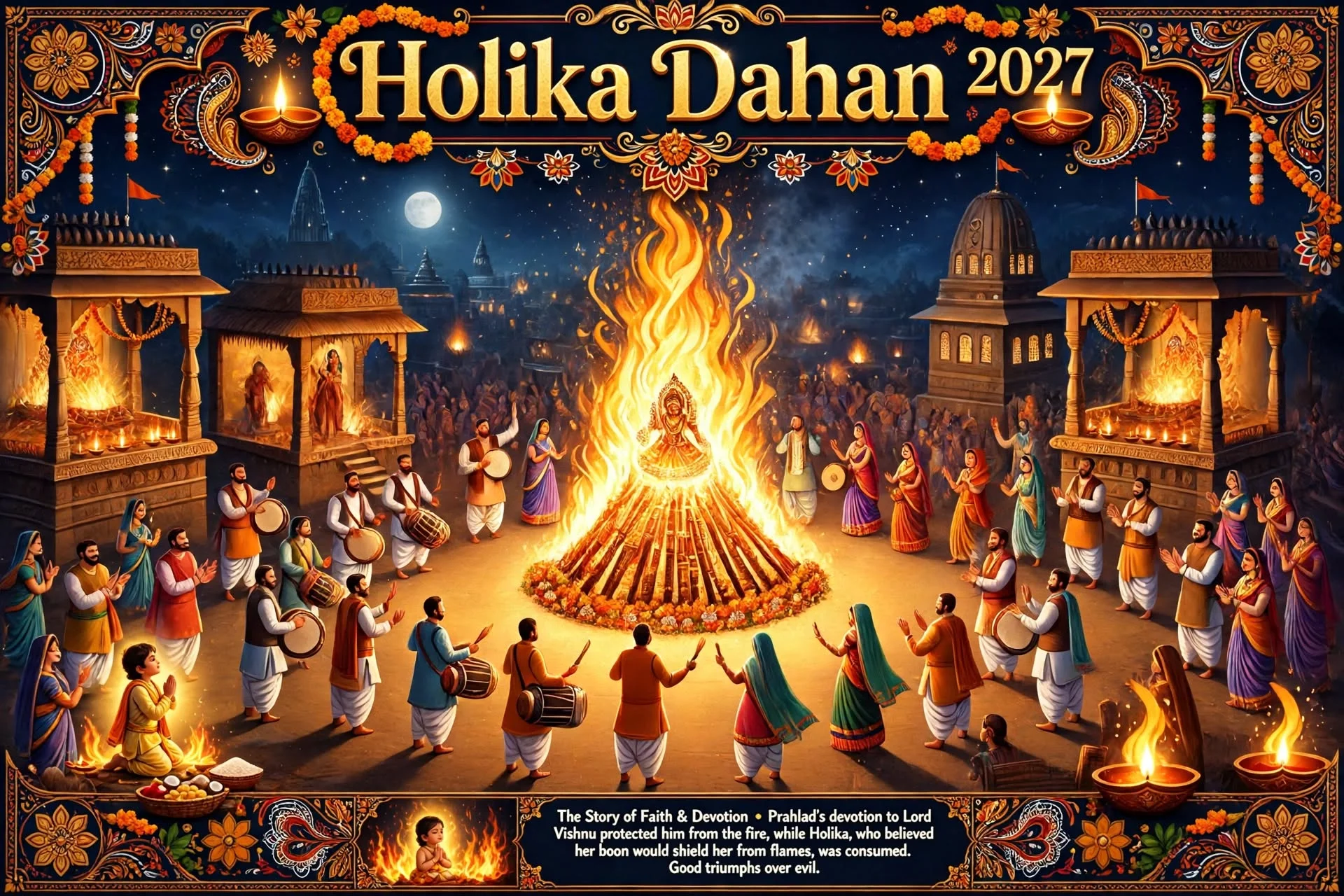
Sunday, Mar 21, 2027
Holika Dahan (Choti Holi)
Holika Dahan, affectionately celebrated as the sacred bonfire night of Holi, is an ancient, monumental, and deeply spiritual Vedic ritual performed on the full moon night (Purnima tithi) of the lunar month of Phalguna according to the Hindu calendar. Celebrated on the night preceding the exuberant festival of colors (Dhulandi or Rangwali Holi), Holika Dahan marks the ceremonial burning of the cosmic pyre, symbolizing the inevitable triumph of divine righteousness (Dharma), supreme devotion (Bhakti), and spiritual truth over demonic tyranny, pride, and persecution.
View Festival Guide

Monday, Mar 22, 2027
Anvadhan
Anvadhan (अन्वाधान) is an ancient, highly revered Vedic ritual and spiritual observance in Sanatana Dharma performed on the day immediately preceding the New Moon (Amavasya) or Full Moon (Purnima). Rooted in the pristine traditions of the Shrauta and Grihya Sutras, Anvadhan literally translates to 'the solemn placing and replenishment of sacred fuel wood into the consecrated Vedic fires'. In traditional Vedic ritualism, householders (Grihasthas) and priests who maintain the sacred Agnihotra fires perform Anvadhan to prepare the sacrificial altars for the grand Darsha Yajna (New Moon sacrifice) or Paurnamasa Yajna (Full Moon sacrifice) scheduled for the following day.
View Festival Guide
Monday, Mar 22, 2027
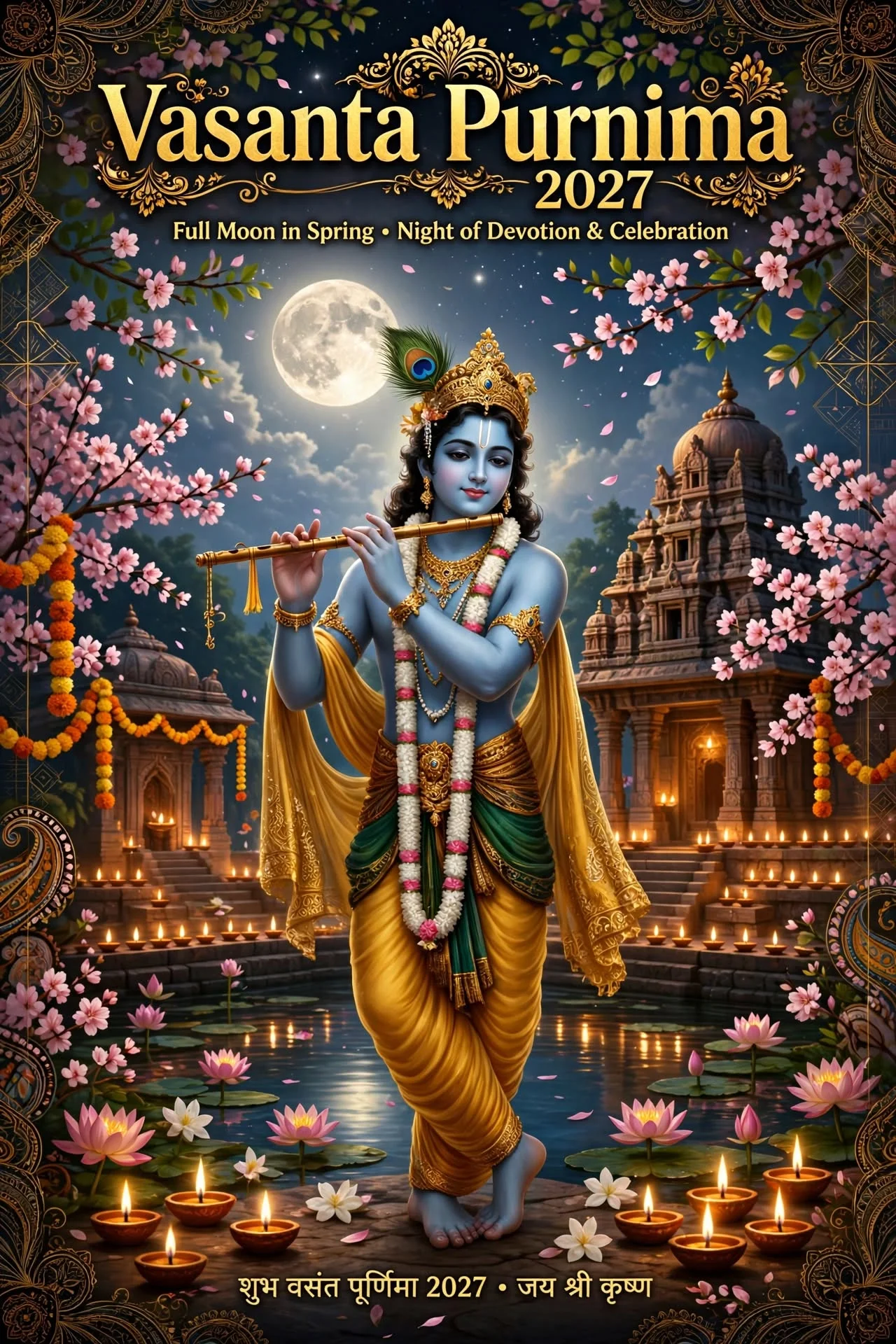
Vasanta Purnima
Vasanta Purnima (also known as Vasantotsava Purnima or the Spring Full Moon) is an extraordinarily radiant, culturally celebrated, and spiritually elevating Hindu festival observed on the full moon day (Purnima tithi) of the lunar month of Phalguna according to the traditional Hindu calendar. Coinciding with the peak of the spring season (Rituraj Vasant), this glorious night represents the full flowering of natural beauty, romantic affection, aesthetic grace, and sublime divine devotion (Prema Bhakti) across Sanatana Dharma. Celebrated as the eve of the vibrant festival of colors and the sacred night of Holika Dahan, Vasanta Purnima serves as the crowning jewel of the spring festival cycle.
View Festival Guide
Monday, Mar 22, 2027
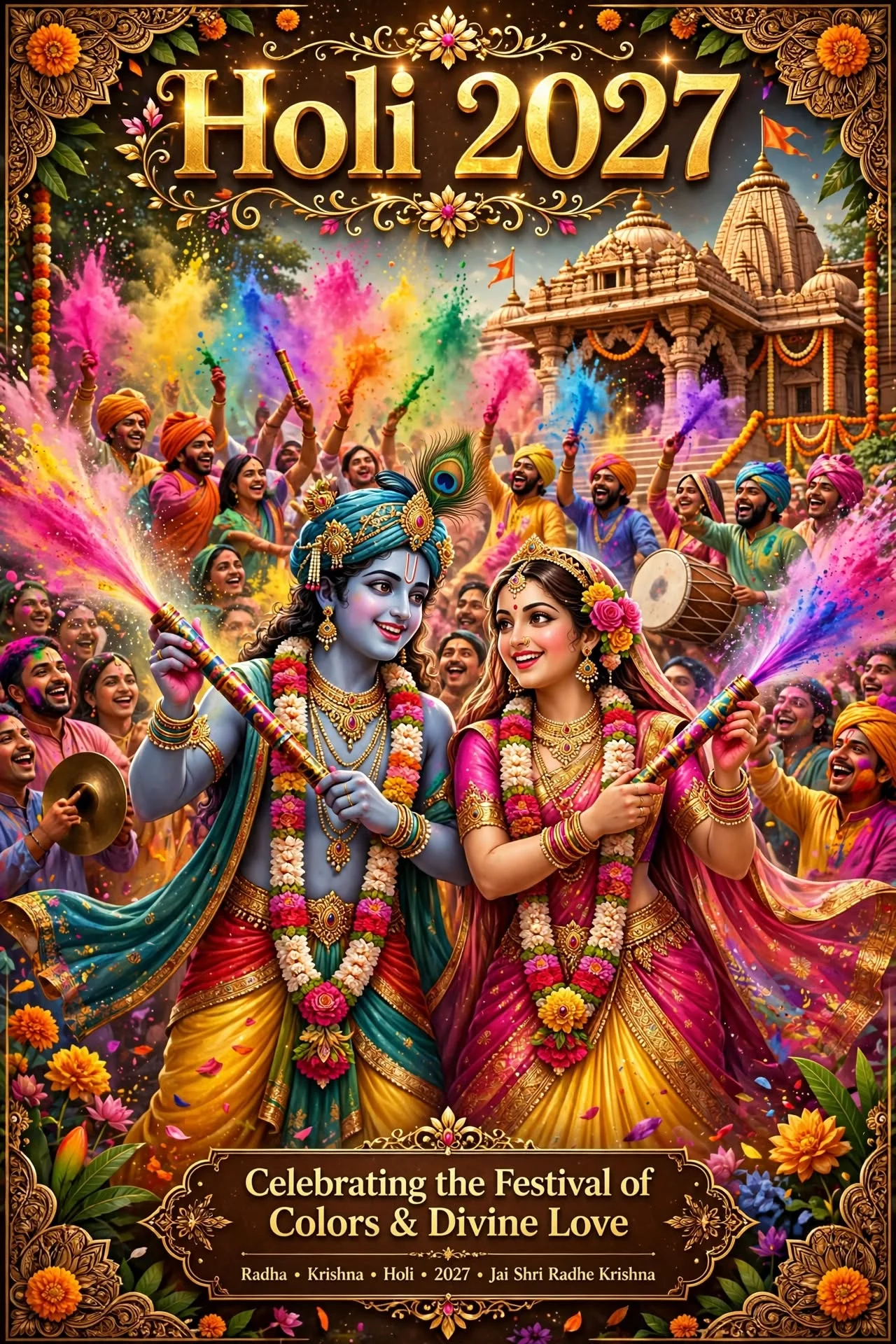
Holi
Holi, celebrated with incomparable exuberance, color, and spiritual fraternity, is one of the most ancient, glorious, and universally beloved festivals in Sanatana Dharma. Celebrated on the first day (Pratipada tithi) of the Krishna Paksha in the holy month of Chaitra according to the traditional Hindu calendar (occurring immediately after the night of Holika Dahan), this grand festival of colors—affectionately known as Dhulandi, Dhuleti, Rangwali Holi, and Vasantotsava—marks the triumphant arrival of spring (Rituraj Vasant), the rebirth of nature's vibrant beauty, and the profound social and spiritual renewal of human hearts.
View Festival Guide
Monday, Mar 22, 2027
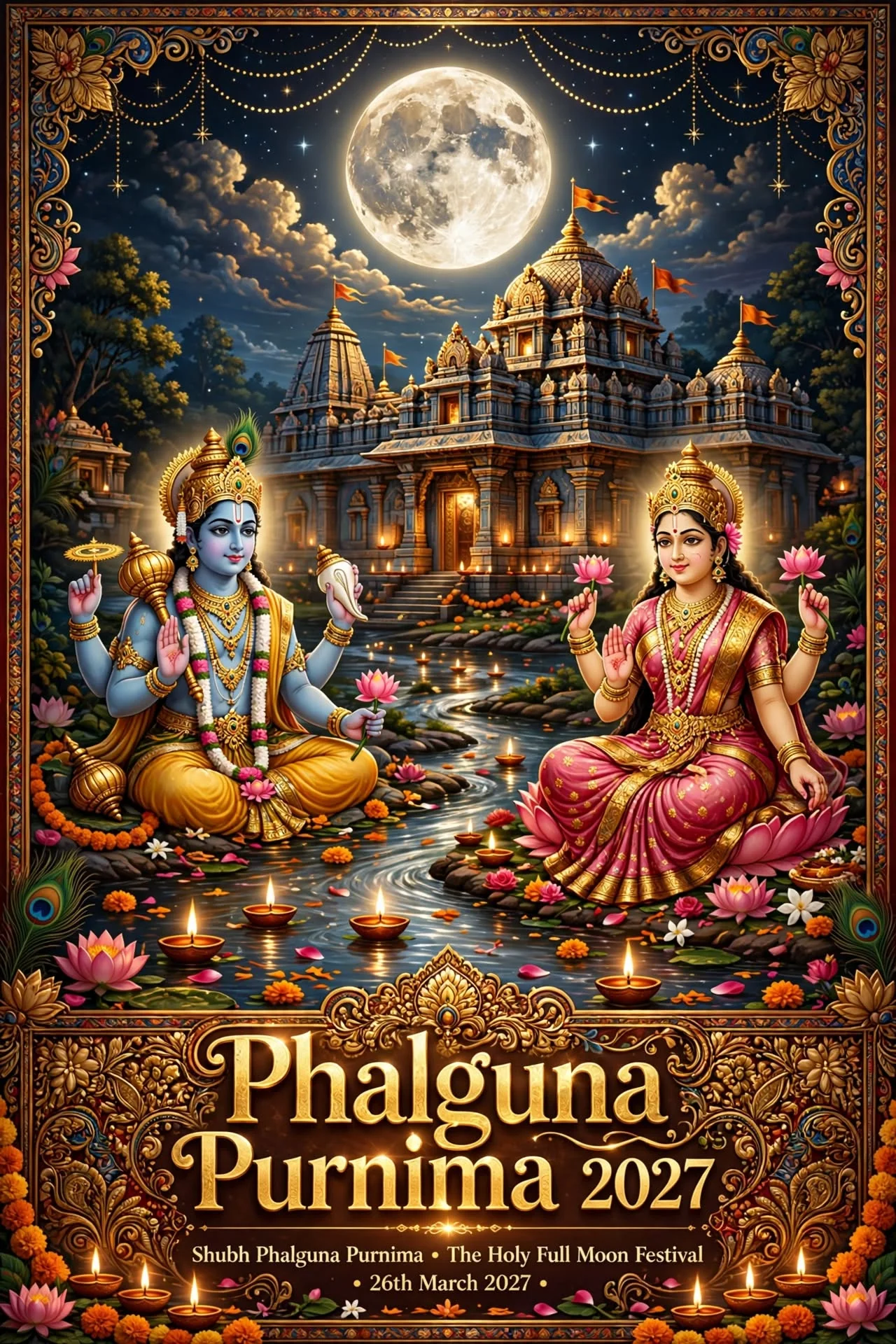
Phalguna Purnima
Phalguna Purnima is one of the most spiritually multifaceted, sacred, and joyously celebrated full moon days in the Hindu calendar, marking the magnificent culmination of the holy lunar month of Phalguna. Occurring on the final day of the Phalguna month in the Purnimanta calendar, this momentous full moon represents the harmonious convergence of several monumental religious observances: the sacred bonfire night of Holika Dahan, the divine advent day of Sri Chaitanya Mahaprabhu (Gaura Purnima), the glorious appearance day of Goddess Lakshmi (Lakshmi Jayanti), and the vibrant swing festivals (Dolotsava) celebrated across India.
View Festival Guide

Tuesday, Mar 23, 2027
Ishti
Ishti is a foundational Vedic ritual observance appearing prominently in Hindu Panchangs on the Pratipada tithi (the first lunar day) following either Amavasya (new moon) or Purnima (full moon), marking the prescribed performance day for the fortnightly Vedic Darsha-Purnamasa sacrifices.
View Festival Guide
Wednesday, Mar 24, 2027
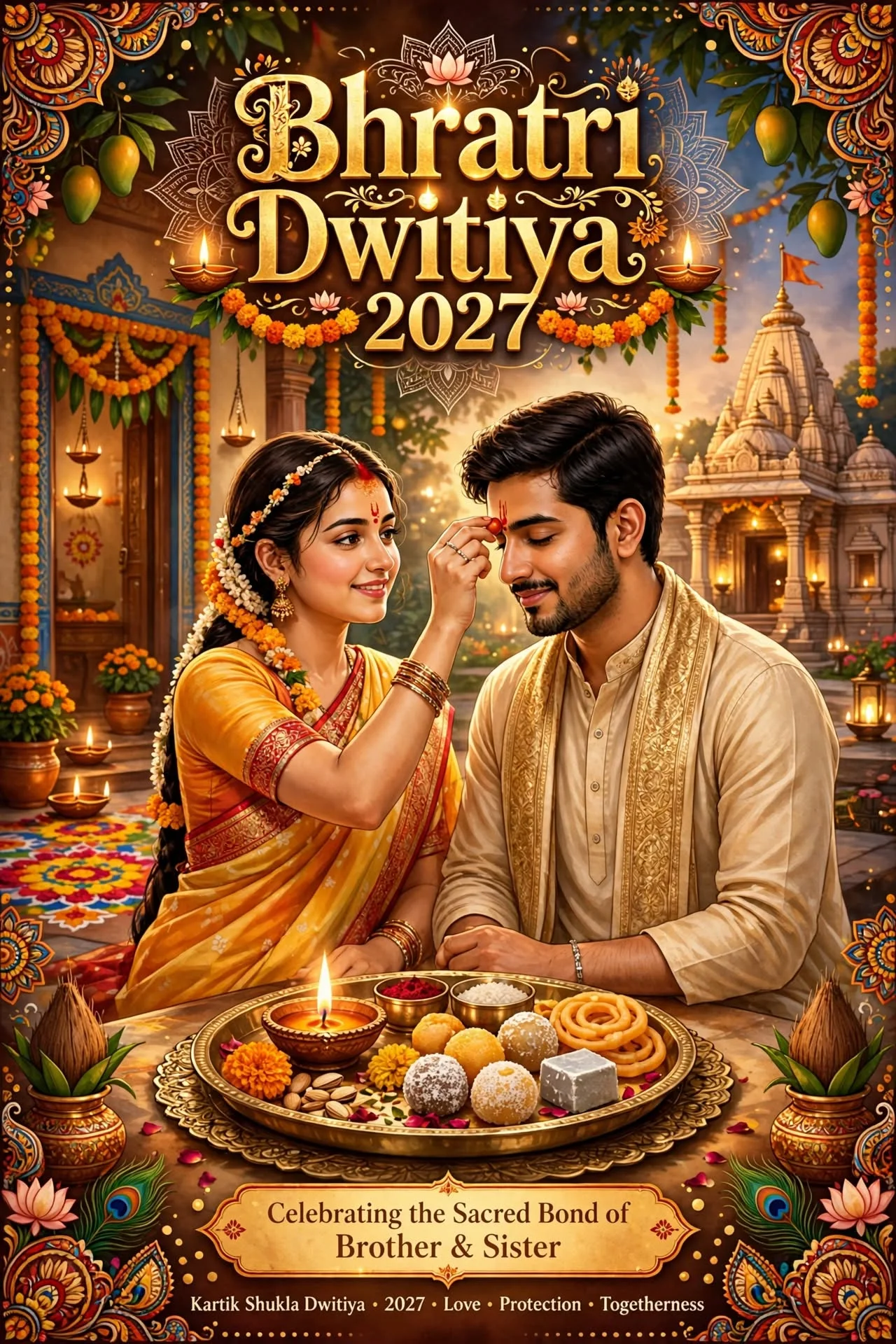
Bhratri Dwitiya
Bhratri Dwitiya (भ्रातृ द्वितीया), linguistically derived from the Sanskrit terms 'Bhratri' (brother) and 'Dwitiya' (the second lunar tithi), is a time-honored, deeply venerable, and emotionally uplifting Hindu festival that sanctifies and celebrates the sacred bond between brothers and sisters. Observed on the second day (Dwitiya tithi) of the lunar fortnight—most prominently celebrated following Holi in the month of Chaitra as well as following Diwali in the month of Kartika—Bhratri Dwitiya represents the classical, scriptural manifestation of the pan-Indian sibling festival known in regional vernaculars as Bhai Dooj, Bhai Phota (in Bengal), and Bhav Bij (in Maharashtra).
View Festival Guide
Wednesday, Mar 24, 2027
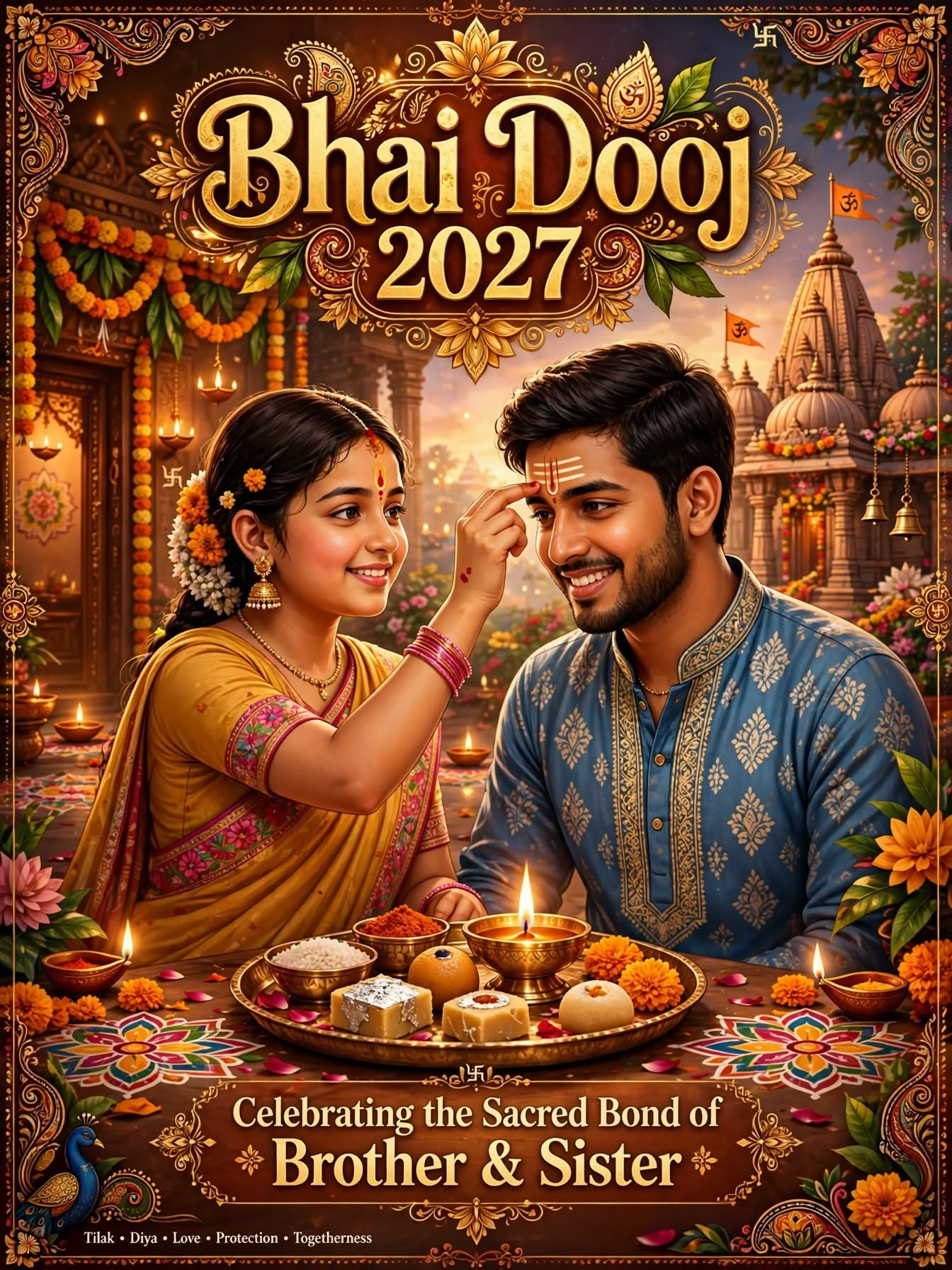
Bhai Dooj (Yama Dwitiya / Bhai Tika)
Bhai Dooj (also lovingly known as Holi Bhai Dooj or Chaitra Bhai Dooj) is an intensely affectionate, culturally sacred, and spiritually protective Hindu festival observed on the second day (Dwitiya tithi) of the Krishna Paksha in the month of Chaitra according to the traditional Hindu calendar. Occurring on the second day immediately following the vibrant festival of colors (Holi), this sacred observance mirrors the post-Diwali Bhai Dooj, serving to reaffirm, sanctify, and celebrate the pure, unconditional bond of love and protection between brothers and sisters across Sanatana Dharma.
View Festival Guide