




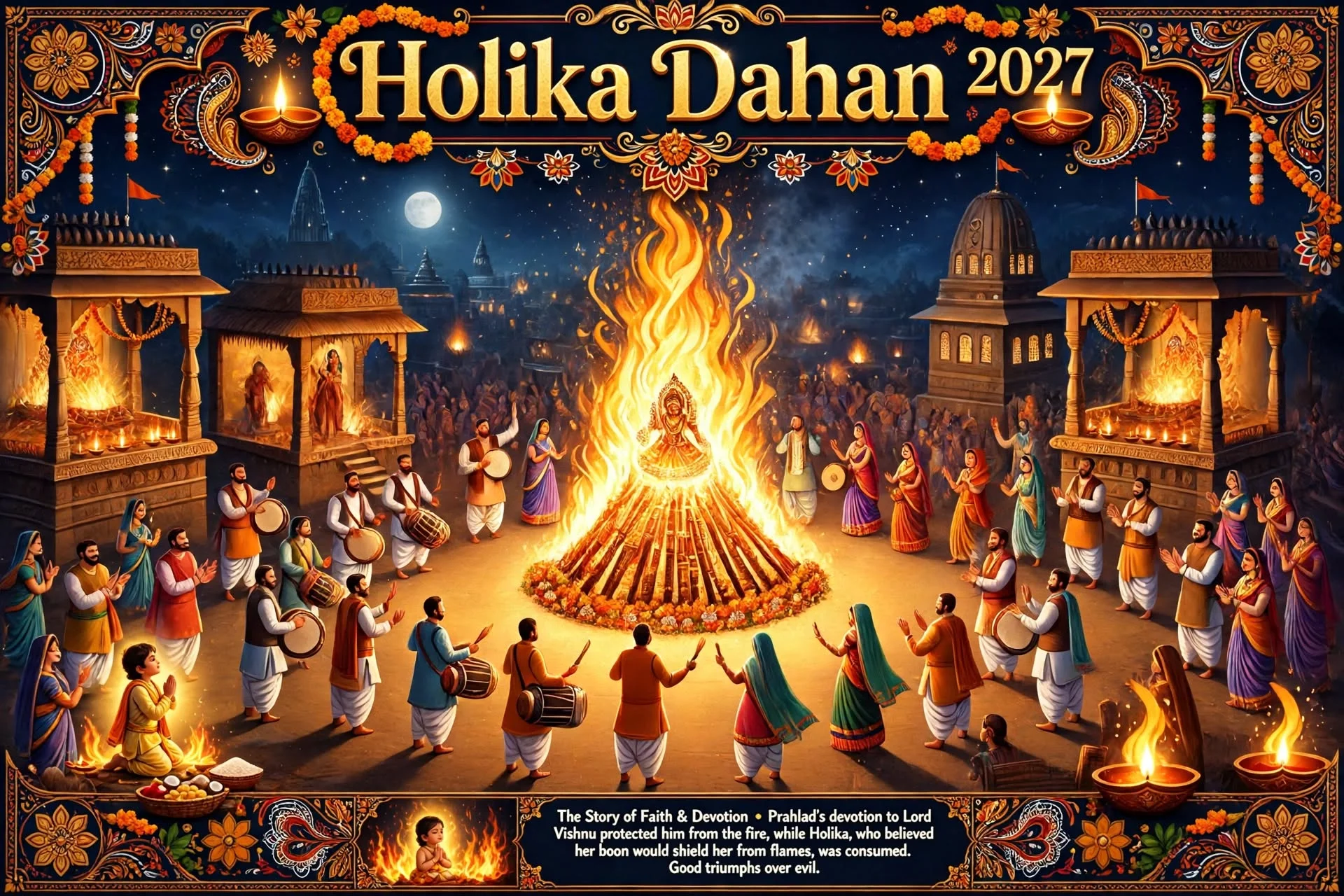
Holika Dahan, affectionately celebrated as the sacred bonfire night of Holi, is an ancient, monumental, and deeply spiritual Vedic ritual performed on the full moon night (Purnima tithi) of the lunar month of Phalguna according to the Hindu calendar. Celebrated on the night preceding the exuberant festival of colors (Dhulandi or Rangwali Holi), Holika Dahan marks the ceremonial burning of the cosmic pyre, symbolizing the inevitable triumph of divine righteousness (Dharma), supreme devotion (Bhakti), and spiritual truth over demonic tyranny, pride, and persecution.
Holika Dahan (Choti Holi) 2027: Date, Puja Timings, Rituals & Stories
Holika Dahan (Choti Holi) Timings & Panchang
Important festival dates and auspicious timings
Usha Arghya (Sunrise)
06:25 am
Sandhya Arghya (Sunset)
06:33 pm
Start Date
Sunday, 21 Mar 2027
Puja Muhurat
08:45 pm – 06:21 pm
Holika Dahan (Choti Holi)
The theological genesis of Holika Dahan is enshrined in the Srimad Bhagavatam (Canto 7), the Vishnu Purana (Book 1), and the Narada Purana. The ritual commemorates the legendary trial of the child-saint Bhakta Prahlada, the unshakeable devotee of Lord Sri Hari Vishnu. When his megalomaniac father, King Hiranyakashipu, failed to extinguish Prahlada's devotion, he commanded his sister Holika—who possessed a divine boon of invulnerability to fire—to sit inside a roaring furnace with Prahlada on her lap. However, by the infallible will of Lord Narayana, the protective divine shawl slipped from Holika and wrapped Prahlada, reducing Holika to ashes and preserving the boy untouched by flames.
In Vedic astronomical tradition, Holika Dahan is governed by strict astrological calculations outlined in the Dharma Sindhu and the Nirnaya Sindhu. The sacred fire must be ignited during the Pradosha Kaal (twilight to late evening) strictly after the expiration of the inauspicious astrological shadow period known as Bhadra (specifically avoiding Bhadra Mukha). Lighting the fire within the precise post-Bhadra muhurat is believed to bring peace, agricultural prosperity, and spiritual vitality to the entire community, while incinerating seasonal pathogens and negative planetary influences.
Communities observe Holika Dahan by circumambulating the roaring pyre, offering unbroken coconuts, sweet sugar candy (batashas), and sacred black sesame seeds into the flames. Farmers roast the newly harvested green ears of wheat and barley (Holka) in the embers, sharing them as consecrated prasad. The following morning, devotees collect the sanctified ash (Holika Bhasma), applying it to their foreheads as an impenetrable talisman of health, fearlessness, and divine protection.
Why is Holika Dahan (Choti Holi) Celebrated?
Holika Dahan is celebrated to commemorate the miraculous preservation of the child-saint Bhakta Prahlada and the destruction of the demoness Holika, affirming that God never abandons His surrendered devotees.
The sacred bonfire incinerates negative psychological impurities—ego, malice, lust, anger, and greed—cleansing the individual and collective consciousness before entering the joy of spring.
It marks the ancient agricultural ritual of Navanna Yajna, where the first newly harvested ears of green wheat and barley (Holka) are offered to Agni Deva and consumed as blessed prasad.
The ritual smoke of dried cow-dung cakes, camphor, and medicinal wood purifies the spring environment, destroying airborne bacteria and protecting communities against seasonal ailments.
Scriptural Chronicles and Sacred Lore of Holika Dahan
The Trial of Bhakta Prahlada and the Incineration of Holika
The foundational scriptural chronicle of Holika Dahan is detailed in the Srimad Bhagavatam (Canto 7, Chapters 4-8) and the Vishnu Purana. The demon emperor Hiranyakashipu, having conquered the three worlds through boons obtained from Lord Brahma, decreed that all worship of Lord Vishnu must cease on pain of death.
However, his five-year-old son, Prahlada, born with natural enlightenment through the pre-natal teachings of Sage Narada, openly worshipped Lord Vishnu with every breath. Hiranyakashipu subjected his son to lethal persecutions, but neither deadly poison, wild elephants, venomous snakes, nor throwing him off mountain cliffs could harm the child.
Finally, Hiranyakashipu's sister Holika volunteered to eliminate Prahlada. Holika possessed a celestial shawl granted by Lord Brahma that made her impervious to fire. Dressing in her fireproof mantle, she sat in the center of a colossal pyre, holding Prahlada on her lap, and commanded the flames to be ignited. As the fire roared, Prahlada closed his eyes and meditated on Lord Narayana. A divine gust of wind blew the celestial shawl off Holika and draped it securely around Prahlada. Deprived of the shawl, Holika screamed and burned to ashes, while Prahlada emerged from the embers completely unscathed, demonstrating that no boon can protect evil against divine righteousness.
The Legend of the Demoness Dhundha in the Bhavishya Purana
In the Bhavishya Purana (Uttara Parva), King Yudhishthira inquires from Lord Krishna about the ancient custom of building bonfires on Phalguna Purnima. Lord Krishna narrates the history of King Raghu of Ayodhya, whose kingdom was terrorized by a fierce female ogre named Dhundha (or Dhondha) who preyed upon newborn children.
Dhundha had attained severe boons making her invincible to gods, men, and weapons, but Sage Vasishtha discovered that she possessed a single vulnerability: she could be driven away by the joyful shouts, laughter, and high energy of children combined with a consecrated public fire.
On Phalguna Purnima, the youth of Ayodhya built a massive community fire, played drums, chanted sacred hymns, and threw consecrated mustard seeds into the flames while shouting joyful battle cries. Overpowered by the spiritual heat and collective merriment, Dhundha was incinerated, giving rise to the custom of community bonfires.
Esoteric, Astrological, and Environmental Dimensions of Holika Dahan
Annihilation of Asuric Ego and Triumph of Faith
Hiranyakashipu represents the tyrannical human ego that demands to be worshipped, while Holika represents the misuse of divine gifts for malicious ends. Prahlada represents unadulterated divine faith (Shraddha).
Holika Dahan proves that divine boons and powers desert the practitioner the moment they are used to harm the innocent, whereas unconditional surrender to God (Sharanagati) makes the soul invulnerable to all worldly destruction.
Navanna Parva and the Sacred Holka Grain
In classical Sanskrit, 'Holka' denotes roasted green ears of grain. Holika Dahan coincides with the harvesting of the Rabi crop (wheat, barley, gram).
Offering the first roasted ears of grain to Agni Deva is a sacred act of gratitude (Kritajnata) to Mother Earth and the Sun God, ensuring that the community partakes only of food that has been sanctified through divine sacrifice.
The Environmental Antiseptic Action of Medicinal Smoke
During the seasonal transition from winter to spring, viral and bacterial pathogens multiply rapidly in the warming atmosphere. Burning thousands of tons of sun-dried cow dung cakes, camphor, guggul, mustard seeds, and neem wood releases medicinal aerosols that disinfect the atmosphere across entire settlements.
The ambient heat also raises human body temperature slightly, helping sweat out winter metabolic toxins (Ama) and boosting the immune system.
The Mystical Shield of Holika Bhasma
The sacred ash remaining after the fire has cooled (Holika Bhasma) is revered as an energized protective substance. Applying it upon the Ajna chakra (brow) balances the nervous system and creates an energetic shield (Kavacha) against negative psychic influences.
Practical Worship Manual and Guide for Holika Dahan
Determining the Exact Post-Bhadra Muhurat
Consult your regional Panchang to determine the exact Holika Dahan muhurat. Ensure the fire is lit during Pradosha Kaal strictly after the conclusion of Bhadra (avoiding Bhadra Mukha).
Lighting the fire during Bhadra is strictly prohibited by scriptures, as it is believed to bring severe national and community calamities. If Bhadra extends late into the night, the fire is lit during Bhadra Punchha.
Afternoon Holika Pujan at the Pyre
In the afternoon before sunset, devotees carry a thali with water, roli, akshata, turmeric, sweet batashas, jaggery, raw white cotton thread (Kacha Sutra), and garlands of sun-dried cow-dung cakes (Badkula).
Apply tilak to the pyre, place the garlands, wind raw cotton thread around the wood while walking clockwise (Pradakshina) three, five, or seven times, and pour water in an unbroken stream.
The Night Bonfire Ceremony and Chanting
At the designated muhurat, community elders and priests ignite the pyre using camphor and holy fire. As the flames roar, devotees chant the Narasimha Maha Mantra, Vishnu Sahasranama, and Agni Sukta.
Offer whole coconuts, batashas, black sesame seeds, and mustard seeds into the flames, praying for the eradication of domestic troubles and illnesses.
Roasting the New Harvest and Morning Bhasma Collection
Hold stalks of fresh green wheat and barley (Baali) at the edge of the flames until lightly roasted. Remove, peel, and distribute the roasted grains (Holka) as sacred prasad.
The following morning at dawn, visit the cooled pyre, collect the sanctified wood ash (Holika Bhasma), apply a tilak upon your forehead, and store a small amount in your home temple.
Holika Dahan (Choti Holi) Puja Vidhi (Step by Step)
- 1
Brahma Muhurta Jagaran and Morning Snana
Wake before dawn during Brahma Muhurta. Meditate upon Lord Sri Hari Vishnu and take a purificatory bath with clean water mixed with holy Gangajal, wearing clean traditional attire.
- 2
Pratah Sankalpa and Household Mandir Puja
Sit facing East before the home mandir. Light a pure cow-ghee lamp, apply sandalwood paste to Lord Vishnu, offer Tulsi leaves and sweets, and make a formal Sankalpa vow to celebrate Holika Dahan with devotion and purity.
- 3
Assembling the Badkula (Cow Dung Toys) and Offerings
Assemble the traditional Badkula (garlands made of sun-dried cow-dung cakes, stars, moons, and toy shields crafted weeks earlier), raw white cotton thread (Kacha Sutra), sweet batashas, and turmeric.
- 4
Proceeding to the Consecrated Community Pyre
Carry a brass thali containing a water lota, roli, akshata, turmeric paste, fresh flowers, batashas, unbroken coconut, and the Badkula garland to the consecrated community Holika pyre.
- 5
Holika Dahan (Choti Holi) Puja Samagri List
Holika Pujan and Threading Items
Traditional items used for the daytime worship and winding around the pyre.
- Copper or brass lota filled with clean water and Gangajal
- Garlands of miniature sun-dried cow dung cakes (Badkula / Gulari)
- Unspun raw white cotton thread (Kacha Sutra) - 1 spool
- Sacred red roli (Kumkum) and turmeric powder (Haldi)
- Unbroken white rice grains (Akshata) and fresh marigold flowers
Naivedya and Pyre Offerings
Sweets, grains, and fruits offered into the Holika bonfire.
- Sweet sugar batashas (250 grams) and raw jaggery (Gur)
- Unbroken whole dry coconut (Shreephal) wrapped in sacred thread
- Fresh stalks of green wheat and barley (Baali) - 5 bunches
- Whole black gram and black sesame seeds (Kala Til)
- Bhimseni camphor for lighting and sandalwood incense sticks
Home Mandir and Festive Feast Essentials
Ingredients for home deity worship and traditional festival meals.
- Pure cow ghee lamp and cotton wicks for evening mandir aarti
Mantras and Prayers for Holika Dahan (Choti Holi)
Holika Dahan (Choti Holi) Vrat Rules and Fasting Guidelines
Bhadra Kaal Injunctions
Strict astrological rules governing Holika Dahan timing:
- Holika Dahan must NEVER be performed during Bhadra Kaal (the astrological shadow period).
- Lighting the fire during Bhadra Mukha is strictly forbidden by the Dharma Sindhu, as it is believed to bring severe national and community calamities.
- The fire must be lit during Pradosha Kaal strictly after Bhadra concludes; if Bhadra extends past midnight, it may be performed during Bhadra Punchha.
- Consult verified regional panchang timings before igniting the community pyre.
Pujan and Offering Guidelines
Rules for daytime Holika worship:
- Women performing the puja must bathe and wear fresh traditional attire (avoiding black or gloomy colors).
- Always circumambulate the pyre in a clockwise direction, never stepping over the offerings or walking counter-clockwise.
- Do not consume the raw grains intended for roasting until they have been blessed in the sacred fire.
- Maintain harmony, avoiding anger, foul language, and disputes on this festival of purification.
Bhasma (Ash) Collection Injunctions
Rules for handling the sacred ash on the following morning:
- Collect the warm, grey wood ash (Holika Bhasma) respectfully at dawn using a clean copper or brass plate.
Dos and Don'ts of Holika Dahan (Choti Holi)
Good Practices (Do's)
- Wake early during Brahma Muhurta and take a purificatory bath with holy Gangajal.
- Perform the afternoon Holika Pujan offering water, roli, batashas, and cow-dung garlands (Badkula).
- Ensure Holika Dahan is lit only during the prescribed auspicious muhurat strictly after Bhadra ends.
- Circumambulate the sacred fire clockwise three, five, or seven times while pouring water from a copper lota.
- Roast fresh stalks of green wheat and barley in the embers and distribute them as blessed prasad.
Holika Dahan (Choti Holi) Across Regions
| Region | Local Name |
|---|---|
| Uttar Pradesh and Braj Bhoomi | Chhoti Holi & Badkula Pujan |
| Rajasthan and Gujarat | Holika Dahan & Baali Sekna |
| Madhya Pradesh (Malwa & Nimar) | Chhoti Holi & Gobar Dhundh |
| Bihar and Jharkhand | Sammat Jalana |
Holika Dahan (Choti Holi) FAQs
What is Holika Dahan?
Holika Dahan is the sacred bonfire night celebrated on Phalguna Purnima, commemorating the miraculous preservation of Bhakta Prahlada and the fiery destruction of the demoness Holika.
Why is Holika Dahan avoided during Bhadra Kaal?
Bhadra is an inauspicious astrological shadow period. Classical scriptures state that lighting the Holika bonfire during Bhadra Mukha brings severe calamity, requiring the ritual to be performed strictly after Bhadra ends.
What is the meaning of the word 'Holi'?
The word 'Holi' originates from 'Holka'—the Sanskrit term for roasted green ears of grain. The festival represents offering the new harvest to Agni Deva and sharing the roasted grains as prasad.
Upcoming Festivals
View All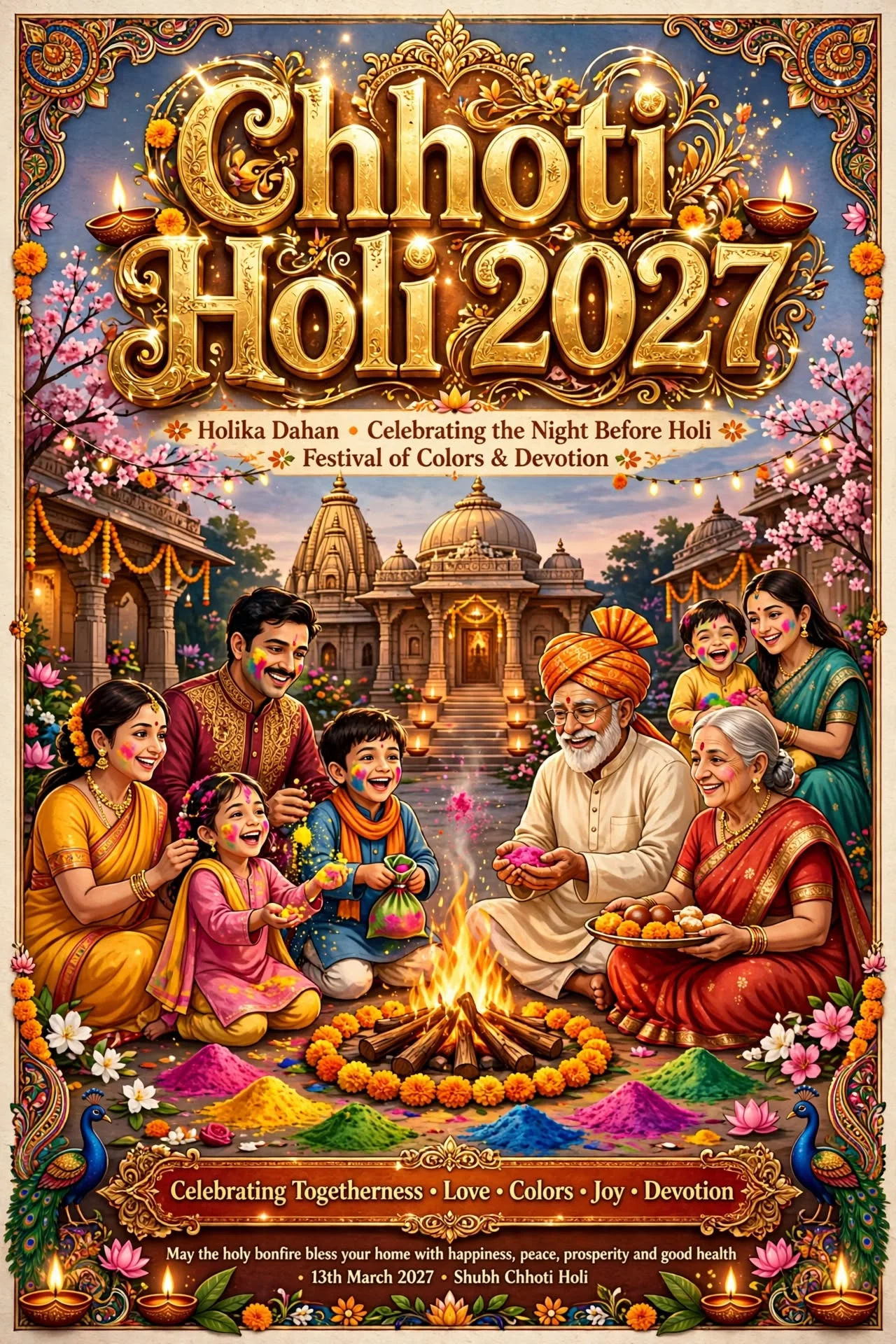
Sunday, Mar 21, 2027
Chhoti Holi
Chhoti Holi, celebrated with boundless excitement and devotion across North, Central, and Western India, is the auspicious festival observed on the fourteenth and fifteenth tithis (Chaturdashi merging into Purnima) of the Shukla Paksha in the month of Phalguna. Serving as the divine prelude to the grand festival of colors (Dhulandi or Badi Holi), Chhoti Holi is universally centered around the sacred ritual of assembling, consecrating, and lighting the community bonfire known as Holika Dahan. It commemorates the eternal victory of pure devotion, righteousness, and truth over demonic arrogance, persecution, and darkness.
View Festival Guide

Monday, Mar 22, 2027
Anvadhan
Anvadhan (अन्वाधान) is an ancient, highly revered Vedic ritual and spiritual observance in Sanatana Dharma performed on the day immediately preceding the New Moon (Amavasya) or Full Moon (Purnima). Rooted in the pristine traditions of the Shrauta and Grihya Sutras, Anvadhan literally translates to 'the solemn placing and replenishment of sacred fuel wood into the consecrated Vedic fires'. In traditional Vedic ritualism, householders (Grihasthas) and priests who maintain the sacred Agnihotra fires perform Anvadhan to prepare the sacrificial altars for the grand Darsha Yajna (New Moon sacrifice) or Paurnamasa Yajna (Full Moon sacrifice) scheduled for the following day.
View Festival Guide
Monday, Mar 22, 2027
Vasanta Purnima
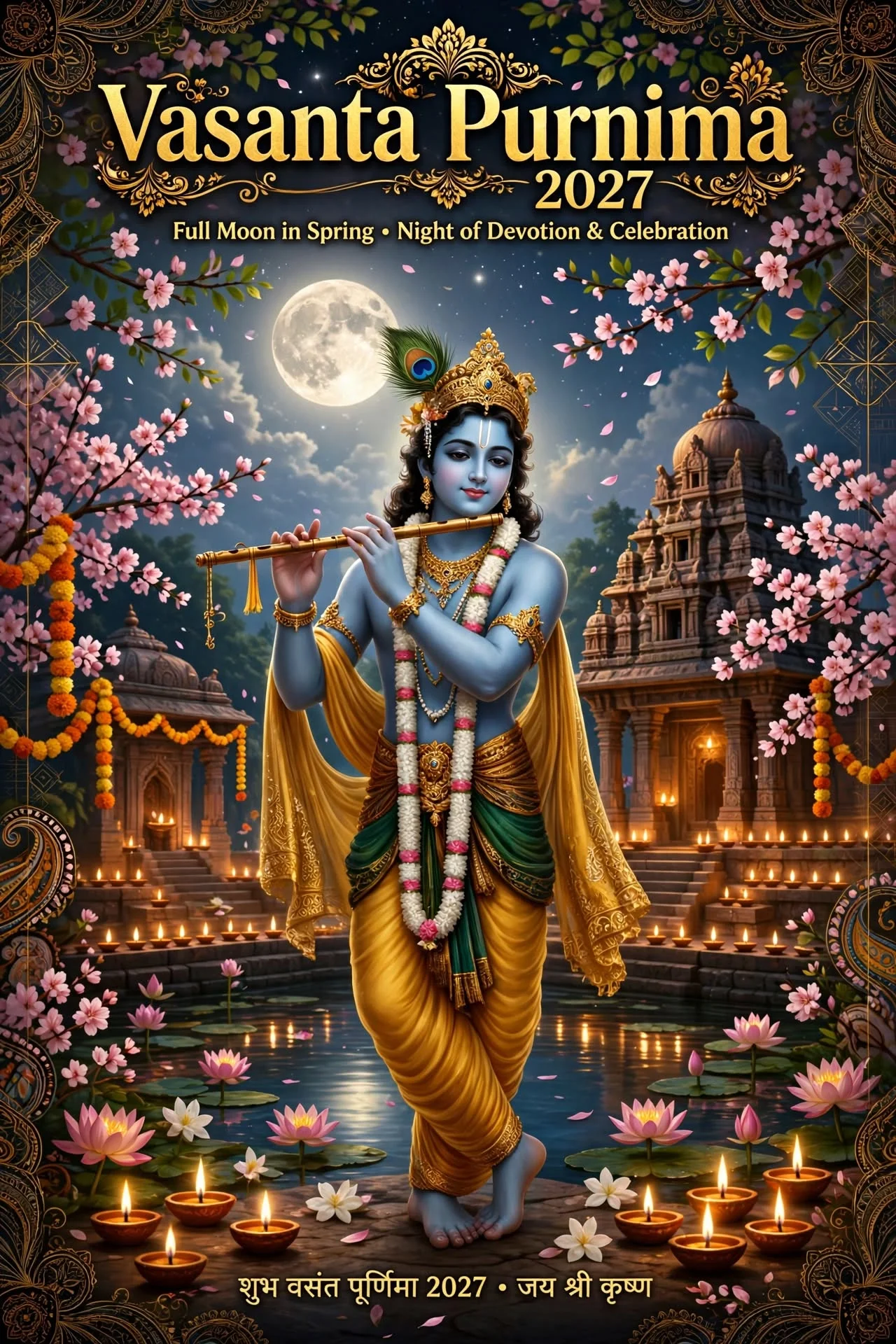
Vasanta Purnima (also known as Vasantotsava Purnima or the Spring Full Moon) is an extraordinarily radiant, culturally celebrated, and spiritually elevating Hindu festival observed on the full moon day (Purnima tithi) of the lunar month of Phalguna according to the traditional Hindu calendar. Coinciding with the peak of the spring season (Rituraj Vasant), this glorious night represents the full flowering of natural beauty, romantic affection, aesthetic grace, and sublime divine devotion (Prema Bhakti) across Sanatana Dharma. Celebrated as the eve of the vibrant festival of colors and the sacred night of Holika Dahan, Vasanta Purnima serves as the crowning jewel of the spring festival cycle.
View Festival Guide
Monday, Mar 22, 2027
Holi
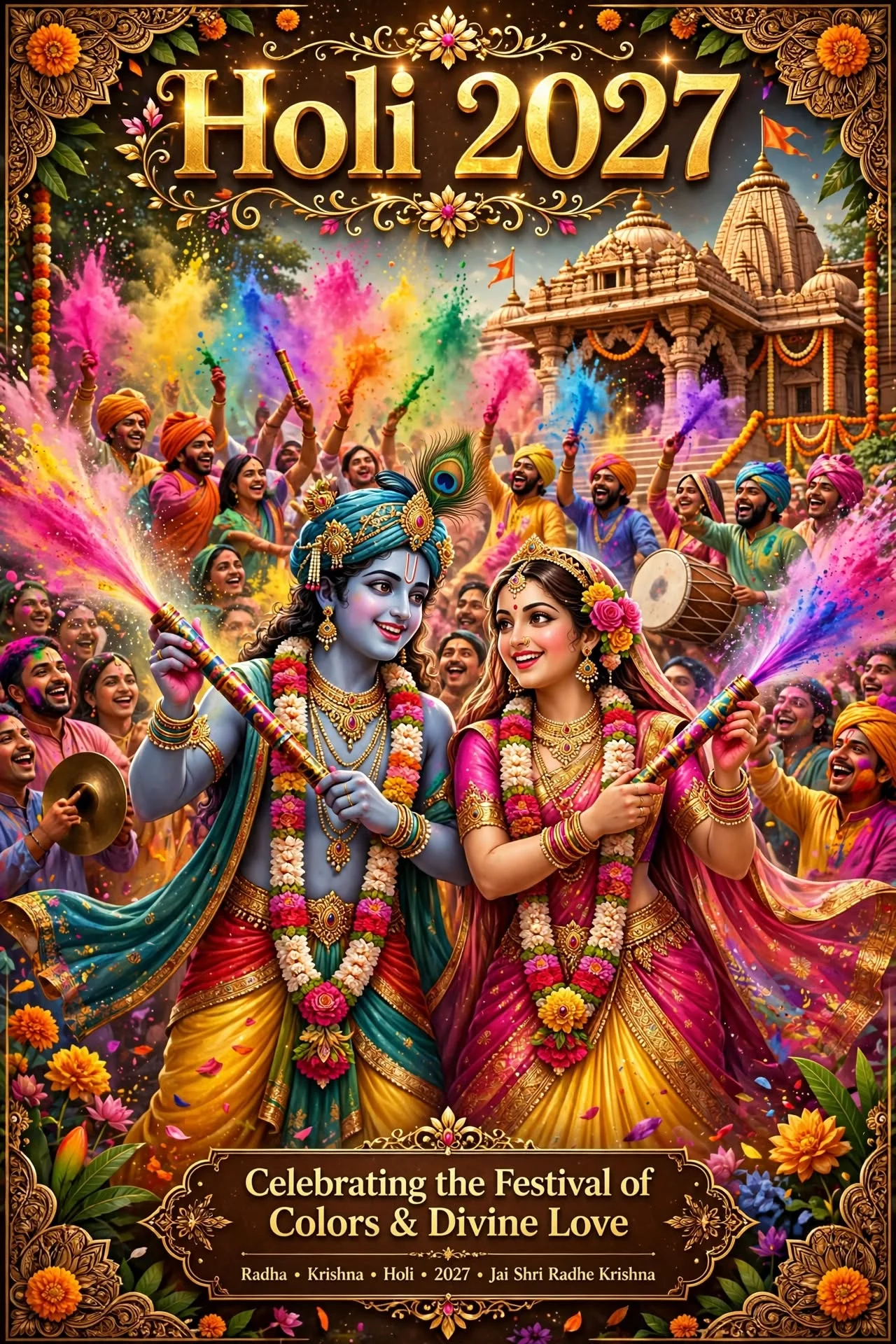
Holi, celebrated with incomparable exuberance, color, and spiritual fraternity, is one of the most ancient, glorious, and universally beloved festivals in Sanatana Dharma. Celebrated on the first day (Pratipada tithi) of the Krishna Paksha in the holy month of Chaitra according to the traditional Hindu calendar (occurring immediately after the night of Holika Dahan), this grand festival of colors—affectionately known as Dhulandi, Dhuleti, Rangwali Holi, and Vasantotsava—marks the triumphant arrival of spring (Rituraj Vasant), the rebirth of nature's vibrant beauty, and the profound social and spiritual renewal of human hearts.
View Festival Guide
Monday, Mar 22, 2027
Phalguna Purnima
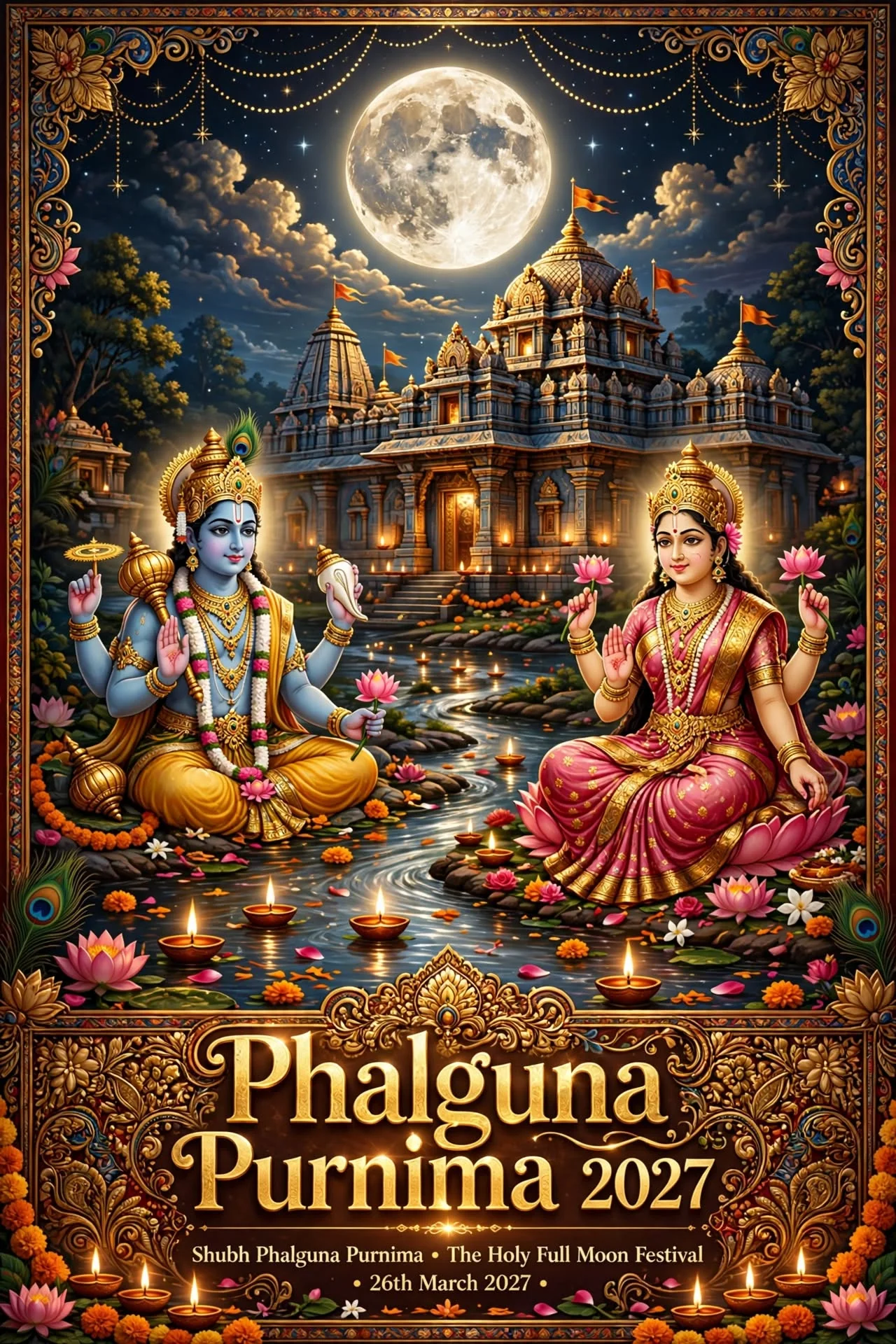
Phalguna Purnima is one of the most spiritually multifaceted, sacred, and joyously celebrated full moon days in the Hindu calendar, marking the magnificent culmination of the holy lunar month of Phalguna. Occurring on the final day of the Phalguna month in the Purnimanta calendar, this momentous full moon represents the harmonious convergence of several monumental religious observances: the sacred bonfire night of Holika Dahan, the divine advent day of Sri Chaitanya Mahaprabhu (Gaura Purnima), the glorious appearance day of Goddess Lakshmi (Lakshmi Jayanti), and the vibrant swing festivals (Dolotsava) celebrated across India.
View Festival Guide

Tuesday, Mar 23, 2027
Ishti
Ishti is a foundational Vedic ritual observance appearing prominently in Hindu Panchangs on the Pratipada tithi (the first lunar day) following either Amavasya (new moon) or Purnima (full moon), marking the prescribed performance day for the fortnightly Vedic Darsha-Purnamasa sacrifices.
View Festival Guide
Wednesday, Mar 24, 2027
Bhratri Dwitiya
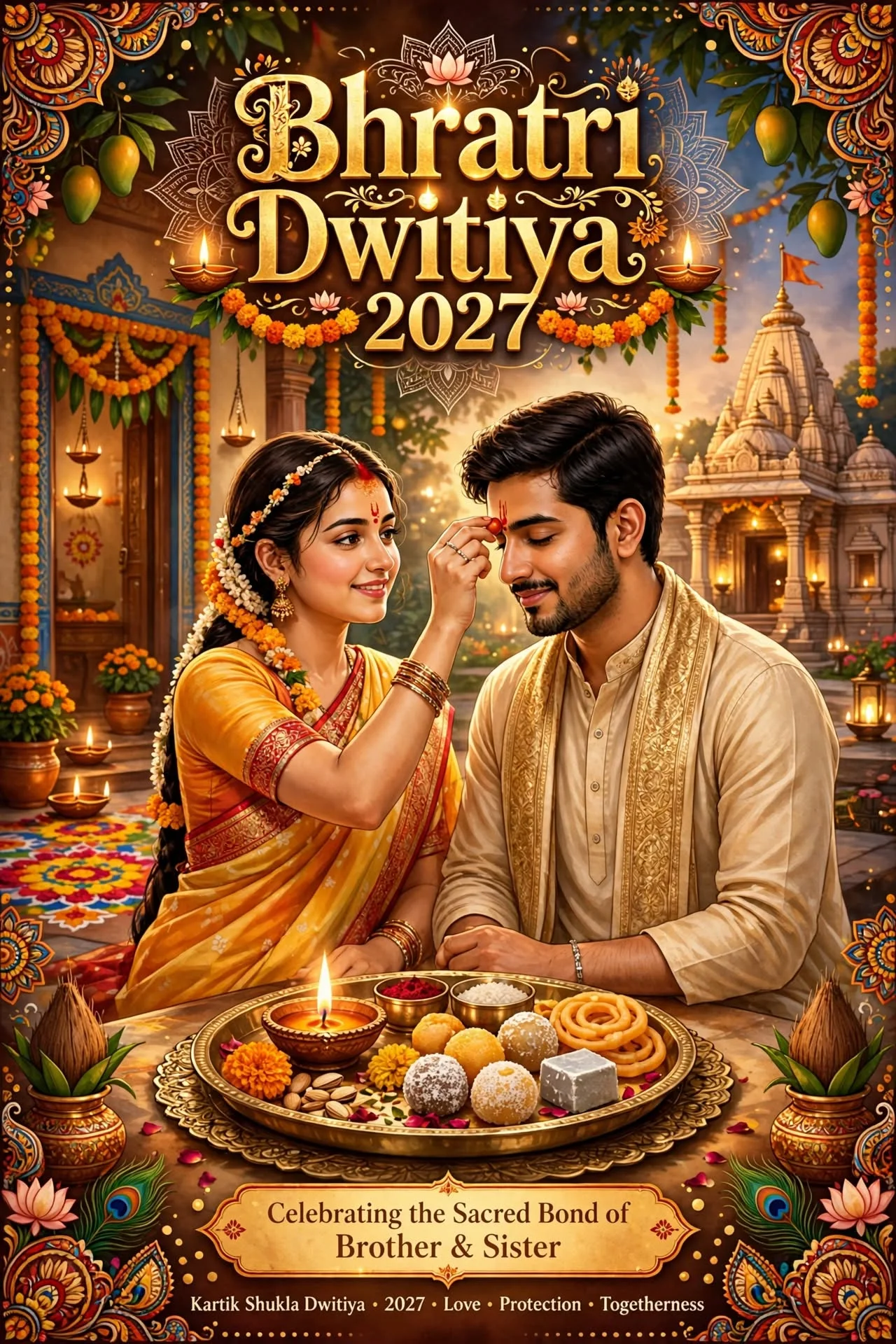
Bhratri Dwitiya (भ्रातृ द्वितीया), linguistically derived from the Sanskrit terms 'Bhratri' (brother) and 'Dwitiya' (the second lunar tithi), is a time-honored, deeply venerable, and emotionally uplifting Hindu festival that sanctifies and celebrates the sacred bond between brothers and sisters. Observed on the second day (Dwitiya tithi) of the lunar fortnight—most prominently celebrated following Holi in the month of Chaitra as well as following Diwali in the month of Kartika—Bhratri Dwitiya represents the classical, scriptural manifestation of the pan-Indian sibling festival known in regional vernaculars as Bhai Dooj, Bhai Phota (in Bengal), and Bhav Bij (in Maharashtra).
View Festival Guide
Wednesday, Mar 24, 2027
Bhai Dooj (Yama Dwitiya / Bhai Tika)
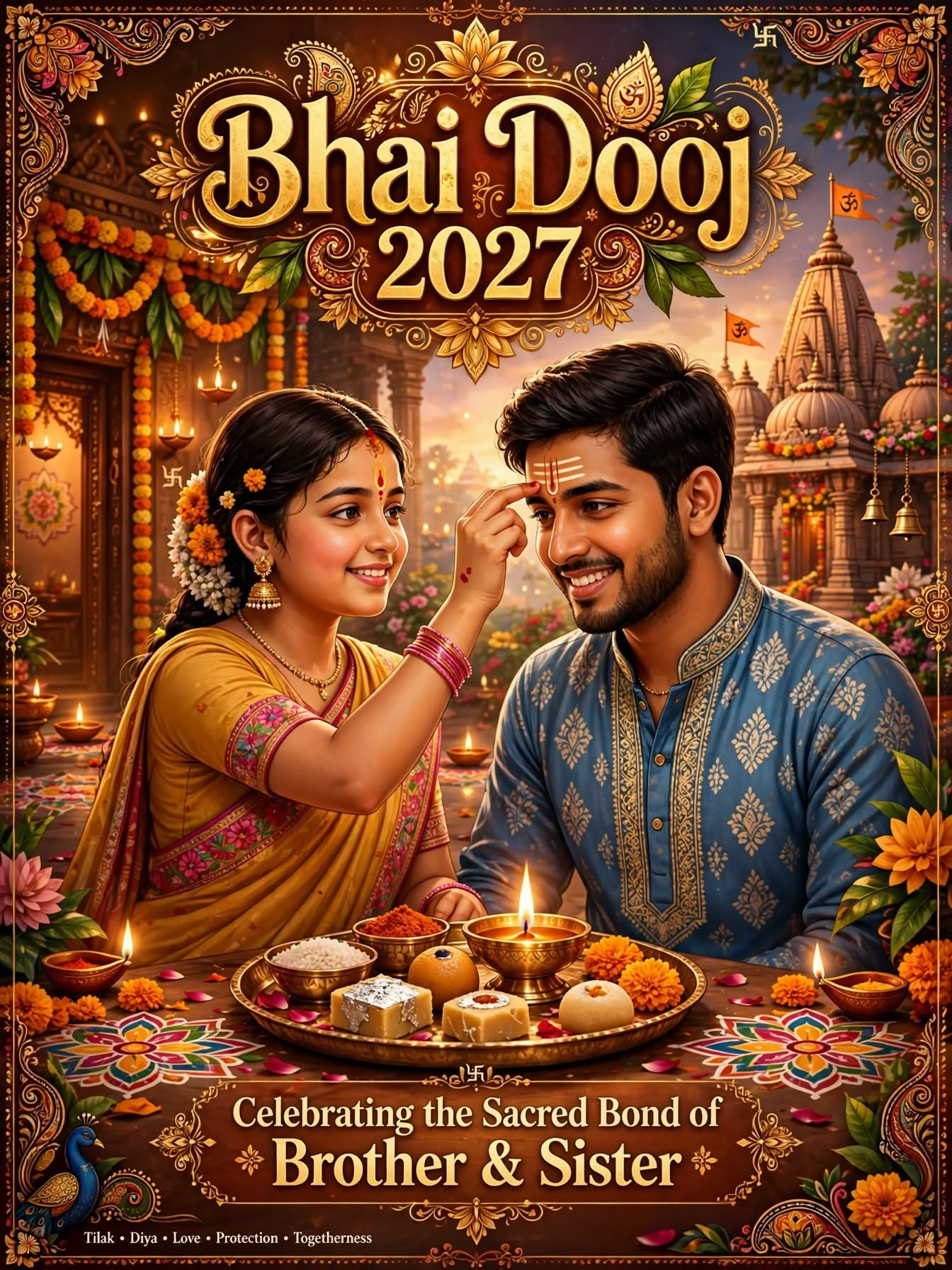
Bhai Dooj (also lovingly known as Holi Bhai Dooj or Chaitra Bhai Dooj) is an intensely affectionate, culturally sacred, and spiritually protective Hindu festival observed on the second day (Dwitiya tithi) of the Krishna Paksha in the month of Chaitra according to the traditional Hindu calendar. Occurring on the second day immediately following the vibrant festival of colors (Holi), this sacred observance mirrors the post-Diwali Bhai Dooj, serving to reaffirm, sanctify, and celebrate the pure, unconditional bond of love and protection between brothers and sisters across Sanatana Dharma.
View Festival Guide