




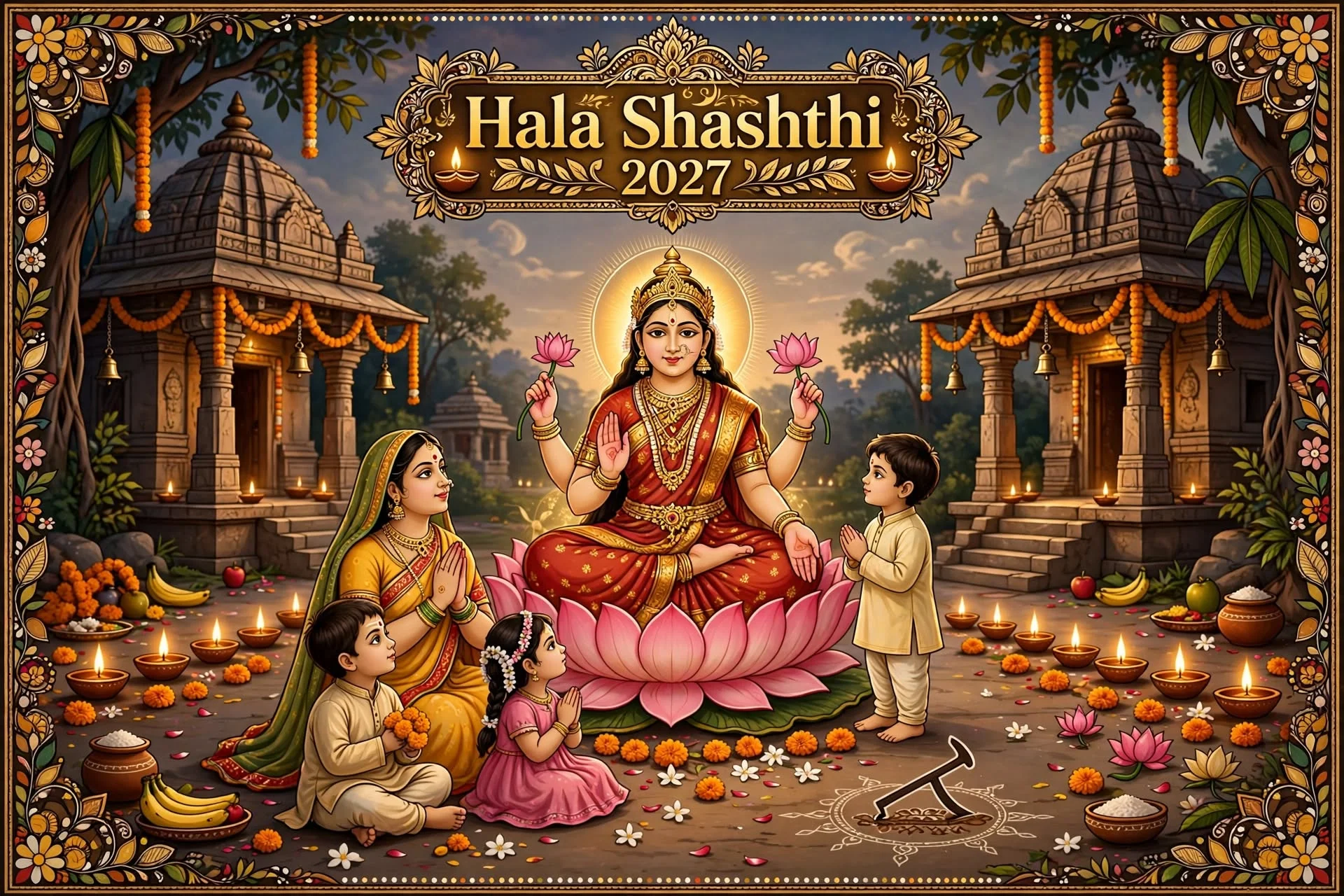
Hala Shashthi, also reverently celebrated across India as Balarama Jayanti, Harshath, Hal Chhath, Tin-chhathi, or Chandan Chhath, falls on the sixth lunar day (Shashthi tithi) of the Krishna Paksha (waning fortnight) in the sacred monsoon month of Bhadrapada (or Shravana in the Amanta calendar). This sanctified day marks the auspicious appearance anniversary (Avatara Jayanti) of Bhagwan Balarama, the elder brother of Lord Sri Krishna and the seventh incarnation of Lord Vishnu, who manifested as the direct embodiment of the primordial thousand-headed serpent Adishesha.
Hala Shashthi 2027: Date, Puja Timings, Rituals & Stories
Hala Shashthi Timings & Panchang
Important festival dates and auspicious timings
Usha Arghya (Sunrise)
05:54 am
Sandhya Arghya (Sunset)
06:53 pm
Start Date
Monday, 23 Aug 2027
Puja Muhurat
08:45 pm – 08:53 pm
Hala Shashthi
Lord Balarama is renowned across Vedic scriptures as 'Haladhara' (the bearer of the sacred plow, Hala) and 'Musali' (the bearer of the cosmic pestle, Musala), symbolizing agrarian fertility, physical strength, protection of cosmic order, and righteous warfare. Because the plow is His divine emblem, Hala Shashthi is an ancient agrarian thanksgiving festival honoring agricultural labor, the sanctity of uncultivated earth, and the vital role of bullocks and farmers in sustaining human civilization.
Predominantly observed by mothers across northern and central India (especially Uttar Pradesh, Bihar, Madhya Pradesh, and Rajasthan), Hala Shashthi is marked by an extraordinary dietary and ritual code. Mothers observe a strict fast for the long life, health, and prosperity of their sons. In honor of Lord Balarama's plow, nothing plowed or cultivated by oxen or tractors is consumed—only wild forest rice (Tinni / Pasa rice) and uncultivated greens are eaten. Furthermore, cow's milk and ghee are strictly avoided in reverence to Lord Krishna's cows, and only buffalo milk (Bhains ka doodh) and buffalo ghee are utilized for rituals and nourishment.
Why is Hala Shashthi Celebrated?
Hala Shashthi is celebrated to commemorate the divine birth of Bhagwan Balarama, the celestial incarnation of Adishesha who embodies inexhaustible spiritual and physical strength (Bala).
According to the Srimad Bhagavatam, Balarama represents the original spiritual guru (Akhanda Guru-Tattva) who plows the hard soil of the human heart, uprooting the weeds of lust, greed, and ego to make it fertile for the seed of pure devotion (Bhakti).
The festival simultaneously honors the agricultural plow (Hala) as a sacred instrument of sustenance, teaching humanity to revere the soil, practice restraint, and seek divine protection for children.
- Commemorating the appearance day of Bhagwan Balarama, the elder brother of Lord Krishna.
- Praying for the longevity, physical vitality, and moral integrity of sons and children.
- Worshiping the agricultural plow (Hala) and pestle (Musala) as divine emblems of righteous labor.
- Consuming only wild uncultivated forest rice (Tinni rice) and unplowed produce.
- Observing strict abstinence from cow dairy, utilizing only buffalo milk and buffalo ghee.
Scriptural Foundations in the Srimad Bhagavatam and Garga Samhita
The Miraculous Transfer of the Seventh Womb
In the tenth canto of the Srimad Bhagavatam, King Kamsa imprisoned his sister Devaki and her husband Vasudeva in the subterranean dungeons of Mathura, cruelly slaughtering their first six newborn infants. When the radiant seventh embryo entered Devaki's womb, it was none other than Bhagwan Shesha, the plenary expansion of the Lord.
To preserve the divine child, the Supreme Lord Vishnu commanded Yogamaya (the goddess of divine arrangement): 'O auspicious one, go to the cowherd settlement of Gokul. In the home of Nanda Maharaja resides Vasudeva's other virtuous wife, Rohini. Attract the seventh embryo from Devaki's womb and transfer it safely into the womb of Rohini.' Yogamaya executed the divine command on Shashthi tithi. Because the child was drawn (Sankarshana) from one womb to another, He was named Sankarshana, and because of His supreme spiritual and physical might, He was named Balarama and Balabhadra.
The Symbolism of the Plow and the Yamuna Leela
The Garga Samhita records numerous divine pastimes of Lord Balarama. Wielding His golden plow (Sunanda Hala), Balarama once commanded the sacred river Yamuna to alter her course to irrigate the parched pastures of Gokul and Vrindavan. When the river goddess hesitated out of pride, Balarama struck the earth with the tip of His plow, carving channels that redirected the river, blessing the land with eternal fertility.
Balarama vanquished terrifying demonic adversaries like Dhenukasura (the donkey demon in the Talavana palm forest) and Pralambasura, ever standing as the steadfast, protective elder brother to Sri Krishna.
The Traditional Origin of Harshath Rituals
Centuries of agricultural folklore integrated Balarama's worship with environmental respect. By forbidding the consumption of any food grown with a plow on this day, ancient seers granted a symbolic day of rest to the soil, bullocks, and plows, celebrating wild nature and unplowed forest vegetation.
Source: Srimad Bhagavatam (Tenth Canto, Chapters 1-2) and Garga Samhita (Balabhadra Khanda)
Guru Tattva, Spiritual Cultivation, and Restraint
Balarama as the Original Spiritual Master (Adi Guru)
In Vaishnava philosophy, Lord Balarama represents the original Guru who bestows spiritual stamina (Bala). Without Balarama's grace, the soul cannot overcome deep-seated material illusions (Maya).
The plow represents the rigorous discipline of spiritual practice (Sadhana), which tills the hardened, rocky field of the subconscious mind so that the seeds of divine love (Prema) can germinate and bear fruit.
The Sacred Ecology of Uncultivated Grains
Eating wild forest rice (Tinni / Pasa rice) and uncultivated greens (like Chaulai and Mahua) represents a sacred return to natural simplicity. It honors the innate abundance of Mother Earth when untamed by human instruments.
Abstaining from cow milk honors the sacred cattle of Braj, while using buffalo milk channels a grounding, protective physical strength for growing sons.
Miniature Pond Digging, Plow Worship, and Dietary Manual
Digging the Sacred Pond and Ber-Palash Setup
In the courtyard or domestic puja area, women clean the earth and dig a small symbolic square pond (often lined with mud or brick). Beside the pond, leafy branches of the Ber (jujube), Palash (flame of the forest), and Kasi (sacred grass) trees are planted together.
A small wooden or silver model of a plow (Hala) and pestle is installed beside the pond and anointed with turmeric, vermilion, and sandalwood.
The Buffalo Milk and Tinni Rice Offering
Women prepare a special prasad of wild Tinni rice boiled in fresh buffalo milk, sweetened with unrefined jaggery, and cooked with dried Mahua flowers. Six small earthen pots (Kulhars) filled with soaked gram, maize, and sweet rice are offered at the altar.
Mothers mark the clothing or chests of their sons with six auspicious dots of turmeric paste and buffalo milk, praying for their long life and robust health.
Hala Shashthi Puja Vidhi (Step by Step)
- 1
Brahma Muhurta Snana & Sankalpa
Wake early before sunrise, take a purificatory bath in clean water, wear fresh red or yellow traditional attire, and take a solemn vow to observe the Hala Shashthi fast for your sons' welfare.
- 2
Construction of the Symbolic Pond
Dig or construct a small miniature pond in the courtyard using clean mud, decorating its perimeter with lime and turmeric powder.
- 3
Sthapana of Ber, Palash, and Kasi Twigs
Plant fresh leafy twigs of the Ber (jujube) and Palash trees along with tall Kasi grass firmly beside the miniature pond, representing nature's protective shelter.
- 4
Installation and Worship of the Sacred Plow
Place a miniature wooden, silver, or brass plow (Hala) beside the pond, anointing it with turmeric paste, vermilion (rolli), and red sacred thread (moli).
- 5
Avahana of Bhagwan Balarama
Invoke Bhagwan Balarama and Mother Rohini with folded hands, meditating upon His white complexion, blue silk garments, and golden plow.
Hala Shashthi Puja Samagri List
Altar and Agricultural Representation Articles
- Miniature wooden, brass, or silver agricultural plow (Hala)
- Fresh leafy branches of Ber (jujube) and Palash (flame of the forest) trees
- Tall reeds of Kasi grass (Kusha grass)
- Clean mud, unbaked bricks, and lime for making the pond
- Six small earthen pots (Kulhars or Mitti ke Kasore)
Botanical, Anointing, and Sacred Items
- Fresh yellow turmeric powder, rolli (kumkum), and sandalwood paste
- Red sacred thread (Moli / Kalava) and unbroken raw rice grains (Akshata)
- Fresh wild monsoon flowers and marigold garlands
- Earthen oil lamp with cotton wicks and natural camphor tablets
- Sandalwood incense sticks (agarbatti) and clean river water
Naivedyam and Dietary Essentials
- Wild uncultivated forest rice (Tinni / Pasa / Samak rice)
- Fresh raw buffalo milk (Bhains ka doodh), buffalo curd, and buffalo ghee
- Dried Mahua flowers (Madhuca longifolia) and unrefined jaggery
- Soaked uncultivated gram and wild leafy greens (Chaulai saag)
Mantras and Prayers for Hala Shashthi
Hala Shashthi Vrat Rules and Fasting Guidelines
Dietary Strictures and Unplowed Food Rules
Mothers observe a complete fast until late afternoon or evening. The most essential rule of Hala Shashthi is that nothing grown with the help of a plow (like wheat, ordinary rice, cultivated lentils) can be eaten.
- Consume strictly uncultivated, wild forest rice (Tinni / Pasa rice).
- Total avoidance of all cow dairy (cow milk, curd, butter, and ghee).
- Only buffalo milk, buffalo curd, and buffalo ghee are permitted.
- Do not use sharp kitchen knives; break wild greens by hand.
Respect for Agriculture and Soil
No plowing, digging of fields, or harvesting with metal tools is conducted on this day. The plow is revered as an instrument of divine sustenance and given rest.
Dos and Don'ts of Hala Shashthi
Good Practices (Do's)
- Wake up before sunrise, bathe, and take the vow of Hala Shashthi fasting.
- Establish a miniature pond and plant branches of Ber, Palash, and Kasi grass.
- Worship the plow (Hala) as the sacred emblem of Lord Balarama.
- Consume only wild uncultivated forest rice (Tinni rice) and wild greens.
- Use exclusively buffalo milk, curd, and ghee for all puja offerings and meals.
Hala Shashthi Across Regions
| Region | Local Name |
|---|---|
| Uttar Pradesh & Bihar | Harshath / Hal Chhath |
| Madhya Pradesh (Bundelkhand & Baghelkhand) | Tin-chhathi |
| Rajasthan | Chandan Chhath / Balarama Jayanti |
Hala Shashthi FAQs
Why is this festival called Hala Shashthi?
It is called Hala Shashthi because it occurs on the Shashthi tithi (sixth lunar day) and honors the divine agricultural plow ('Hala'), the sacred weapon and emblem of Bhagwan Balarama.
Why is ordinary cultivated rice and wheat prohibited on this day?
To honor Lord Balarama's plow and give symbolic rest to the tilled earth and working bullocks, only uncultivated, wild forest grains (such as Tinni or Pasa rice) that grow without plowing are consumed.
Why is cow milk forbidden while buffalo milk is permitted?
Cow milk is spared in loving reverence to Lord Krishna's cows (Gau Mata), ensuring the calves receive all milk; buffalo milk is used instead to invoke physical strength and vitality for sons.
Upcoming Festivals
View All
Wednesday, Aug 25, 2027
Krishna Janmashtami
Krishna Janmashtami, also celebrated worldwide as Gokulashtami, Krishnashtami, Saatam-Aatham, or Janmashtami, is the supreme, ecstatic celebration marking the divine advent (Avatara Jayanti) of Bhagwan Sri Krishna—revered in the Srimad Bhagavatam as 'Krishnas Tu Bhagavan Svayam' (Sri Krishna is the Supreme Divine Personality of Godhead Himself in His complete, plenary fullness). Occurring on the eighth lunar day (Ashtami tithi) of the Krishna Paksha in the sacred monsoon month of Bhadrapada (or Shravana in the Amanta calendar) at the stroke of midnight under the auspicious Rohini Nakshatra, this festival commemorates the celestial moment when the dark midnight sky was illuminated by the birth of the cosmic protector.
View Festival Guide

Thursday, Aug 26, 2027
Dahi Handi
Dahi Handi, also celebrated as Gopalakala, Utlotsavam, or the Curd Pot Festival, is an exuberant, high-energy festival celebrated on the Navami tithi (ninth lunar day) of Krishna Paksha in the sacred monsoon month of Bhadrapada (or Shravana in the Amanta calendar). Occurring on the morning immediately following Krishna Janmashtami, Dahi Handi commemorates the enchanting childhood pastimes (Baal Leelas) of Bhagwan Sri Krishna in the pastoral village of Gokul, where the young Lord and His cowherd companions (Gopas) formed ingenious human pyramids to reach and break earthen pots filled with freshly churned curd, butter, and milk hung from the high ceilings of gopis' houses.
View Festival Guide

Saturday, Aug 28, 2027
Aja Ekadashi
Aja Ekadashi, also celebrated with immense spiritual reverence as Ananda Ekadashi, is observed on the eleventh lunar day (Ekadashi tithi) of the Krishna Paksha (dark waning fortnight) in the sacred monsoon month of Bhadrapada (or Shravana in the Amanta calendar). Dedicated to Bhagwan Vishnu in His divine form as Hrishikesha (the supreme master of the senses), this sanctified vrata is extolled in the Brahmavaivarta Purana and Padma Purana as an extraordinary spiritual penance capable of destroying all accumulated sins, reversing catastrophic worldly misfortunes, and bestowing liberation (Moksha).
View Festival Guide
Saturday, Aug 28, 2027
Bachha Baras Dwadashi
Bachha Baras Dwadashi, also reverently celebrated as Govatsa Dwadashi, Vasu Baras, or Vatsa Dwadashi, is observed on the twelfth lunar day (Dwadashi tithi) of Krishna Paksha in the sacred monsoon month of Bhadrapada (or Shravana in the Amanta calendar scheme). Falling four days after Krishna Janmashtami, this heartwarming festival is dedicated exclusively to the adoration of Kamadhenu's celestial daughter, the divine cow Nandini, and her young suckling calf (Bachha / Vatsa), celebrating maternal devotion, rural cattle welfare, and the sacred spiritual bond between humanity and the animal kingdom.
View Festival Guide
Sunday, Aug 29, 2027
Ravi Pradosh Vrat
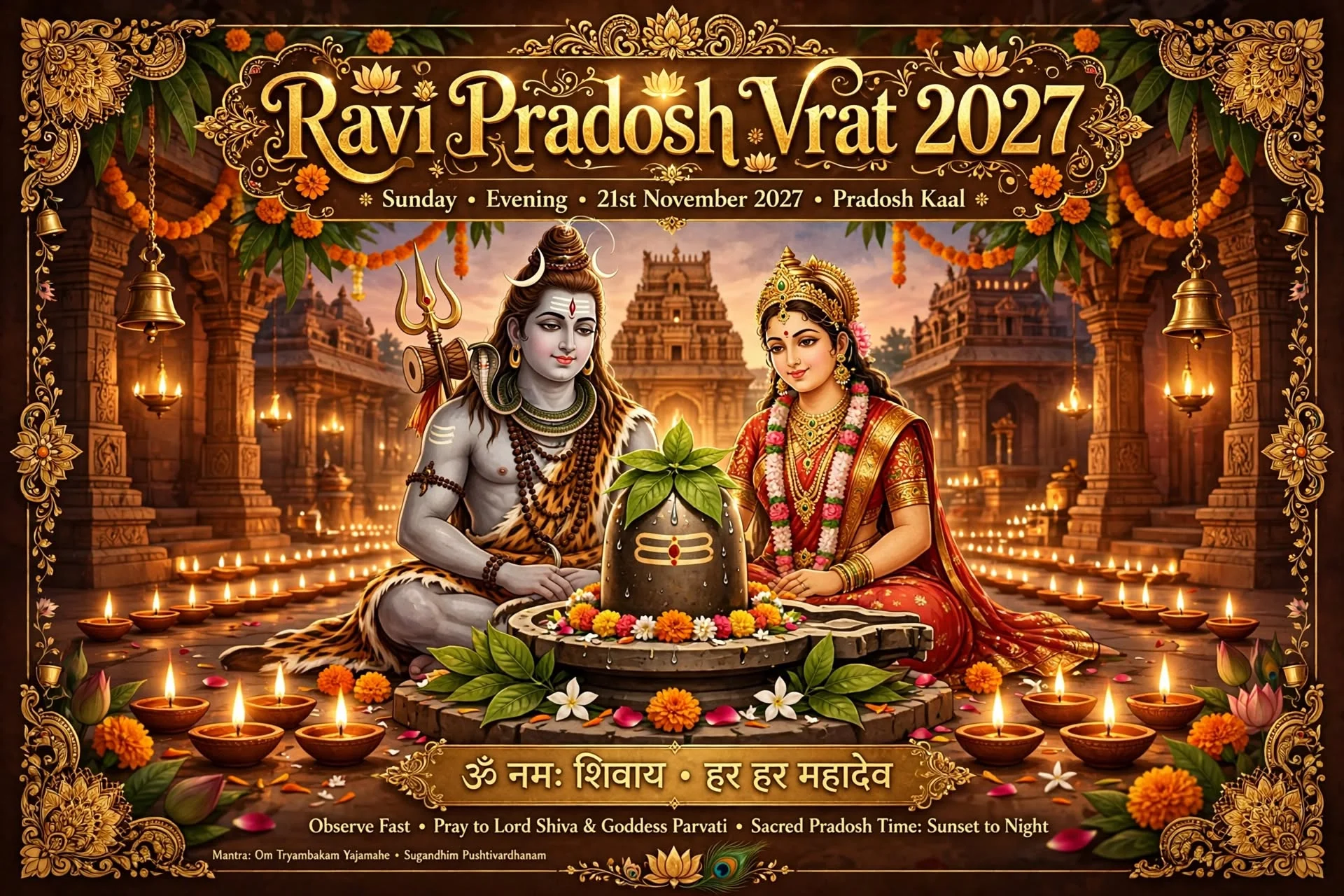
Ravi Pradosh Vrat is an exceptionally sacred fasting day observed on the thirteenth lunar day (Trayodashi) that coincides with a Sunday (Ravivara). Dedicated to Lord Shiva, the cosmic dissolver of sorrow, this bimonthly vow unites the healing radiance of Surya Bhagavan with the boundless compassion of Mahadeva. Observed during the twilight Sandhya period, it is believed to banish physical ailments, clear karmic obstructions, and bestow vitality and longevity.
View Festival Guide

Tuesday, Aug 31, 2027
Anvadhan
Anvadhan (अन्वाधान) is an ancient, highly revered Vedic ritual and spiritual observance in Sanatana Dharma performed on the day immediately preceding the New Moon (Amavasya) or Full Moon (Purnima). Rooted in the pristine traditions of the Shrauta and Grihya Sutras, Anvadhan literally translates to 'the solemn placing and replenishment of sacred fuel wood into the consecrated Vedic fires'. In traditional Vedic ritualism, householders (Grihasthas) and priests who maintain the sacred Agnihotra fires perform Anvadhan to prepare the sacrificial altars for the grand Darsha Yajna (New Moon sacrifice) or Paurnamasa Yajna (Full Moon sacrifice) scheduled for the following day.
View Festival Guide

Tuesday, Aug 31, 2027
Pithori Amavasya
Pithori Amavasya, also reverently celebrated across India as Kushagrahani Amavasya, Pola Amavasya, or Pithori Vrat, is the sacred New Moon day concluding the holy monsoon month of Shravana (or Bhadrapada in the Purnimanta calendar scheme). Dedicated to Goddess Durga, Goddess Parvati, and the Sixty-Four Yoginis (Chausath Yogini), this ancient festival is celebrated with profound devotion by mothers for the longevity, health, moral strength, and spiritual protection of their children, as well as the pacification of ancestral souls (Pitrus).
View Festival Guide
Tuesday, Aug 31, 2027
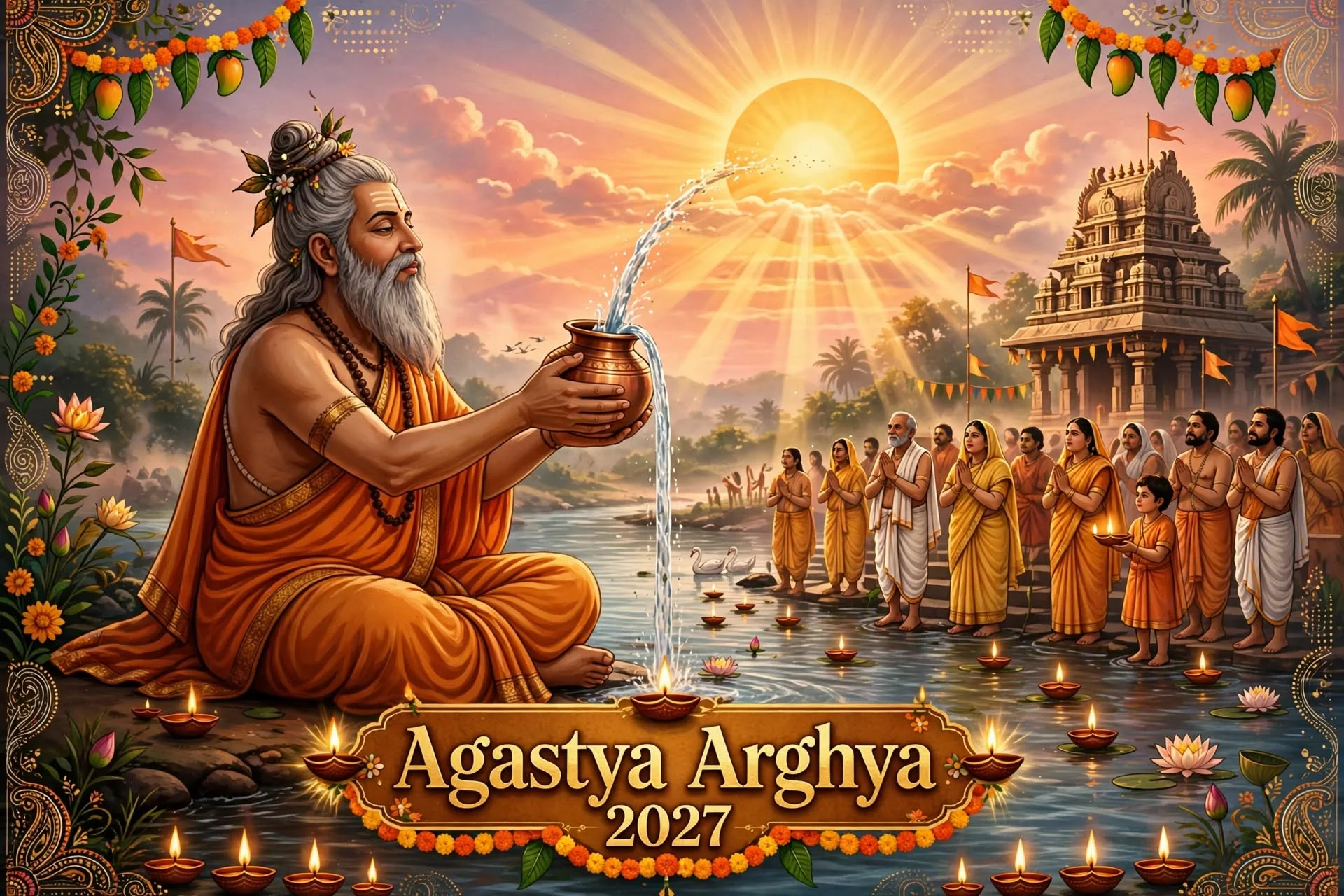
Agastya Arghya
Agastya Arghya, also known as Agastya Udaya Arghya, is a profound astronomical and Vedic ritual observed during the transition of late monsoon into early autumn (Sharad Ritu), when the celestial star Canopus (known in Sanskrit as the Agastya Nakshatra) first rises above the southern horizon at dawn. In ancient Indian astronomy (Surya Siddhanta) and Puranic literature, the dawn rising of Agastya is celebrated as an extraordinary cosmic event marking the physical and energetic purification of all terrestrial waters, the calming of turbulent monsoon rivers, and the pacification of atmospheric toxins.
View Festival Guide