




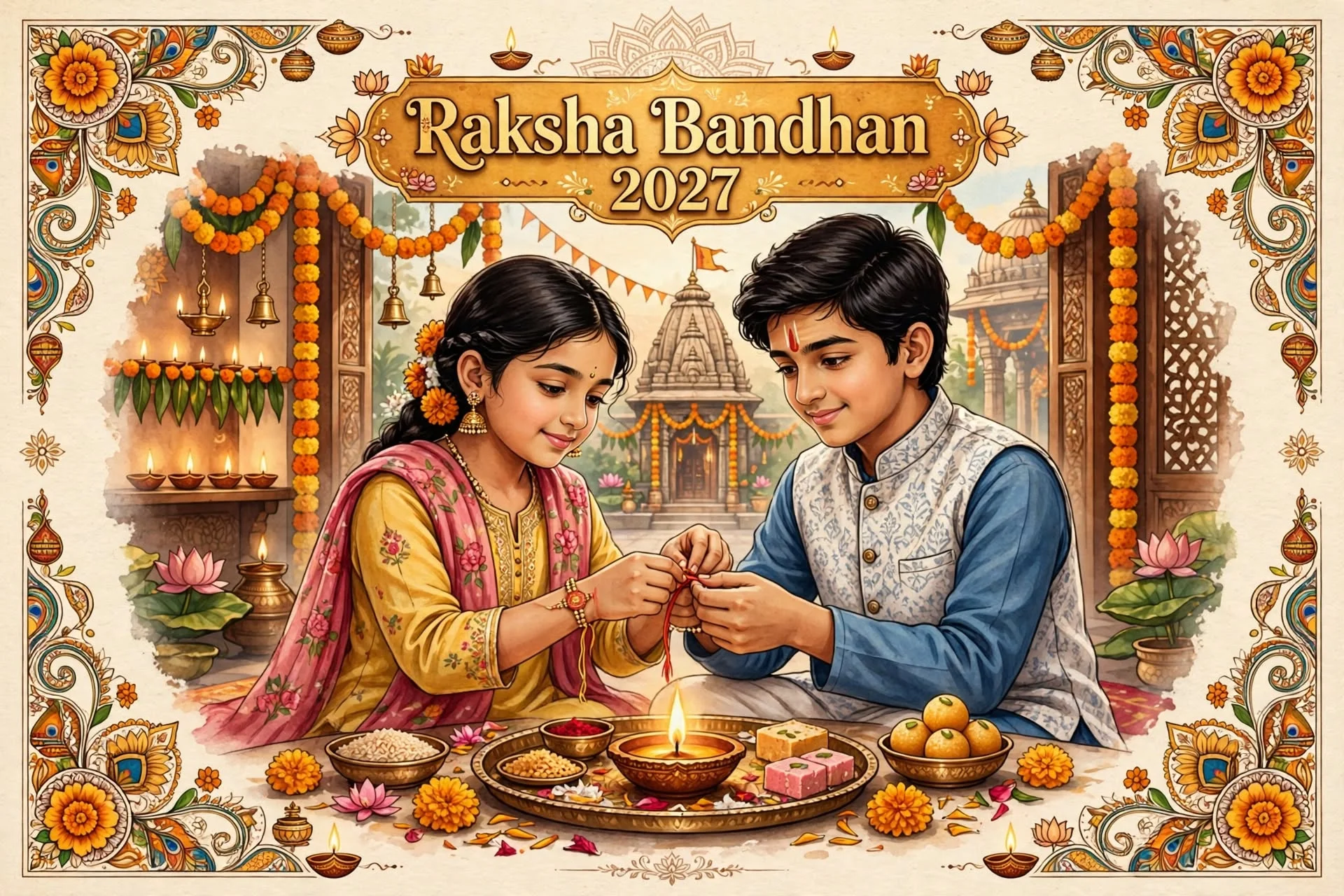
Raksha Bandhan, celebrated on the sacred Full Moon day (Purnima) of the holy Hindu month of Shravana, is one of the most cherished, ancient, and emotionally resonant festivals of India. Translated literally as 'the bond of protection', Raksha Bandhan honors the sacred relationship between brothers and sisters while simultaneously encapsulating broader cosmic and moral principles of mutual duty, chivalric honor, spiritual righteousness, and universal solidarity.
Raksha Bandhan 2027: Date, Puja Timings, Rituals & Stories
Raksha Bandhan Timings & Panchang
Important festival dates and auspicious timings
Usha Arghya (Sunrise)
05:51 am
Sandhya Arghya (Sunset)
06:59 pm
Start Date
Tuesday, 17 Aug 2027
Puja Muhurat
10:29 am – 12:58 pm
Raksha Bandhan
On this joyous day, sisters tie an ornate, sacred talisman thread known as a 'Rakhi' around the right wrists of their brothers. In doing so, sisters pray for their brothers' long life, health, spiritual nobility, and prosperity, marking their foreheads with auspicious vermilion (tilak) and unbroken rice (akshata). In return, brothers offer loving gifts and make a solemn, lifelong pledge to protect their sisters' honor, dignity, and welfare under all circumstances.
Beyond the cherished fraternal bond, Raksha Bandhan is anchored in deep Puranic and Vedic antiquities. Concurrently celebrated as Shravani Upakarma (Avani Avittam), sacred thread renewal (Yajnopavita Dharanam), and Narali Purnima, this sanctified day commemorates legendary moments of divine protection: Indrani tying the protective amulet to Lord Indra to defeat demons, Draupadi bandaging Lord Krishna's wounded finger with a strip of her silk sari, and Goddess Lakshmi tying a sacred cord around King Bali's wrist to secure the release of Lord Vishnu.
Why is Raksha Bandhan Celebrated?
Raksha Bandhan is celebrated to renew and celebrate the timeless bond of mutual love, trust, and protective commitment between siblings and fellow human beings.
Rooted in Vedic scriptures, the tying of a protective thread ('Raksha') was originally an ancient spiritual rite performed by family priests (Purohits) and women to shield warriors, kings, and loved ones from demonic energies, moral failure, and physical danger before venturing into challenges.
The festival reminds society of the sacred obligation to honor, respect, and defend the dignity of women, while instilling virtues of selflessness, family loyalty, and communal harmony.
- Affirming the eternal, unconditional bond of affection, duty, and mutual protection between siblings.
- Commemorating the sacred Vedic tradition of tying protective amulets (Raksha Sutras) empowered by mantras.
- Honoring the historic pledge of Lord Krishna to protect Draupadi during her times of extreme crisis.
- Celebrating Goddess Lakshmi's affection toward King Bali, demonstrating that love transcends social and cosmic status.
- Performing Shravani Upakarma and renewing the sacred Yajnopavita thread for spiritual regeneration.
Scriptural Foundations and Historical Legends of Raksha Bandhan
Indra and Indrani in the Bhavishya Purana
In the ancient records of the Bhavishya Purana, a cataclysmic war raged between the Devas and Asuras for twelve cosmic years. The demon king Bali overwhelmed the celestial hosts, capturing the heavens and driving Lord Indra, the king of the gods, from his throne. Depressed and seeking refuge, Indra approached the preceptor of the gods, Sage Brihaspati, pleading for a weapon to turn the tide.
Brihaspati advised that on the auspicious Full Moon day of Shravana, a sacred protective amulet (Raksha Potli) charged with Vedic mantras should be prepared. Indra's devoted consort, Indrani (Sachi), sanctified the thread with sacred herbs and mantras and tied it around Indra's right wrist. Fortified by the divine spiritual shield, Indra returned to battle, vanquished the Asuric forces, and reclaimed Amaravati. This established the foundational principle that a sanctified Raksha thread possesses the power to repel all negative forces.
Sri Krishna and Draupadi in the Mahabharata
One of the most touching narratives of Raksha Bandhan is found in the Mahabharata. During the great Rajasuya Yajna performed by Emperor Yudhishthira, the wicked King Shishupala unleashed relentless verbal abuses against Lord Sri Krishna. Reaching the limit of his granted pardons, Krishna released His divine Sudarshana Chakra, which severed Shishupala's head and returned to His hand, slightly nicking the Lord's finger.
As blood flowed from Krishna's divine hand, royal queens and attendees hurried to fetch bandages and medicines. But Queen Draupadi, driven by spontaneous, pure devotion, did not hesitate for a second. She immediately tore a broad strip of golden silk from her royal sari and tenderly wrapped it around Krishna's bleeding finger. Touched deeply by her unhesitating affection, Lord Krishna looked into her eyes and uttered the word 'Akshayam' (endless), declaring that He was forever indebted to her for every thread of that cloth. Years later, when the Kauravas attempted to disrobe Draupadi in the royal court of Hastinapura, Lord Krishna miraculously provided an endless stream of silk, preserving her dignity and vindicating her faith.
Goddess Lakshmi and King Bali in the Bhagavata Purana
The Esoteric Power of the Sacred Thread and Atmic Union
The Sacred Thread as an Energy Shield (Kavacha)
In Vedic metaphysics, the tying of the Raksha Sutra is an act of spiritual energization. When accompanied by the verse 'Yena Baddho Bali Raja', the simple cotton or silk thread absorbs divine vibrations, acting as an energetic shield (Kavacha) that shields the wearer's vital aura from psychic distress, disease, and misfortune.
The wrist is the focal point of the radial pulse and vital nadis; binding it with a sanctified thread calms the nervous system and stimulates righteous resolve.
Transcending Physical Relationships into Spiritual Brotherhood
Raksha Bandhan elevates biological relationships into universal spiritual fraternity. It embodies the Vedic ideal of 'Vasudhaiva Kutumbakam' (the world is one single family).
By binding oneself with a promise of mutual protection and moral support, each individual acts as a conscious guardian of societal harmony and feminine honor.
Ceremonial Thali Setup, Muhurta Rules, and Ritual Flow
Observance of the Auspicious Muhurta (Avoiding Bhadra)
According to the Nirnaya Sindhu and Dharma Sindhu, Raksha Bandhan rituals must strictly avoid the malefic shadow of 'Bhadra' (the daughter of Surya). Tying Rakhi during Bhadra is believed to bring adversity and discord.
The ideal time for tying the Rakhi is during Aparahna (afternoon) or Pradosh kala after the conclusion of Bhadra.
The Fraternal Ceremony and Exchange of Blessings
The brother sits on a raised wooden seat facing East or North. The sister applies the crimson tilak and unbroken rice (akshata) on his forehead, ties the sacred Rakhi on his right wrist while chanting the protection mantra, performs aarti, and feeds him traditional sweets.
The brother presents gifts, touches the feet of elder sisters, and reaffirms his lifelong vow of protection.
Raksha Bandhan Puja Vidhi (Step by Step)
- 1
Dawn Ablutions & Deva Raksha Arpana
Wake early, bathe in clean water, wear fresh traditional clothes, and place the first consecrated Rakhi at the feet of Lord Ganesha and Sri Krishna in the home altar.
- 2
Rakhi Thali Preparation
Arrange an ornate silver or brass thali with rolli (kumkum), unbroken white rice (akshata), sandalwood paste, sweet delicacies, a pure cow-ghee lamp, and the sacred Rakhis.
- 3
Asana Sthapana for the Brother
Seat the brother on a clean wooden chowki (patta) facing East or North, placing a handkerchief or ceremonial cap upon his head.
- 4
Achamana and Purification
Sip water three times while reciting the divine names of Lord Vishnu, purifying body and mind before commencing the sacred ritual.
- 5
Tilak and Akshata Samarpan
Apply a vertical tilak of fragrant rolli and sandalwood paste on the brother's Ajna chakra (forehead) and gently press unbroken rice grains upon it.
Raksha Bandhan Puja Samagri List
Thali and Ceremonial Essentials
- Decorative brass, silver, or bronze puja thali
- Consecrated Rakhis made of silk, cotton, sandalwood, or silver threads
- Rolli (vermilion) and fragrant yellow sandalwood paste
- Unbroken white raw rice grains (Akshata)
- Brass or silver diya with pure cow ghee and cotton wicks
Traditional Sweets and Offerings
- Fresh traditional sweets: Ghevar, Kaju Katli, Besan Ladoo, or Peda
- Whole unbroken dry coconut (Gola / Nariyal) draped with red sacred thread
- Fresh fragrant flowers (marigold, rose petals, and jasmine)
- Clean drinking water in a glass with a silver or brass spoon
- Natural camphor tablets and fragrant dhoop sticks
Seating and Gift Articles
- Clean wooden stool or chowki (patta) for seating the brother
- Clean head covering (handkerchief, turban, or topi) for the brother
- Gift envelope, new garments, or jewelry presented to the sister
- Lumba Rakhi (decorative tasseled Rakhi) for sister-in-law
Mantras and Prayers for Raksha Bandhan
Raksha Bandhan Vrat Rules and Fasting Guidelines
Muhurta Observance and Fasting Rules
Sisters observe a traditional fast, abstaining from cooked food and water until the Rakhi tying ceremony and aarti are concluded. The ceremony must strictly never be performed during the inauspicious period of Bhadra.
- Avoid performing the Rakhi ritual during Bhadra Mukha or Bhadra Punchha.
- The brother must sit facing East or North; never sit facing South.
- Tie the Rakhi strictly on the right wrist, the conduit of vital solar energy.
- Conclude the sister's fast with sanctified sweets and a festive vegetarian feast.
Reverence for the Consecrated Thread
The Rakhi is a sacred consecrated talisman and must be worn with respect. When removed weeks later, it should be immersed in a clean river or placed beneath a holy tree, never discarded in waste.
Dos and Don'ts of Raksha Bandhan
Good Practices (Do's)
- Check the Panchang carefully to ensure Rakhi is tied during an auspicious Muhurta outside Bhadra.
- Face East or North while performing the tilak, aarti, and Rakhi tying ceremony.
- Offer the first Rakhi to Lord Ganesha, Sri Krishna, or your Ishta Devata before human siblings.
- Treat the Rakhi as a sacred talisman, honoring its commitment to virtue and mutual protection.
- Share sweets, gifts, and heartfelt blessings with family members and neighbors.
Raksha Bandhan Across Regions
| Region | Local Name |
|---|---|
| North India (Rajasthan, Uttar Pradesh, Punjab, Haryana) | Raksha Bandhan / Rakhi |
| Maharashtra & Goa | Narali Purnima |
| South India (Tamil Nadu, Kerala, Andhra Pradesh) | Avani Avittam / Shravani Upakarma |
| Uttarakhand & Kumaon | Janopunya / Raksha Bandhan |
Raksha Bandhan FAQs
Why should Rakhi not be tied during Bhadra?
According to Vedic astrology, Bhadra is the malefic daughter of Surya Deva and Chhaya. Actions initiated during Bhadra are believed to face obstacles and discord; hence, Raksha Bandhan rituals are postponed until Bhadra concludes.
Can sisters tie Rakhi to other women or sisters-in-law?
Yes, in many regions like Rajasthan, sisters tie 'Lumba Rakhis' to their sisters-in-law (Bhabhi) to ensure marital happiness, and sisters frequently tie Rakhis to one another as a sign of mutual love and solidarity.
What is the historical significance of Draupadi tying a cloth to Sri Krishna?
When Lord Krishna injured His finger, Draupadi instantly tore a piece of her sari to bind it. Krishna pledged to protect her dignity, subsequently providing endless fabric when she was assaulted in the Hastinapura assembly.
Upcoming Festivals
View All
Tuesday, Aug 17, 2027
Shravana Purnima
Shravana Purnima is the radiant Full Moon day of the sacred Hindu month of Shravana, representing one of the most spiritually vibrant, multifaceted, and revered junctures of the entire Hindu calendar. Illuminating the night sky during the heart of the rejuvenating monsoon, this sanctified tithi marks the confluence of numerous historic, ascetic, familial, and astronomical observances across the length and breadth of the Indian subcontinent.
View Festival Guide

Tuesday, Aug 17, 2027
Anvadhan
Anvadhan (अन्वाधान) is an ancient, highly revered Vedic ritual and spiritual observance in Sanatana Dharma performed on the day immediately preceding the New Moon (Amavasya) or Full Moon (Purnima). Rooted in the pristine traditions of the Shrauta and Grihya Sutras, Anvadhan literally translates to 'the solemn placing and replenishment of sacred fuel wood into the consecrated Vedic fires'. In traditional Vedic ritualism, householders (Grihasthas) and priests who maintain the sacred Agnihotra fires perform Anvadhan to prepare the sacrificial altars for the grand Darsha Yajna (New Moon sacrifice) or Paurnamasa Yajna (Full Moon sacrifice) scheduled for the following day.
View Festival Guide
Tuesday, Aug 17, 2027
Simha Sankranti
Simha Sankranti marks the momentous astronomical and astrological transit (Sankramana) when Surya Deva, the radiant Sun God, enters the regal zodiac sign of Simha (Leo). In Vedic astrology, Simha is the Sun's own moolatrikona and swakshetra (domicile sign), making this celestial ingress exceptionally powerful, revitalizing, and spiritually auspicious. Occurring in mid-August in the traditional solar calendar, Simha Sankranti inaugurates the solar month of Simha (known as Chingam in Kerala and Bhadra / Avani in other solar calendars).
View Festival Guide
Tuesday, Aug 17, 2027
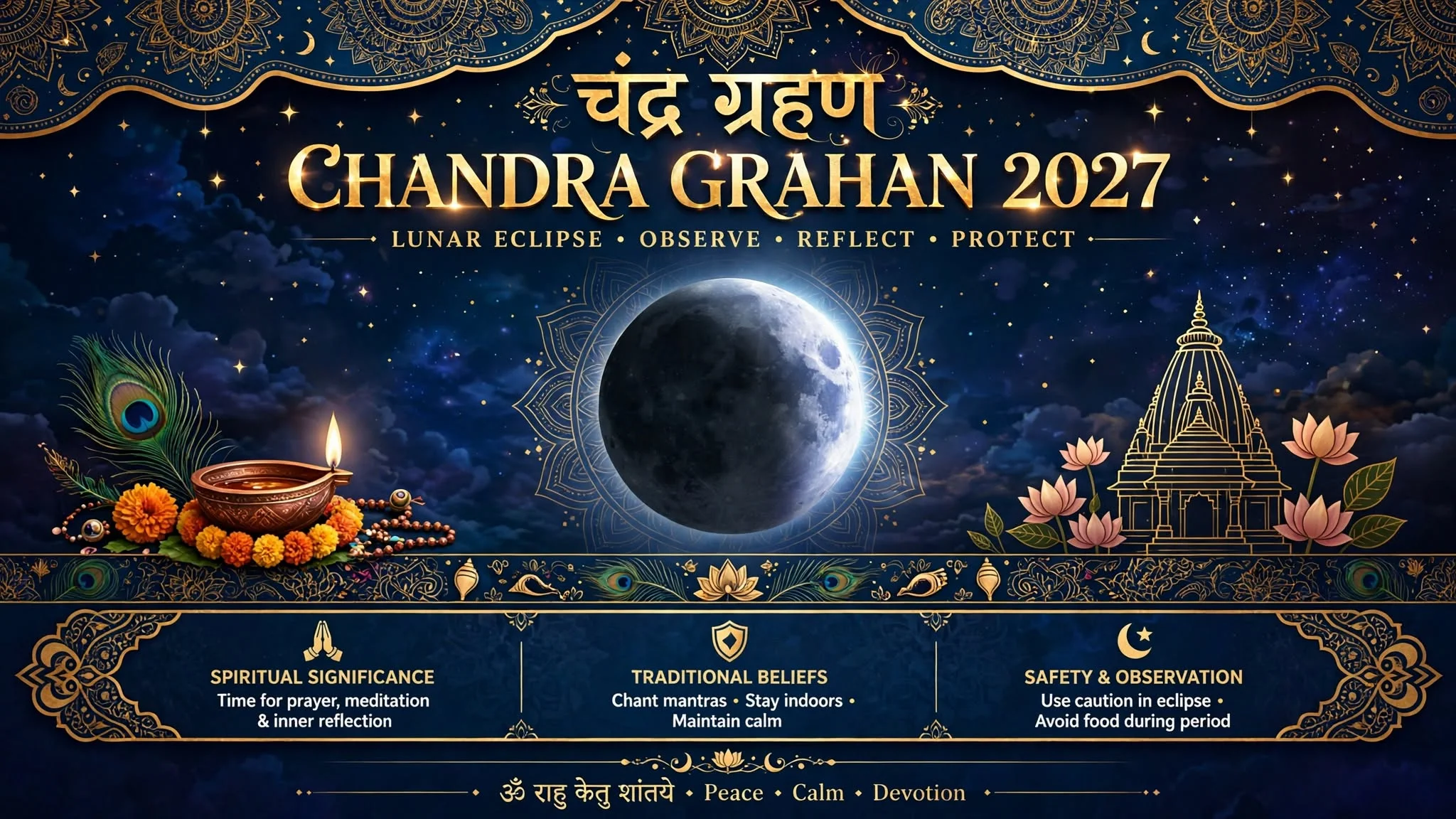
Chandra Grahan
Chandra Grahan (Lunar Eclipse) is a sacred cosmic and spiritual juncture (Parva Kaal) in Sanatana Dharma occurring exclusively on Purnima (the full moon day) when the Earth moves directly between the Sun and the Moon, casting its conical shadow across the lunar orb. In Vedic philosophy and Jyotisha, the Moon presides over the mind, subconscious emotions, and water elements (Chandrama Manaso Jatah - Rigveda Purusha Sukta). The temporary obscuration of the Moon by the shadowy nodes Rahu or Ketu induces profound subtle energetic shifts across terrestrial nature and human consciousness.
View Festival Guide
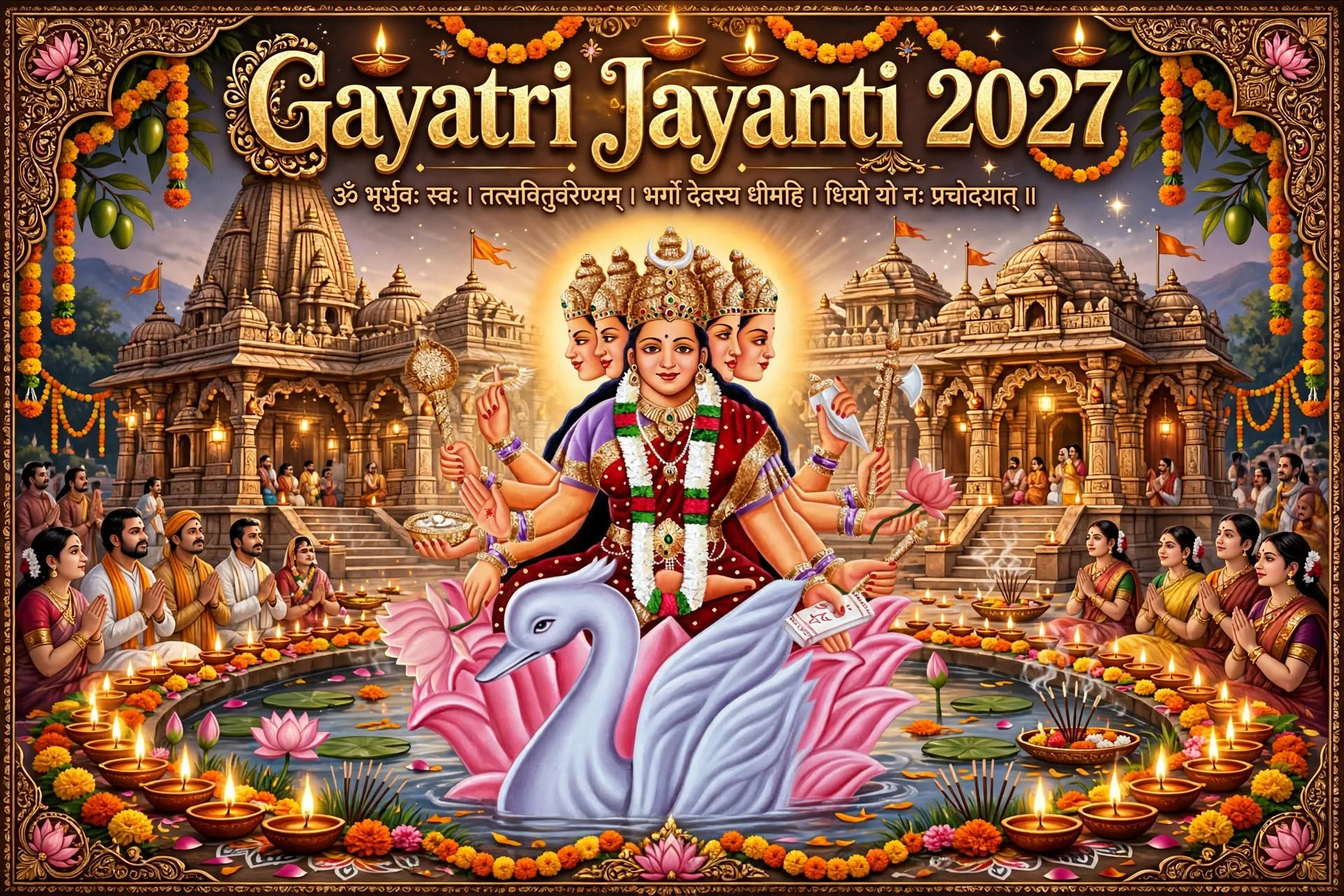
Tuesday, Aug 17, 2027
Gayatri Jayanti
Gayatri Jayanti is a sacred Hindu festival dedicated to Goddess Gayatri, revered as Ved Mata, the Mother of the Vedas. She represents divine wisdom, spiritual illumination, purity and the power of sacred knowledge. Devotees worship her as the personification of the Gayatri Mantra, one of the most revered prayers in the Vedic tradition.
View Festival Guide

Wednesday, Aug 18, 2027
Ishti
Ishti is a foundational Vedic ritual observance appearing prominently in Hindu Panchangs on the Pratipada tithi (the first lunar day) following either Amavasya (new moon) or Purnima (full moon), marking the prescribed performance day for the fortnightly Vedic Darsha-Purnamasa sacrifices.
View Festival Guide
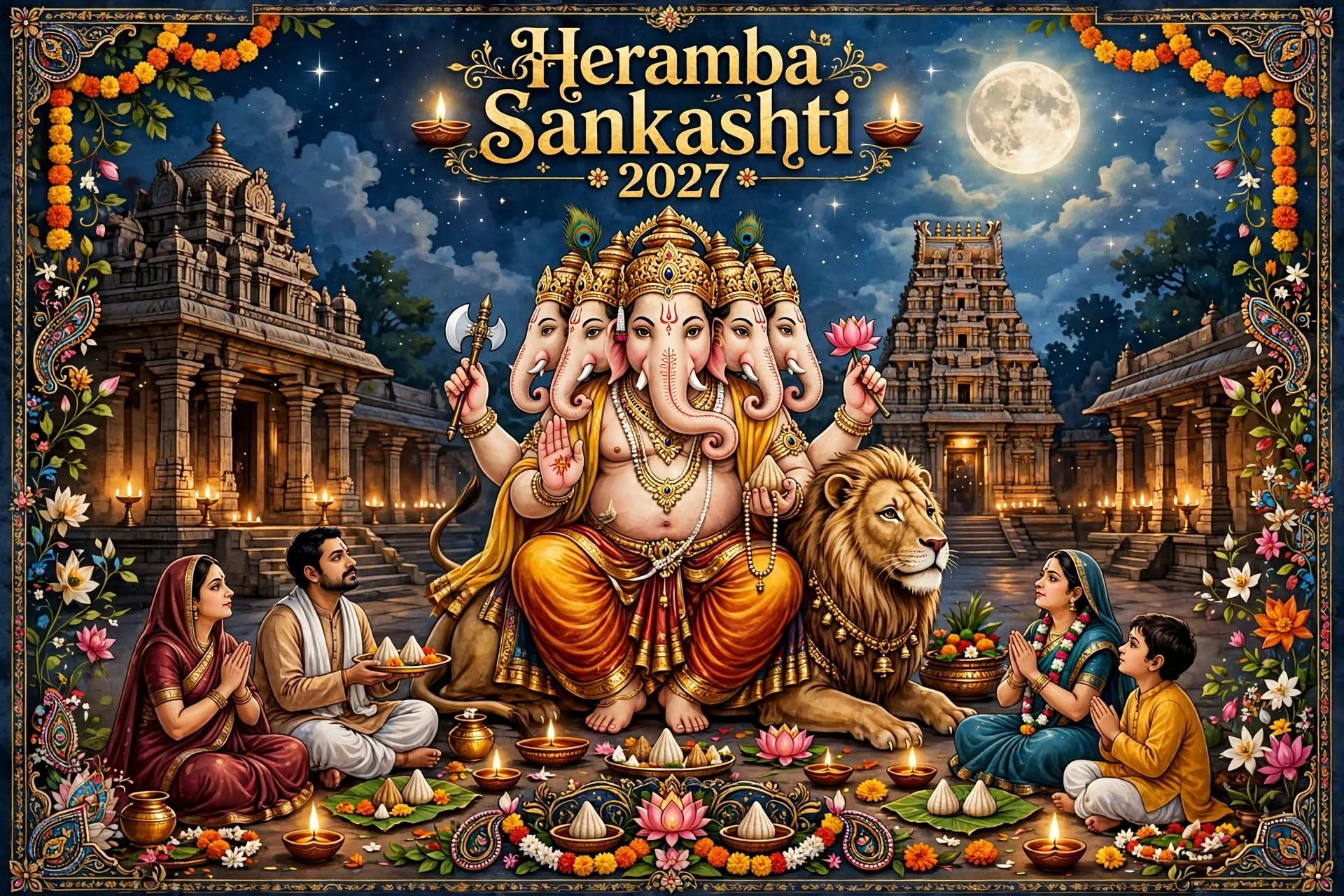
Friday, Aug 20, 2027
Heramba Sankashti
Heramba Sankashti Chaturthi, also celebrated with profound veneration as Heramba Sankashtahara Chaturthi, falls on the fourth lunar day (Chaturthi) of the Krishna Paksha (waning fortnight) in the sacred monsoon month of Bhadrapada (or Shravana in the Amanta calendar). Dedicated to Heramba Ganapati—one of the thirty-two classical iconographic forms of Lord Ganesha—this sacred day is celebrated as an extraordinary spiritual penance for overcoming seemingly insurmountable existential distress, severe financial distress, health catastrophes, and deep karmic obstacles.
View Festival Guide
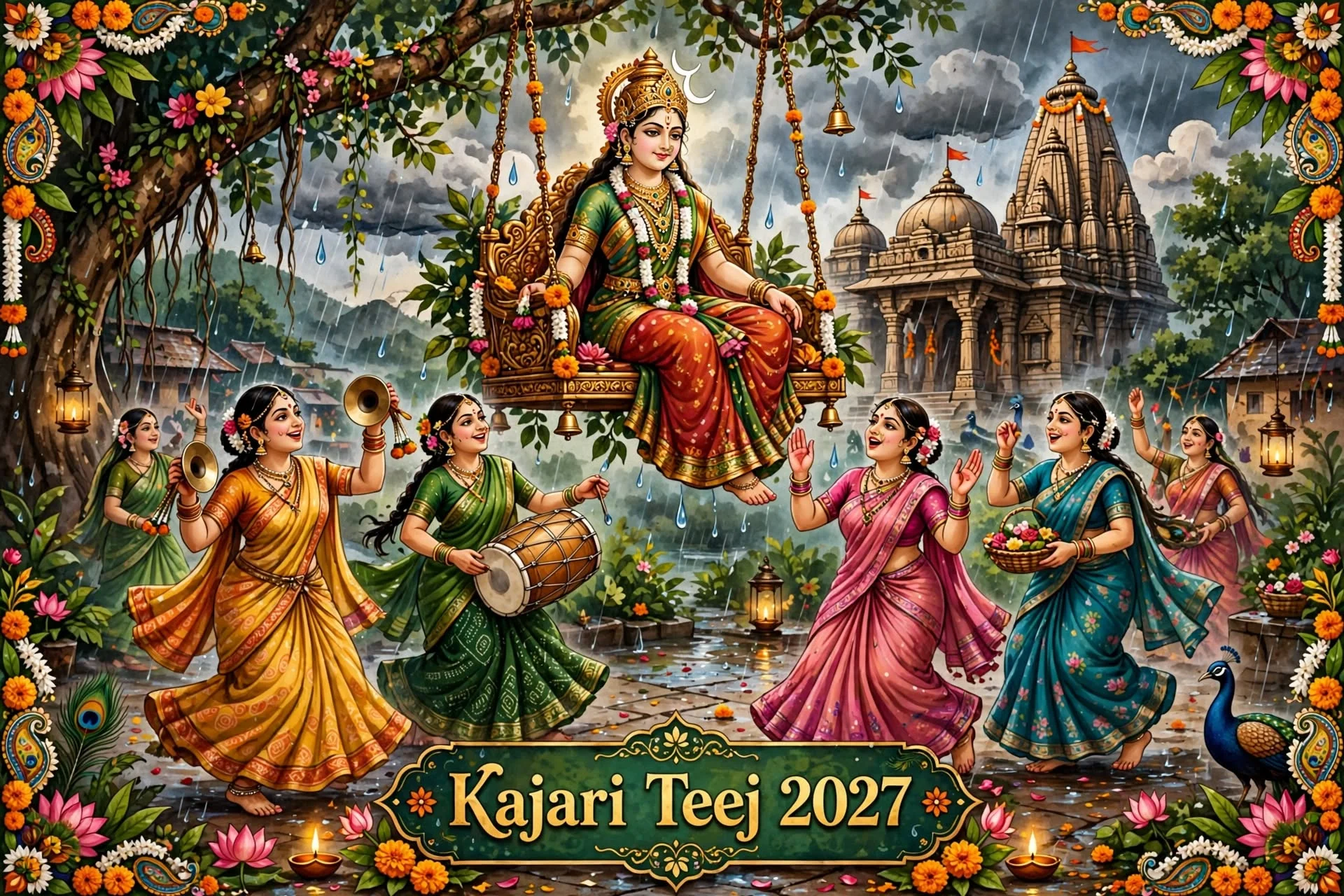
Friday, Aug 20, 2027
Kajari Teej
Kajari Teej, also reverently celebrated as Badi Teej, Satva Teej, or Kajali Teej, is one of the three principal Teej festivals in the Hindu calendar, alongside Hariyali Teej and Hartalika Teej. Falling on the Tritiya tithi (third lunar day) of the Krishna Paksha (dark waning fortnight) in the sacred monsoon month of Bhadrapada (corresponding to Shravana in the Amanta calendar scheme), this vibrant festival is dedicated to the divine union of Lord Shiva and Goddess Parvati, embodying marital fidelity, female austerity, and the lush romantic beauty of the monsoon season.
View Festival Guide