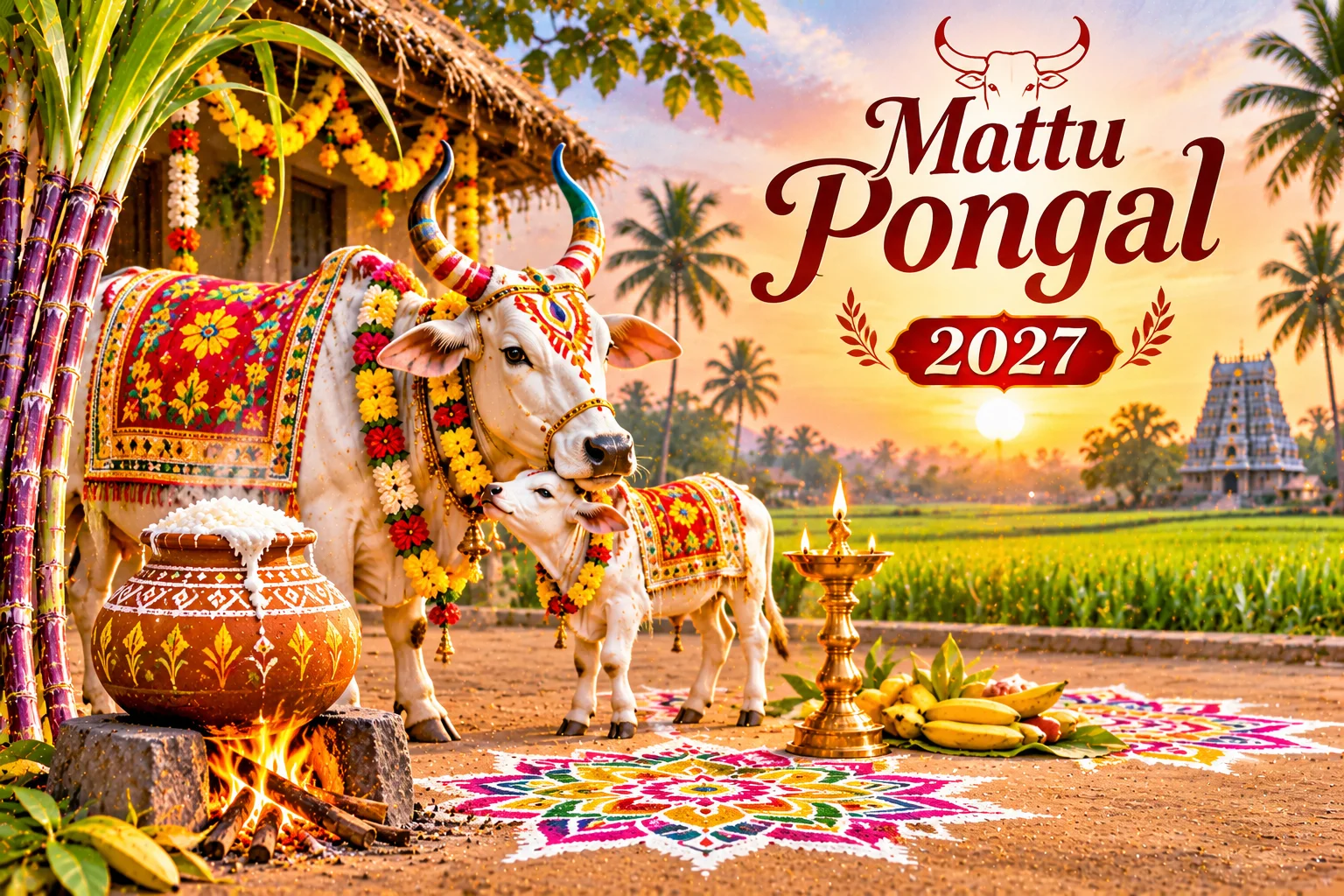
Mattu Pongal is the third day of the traditional four-day Pongal harvest festival celebrated primarily in Tamil Nadu. The word Mattu means cattle in Tamil, and the day is dedicated to honouring cows, bulls, oxen, and other cattle for their valuable contribution to agriculture and rural life.
The festival recognises the important relationship between farmers and their animals. Traditionally, cattle helped plough fields, transport agricultural produce, support dairy production, and perform many other essential farming activities. Mattu Pongal provides an occasion to express gratitude towards these animals and acknowledge their role in the prosperity of agricultural communities.
On Mattu Pongal, farmers and families traditionally bathe their cattle, clean and decorate their horns, adorn them with colourful garlands and bells, and offer them special food. In some communities, cattle are worshipped through aarti and prayers for their health, strength, and well-being.
The day is also associated with Nandi, the sacred bull and vehicle of Lord Shiva, and with Lord Krishna in his role as Gopala, the protector of cows. These associations reflect the important place of cattle in Hindu religious and cultural traditions.
In certain parts of Tamil Nadu, particularly the southern districts, Mattu Pongal is associated with traditional rural events such as Jallikattu, Manju Virattu, and other cattle-related festivities. These are regional practices and are not compulsory elements of every household's celebration.
Some Tamil families also observe Kanu Pidi on this day. Women and girls arrange small portions of coloured rice and other food on leaves, traditionally offering them to birds while praying for the well-being and unity of their brothers and family members.
Why is Mattu Pongal Celebrated?
Mattu Pongal is celebrated to honour cattle for their contribution to agriculture, food production, transportation, and rural livelihoods. It is an important part of the Tamil harvest festival and expresses gratitude towards the animals that have traditionally supported farming communities.
The observance encourages people to recognise the value of animals, treat them with compassion, and appreciate the relationship between agriculture, nature, and human life.
To honour cattle: Cows, bulls, oxen, and other cattle are respected for their traditional contribution to farming and rural life.
To express gratitude to working animals: Cattle have historically helped plough fields, transport crops, and perform agricultural tasks that support food production.
To worship Nandi: The sacred bull Nandi, the vehicle of Lord Shiva, is remembered as a symbol of devotion, strength, loyalty, and service.
To honour Lord Krishna as Gopala: Krishna's association with cows and cowherds represents compassion, protection, and the importance of caring for animals.
To celebrate agricultural prosperity: Mattu Pongal recognises that a successful harvest depends on farmers, animals, fertile land, water, and favourable natural conditions.
To pray for cattle health and protection: Farmers offer prayers for the well-being, strength, and safety of their animals.
To preserve Tamil agricultural heritage: The festival keeps traditional cattle-related customs, rural celebrations, folk practices, and community traditions alive.
To encourage kindness towards animals: The observance reminds people that animals should be treated with care, dignity, and compassion.
To celebrate rural community life: Village gatherings, traditional music, cattle decorations, and regional activities bring farming communities together.
History and Origins of Mattu Pongal
Ancient Agricultural Traditions of Tamil Nadu
Mattu Pongal is rooted in the agricultural traditions of Tamil society, where cattle have traditionally been essential to farming and village life. Before the widespread use of modern machinery, bulls and oxen were important for ploughing fields, transporting produce, and carrying out other agricultural activities.
Cows also supported rural households through milk and dairy products. Cattle therefore represented not only agricultural assistance but also nourishment, economic stability, and household prosperity.
Tamil farming communities developed customs to honour these animals and express gratitude for their contribution. The practice of bathing, decorating, feeding, and worshipping cattle became an important part of the seasonal harvest celebration.
Mattu Pongal preserves this agricultural heritage by giving special recognition to animals that have supported generations of farmers.
Mattu Pongal as the Third Day of Pongal
Pongal is traditionally celebrated over four days, with each day representing a different aspect of agricultural and community life.
Bhogi Pongal marks the beginning of the festival and is associated with household renewal. Thai Pongal is dedicated to Lord Surya and celebrates the harvest through the preparation of newly harvested rice. Mattu Pongal follows as a day of gratitude towards cattle, while Kaanum Pongal focuses on family visits and social relationships.
The position of Mattu Pongal within the festival highlights the importance of animals in the agricultural cycle. After expressing gratitude for sunlight and the harvest, families turn their attention to the cattle that have helped make farming possible.
The Historical Importance of Cattle in Tamil Agriculture
Traditional Tamil agriculture depended heavily on the strength and labour of cattle. Bulls and oxen were used to prepare fields, draw ploughs, pull carts, and transport agricultural produce.
Spiritual Significance of Mattu Pongal
Gratitude Towards Cattle
The central spiritual message of Mattu Pongal is gratitude towards cattle. Cows, bulls, and oxen have traditionally supported farming, transportation, and household nourishment.
Honouring these animals expresses appreciation for their contribution to human life. The observance encourages devotees to recognise that agricultural prosperity depends on the efforts of animals as well as people and natural resources.
The festival reminds people that gratitude should extend beyond material possessions to every living being that supports life.
The Sacred Significance of Nandi
Nandi is the sacred bull and vehicle of Lord Shiva. He is traditionally regarded as a symbol of devotion, patience, discipline, strength, and loyalty.
Nandi's presence in Shiva temples represents the importance of sincere devotion and unwavering dedication. His association with cattle worship during Mattu Pongal adds a spiritual dimension to the celebration.
Remembering Nandi encourages devotees to cultivate humility, responsibility, and devotion while treating animals with respect.
Lord Krishna as Gopala
Lord Krishna is worshipped as Gopala, the protector and caretaker of cows. His childhood stories describe his affectionate relationship with cattle and cowherds.
Krishna's association with cows symbolises compassion, protection, and the importance of caring for living beings.
Mattu Pongal reflects these values by encouraging people to honour cattle, provide them with proper care, and recognise their contribution to agriculture.
Respect for Mother Nature
How Mattu Pongal Is Celebrated
Mattu Pongal is celebrated through cattle bathing, decoration, feeding, prayers, and community activities. It is traditionally the third day of the Pongal festival and focuses on honouring animals that have supported agricultural life.
1. Prepare the Cattle and Surroundings
Farmers and cattle owners prepare a clean and safe area for the celebration.
Cattle shelters and surrounding spaces may be cleaned before the animals are brought for bathing.
Fresh water, suitable food, flower garlands, and safe decorative items are arranged.
The animals are handled calmly to avoid unnecessary fear or discomfort.
2. Bathe the Cattle
Cows, bulls, and other cattle are traditionally given a ceremonial bath. Their bodies are cleaned gently using clean water and appropriate grooming methods.
Farmers may clean their horns and hooves while checking the animals for injuries or discomfort.
The bath symbolises cleanliness, respect, and preparation for the festive worship.
3. Decorate the Horns
Decorating cattle horns is one of the most recognisable Mattu Pongal customs. In some villages, the horns are cleaned, polished, and decorated with colourful designs.
Traditional decorations may include suitable non-toxic colours or decorative coverings. The designs differ between regions and farming communities.
Any decoration should be animal-safe and should not interfere with the cattle's comfort, vision, or movement.
Mattu Pongal Puja Vidhi (Step by Step)
1
Clean the Cattle Shelter
Clean the cattle shelter and the surrounding area. Prepare a safe, comfortable space where the animals can be bathed and decorated without stress.
2
Prepare the Cattle Bathing Arrangements
Arrange clean water and suitable grooming materials. Bathe the cattle gently and allow them to become comfortable before beginning the decoration and worship.
3
Clean and Groom the Horns
Clean the cattle horns carefully. If the family tradition includes decorating them, use only non-toxic, animal-safe colours or suitable decorative coverings. Avoid applying materials that may irritate the animals.
4
Decorate the Cattle
Adorn the cattle with suitable flower garlands, colourful beads, and comfortable ornaments. Ensure that decorations do not restrict movement, breathing, hearing, or vision.
5
Arrange the Cattle Puja
Prepare a clean plate containing flowers, turmeric, kumkum, akshat, and other traditional offerings. Arrange a diya and suitable food for the animals.
Mattu Pongal Puja Samagri List
Cattle Decoration Samagri
Fresh flower garlands
Colourful beads
Comfortable decorative bells
Traditional cattle ornaments
Non-toxic horn colours where appropriate
Turmeric
Kumkum
Safe decorative threads
Clean cloth for grooming
Mattu Pongal Puja Samagri
Flowers
Turmeric
Kumkum
Akshat (unbroken rice grains)
Sandalwood paste
Diya
Cotton wicks
Ghee or suitable diya oil
Incense sticks
Camphor
Clean water
Puja plate
Traditional Food Offerings
Mantras and Prayers for Mattu Pongal
Nandi Namaskar Mantra
ॐ नन्दिकेश्वराय नमः॥
Om Nandikeshvaraya Namah.
Simple Meaning: Salutations to Nandikeshvara, the sacred bull and devoted attendant of Lord Shiva.
Lord Shiva Mantra
ॐ नमः शिवाय॥
Om Namah Shivaya.
Simple Meaning: I offer my salutations to Lord Shiva, the auspicious and compassionate Supreme Being.
Mattu Pongal Vrat Rules and Fasting Guidelines
Fasting on Mattu Pongal
Mattu Pongal is primarily an agricultural thanksgiving and cattle-honouring observance. It does not have a universally prescribed fasting rule followed by every Tamil household or community.
Some devotees may continue a personal or family-specific religious observance during the Pongal period, but fasting is not the central requirement of Mattu Pongal. The main emphasis is gratitude towards cattle, animal care, worship, and community celebration.
Traditional Observances
Begin the day with cleanliness and a peaceful mindset.
Prepare a safe and clean area for cattle bathing and worship.
Decorate cattle using comfortable and animal-safe materials.
Offer prayers for the health and protection of animals.
Feed cattle appropriate food and provide clean drinking water.
Remember Nandi and Lord Krishna according to household tradition.
Share traditional Pongal food with family and neighbours.
Participate in local celebrations while respecting animal welfare.
Observe Kanu Pidi if it is part of the family's tradition.
Practise kindness, gratitude, and generosity.
Animal Care and Respect
Handle cattle calmly and avoid causing fear or stress.
Dos and Don'ts of Mattu Pongal
Good Practices (Do's)
Treat cows, bulls, oxen, and other cattle with kindness and respect.
Clean the cattle shelter and prepare a comfortable space for the celebration.
Bathe animals gently using clean water and suitable grooming practices.
Decorate horns only with non-toxic, animal-safe materials.
Use comfortable garlands and ornaments that do not restrict movement.
Provide cattle with suitable food, clean water, and adequate rest.
Mattu Pongal Across Regions
Region
Local Name
Tamil Nadu
Mattu Pongal
Madurai
Mattu Pongal
Alanganallur
Jallikattu and Mattu Pongal
Palamedu
Mattu Pongal
Avaniyapuram
Mattu Pongal
Tiruchirappalli
Mattu Pongal
Thanjavur
Mattu Pongal
Coimbatore
Mattu Pongal
Puducherry
Mattu Pongal
Sri Lanka
Mattu Pongal
Tamil Diaspora
Mattu Pongal
Andhra Pradesh
Kanuma
Mattu Pongal FAQs
What is Mattu Pongal?
Mattu Pongal is the third day of the four-day Tamil Pongal harvest festival. It is dedicated to honouring cows, bulls, oxen, and other cattle for their contribution to agriculture, food production, and rural livelihoods.
Why is Mattu Pongal celebrated?
Mattu Pongal is celebrated to express gratitude towards cattle for their traditional role in farming and rural life. Farmers bathe, decorate, feed, and worship their animals while praying for their health, protection, and well-being.
What does the word Mattu mean?
Mattu is a Tamil word referring to cattle. Mattu Pongal therefore means the Pongal celebration dedicated to cattle.
Mattu Pongal represents gratitude, kindness towards animals, respect for agricultural labour, and the interdependence of humans and nature. Its deeper message is that prosperity is not achieved by human effort alone but also depends on the animals and natural resources that support life.
To strengthen family relationships: Customs such as Kanu Pidi, followed by some households, express prayers for family unity and the well-being of brothers and relatives.
Cows were valued for their milk and their contribution to household nourishment. Cattle manure was also traditionally used to enrich agricultural soil and support farming practices.
In rural communities, the health and strength of cattle were closely connected with the success of agricultural work. Farmers therefore maintained customs of animal care and seasonal celebrations that acknowledged their contribution.
Mattu Pongal became an important occasion for publicly expressing this gratitude through animal decorations, special feeding, prayers, and village festivities.
The Story of Lord Shiva and Nandi
A popular traditional folk story associated with cattle worship during Pongal describes Lord Shiva and his bull, Basava, who is also identified with Nandi in some tellings.
According to the commonly narrated version, Lord Shiva sent Basava to Earth with a message for human beings. The intended instruction was that people should bathe regularly and eat only once a month.
Basava mistakenly communicated that people should eat every day and bathe only once a month. When Lord Shiva learned of the mistake, he sent Basava to Earth to help human beings by ploughing agricultural fields and supporting food production.
The story is popularly used to explain why cattle are associated with farming and why they are honoured during Mattu Pongal.
This narrative is best understood as a traditional folk explanation rather than a universally prescribed scriptural account. Its central message is the importance of cattle in agricultural life and the gratitude people should show towards working animals.
Nandi and the Significance of Devotion
Nandi is the sacred bull associated with Lord Shiva and is traditionally regarded as his vehicle and devoted attendant. Nandi is an important figure in Shaiva traditions and is commonly represented seated before Shiva temples.
Nandi symbolises devotion, discipline, patience, strength, and unwavering service. His association with Mattu Pongal reflects the cultural and religious respect given to cattle.
For devotees of Lord Shiva, honouring cattle during Mattu Pongal may also serve as a reminder of Nandi's devotion and the importance of caring for living beings.
Lord Krishna and the Tradition of Gopala
Lord Krishna is also closely associated with cows and cowherds. His childhood in Gokul and Vrindavan is traditionally described through stories of protecting cattle, tending cows, and living among cowherd communities.
Krishna is worshipped as Gopala and Govinda, names associated with his role as the protector and caretaker of cows.
His stories emphasise compassion, affection, and responsibility towards animals. These qualities complement the values expressed through Mattu Pongal, where cattle are honoured for their contribution to agricultural and household life.
Traditional Cattle Decorations and Worship
The customs of Mattu Pongal developed around the recognition and celebration of cattle. Farmers traditionally bathe their animals, clean their horns, decorate them with colours and ornaments, and place garlands around their necks.
Some communities tie small bells and colourful beads around cattle and offer them special food prepared for the festival. Prayers and aarti may be performed to express gratitude and seek protection for the animals.
In certain villages, decorated cattle are taken through the streets in ceremonial processions. These gatherings bring farming families together and preserve local traditions.
The practices vary between communities and households, but the central purpose remains the same: honouring cattle and recognising their importance in rural life.
Jallikattu and Traditional Rural Celebrations
Jallikattu is a traditional bull-related sport associated with the Pongal season in parts of Tamil Nadu. It is particularly prominent in certain southern districts and is connected with local traditions of cattle breeding, rural identity, and community celebrations.
Other regional events include Manju Virattu and related cattle activities. Their customs and formats differ across locations.
Jallikattu is not a compulsory religious ritual of Mattu Pongal and is not practised in every village or household. It should be distinguished from the simple devotional customs of bathing, decorating, feeding, and caring for cattle.
Where organised events take place, they are subject to applicable laws, regulations, and animal-welfare requirements. The broader message of Mattu Pongal remains gratitude and respect for animals.
Kanu Pidi and Family Traditions
Some Tamil families observe Kanu Pidi on the day associated with Mattu Pongal. This custom is particularly followed by women and girls, who arrange small portions of coloured rice and other food on leaves.
The food may be placed outdoors for crows and other birds while women pray for the well-being of their brothers and the unity of the family.
Traditional preparations may include leftover sweet Pongal, turmeric-coloured rice, curd rice, and other household foods. The exact ingredients and prayers vary between families.
Kanu Pidi is a distinct household custom associated with this day and should not be confused with Kaanum Pongal, which is the fourth day of the wider Pongal festival.
Mattu Pongal in Contemporary Tamil Culture
Mattu Pongal continues to be celebrated in Tamil Nadu and among Tamil communities around the world. In farming villages, cattle-related traditions remain an important part of the harvest season, while urban households may observe the day through prayers, food offerings, and cultural gatherings.
Temples and community organisations may arrange special cattle worship, devotional activities, and traditional celebrations. Families also use the occasion to teach younger generations about agriculture, animal care, and Tamil heritage.
Although modern farming increasingly uses machinery, the festival continues to preserve the cultural memory of the relationship between farmers and animals.
Mattu Pongal remains a reminder that agriculture is supported by many living beings and that prosperity should be accompanied by gratitude, compassion, and responsible care.
Mattu Pongal expresses gratitude towards the natural world and the interconnected systems that support agriculture.
Fertile soil, water, sunlight, crops, animals, and human labour all contribute to the production of food. The festival recognises that human prosperity depends on maintaining a respectful relationship with nature.
The observance encourages responsible farming, animal welfare, environmental awareness, and appreciation for natural resources.
The Spiritual Meaning of Animal Care
Bathing, feeding, decorating, and worshipping cattle during Mattu Pongal symbolise respect and affection towards animals.
The festival teaches that animals should not be valued only for their usefulness. They are living beings that deserve proper food, clean water, shelter, medical attention, and humane treatment.
Its deeper spiritual message is that compassion should be reflected through everyday actions rather than limited to ceremonial worship.
The Importance of Agricultural Service
Mattu Pongal recognises the work performed by farmers and agricultural animals. It reminds people that every harvest is the result of cooperation between human effort, natural resources, and living beings.
The festival encourages respect for agricultural labour and appreciation for the food that reaches households through the work of farming communities.
It also promotes humility by reminding people that food production depends on many interconnected forms of effort.
Prosperity and Protection
Farmers traditionally pray for the health, strength, and safety of their cattle. Healthy animals support agricultural work and contribute to the stability of rural households.
Prayers offered during Mattu Pongal express wishes for prosperous farms, healthy livestock, sufficient food, and peaceful family life.
The observance symbolises the idea that true prosperity includes the well-being of animals and the natural environment.
Family Unity Through Kanu Pidi
The Kanu Pidi custom practised by some families expresses affection and concern for brothers and other family members.
Women and girls offer small portions of rice to birds while praying for family well-being, unity, and lasting relationships.
The practice reflects the importance of gratitude, affection, and the bond between family members. It also expresses care towards birds and other living beings.
The Victory of Compassion Over Neglect
Mattu Pongal encourages people to replace neglect and exploitation with care, respect, and responsibility towards animals.
The festival reminds devotees that strength should be used to protect vulnerable beings rather than harm them. Caring for cattle and supporting responsible animal husbandry are practical expressions of its spiritual values.
Its message extends beyond the festival: compassion towards animals should remain part of everyday life.
4. Adorn Cattle with Garlands and Bells
Cattle are traditionally decorated with flower garlands, colourful beads, bells, and other ornaments.
Garlands may be placed around their necks, while suitable decorative accessories are used according to local customs.
The decorations make the animals part of the celebration and express affection and appreciation for their contribution.
5. Offer Special Food to Cattle
After the animals have been cleaned and decorated, farmers offer them suitable food as part of the celebration.
Traditional offerings may include fresh fodder, green grass, bananas, and specially prepared Pongal. Some families offer a small portion of sweet Pongal that has been prepared for the festival.
The food should be appropriate for the animal's dietary needs and should not contain ingredients that may harm cattle.
6. Perform Cattle Puja
Farmers and family members may perform a simple puja to express gratitude towards their cattle.
Flowers, turmeric, kumkum, and other traditional offerings may be used according to local custom. A diya or camphor aarti may be performed while praying for the health and protection of the animals.
The ritual symbolises respect for cattle and recognises their contribution to agricultural prosperity.
7. Honour Nandi and Lord Krishna
Some devotees remember Nandi, the sacred bull of Lord Shiva, and Lord Krishna in his form as Gopala during Mattu Pongal.
Prayers may be offered at Shiva temples, Krishna temples, or household altars. Devotees may recite Nandi or Krishna mantras according to their religious tradition.
These devotional practices reinforce the values of protection, service, compassion, and respect towards animals.
8. Take Part in Traditional Village Celebrations
In rural areas, decorated cattle may be taken through village streets in ceremonial processions. Music, folk songs, community gatherings, and traditional activities contribute to the festive atmosphere.
Some villages organise bull-related events such as Jallikattu or Manju Virattu. These are regional traditions and are not practised in every area.
Organised events should follow applicable legal and animal-welfare requirements. Visitors should respect safety boundaries and avoid disturbing animals.
9. Observe Kanu Pidi if Followed
Some Tamil families observe Kanu Pidi on this day. Women and girls arrange small portions of coloured rice and other food on leaves, traditionally placing them outdoors for birds.
Prayers are offered for the well-being of brothers and family members. The exact ingredients and ritual wording vary between households.
This practice is optional and should be distinguished from Kaanum Pongal, the fourth day of the larger festival.
10. Share Food and Celebrate with Family
Families prepare traditional meals and share sweet Pongal, rice dishes, sugarcane, fruits, and other seasonal foods.
Relatives and neighbours may visit one another, participate in celebrations, and exchange greetings.
The day concludes with gratitude towards cattle, farmers, and the natural resources that support agricultural life.
6
Offer Prayers to the Cattle
Stand respectfully before the cattle and express gratitude for their contribution to agriculture and family life. Offer flowers and prayers for their health, protection, strength, and well-being.
7
Remember Nandi and Lord Krishna
Offer prayers to Nandi, the sacred bull associated with Lord Shiva, and Lord Krishna in his form as Gopala. Devotees may recite Om Nandikeshvaraya Namah or Om Krishnaya Namah according to their tradition.
8
Perform Aarti
Perform a simple aarti according to family custom. Keep the flame at a safe distance from the animals and avoid creating smoke or heat that could cause discomfort.
9
Offer Special Food
Offer appropriate food such as fresh grass, fodder, and suitable Pongal preparations. Ensure that the food is safe for cattle and suitable for their dietary requirements.
10
Perform a Traditional Blessing
Some families sprinkle clean water or perform a traditional blessing while praying for the protection and prosperity of their cattle. Follow the household custom without causing discomfort to the animals.
11
Observe Kanu Pidi if Practised
Women and girls who follow Kanu Pidi may prepare small portions of coloured rice and place them on leaves outdoors for birds. They offer prayers for the well-being of brothers and family members.
12
Conclude with Gratitude
Conclude the observance by expressing gratitude to cattle, farmers, and nature. Share traditional food with family members and support people in need as an expression of generosity.
Fresh grass
Green fodder
Suitable cattle feed
Sweet Pongal
Sugarcane pieces
Bananas where suitable
Clean drinking water
Other animal-safe seasonal foods
Kanu Pidi Samagri
Cooked rice
Sweet Pongal
Turmeric-coloured rice
Curd rice
Turmeric leaves or other suitable leaves
Fresh flowers
Clean water
Traditional household offerings
Additional Household Items
Kolam powder or rice flour
Sugarcane
Traditional Pongal pot
Fresh fruits
Coconut
Banana leaves
Traditional sweets
Clean serving vessels
Lord Krishna Mantra
ॐ कृष्णाय नमः॥
Om Krishnaya Namah.
Simple Meaning: Salutations to Lord Krishna, the divine protector and guide who represents love, compassion, and righteousness.
Gopala Mantra
ॐ गोपालाय नमः॥
Om Gopalaya Namah.
Simple Meaning: Salutations to Lord Krishna in his form as Gopala, the protector and caretaker of cows.
Govinda Mantra
ॐ गोविन्दाय नमः॥
Om Govindaya Namah.
Simple Meaning: Salutations to Govinda, a revered name of Lord Krishna associated with the protection of cows and the well-being of living beings.
Surya Namaskar Mantra
ॐ सूर्याय नमः॥
Om Suryaya Namah.
Simple Meaning: Salutations to Lord Surya, the source of light, warmth, and energy that supports agricultural life.
Sarve Bhavantu Sukhinah Sarve Santu Niramayah, Sarve Bhadrani Pashyantu Ma Kashchid Duhkhabhag Bhavet.
Simple Meaning: May everyone be happy, may everyone be free from illness, may everyone experience goodness, and may no one suffer. This prayer expresses compassion and well-being for all living beings.
Use only non-toxic and animal-safe decorative materials.
Do not apply harmful paints, chemicals, or irritants to the animals.
Ensure bells and ornaments are comfortable and do not restrict movement.
Provide clean water, appropriate food, and adequate rest.
Seek veterinary assistance when an animal is injured or unwell.
Avoid excessive noise, overcrowding, and unsafe activities.
Charity and Community Service
Support responsible cattle-care initiatives.
Help farmers and families who depend on livestock.
Donate suitable fodder or support animal shelters where appropriate.
Share food with people in need.
Support community activities that promote animal welfare.
Avoid wasting food and natural resources.
Offer prayers for the health, safety, and well-being of animals.
Remember Nandi and Lord Krishna according to family tradition.
Recognise the contribution of farmers and agricultural workers.
Share traditional Pongal food with family members and neighbours.
Support animal welfare and responsible livestock care.
Follow applicable rules and safety measures at organised cattle events.
Observe Kanu Pidi if it is part of your household tradition.
Celebrate with gratitude towards nature and all living beings.
Things to Avoid (Don'ts)
Do not beat, frighten, or unnecessarily restrain cattle during the celebration.
Do not apply toxic paints, chemicals, or irritants to horns or skin.
Do not use tight ornaments, sharp accessories, or decorations that may injure animals.
Do not force cattle to participate in noisy or crowded activities.
Do not withhold food, water, or rest from animals for decorative purposes.
Do not feed cattle unsuitable food or excessive quantities of sweets.
Do not use fire or camphor close to animals in a way that causes fear or injury.
Do not treat Jallikattu or other cattle sports as compulsory religious rituals.
Do not participate in or promote activities that violate applicable animal-welfare laws.
Do not approach unfamiliar cattle without permission or proper supervision.
Do not waste food or agricultural resources.
Do not forget that the central purpose of Mattu Pongal is gratitude and compassion towards animals.
Telangana
Kanuma
Karnataka
Mattu Sankranti and Cattle Traditions
Which day of Pongal is Mattu Pongal?
Mattu Pongal is traditionally the third day of the four-day Pongal festival. It follows Bhogi Pongal and Thai Pongal and comes before Kaanum Pongal.
Which animals are honoured on Mattu Pongal?
Cows, bulls, oxen, and other cattle are honoured on Mattu Pongal. These animals have traditionally supported agriculture through ploughing, transportation, dairy production, and other activities.
Why are cows and bulls worshipped on Mattu Pongal?
Cows and bulls have traditionally played an important role in agricultural life. They help farmers cultivate fields, transport produce, and support household nourishment. Mattu Pongal recognises their contribution and encourages respect and care for animals.
Why are cattle bathed on Mattu Pongal?
Bathing cattle is a traditional expression of cleanliness, care, and respect. Farmers prepare their animals for the celebration by gently cleaning and grooming them before decorating and worshipping them.
Why are cattle horns painted during Mattu Pongal?
Decorating cattle horns is a traditional festive custom. It makes the animals part of the celebration and symbolises appreciation and honour. Any materials used should be non-toxic and safe for the animals.
Why are bells and garlands tied around cattle?
Bells and flower garlands are traditional decorations used to honour cattle. They add to the festive appearance and express affection and gratitude towards the animals.
Which god is worshipped on Mattu Pongal?
Mattu Pongal primarily honours cattle. Some devotees also remember Nandi, the sacred bull associated with Lord Shiva, and Lord Krishna in his form as Gopala, the protector of cows.
What is the connection between Nandi and Mattu Pongal?
Nandi is the sacred bull and vehicle of Lord Shiva. He symbolises devotion, patience, strength, and loyalty. His association with cattle makes him an important religious figure remembered by some devotees during Mattu Pongal.
What is the connection between Lord Krishna and Mattu Pongal?
Lord Krishna is worshipped as Gopala and Govinda, names associated with the protection of cows. His traditional stories emphasise compassion towards cattle and the importance of caring for animals.
What is the story of Lord Shiva and Basava?
A popular folk story says that Lord Shiva sent Basava to Earth with a message for humans, but Basava communicated it incorrectly. As a result, Shiva sent him to Earth to help farmers plough fields and produce food. The story is commonly used to explain the association between cattle and agriculture during Pongal.
Is the story of Basava a scriptural account?
The commonly narrated Basava story is a traditional folk explanation associated with Mattu Pongal. It should not be presented as a universally established scriptural account.
What is Jallikattu?
Jallikattu is a traditional bull-related sport associated with the Pongal season in certain parts of Tamil Nadu, particularly the southern districts. It is a regional cultural event and is not a compulsory ritual of Mattu Pongal.
Is Jallikattu performed in every village during Mattu Pongal?
No. Jallikattu is associated with particular regions and communities. Many households and villages celebrate Mattu Pongal through cattle worship, bathing, decoration, feeding, prayers, and family gatherings without organising any bull-related event.
What is Manju Virattu?
Manju Virattu is a traditional bull-related rural event associated with parts of Tamil Nadu. It is distinct from ordinary household cattle worship and is not practised everywhere during Mattu Pongal.
What is Kanu Pidi?
Kanu Pidi is a traditional observance followed by some Tamil women and girls on the day associated with Mattu Pongal. They arrange small portions of coloured rice and other food on leaves, traditionally offering them to birds while praying for the well-being of brothers and family members.
Is Kanu Pidi the same as Kaanum Pongal?
No. Kanu Pidi is a household custom observed by some women and girls on the day associated with Mattu Pongal. Kaanum Pongal is the fourth day of the larger Pongal festival and is mainly associated with visiting relatives and community gatherings.
What food is offered to cattle on Mattu Pongal?
Cattle may be offered fresh grass, green fodder, suitable feed, and other animal-safe foods. Some families also offer a small quantity of specially prepared Pongal according to their tradition. Food should always be suitable for the animal's dietary needs.
Is fasting compulsory on Mattu Pongal?
No. Mattu Pongal does not have a universally prescribed fasting requirement. It is primarily a day of gratitude towards cattle, animal worship, and agricultural celebration.
Can Mattu Pongal be celebrated without owning cattle?
Yes. Families without cattle can celebrate by offering prayers, supporting animal welfare, helping farmers, sharing food, and learning about the contribution of livestock to agriculture.
How can Mattu Pongal be celebrated in cities?
Urban families can celebrate through prayers to Nandi or Lord Krishna, traditional food, cultural programmes, and support for responsible cattle-care initiatives. They can also teach children about agriculture and the importance of animal welfare.
What is the main message of Mattu Pongal?
The main message is gratitude and compassion towards animals that support human life. Mattu Pongal encourages respect for farmers, cattle, nature, and the interconnected relationships that make agricultural prosperity possible.
What is the difference between Thai Pongal and Mattu Pongal?
Thai Pongal is the main harvest day dedicated to Lord Surya and the preparation of sweet Pongal. Mattu Pongal follows it and is dedicated to honouring cattle for their contribution to farming and rural life.
What is the difference between Mattu Pongal and Kanuma?
Mattu Pongal is the Tamil cattle-honouring observance on the third day of Pongal. Kanuma is a related cattle-focused celebration in Andhra Pradesh and parts of Telangana during the regional Sankranti festival. Both express gratitude towards livestock but follow distinct regional customs.
What is the historical origin of Mattu Pongal?
Mattu Pongal developed from the agricultural traditions of Tamil communities, where cattle were essential for ploughing fields, transporting produce, and supporting household nourishment. The festival preserves customs of honouring animals during the harvest season.
Why were cattle so important in ancient Tamil agriculture?
Cattle provided the strength needed to plough agricultural fields, pull carts, transport harvested crops, and support dairy production. Their contribution was central to rural livelihoods and the success of farming communities.
How did cattle worship become part of Pongal?
Cattle were essential to traditional agricultural life, and communities developed seasonal customs to express gratitude towards them. These practices became part of the wider Pongal harvest celebration, with Mattu Pongal dedicated specifically to honouring livestock.
What is the historical connection between Nandi and cattle worship?
Nandi is the sacred bull associated with Lord Shiva and is traditionally regarded as his vehicle and devoted attendant. His symbolic qualities of strength, loyalty, patience, and service make him an important figure in traditions that honour cattle.
How is Lord Krishna associated with cattle?
Lord Krishna's childhood stories describe his life among cowherds and his affectionate relationship with cows. His names Gopala and Govinda reflect his association with protecting cattle and caring for living beings.
What is the origin of the Basava legend associated with Mattu Pongal?
The Basava story is a popular folk explanation connecting Lord Shiva's bull with agricultural labour. In the commonly narrated version, Basava is sent to Earth to help humans plough fields after delivering Shiva's message incorrectly. The story explains the cultural association between cattle and farming.
Why is Mattu Pongal celebrated after Thai Pongal?
The four-day Pongal festival recognises different parts of agricultural and community life. After Thai Pongal honours the Sun and celebrates the harvest, Mattu Pongal turns attention towards the cattle that traditionally helped farmers produce and transport crops.
What is the historical significance of cattle decorations?
Bathing, decorating, and adorning cattle with flowers and bells are traditional ways of honouring animals during the harvest season. These customs express gratitude, affection, and recognition of their contribution to rural livelihoods.
How did Jallikattu become associated with Mattu Pongal?
Jallikattu is a traditional bull-related event that became associated with the Pongal season in particular regions of Tamil Nadu. It reflects local rural culture and traditions connected with cattle breeding and community identity. It is not a universal religious requirement of Mattu Pongal.
What is the difference between Jallikattu and ordinary Mattu Pongal cattle worship?
Mattu Pongal cattle worship involves bathing, decorating, feeding, and honouring animals. Jallikattu is a distinct regional bull-related sport associated with the Pongal season. The two should not be treated as identical practices.
What is the historical background of Kanu Pidi?
Kanu Pidi is a traditional household observance followed by some Tamil women and girls. It involves placing portions of coloured rice and other food outdoors for birds while praying for family well-being and the happiness of brothers. Its details vary among households and regional communities.
How has Mattu Pongal changed with modern agriculture?
Mechanisation has reduced the use of cattle for some agricultural tasks, but livestock remain important in many farming communities through dairy production, breeding, transport, and traditional livelihoods. Mattu Pongal continues to preserve the cultural memory of the relationship between farmers and animals.
Why is Mattu Pongal important for Tamil cultural heritage?
Mattu Pongal preserves traditional knowledge about agriculture, cattle care, rural life, and community relationships. Its customs remind younger generations of the contribution of animals and farmers to food production and Tamil cultural identity.