




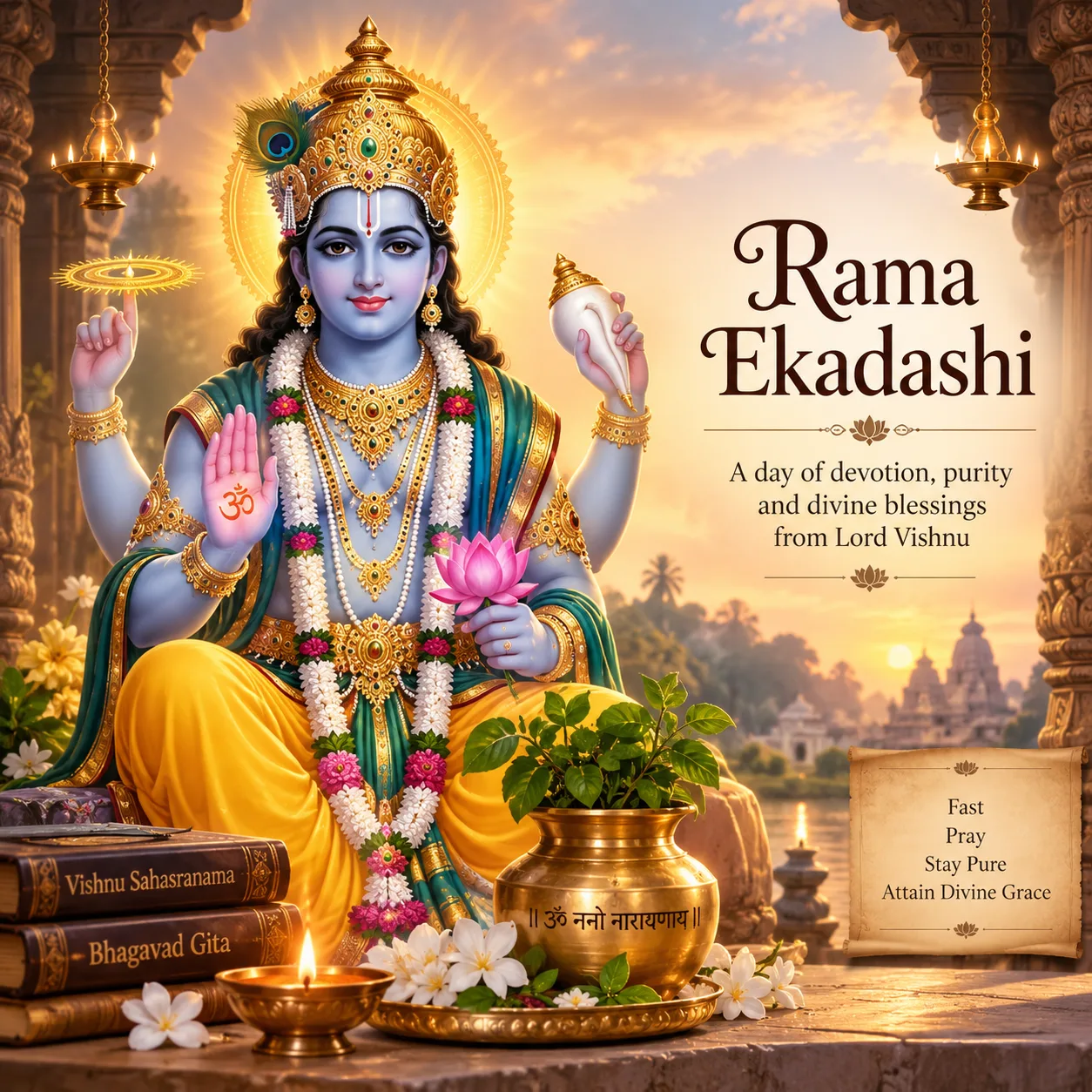
Rama Ekadashi is an extraordinarily meritorious Vaishnava fast observed on the Krishna Paksha Ekadashi (eleventh lunar day of the waning moon) in the sacred month of Kartika. Occurring just four days before the grand celebration of Deepavali, this holy day is named in honour of 'Rama', one of the revered names of Goddess Mahalakshmi, the eternal divine consort of Lord Sri Hari Vishnu. Worshipping Lord Vishnu alongside Goddess Lakshmi on this day awakens divine grace, eradicates the darkest stains of past negative karmas, and bestows boundless material prosperity, physical vitality, and eternal spiritual liberation (Moksha) upon the sincere seeker.
Rama Ekadashi 2026: Date, Puja Timings, Rituals & Stories
Rama Ekadashi Timings & Panchang
Important festival dates and auspicious timings
Usha Arghya (Sunrise)
06:17 am
Sandhya Arghya (Sunset)
06:02 pm
Start Date
Tuesday, 6 Oct 2026
Puja Muhurat
02:07 am – 12:34 am
Rama Ekadashi
The glories of Rama Ekadashi are extolled in the Brahmavaivarta Purana in an enchanting discourse between Lord Sri Krishna and Maharaja Yudhishthira. The Lord reveals that observing this single Ekadashi grants greater spiritual merit than performing a hundred grand Ashwamedha sacrifices or severe penances across centuries. The sacred story of Prince Shobhana and Princess Chandrabhaga illustrates the miraculous potency of this fast: even a physically fragile being who observes Rama Ekadashi attains an imperishable celestial kingdom, free from all mortal decay, poverty, and sorrow.
As an integral part of the holy month of Damodara (Kartika), Rama Ekadashi serves as a profound catalyst for spiritual and domestic renewal. Devotees observe strict waterless (Nirjala) or fruit-based (Phalahari) fasts, clean and decorate their homes in anticipation of Diwali, and illuminate sacred ghee lamps before the Tulsi plant and Lord Vishnu. By combining intense sensory self-restraint with loving devotion, practitioners invoke the combined blessings of Vishnu and Lakshmi, sweeping away inner darkness and preparing their hearts to radiate divine effulgence.
Why is Rama Ekadashi Celebrated?
Rama Ekadashi is celebrated to seek the divine benevolence of Lord Vishnu and Goddess Lakshmi under Her sacred name 'Rama'.
Scriptures declare that observing this fast eliminates severe moral transgressions and grants greater spiritual merit than hundreds of royal yajnas.
It serves as a sacred threshold of purification four days prior to Deepavali, preparing devotees to welcome divine prosperity.
- Honouring Goddess Rama (Lakshmi): Worshipping Goddess Mahalakshmi under Her exalted name 'Rama', ensuring that righteous wealth and auspiciousness flourish in the home.
- Expiation of Heinous Sins: Dissolving severe karmic burdens, moral transgressions, and spiritual lethargy through the transformative heat of sensory fasting.
- Precursor to Deepavali Splendour: Cleansing the body, mind, and domestic environment four days prior to Diwali, inviting divine energies to enter the home.
- Attainment of Celestial Opulence: Commemorating the triumph of Prince Shobhana and Princess Chandrabhaga, who attained an eternal golden city in the heavens.
- Liberation from Samsara: Ensuring that at the end of physical embodiment, the devoted soul bypasses the realms of distress and enters the eternal realm of Vaikuntha.
Scriptural Chronicle: The Tale of King Muchukunda, Chandrabhaga, and Shobhana
The Empire of King Muchukunda and the Sacred Edict
In the Brahmavaivarta Purana, King Yudhishthira beseeched Lord Sri Krishna to describe the Ekadashi of the dark fortnight in the month of Kartika. Lord Krishna narrated the inspiring history of King Muchukunda, a righteous sovereign of ancient eras who was an ardent devotee of Lord Vishnu.
Muchukunda was so deeply devoted to spiritual discipline that he promulgated an empire-wide edict: on every Ekadashi, every citizen in his realm—from royalty and nobles to laborers and even domestic animals—was required to observe a strict, sacred fast to maintain spiritual purity.
The Frailty and Surrender of Prince Shobhana
King Muchukunda had a virtuous daughter named Chandrabhaga, who was married to Prince Shobhana, the son of King Chandrasena. Shobhana was noble and pious, but physically weak and incapable of withstanding severe hunger. When Shobhana visited his father-in-law's palace, the sacred day of Rama Ekadashi arrived.
The royal heralds beat drums throughout the city, declaring the mandatory fast. Shobhana grew intensely distressed, explaining to his devoted wife Chandrabhaga that even a few hours without food caused him unbearable agony. Chandrabhaga gently explained that in her father's kingdom, neither human nor animal could consume food on Ekadashi, and advised him that he must summon his resolve and place his faith entirely in Lord Sri Hari.
The Celestial Golden City on Mount Mandara
Surrendering to divine will, Prince Shobhana observed the strict fast alongside Chandrabhaga. As the day progressed into night, his physical strength withered, and by sunrise on Dwadashi, his mortal body succumbed to exhaustion. Grief-stricken, King Muchukunda and Chandrabhaga performed his final rites on the banks of the sacred river Chandrabhaga, yet Chandrabhaga continued her life of intense devotion.
Due to the incomparable merit of observing Rama Ekadashi, Shobhana was immediately reborn as the ruler of a magnificent celestial kingdom on the slopes of Mount Mandara, blessed with golden palaces, bejewelled thrones, and celestial attendants. Later, when Chandrabhaga visited him through the mystic grace of Rishi Somasharma, she transferred her lifelong Ekadashi merits to him, transforming his celestial city into an eternal realm where they ruled together in divine joy.
Metaphysical Wisdom: The Union of Righteousness and Spiritual Abundance
Sanctified Prosperity versus Material Delusion
The philosophical essence of Rama Ekadashi lies in the profound reconciliation of material well-being (Artha) with ultimate spiritual liberation (Moksha). The name 'Rama' signifies Goddess Lakshmi as the eternal power of divine beauty, grace, and lawful abundance.
Unlike unrighteous wealth that breeds arrogance, greed, and destruction, the wealth bestowed by Goddess Rama on this Ekadashi is sanctified, sattvic, and dedicated to the service of Lord Vishnu and the cosmic order. The observance reminds spiritual seekers that true prosperity is not the accumulation of transient goods, but the continuous flow of divine grace in all dimensions of life.
Spiritual Resolve over Bodily Limitations
The narrative of Prince Shobhana illustrates the law of spiritual grace versus physical frailty. The physical body is temporary and subject to mortal limitations, but the soul's commitment to divine law generates eternal spiritual capital.
Even when Shobhana's mortal frame collapsed, the subtle spiritual merit of having endured the fast elevated his consciousness to celestial realms. When conjoined with the steady, lifelong devotion of Chandrabhaga, this merit achieved permanence. The fast teaches that individual spiritual weakness can be redeemed through earnest surrender, holy association, and the unwavering grace of the Supreme Lord.
Fasting Discipline: Shodashopachara Worship, Tulsi Deepadaan, and Night Vigil
The Fasting Protocol and Altar Consecration
The observances of Rama Ekadashi commence on Dashami evening with a sattvic meal taken before sunset, accompanied by celibacy and devotional study. On the Ekadashi morning, devotees rise during Brahma Muhurta, cleanse themselves with holy water, and take the solemn Ekadashi Sankalpa.
Devotees fast according to their capacity—either waterless (Nirjala) or consuming milk, fruits, and roots (Phalahari). The household altar is consecrated and adorned with auspicious rangolis, where Lord Vishnu and Goddess Lakshmi are worshipped together with fragrant flowers, sandalwood paste, and sixteen traditional offerings.
Kartika Tulsi Aradhana and Dwadashi Parana
Because Rama Ekadashi falls during the sacred month of Kartika, lighting lamps before the Tulsi plant holds supreme spiritual merit. Devotees light numerous ghee lamps around Tulsi Devi and the home shrine, singing the Damodarashtakam and Vishnu Sahasranama.
The night is celebrated with an auspicious Jagran (night vigil) filled with congregational bhajans, kirtans, and reading of the Brahmavaivarta Purana. On the following Dwadashi morning, after completing the morning prayers and distributing charity of food and clothes to Brahmanas and the needy, the fast is broken within the auspicious Parana muhurta with sanctified charanamrita and satvik prasad.
Rama Ekadashi Puja Vidhi (Step by Step)
- 1
Brahma Muhurta Jagran and Sacred Bathing
Awaken during the auspicious Brahma Muhurta. Bathe in water infused with sacred Ganga jal, Tulsi leaves, and a pinch of turmeric powder to invoke spiritual purity and physical health.
- 2
Achamana and Solemn Rama Ekadashi Sankalpa
Sit facing East or North on a clean woollen asana. Perform Achamana three times, sprinkle water over the self, and take the solemn Sankalpa holding water, akshata, and flower petals, dedicating the fast to Lord Sri Hari and Goddess Rama.
- 3
Sanctification of the Altar and Lakshmi-Narayana Vigraha
Set up a wooden platform draped with red or yellow silk. Place the sacred idols or framed portraits of Lord Lakshmi-Narayana or Shaligram Shila upon the sanctified altar.
- 4
Invocation of Lord Ganesha
Light a primary ghee lamp and offer vermilion, flowers, and durva grass to Lord Ganesha, praying for the removal of all impediments during the sacred observance.
- 5
Panchamrita Abhishekam
Rama Ekadashi Puja Samagri List
Altar and Abhishekam Articles
- Idol or framed image of Lord Lakshmi-Narayana or Shaligram Shila
- Copper or brass Kalasha, mango leaves, unpeeled coconut, and sacred mauli thread
- Panchamrita ingredients: pure cow milk, fresh curd, pure cow ghee, honey, and raw sugar
- Sacred Ganga water, rose water, and pure camphor for abhishekam
- Clean yellow and red silk clothes for the deities and chowki
Flowers, Aromatics, and Ritual Offerings
- Fresh Tulsi leaves and manjaris (plucked reverently on Dashami)
- Yellow marigolds, red hibiscus or lotus, white jasmine, and seasonal flowers
- Malayagiri white sandalwood paste, saffron, rolli, and unbroken rice grains (akshata)
- Natural guggul dhoop sticks, pure camphor blocks, and brass arati bell
- Pure cotton wicks and desi cow ghee for altar and Tulsi lamps
Satvik Naivedyam and Charity Materials
- Fresh seasonal fruits (apples, bananas, pears, grapes, oranges)
- Makhana, cashews, almonds, raisins, and crystal rock sugar (mishri)
- Betel leaves (Paan), supari, cloves, and cardamom for Tamboolam
Mantras and Prayers for Rama Ekadashi
Rama Ekadashi Vrat Rules and Fasting Guidelines
Fasting Discipline and Grain Restriction
Devotees must strictly avoid consuming any rice, wheat, pulses, barley, or grain-based foods. Ingesting grains on Ekadashi is strictly forbidden in the Puranas. The fast may be observed as Nirjala (waterless), Sajala (water only), or Phalahari (fruits, milk, and nuts) according to personal stamina.
Tulsi Respect and Plucking Prohibitions
Never pluck Tulsi leaves on the day of Ekadashi or Dwadashi. Leaves required for the worship of Lord Vishnu must be gathered with care on Dashami day. Plucking Tulsi on Ekadashi incurs grave spiritual demerit.
Dwadashi Parana Timing Adherence
- The fast must be formally concluded on Dwadashi morning within the Parana muhurta after Hari Vasara has elapsed.
- Feed the hungry, provide charity to Brahmanas or deserving persons, and perform deity arati prior to consuming food.
- Break the fast by sipping holy charanamrita followed by a light satvik meal free from heavy spices and tamasic elements.
Dos and Don'ts of Rama Ekadashi
Good Practices (Do's)
- Wake up during Brahma Muhurta and take a purificatory bath with Ganga water.
- Observe the fast with sincerity, choosing Nirjala, Sajala, or Phalahari according to physical capability.
- Worship Lord Lakshmi-Narayana together with fragrant flowers, sandalwood paste, and Tulsi leaves.
- Light pure cow ghee lamps before the sacred Tulsi plant during twilight in the month of Kartika.
- Break the fast strictly within the prescribed Parana muhurta on the following Dwadashi morning.
Rama Ekadashi Across Regions
| Region | Local Name |
|---|---|
| North and Central India | Rama Ekadashi / Rambha Ekadashi |
| Gujarat and Maharashtra | Rama Ekadashi |
| South India (Tamil Nadu, Karnataka, Andhra Pradesh) | Rama Ekadasi |
| Odisha and Bengal | Rama Ekadashi |
Rama Ekadashi FAQs
Why is this Ekadashi specifically named 'Rama'?
Rama is an ancient, revered epithet of Goddess Mahalakshmi, the eternal divine consort of Lord Vishnu. The Ekadashi is named after Her because worshipping Lord Vishnu alongside Goddess Rama on this day brings auspiciousness, virtue, and divine prosperity.
How does Rama Ekadashi connect to the upcoming Deepavali festival?
Rama Ekadashi occurs exactly four days before Deepavali. It serves as a sacred threshold of inner and outer purification, allowing devotees to cleanse their physical senses and domestic spaces through fasting and prayer before welcoming Goddess Lakshmi on Diwali.
Can working professionals and students observe Rama Ekadashi?
Yes, anyone can observe the fast according to their stamina by consuming satvik fruits, cow milk, curd, water, and nuts (Phalahar), while keeping the mind focused on truthful conduct, peacefulness, and holy remembrance.
Upcoming Festivals
View All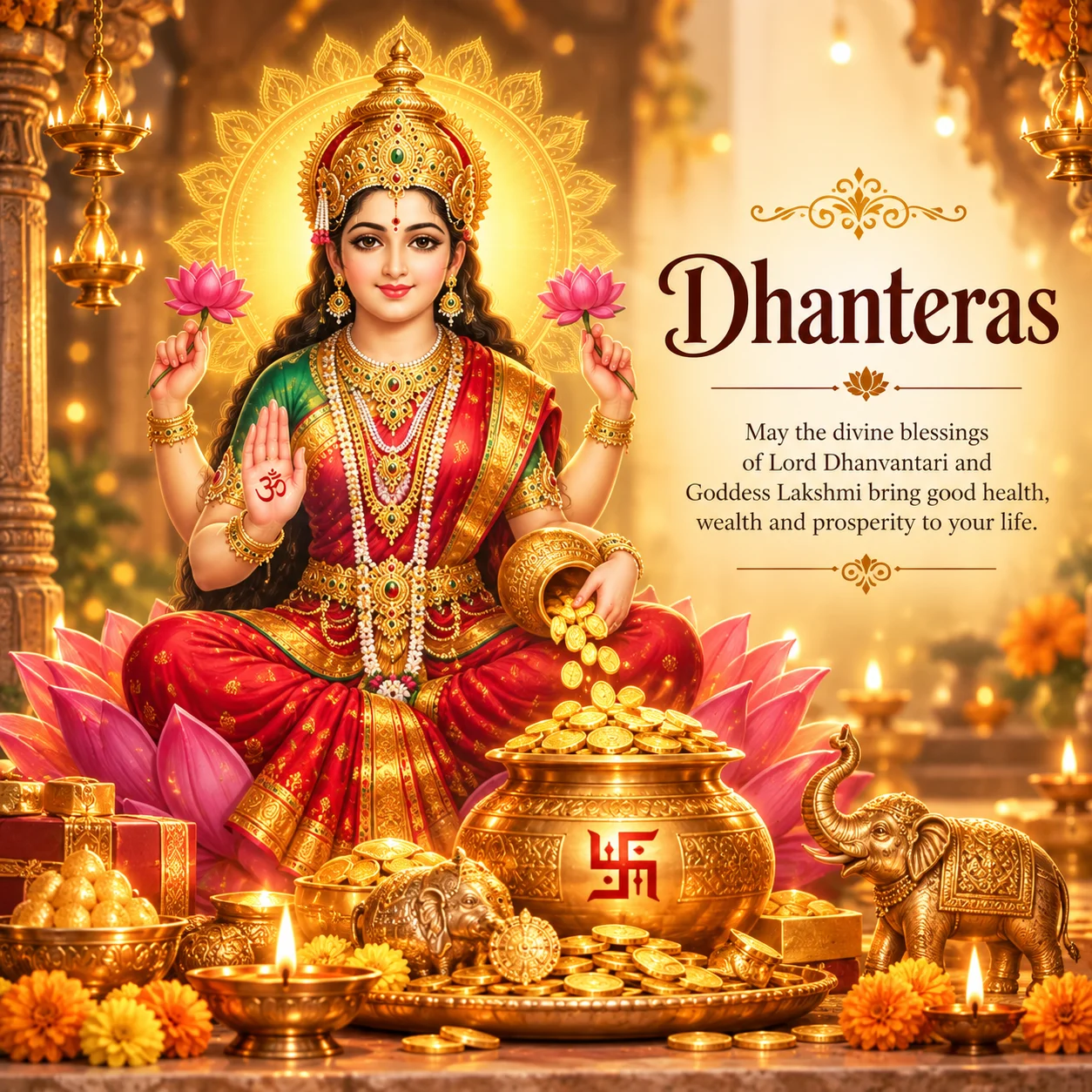
Friday, Nov 6, 2026
Dhanteras
Dhanteras, celebrated with immense auspiciousness, joy, and splendor across the Hindu world as Dhantrayodashi or Dhanwantari Jayanti, is the grand opening festival that marks the first day of the five-day Deepavali celebrations. Occurring on the thirteenth lunar day (Trayodashi tithi) of the dark fortnight (Krishna Paksha) in the sacred month of Kartika, this vibrant festival is dedicated to the worship of Lord Dhanvantari (the divine physician of the gods and founder of Ayurveda), Goddess Mahalakshmi (the deity of wealth and abundance), and Lord Kubera (the celestial treasurer of the cosmos).
View Festival Guide
Sunday, Nov 8, 2026
Diwali
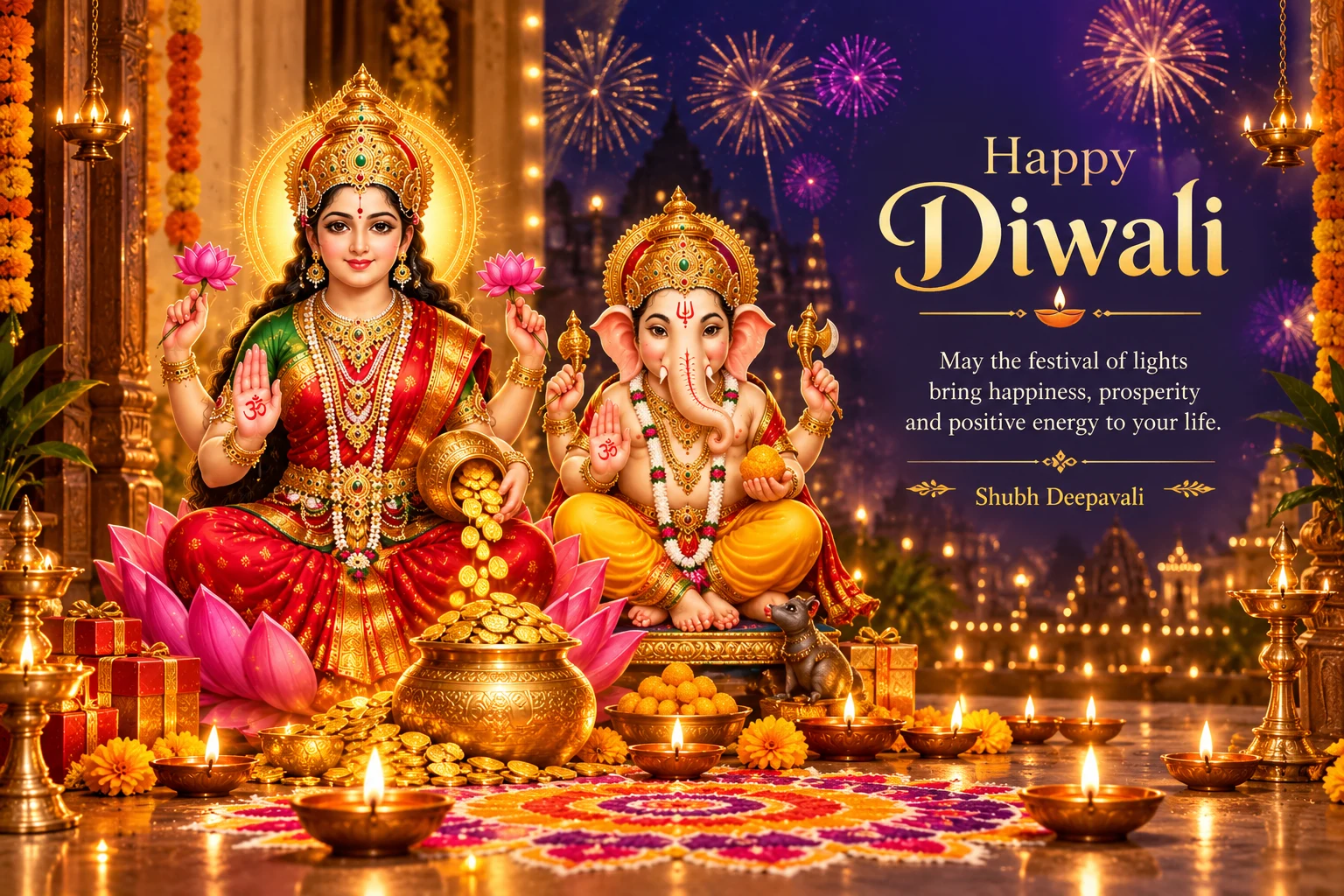
Diwali, celebrated universally as Deepavali (meaning 'row of clay lamps'), is the crown jewel of Hindu festivals, celebrated on the darkest New Moon night (Amavasya) of the sacred month of Kartika. Spanning a radiant five-day festive arc, this transcendent festival of lights commemorates the eternal spiritual triumph of light over darkness, divine righteousness (Dharma) over cosmic iniquity (Adharma), knowledge over ignorance, and inner hope over despair. Across the Indian subcontinent and the worldwide diaspora, homes, streets, temples, and waterways are illuminated with millions of glowing earthen oil lamps (Diyas).
View Festival Guide
Monday, Nov 9, 2026
Govardhan Puja
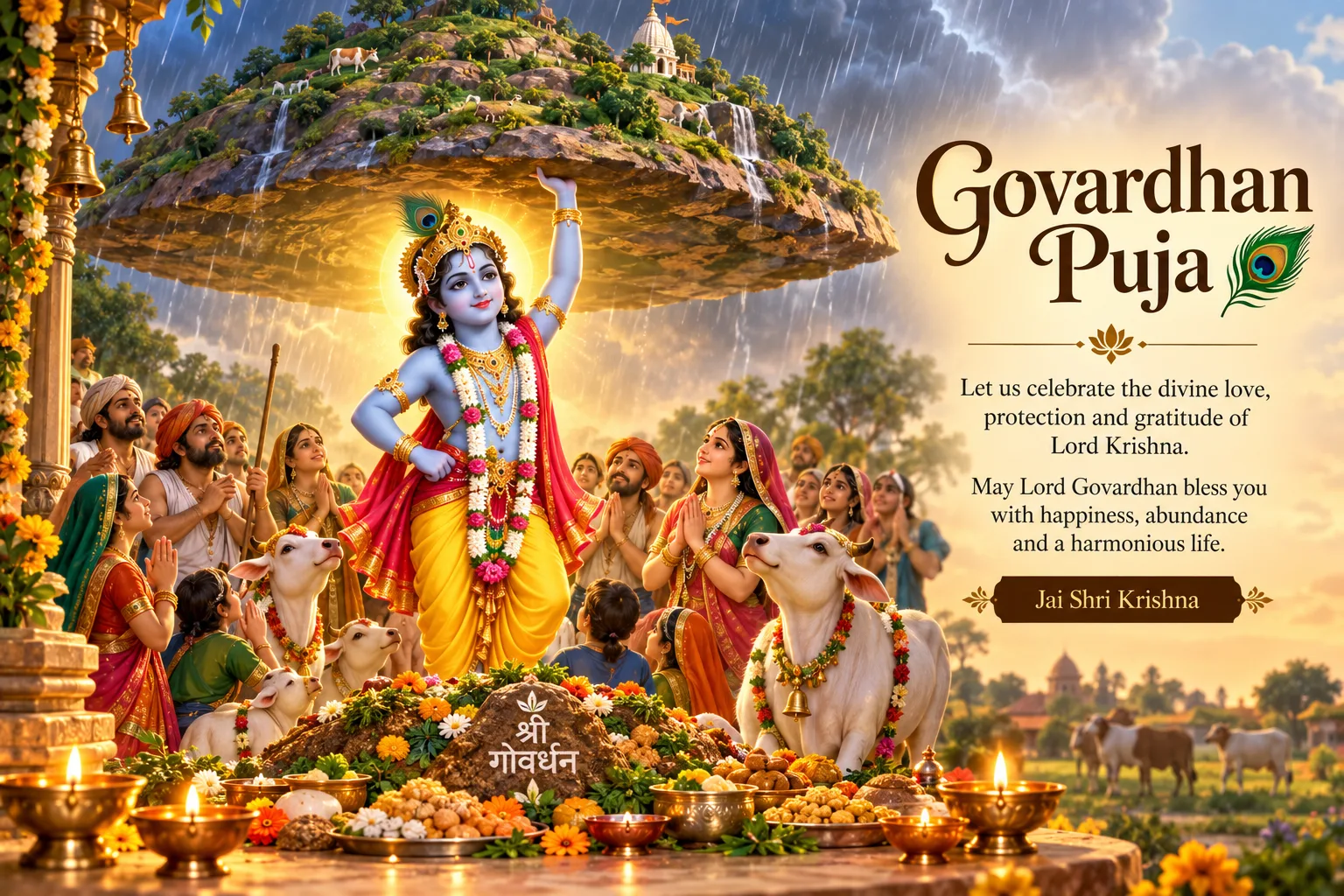
Govardhan Puja, also celebrated with immense spiritual fervor, culinary magnificence, and pastoral joy as Annakut (meaning 'mountain of food') or Bali Pratipada, is celebrated on the first lunar day (Pratipada tithi) of the bright fortnight (Shukla Paksha) in the sacred month of Kartika. Occurring on the day immediately following Deepavali Amavasya, this monumental festival is dedicated to the worship of the sacred Govardhan Hill (Giriraj Ji), Lord Sri Krishna, indigenous cows (Go-mata), and the humble soil of Vraja.
View Festival Guide
Wednesday, Nov 11, 2026
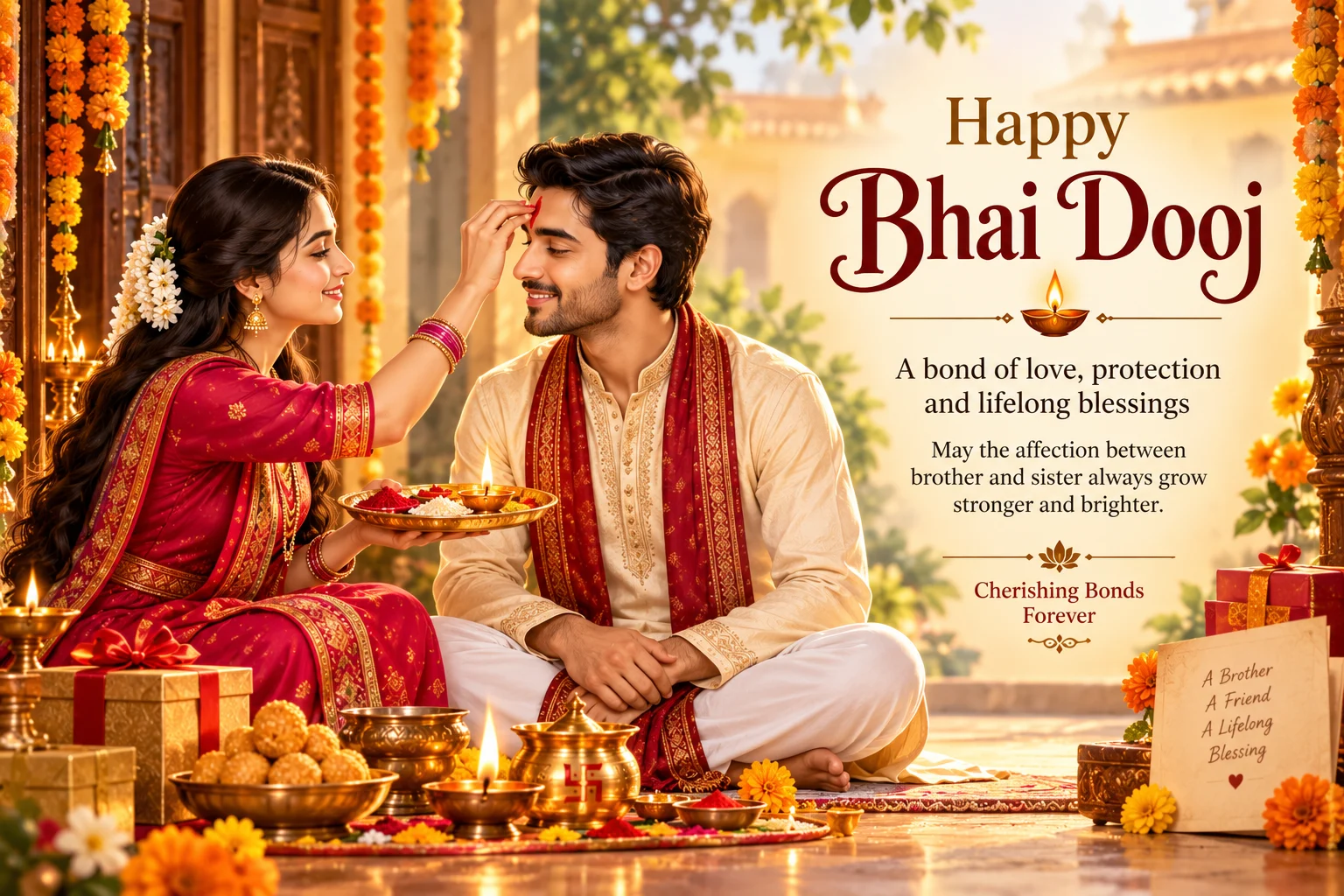
Bhai Dooj
Bhai Dooj (also lovingly known as Holi Bhai Dooj or Chaitra Bhai Dooj) is an intensely affectionate, culturally sacred, and spiritually protective Hindu festival observed on the second day (Dwitiya tithi) of the Krishna Paksha in the month of Chaitra according to the traditional Hindu calendar. Occurring on the second day immediately following the vibrant festival of colors (Holi), this sacred observance mirrors the post-Diwali Bhai Dooj, serving to reaffirm, sanctify, and celebrate the pure, unconditional bond of love and protection between brothers and sisters across Sanatana Dharma.
View Festival Guide
Sunday, Nov 15, 2026
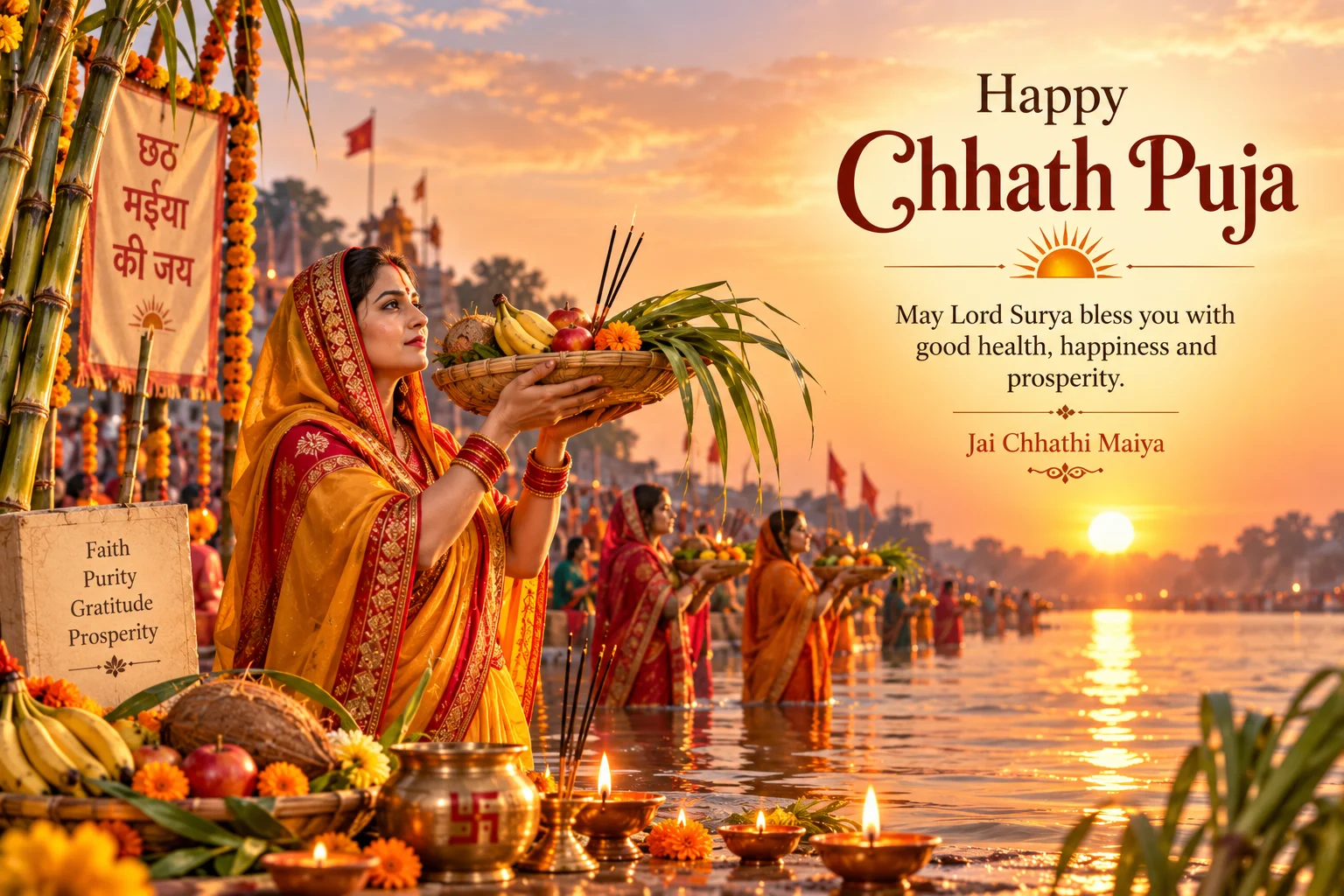
Chhath Puja
Chhath Puja, celebrated with unparalleled spiritual asceticism, Vedic purity, and cosmic reverence from the Chaturthi to Saptami tithis of the Shukla Paksha in the sacred month of Kartika, is the grandest solar festival of the Indian subcontinent. Known classically as Surya Shashthi, Dala Chhath, Chhathi Maiya, and Mahaparva, this sublime four-day pilgrimage of the soul is dedicated exclusively to Bhagavan Surya (the visible Sun God, Pratyaksha Devata) and His divine female dynamic energy, Chhathi Maiya—revered scripturally as Usha (the cosmic dawn) and Pratyusha (the cosmic dusk), and identified in the Devi Bhagavata Purana as Goddess Devasena or Shashti Devi, the sixth cosmic manifestation of primordial Nature (Mula Prakriti). Originating in the ancient cultural heartland of Bihar, Jharkhand, and eastern Uttar Pradesh, Chhath Puja has expanded globally as a shining beacon of ecological harmony, community egalitarianism, and unshakeable yogic austerity.
View Festival Guide
Friday, Nov 20, 2026
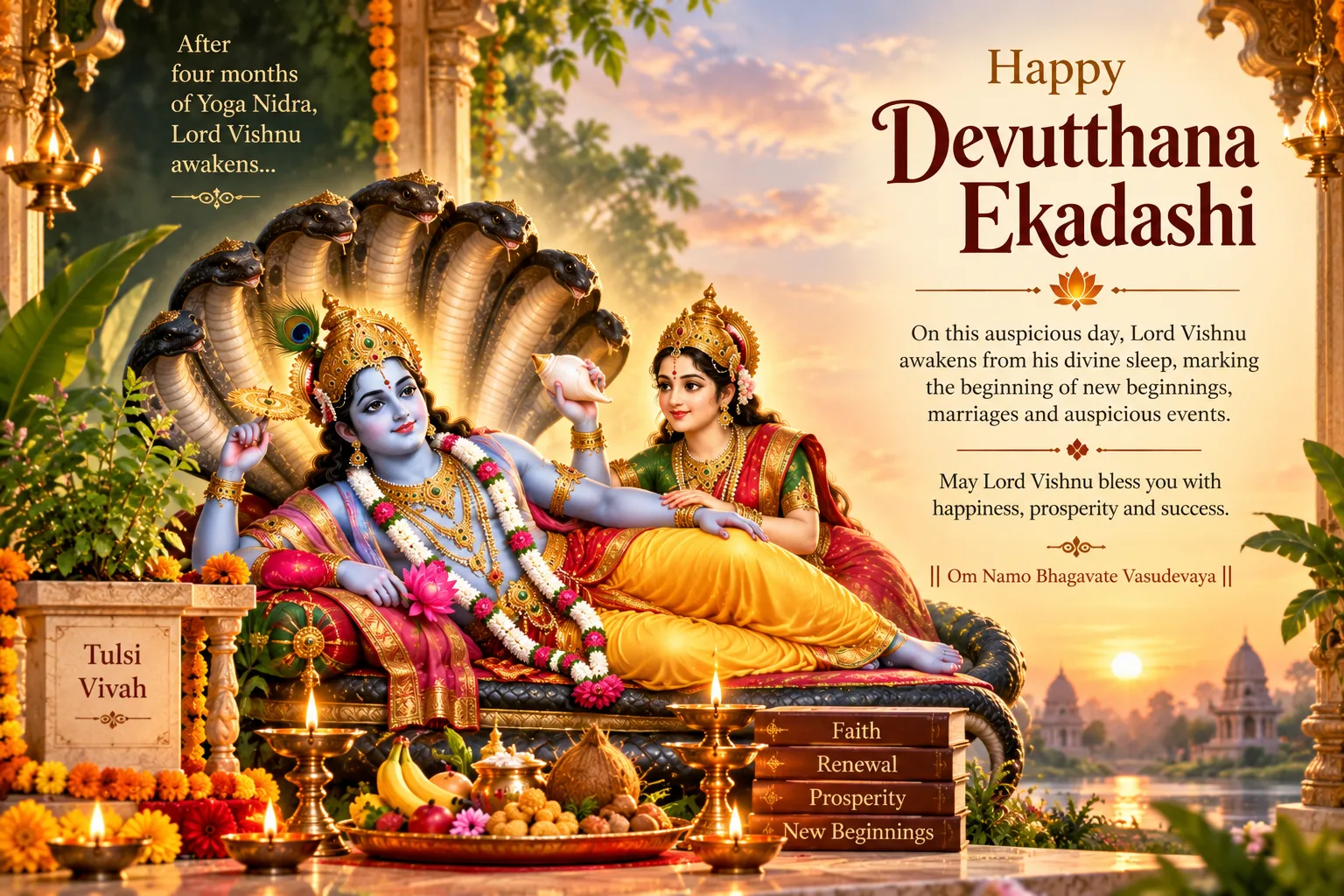
Devutthana Ekadashi
Devutthana Ekadashi, celebrated across the length and breadth of India as Prabodhini Ekadashi, Dev Uthani Gyaras, and Bodhini Ekadashi, is one of the most spiritually profound, joyous, and universally revered festivals in the Hindu calendar. Occurring on the Shukla Paksha Ekadashi (the eleventh lunar day of the waxing moon) in the sacred month of Kartika, this transcendental tithi marks the glorious awakening of the Supreme Preserver, Lord Sri Maha Vishnu, from His four-month mystic yogic slumber (Yoga Nidra). Lord Vishnu enters this cosmic meditative rest on Devshayani Ekadashi in the month of Ashadha, reclining upon the celestial serpent Ananta Shesha in the causal Milk Ocean (Kshirasagara). For four full lunar months—a sacred period known as Chaturmasya—the cosmos observes solemn quietude, and all auspicious life-cycle ceremonies such as marriages, housewarmings, and sacred thread initiations are held in abeyance. With the dawn of Devutthana Ekadashi, the universe awakens to boundless divine joy, celestial trumpets resound, and the sanctifying season of human marital unions and sacred sacraments officially resumes.
View Festival Guide
Saturday, Nov 21, 2026
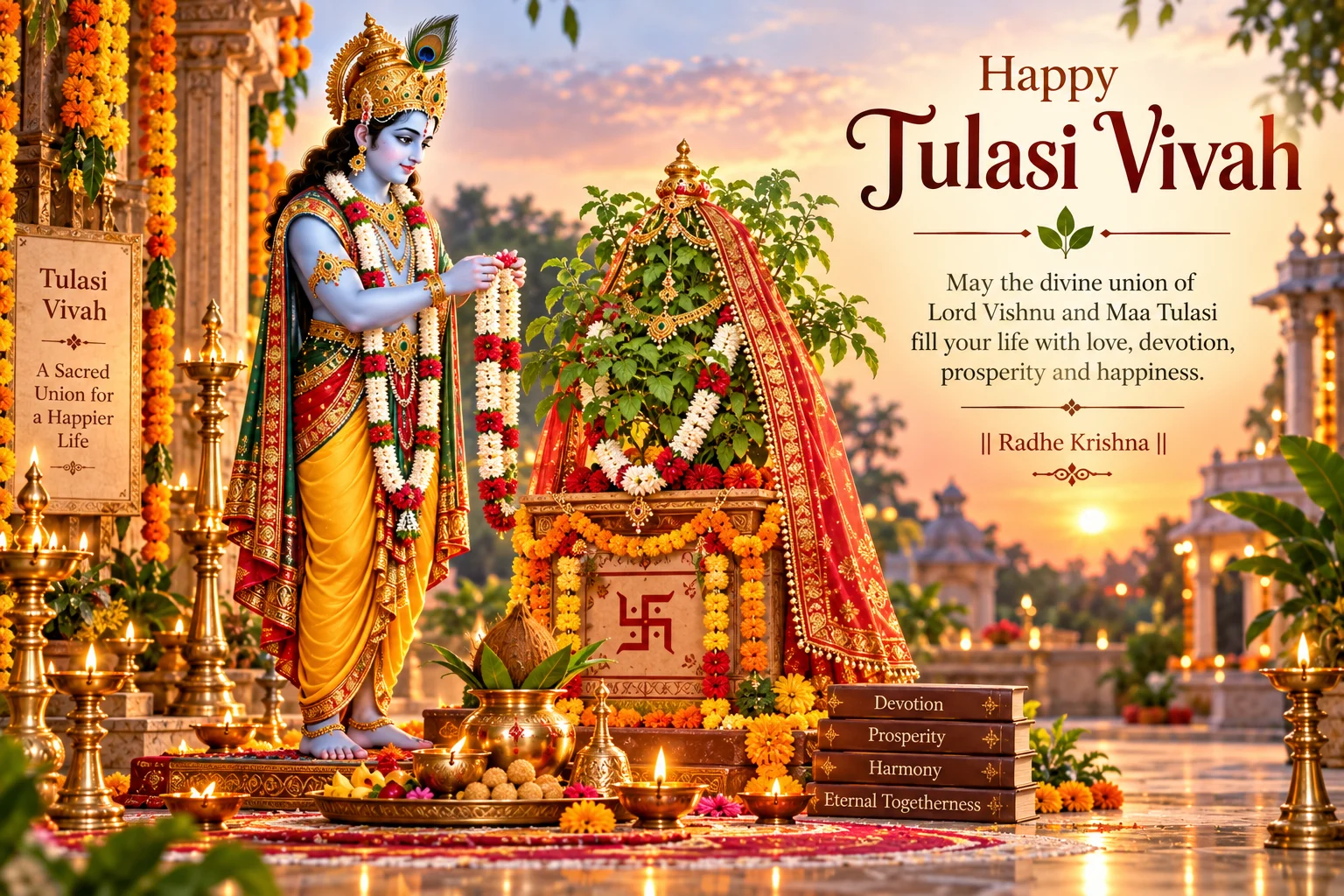
Tulasi Vivah
Tulasi Vivah, observed with supreme aesthetic splendor, Vedic sanctity, and devotional grandeur across India, is the ceremonial divine wedding of Goddess Tulasi—the sacred basil plant personifying divine purity and unshakeable chastity—with Lord Sri Maha Vishnu in His sacred, self-manifested stone form of Sri Shaligram (or Sri Krishna / Damodara). Celebrated during the luminous waxing fortnight of the holy month of Kartika, most traditionally on Kartika Shukla Dwadashi (the twelfth lunar day immediately following Devutthana Ekadashi) or spanning the auspicious five-day window between Ekadashi and Kartika Purnima, this celestial nuptial ceremony marks the official, joyous inauguration of the Hindu wedding season (Vivaha Muhurats). Across millions of households and temples, courtyards are transformed into vibrant wedding pavilions where devotees perform every intricate Vedic marriage rite, establishing a sacred cosmic bridge between earthly devotion, environmental reverence, and transcendental love.
View Festival Guide
Tuesday, Nov 24, 2026
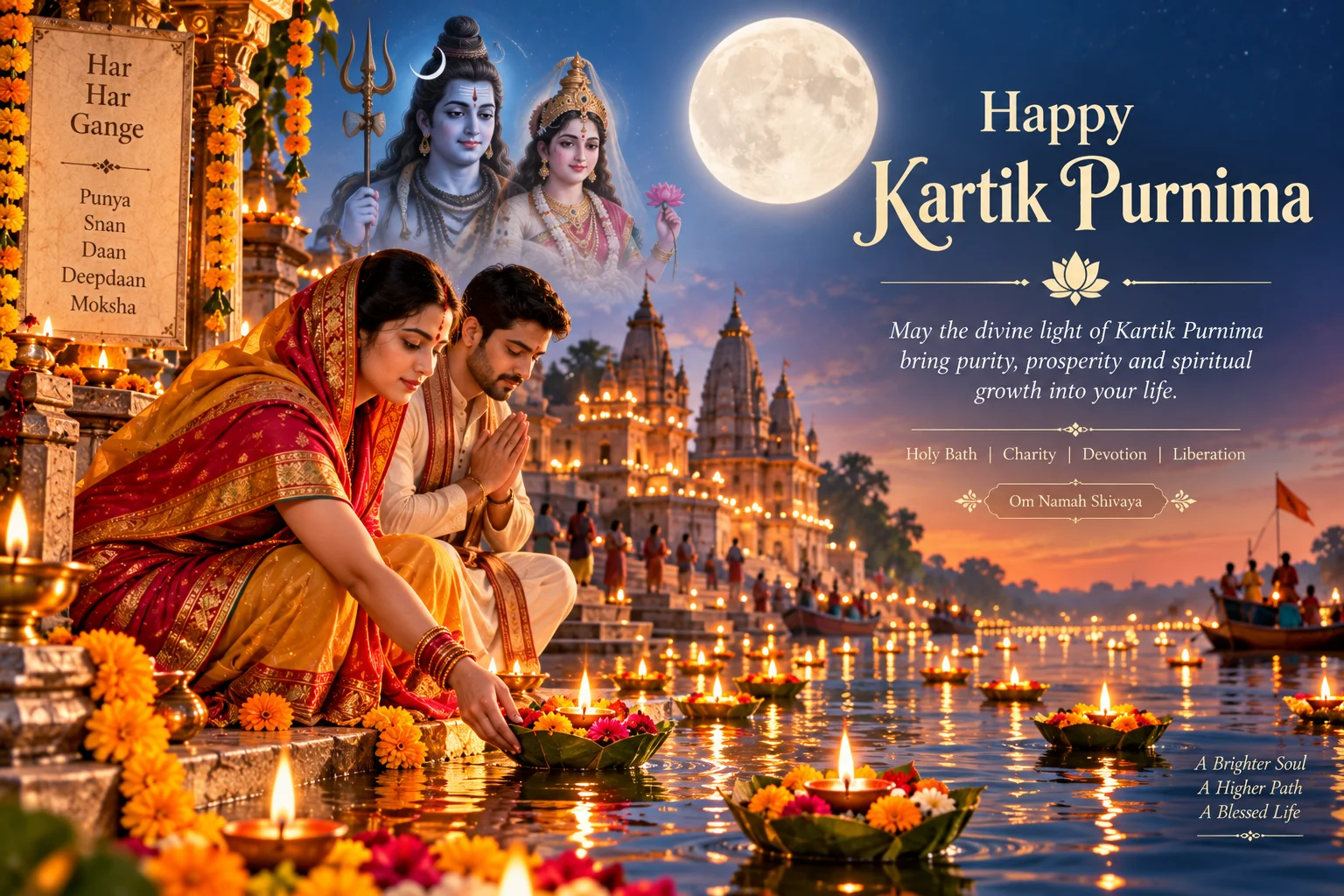
Kartik Purnima
View Festival Guide