




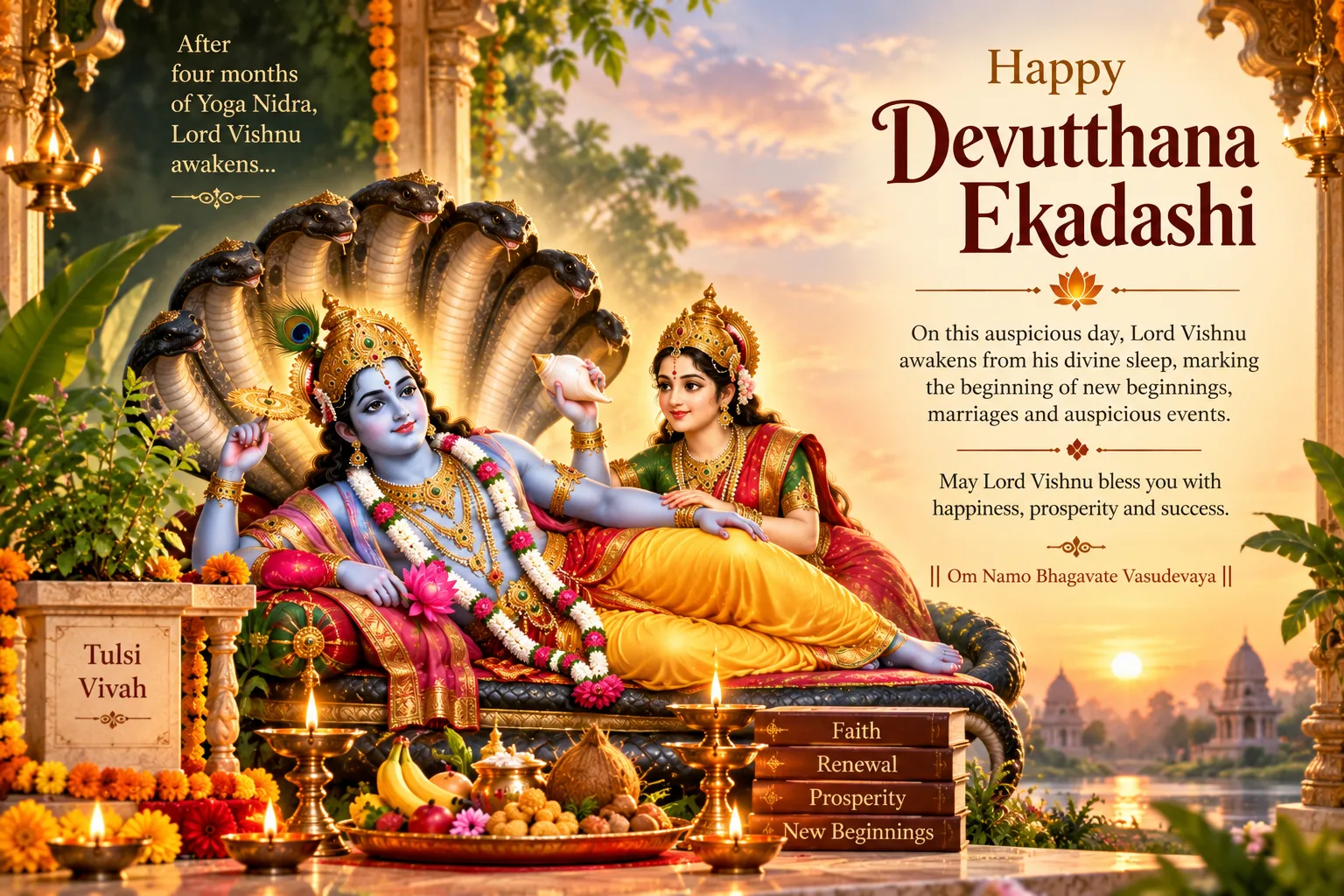
Devutthana Ekadashi, celebrated across the length and breadth of India as Prabodhini Ekadashi, Dev Uthani Gyaras, and Bodhini Ekadashi, is one of the most spiritually profound, joyous, and universally revered festivals in the Hindu calendar. Occurring on the Shukla Paksha Ekadashi (the eleventh lunar day of the waxing moon) in the sacred month of Kartika, this transcendental tithi marks the glorious awakening of the Supreme Preserver, Lord Sri Maha Vishnu, from His four-month mystic yogic slumber (Yoga Nidra). Lord Vishnu enters this cosmic meditative rest on Devshayani Ekadashi in the month of Ashadha, reclining upon the celestial serpent Ananta Shesha in the causal Milk Ocean (Kshirasagara). For four full lunar months—a sacred period known as Chaturmasya—the cosmos observes solemn quietude, and all auspicious life-cycle ceremonies such as marriages, housewarmings, and sacred thread initiations are held in abeyance. With the dawn of Devutthana Ekadashi, the universe awakens to boundless divine joy, celestial trumpets resound, and the sanctifying season of human marital unions and sacred sacraments officially resumes.
Devutthana Ekadashi 2026: Date, Puja Timings, Rituals & Stories
Devutthana Ekadashi Timings & Panchang
Important festival dates and auspicious timings
06:48 am
05:26 pm
Friday, 20 Nov 2026
07:06 am – 07:16 am
Devutthana Ekadashi
The divine scriptural heritage of Devutthana Ekadashi is recorded in monumental detail within the Padma Purana, Skanda Purana, and Narada Purana. In an immortal dialogue between Lord Brahma and the celestial sage Narada Muni, Lord Brahma explains that the spiritual potency of Devutthana Ekadashi is so immeasurable that even the sins accumulated over thousands of lifetimes—whether committed intentionally or unintentionally—are completely incinerated like a colossal mountain of dry cotton caught in a blazing fire when a seeker observes this sacred fast. Lord Brahma declares that the religious merit gained through thousands of Ashwamedha horse sacrifices, hundreds of Rajasuya coronations, and pilgrimages to all sacred river confluences across the earth cannot equal even a single fraction of the merit acquired by fasting on Devutthana Ekadashi with pure devotional surrender to Lord Janardana.
In domestic and regional traditions across northern, western, and central India, Devutthana Ekadashi is celebrated with an enchanting blend of scriptural ritualism and rural agricultural jubilation. In courtyards and temple sanctums, women paint auspicious ceremonial floor diagrams using rice paste and natural ochre (Geru), depicting the sacred lotus footprints of Lord Vishnu entering the household. A festive canopy is constructed using tall, fresh sugarcane stalks (Ikshu-Danda) tied together at the top, under which images or idols of Lord Vishnu, Sri Krishna, or Shaligram are reverently enthroned. Under this sugarcane mandap, devotees arrange the vibrant treasures of the autumn harvest: sweet sugarcane sections, water chestnuts (Singhara), sweet potatoes (Shakarkand), wild jujube fruits (Ber), newly harvested radishes (Mooli), fresh amla, and sacred Tulsi leaves. Devotees softly tap brass plates with wooden pestles or churns, chanting the timeless folk awakening invocation: 'Utho Deva, Baitho Deva, Patiya Paan Kharo, Sone Ki Khunti Rupa Ki Zanjeer, Jagat Jagao Deva' (Awaken, O Lord! Arise and sit upon your throne, accept sweet betel leaves, awaken our fortunes and illuminate the world).
Why is Devutthana Ekadashi Celebrated?
Devutthana Ekadashi is celebrated to commemorate the awakening of Lord Sri Vishnu from His four-month mystic slumber of Yoga Nidra in the Milk Ocean, bringing the auspicious period of Chaturmasya to a joyful conclusion.
According to the Padma Purana, observing complete fasting on this holy day incinerates the accumulated sins of thousands of past births and guarantees residence in Lord Vishnu's transcendental realm of Vaikuntha.
It marks the official reopening of the Hindu auspicious calendar, restoring the performance of weddings, sacred thread initiations, tonsures, and housewarmings across all Hindu communities.
It celebrates the intimate relationship between humanity, divinity, and nature through the worship of newly harvested crops such as sugarcane, water chestnuts, sweet potatoes, and amla under sugarcane mandaps.
It serves as the opening day of the five-day Bhishma Panchaka vrata and inaugurates the multi-day ceremonial nuptials of Goddess Tulasi and Sri Shaligram.
- Awakening of Lord Vishnu: Celebrating the transcendental awakening of Lord Janardana from His cosmic slumber on the serpent bed of Ananta Shesha.
- Conclusion of Chaturmasya: Commemorating the successful completion of the four-month vow of monastic discipline, scriptural study, and ascetic restraint.
- Resumption of Auspicious Rites (Shubha Karya): Reopening the cosmic gate for sacred weddings (Vivaha Samskara), Griha Pravesha, and Upanayana ceremonies.
- Inauguration of Tulasi Vivah: Initiating the sacred divine wedding rites between the sacred basil plant (Tulasi) and Lord Vishnu as Shaligram.
- Commencement of Bhishma Panchaka: Honoring the five-day sacred window consecrated by Lord Krishna in memory of Grandfather Bhishma's teachings.
- Celebration of Agricultural Abundance: Offering the first fruits of the winter harvest—sugarcane, water chestnuts, sweet potatoes, and amla—to the divine preserver.
Scriptural Chronicles: The Dialogue of Brahma and Narada, the Demon Shankhasura, and the Cosmic Awakening
The Eternal Dialogue Between Lord Brahma and Sage Narada
The scriptural glories of Devutthana Ekadashi are extolled in the Padma Purana in an immortal conversation between the creator Lord Brahma and his celestial son, the divine sage Narada Muni. Narada approached his father with folded hands and asked: 'O venerable Creator of the universe! Please reveal to me the specific Ekadashi whose observance immediately destroys the most heinous sins, grants unshakeable righteousness, and bestows the supreme fruit of liberation upon mortal beings.' Lord Brahma replied with profound joy: 'O best of sages! Listen attentively to the glories of Prabodhini Ekadashi, which falls in the waxing fortnight of the holy month of Kartika. This Ekadashi is the supreme jewel among all vows. The sins accumulated over thousands of previous incarnations, even if towering as high as Mount Meru, are reduced to ashes in an instant when a soul observes fasting on this day.'
Lord Brahma continued: 'Whatever spiritual merit is acquired by performing severe penances for a thousand divine years, bathing in the sacred river Ganga during a solar eclipse, or donating millions of cows adorned with gold and jewels to enlightened brahmanas—all of that merit is effortlessly achieved by a householder who fasts on Devutthana Ekadashi and stays awake throughout the night in meditation upon Lord Janardana. Lord Hari, who has slept through the monsoon months, awakens on this day to look upon His devotees with eyes overflowing with compassion. He who worships Lord Vishnu with fresh Kadamba flowers, yellow champaka blossoms, and fragrant Tulsi leaves on this day attains a spiritual status beyond the reach of ordinary mortals.'
The Legend of the Demon Shankhasura and the Four-Month Slumber
A celebrated Puranic narrative explains why Lord Vishnu retreats into His four-month mystic slumber and awakens on Devutthana Ekadashi. In ancient eons, a formidable demon named Shankhasura grew excessively proud of his strength. Driven by malice against the devas, he infiltrated the heavenly realms and stole the four sacred Vedas while Lord Brahma was in deep meditation. Shankhasura hid himself in the subterranean depths of the cosmic ocean. Without the divine vibrations of the Vedas, Vedic rituals on earth ceased, the devas lost their nourishment, and spiritual chaos engulfed the three worlds.
Metaphysical Wisdom: The Cosmic Yoga Nidra, Awakening of the Self, and Spiritual Rebirth
The Symbolism of Yoga Nidra and the Awakening of Consciousness
In Hindu metaphysics, Lord Vishnu's four-month slumber is not an inert physiological sleep (Tamasic Nidra), but the supreme state of Yoga Nidra—a condition of dynamic, unbroken transcendental absorption wherein the Lord contemplates the maintenance, evolution, and spiritual upliftment of the entire cosmos. The Mandukya Upanishad delineates four states of consciousness: Jagrat (waking), Swapna (dreaming), Sushupti (deep dreamless sleep), and Turiya (the transcendental fourth state of pure consciousness). Lord Vishnu's sleep represents the tranquil inward focus of Turiya, wherein the external universe dissolves into silent spiritual unity.
When Lord Vishnu awakens on Devutthana Ekadashi, it symbolizes the dynamic movement from internal contemplation back into righteous external action (Karma Yoga). For the spiritual seeker, this transition serves as an urgent wake-up call. Human life is often spent in the deep slumber of spiritual amnesia, chasing fleeting sensory mirages. Devutthana Ekadashi challenges the aspirant to awaken from the stupor of egoism and worldly attachment, realigning their mind, senses, and daily intellect with eternal spiritual principles.
Sugarcane, Amla, and the Sacred Ecology of Devotion
The profound rituals of Devutthana Ekadashi are intrinsically woven into the sacred ecology of nature. The construction of the sugarcane canopy (Ikshu Mandap) is loaded with esoteric philosophical meaning. Sugarcane represents the sweetness of unalloyed devotional love (Bhakti Rasa). Just as raw sugarcane must undergo intense crushing and refinement to yield pure jaggery and crystalline sugar, the human soul must undergo spiritual discipline, sensory restraint, and selflessness during Chaturmasya to reveal its inherent divine sweetness.
Similarly, the offering of water chestnuts, sweet potatoes, and amla highlights the reverence for the soil and the life-giving energy of the autumn harvest. In Ayurveda, amla (Indian gooseberry) is revered as Dhatri—the divine mother and sustainer of vitality. By placing these earth-born treasures before Lord Vishnu before partaking of them as prasada, the seeker acknowledges that all sustenance flows from the divine preserver, transforming every meal into a sacred act of cosmic gratitude.
Ritual Protocols: Sugarcane Mandap Setup, Lotus Footprint Diagrams, and Deity Awakening
Constructing the Sugarcane Mandap and Drawing Sacred Footprints
On the morning of Devutthana Ekadashi, devotees thoroughly sweep, clean, and sanctify their courtyards, verandas, or domestic worship rooms. Using a natural white rice paste (Aipan or Kolam) blended with natural red ochre (Geru), the women of the household draw intricate geometric auspicious patterns and a continuous trail of tiny sacred footprints (Vishnu Pada) leading from the main threshold of the house directly into the worship sanctuary. These footprints symbolize Lord Maha Vishnu graciously walking into the home to dwell permanently as the divine guest and protector.
At the center of the sanctified space, four or five tall, unblemished sugarcane stalks with their lush green leaves intact are bound together at the crown using sacred red moli thread, creating a charming conical temple canopy (Mandap). Beneath this green sugarcane canopy, a wooden altar (Chowki) draped in pure yellow or red silk is placed. The sacred Shaligram stone, along with brass or silver idols of Lord Vishnu, Goddess Lakshmi, and Sri Krishna, is lovingly installed upon a bed of unblemished rice or sesame seeds.
Arranging Harvest Offerings and Lighting Lamps
Around the wooden altar under the sugarcane mandap, devotees arrange earthen plates and brass platters heaped with seasonal offerings: peeled sections of juicy sugarcane, fresh water chestnuts, boiled or roasted sweet potatoes, crisp radishes, wild jujube berries, freshly picked amla fruits, pomegranates, bananas, and tender Tulsi leaves. A large ceremonial clay or brass lamp filled with pure cow ghee is lit at the center of the mandap, accompanied by numerous smaller earthen lamps placed along the verandah, window sills, and beside the sacred Tulsi plant.
The domestic worship begins with the traditional Kalasha Sthapana and purification rites. Devotees chant the Vedic peace mantras, offer fragrant sandalwood paste, golden turmeric, akshata, yellow marigold garlands, and Tulsi leaves to the Lord, accompanied by the ringing of brass bells and the resonant blowing of conch shells (Shankhanaad) to purify the ether of the residence.
The Ceremonial Awakening Song and Night Vigil
Devutthana Ekadashi Puja Vidhi (Step by Step)
- 1
Pratah Snana and Sankalpa (Dawn Ablution and Sacred Vow)
Rise during Brahma Muhurta (approximately an hour and a half before sunrise). Cleanse the home and take a purifying bath in a sacred river, lake, or with clean water infused with holy Ganga water and sesame seeds. Wear clean, unstitched yellow garments. Facing east, hold holy water, akshata, flowers, and a kusha grass blade in your right palm, solemnly reciting the Devutthana Ekadashi Vrata Sankalpa: 'Om Vishnave Namah! On this sacred Kartika Shukla Ekadashi, to please Lord Sri Janardana and attain spiritual liberation, I resolve to observe complete fasting and celebrate the Lord's divine awakening.'
- 2
Altar and Sugarcane Mandap Consecration
Sanctify the designated puja area with water and cow dung or sandalwood paste. Erect four or five fresh sugarcane stalks bound at the top with red sacred thread (moli) to form a canopy. Draw the auspicious lotus footprints of Lord Vishnu leading into the mandap using rice paste. Position a wooden platform (chowki) covered with clean yellow cloth under the canopy and place the idols of Lord Vishnu, Goddess Lakshmi, and the sacred Shaligram stone upon it.
- 3
Deepa Prajvalana and Kalasha Sthapana
Light an unbroken cow ghee lamp (Akhanda Diya) and incense sticks. Establish a copper or brass Kalasha filled with pure water, mango leaves, a betel nut, a silver coin, and crowned with a thread-wrapped coconut smeared with vermilion. Invoke the sacred rivers—Ganga, Yamuna, Godavari, Saraswati, Narmada, Sindhu, and Kaveri—into the Kalasha with Vedic mantras.
Devutthana Ekadashi Puja Samagri List
Sugarcane Mandap & Altar Essentials
- Four to five long, fresh, unblemished sugarcane stalks with intact green leaves
- Wooden chowki (altar platform) and pure yellow silk altar cloth
- Natural white rice paste (Aipan) and pure red ochre (Geru) for drawing sacred footprints
- Sacred red cotton thread (moli/kalawa) and brass pins for securing the canopy
- Clay or brass lamps (diyas) and pure desi cow ghee for illumination
- Cotton wicks, camphor tablets, and fragrant guggulu and dhoop sticks
Idols, Consecration & Deities
- Sri Shaligram stone, idol of Lord Sri Maha Vishnu or Sri Krishna, and Goddess Mahalakshmi
- Pure copper or brass Kalasha, mango leaves, water coconut, and betel nut
- Panchamrita ingredients: raw cow milk, fresh curd, cow ghee, forest honey, and sugar candy
- Pure Ganga water and fragrant rose water in a ceremonial spouted pot (Arghyapatra)
- Fresh Malayagiri sandalwood paste, turmeric powder (haldi), and pure red kumkum
- Sacred thread (yajnopavita) and yellow silk pitambara robes for the deities
Harvest Fruits, Foliage & Flowers
- Freshly picked sacred Tulsi leaves and Tulsi manjaris (blossom spikes)
Mantras and Prayers for Devutthana Ekadashi
Devutthana Ekadashi Vrat Rules and Fasting Guidelines
Dietary Observance and Strict Fasting Protocols
The fast of Devutthana Ekadashi begins on Dashami evening and concludes on Dwadashi morning. On Dashami, devotees consume only a single sattvic, vegetarian meal before sunset, strictly avoiding grains, onions, garlic, and heavy spices. On Ekadashi day, devotees strive to observe a Nirjala vrata (fasting without drinking water) or Sajala vrata (consuming only water). Householders unable to observe complete waterless fasting may adopt the Phalahari method, consuming fresh seasonal fruits, raw milk, sweet potato, singhara flour preparations, and curd once during the afternoon. The consumption of any rice, wheat, pulses, grains, beans, leafy greens, mustard oil, and non-vegetarian food is strictly forbidden, as Puranic scriptures state that negative karmic residues reside within grains on Ekadashi.
Sensory Discipline, Truthfulness, and Mental Purity
The essence of Ekadashi fasting lies in elevating consciousness beyond physical hunger through rigorous mental and sensual discipline. Devotees observe strict truthfulness (Satya), non-violence in thought and deed (Ahimsa), emotional equanimity (Kshama), and sensory celibacy (Brahmacharya) throughout the day. Gossip, slander, harsh speech, anger, commercial deceit, and mundane entertainment should be completely shunned. Time must be consecrated to reading sacred scriptures like the Shrimad Bhagavad Gita, the Vishnu Sahasranama, and the Shrimad Bhagavatam, turning the home into a peaceful sanctuary of meditation.
The Sacred Night Vigil (Akhanda Jagran) and Lamp Illumination
A mandatory rule of Devutthana Ekadashi is the observance of Jagran—staying awake throughout the entire night in the presence of the sugarcane mandap. Sleeping during the daytime on Ekadashi or sleeping during the holy night diminishes the spiritual fruit of the vow. Devotees illuminate an unbroken cow ghee lamp (Akhanda Diya) that burns continuously through the night. The family members engage in congregational singing of bhajans, chanting the Hare Krishna Maha Mantra, blowing conches, and reciting the glories of Lord Vishnu until sunrise, absorbing the sublime celestial vibrations.
Dos and Don'ts of Devutthana Ekadashi
Good Practices (Do's)
- Wake up during Brahma Muhurta and take a purifying bath with sacred river water or sesame seeds.
- Erect a beautiful sugarcane mandap and decorate the courtyard with lotus footprints drawn using rice paste.
- Offer the newly harvested produce of winter—sugarcane, water chestnuts, sweet potatoes, and amla—to Lord Vishnu.
- Maintain strict fasting (Nirjala, Sajala, or Phalahari) avoiding all grains, pulses, onions, and garlic.
- Observe Jagran by staying awake through the night, singing devotional bhajans, and reciting the Vishnu Sahasranama.
Devutthana Ekadashi Across Regions
| Region | Local Name |
|---|---|
| North and Central India (Uttar Pradesh, Bihar, Madhya Pradesh, Rajasthan) | Dev Uthani Gyaras / Prabodhini Ekadashi |
| Maharashtra (The Grand Kartiki Wari of Pandharpur) | Kartiki Ekadashi / Kartiki Wari |
| Gujarat (Dev Uthi Ekadashi and Girnar Parikrama) | Dev Uthi Agiyaras / Lili Parikrama |
| Rajasthan (The Sacred Pushkar Fair and Brahma Sarovar Snanam) | Prabodhini Ekadashi / Pushkar Mela Snan |
| Odisha and Bengal (Panchaka Vrata Initiation) | Bada Osha / Panchaka Vrata |
Devutthana Ekadashi FAQs
What is Devutthana Ekadashi and why is it celebrated?
Devutthana Ekadashi, also known as Prabodhini Ekadashi and Dev Uthani Gyaras, occurs on the Shukla Paksha Ekadashi of the sacred month of Kartika. It celebrates the glorious awakening of Lord Sri Maha Vishnu from His four-month mystic slumber (Yoga Nidra) in the cosmic Milk Ocean, concluding the four months of Chaturmasya and reopening the auspicious calendar for weddings, housewarmings, and sacred ceremonies.
Why is sugarcane prominently used in the worship on Devutthana Ekadashi?
Sugarcane represents the sweet, pure nectar of devotion (Bhakti Rasa) and symbolizes the bountiful harvest of autumn. Devotees erect four or five fresh sugarcane stalks to create a sacred canopy (mandap) under which Lord Vishnu and Sri Shaligram are enthroned. The sugarcane stalks represent the four Vedas and the four divine arms of the Supreme Preserver protecting the cosmos.
Can weddings be performed immediately on Devutthana Ekadashi?
Upcoming Festivals
View All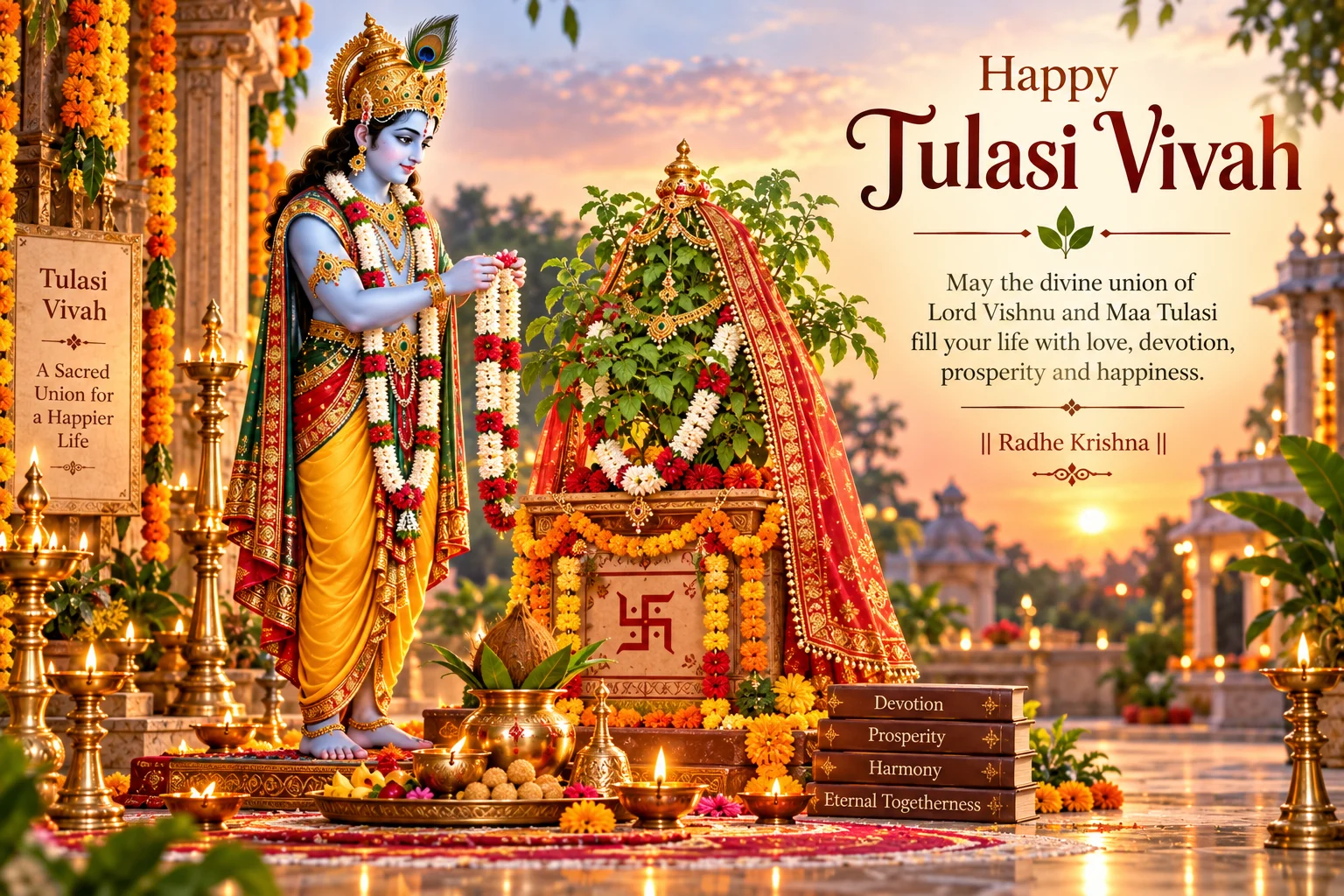
Tulasi Vivah
Tulasi Vivah, observed with supreme aesthetic splendor, Vedic sanctity, and devotional grandeur across India, is the ceremonial divine wedding of Goddess Tulasi—the sacred basil plant personifying divine purity and unshakeable chastity—with Lord Sri Maha Vishnu in His sacred, self-manifested stone form of Sri Shaligram (or Sri Krishna / Damodara). Celebrated during the luminous waxing fortnight of the holy month of Kartika, most traditionally on Kartika Shukla Dwadashi (the twelfth lunar day immediately following Devutthana Ekadashi) or spanning the auspicious five-day window between Ekadashi and Kartika Purnima, this celestial nuptial ceremony marks the official, joyous inauguration of the Hindu wedding season (Vivaha Muhurats). Across millions of households and temples, courtyards are transformed into vibrant wedding pavilions where devotees perform every intricate Vedic marriage rite, establishing a sacred cosmic bridge between earthly devotion, environmental reverence, and transcendental love.
Kartik Purnima
Kalabhairav Jayanti
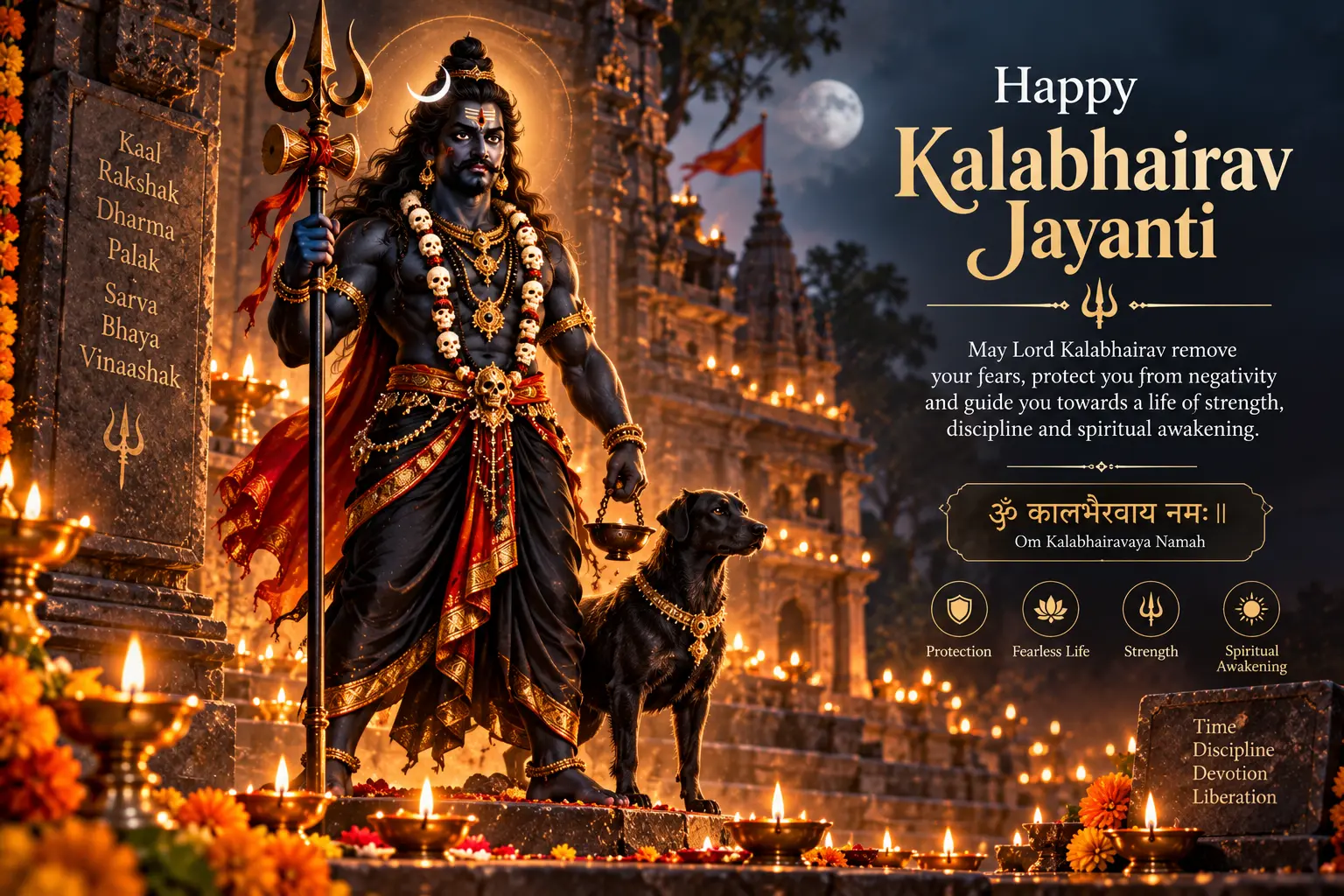
Kalabhairav Jayanti, also celebrated with immense esoteric reverence, scriptural awe, and nocturnal solemnity as Bhairava Ashtami, Kalabhairav Ashtami, and Maha Bhairavashtami, marks the divine advent (Jayanti) of Lord Kalabhairava—the terrifying, fierce, and all-destroying manifestation of Lord Sadashiva who presides as the supreme master over all-consuming Time (Kala) and the invincible annihilator of fear (Bhaya-Nashaka). Occurring on the Krishna Paksha Ashtami (the eighth lunar day of the waning moon) in the sacred month of Margashirsha (or Kartika in the Purnimanta calendar prevalent across northern India), this sacred tithi commemorates the cosmic moment when the Supreme Mahadeva manifested His most awe-inspiring form from between His eyebrows to destroy pride, punish unrighteous arrogance, uphold cosmic order, and establish the sacred law of spiritual justice across the universe.
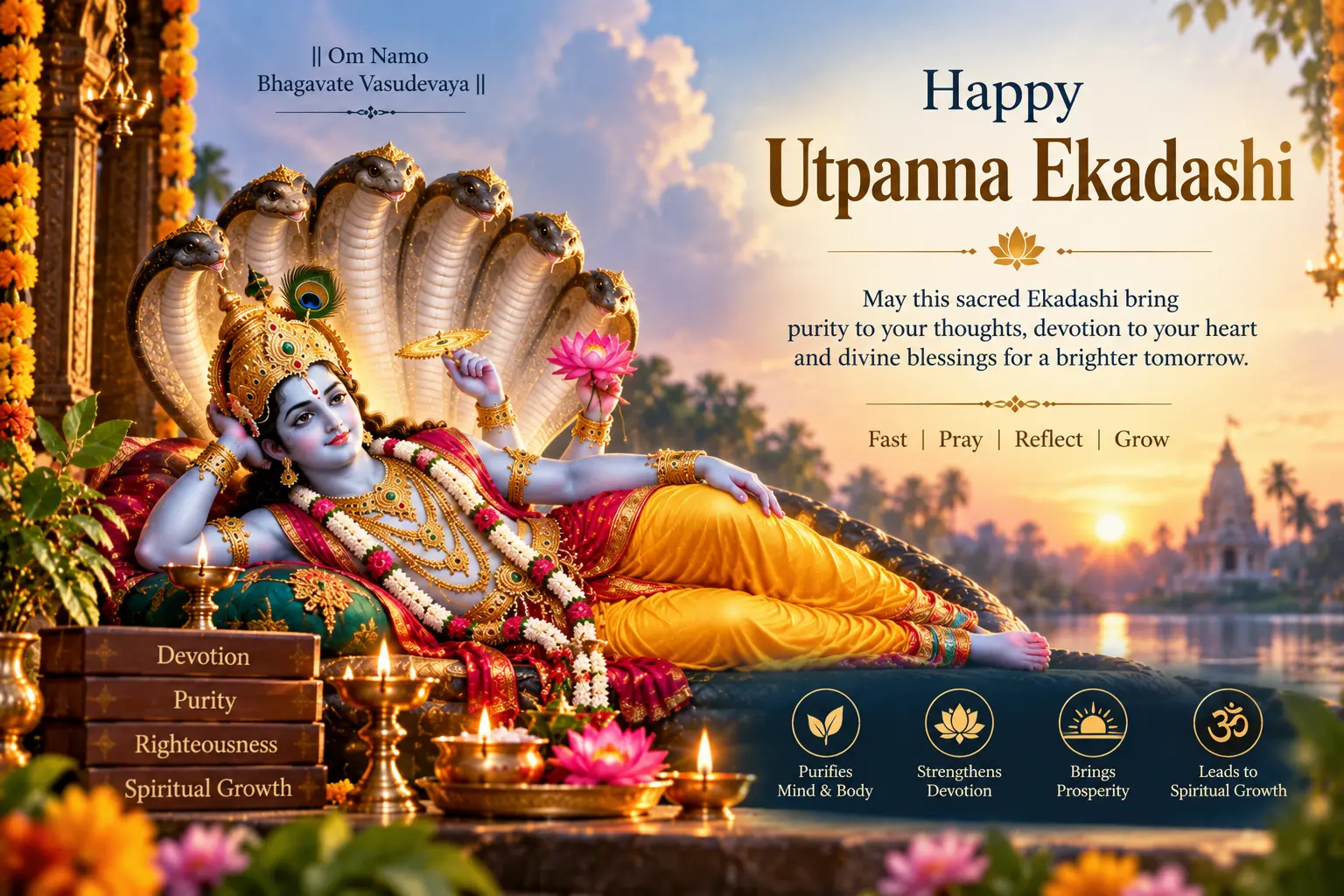
Utpanna Ekadashi
Utpanna Ekadashi, observed with supreme scriptural reverence, incandescent devotion, and profound spiritual joy across India, is the radiant advent anniversary (Utpatti / Jayanti) of Goddess Ekadashi herself—the divine, four-armed celestial maiden who personifies the transcendental fasting power and spiritual potency of the Supreme Preserver, Lord Sri Maha Vishnu. Occurring on the Krishna Paksha Ekadashi (the eleventh lunar day of the waning moon) in the sacred month of Margashirsha (or Kartika in the Purnimanta lunar calendar prevalent across northern India), this foundational tithi marks the divine origin and fountainhead of all twenty-four (and in leap years, twenty-six) Ekadashis of the Hindu liturgical year. It is celebrated as the mother of all Ekadashi vows, the spiritual bridge that initiates the annual cycle of Ekadashi fasting, and the supreme tithi wherein the observance of Ekadashi was forever consecrated as the most direct royal pathway to the transcendental abode of Vaikuntha.

Vivah Panchami
Vivah Panchami, observed with supreme aesthetic elegance, devotional ecstasy, and epic scriptural splendor across the Indian subcontinent and Nepal, is the sacred wedding anniversary of Lord Sri Rama—the Maryada Purushottama and seventh transcendental incarnation of Lord Sri Maha Vishnu—and Goddess Sita, the beloved daughter of King Janaka and the earthly manifestation of Goddess Mahalakshmi. Occurring on the Shukla Paksha Panchami (the fifth lunar day of the waxing moon) in the holy winter month of Margashirsha (Agrahayana), this enchanting festival commemorates the divine nuptial union (Vivaha Samskara) solemnized in the ancient capital of Mithila (modern-day Janakpurdham). Across thousands of temples and domestic shrines, this auspicious tithi is celebrated as the cosmic benchmark of righteous matrimony, spiritual partnership, and unconditional fidelity, reuniting the hearts of devotees with the timeless ideals of the Valmiki Ramayana and the Ramcharitmanas.
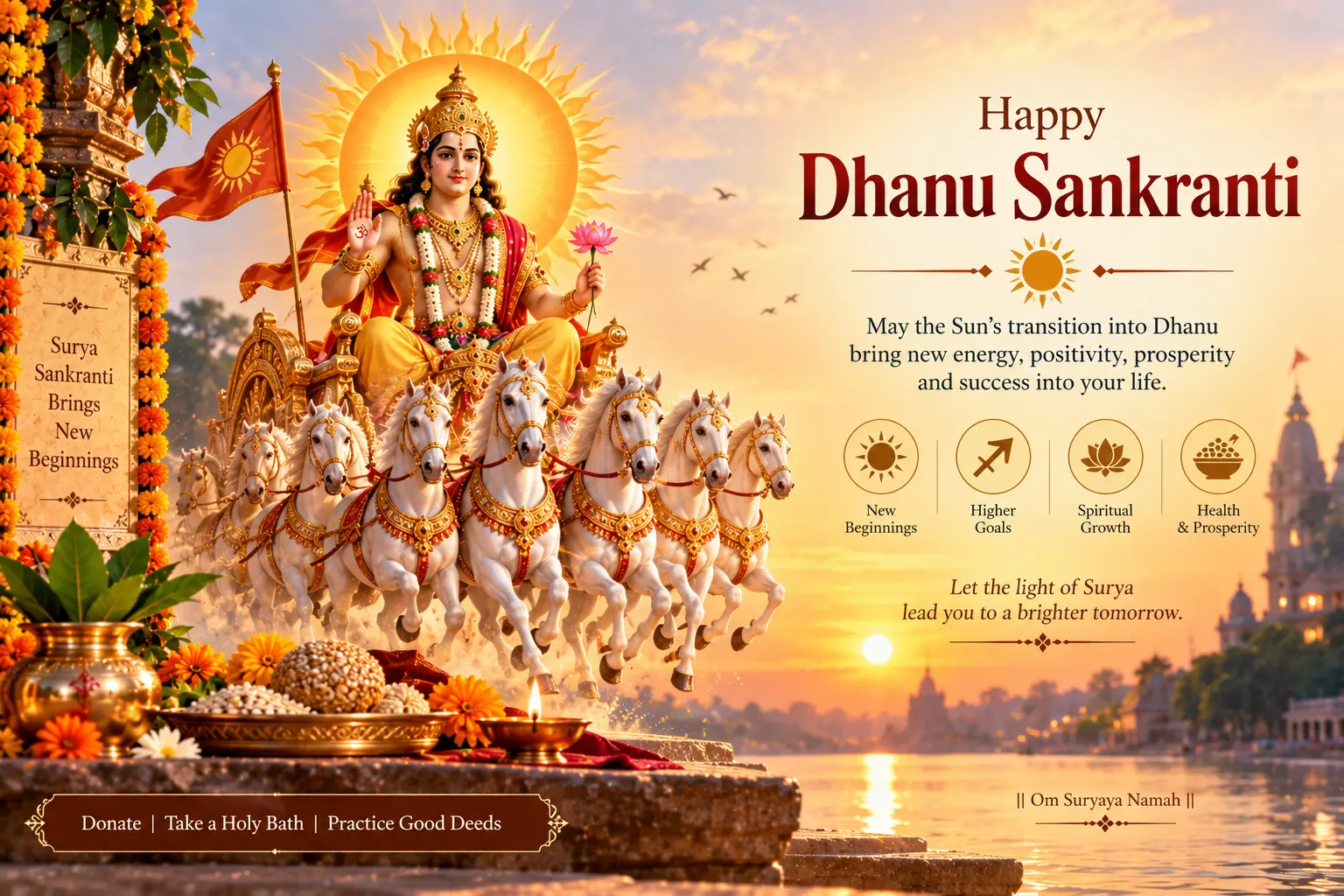
Dhanu Sankranti
Dhanu Sankranti, observed with profound astrological, agricultural, and devotional significance across the Indian subcontinent, marks the momentous astronomical ingress (Sankramana) of Lord Surya—the divine Sun God—from the water sign of Vrishchika (Scorpio) into the fiery, sattvic zodiac sign of Dhanu (Sagittarius), ruled by the celestial preceptor Guru (Jupiter). Occurring in the sacred month of Margashirsha or early Pausha (mid-December), this celestial transition marks the beginning of the solar month of Dhanu Masa and initiates the celebrated period known as Kharmas or Malmas across northern and eastern India. Revering the life-giving solar luminary as the visible eye of the Supreme Cosmic Being (Pratyaksha Devata), Dhanu Sankranti is dedicated to purifying the mind and body through sacred river snanam, Surya arghya, charitable donations, and intense scriptural study before the sun turns northward during Makar Sankranti.
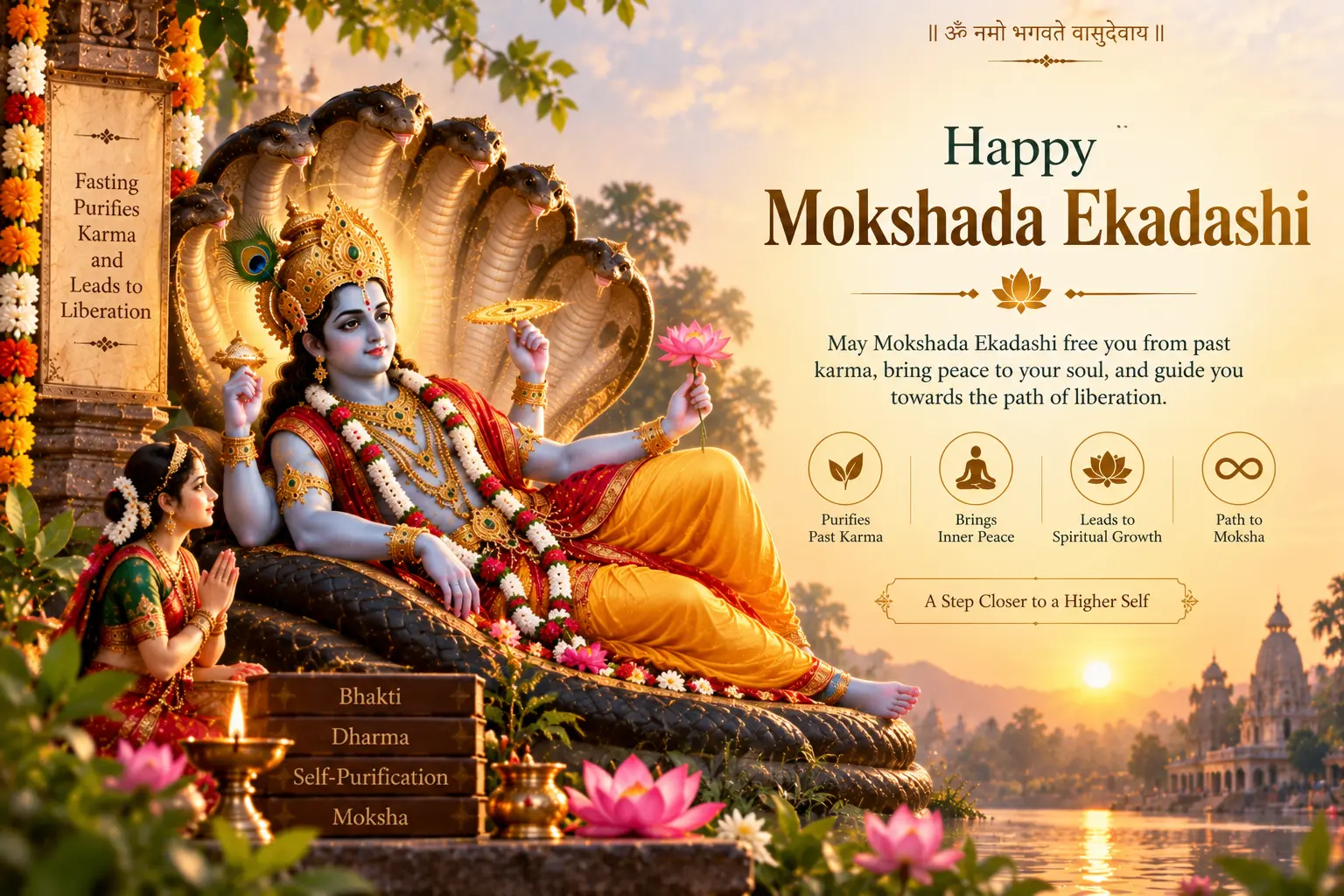
Mokshada Ekadashi
Mokshada Ekadashi, observed on the Shukla Paksha Ekadashi (the eleventh lunar day of the waxing moon) in the sacred winter month of Margashirsha (Agrahayana), is one of the most spiritually venerated and soteriologically potent fasting days in Sanatana Dharma. As its Sanskrit name unequivocally proclaims—'Mokshada', meaning 'the bestower of ultimate liberation (Moksha)'—this holy vrata possesses the extraordinary capacity to dissolve mountains of accumulated karmic transgressions, deliver departed ancestral souls from torment in lower realms (Naraka), and grant unalloyed devotion to Lord Sri Damodara-Krishna. Celebrated with intense ascetic discipline, scriptural recitation, and uninterrupted contemplation across India and Nepal, Mokshada Ekadashi holds supreme significance in both Smarta and Vaishnava traditions as an unshakeable bridge from the ocean of mortal sorrow to the eternal tranquility of Vaikuntha.
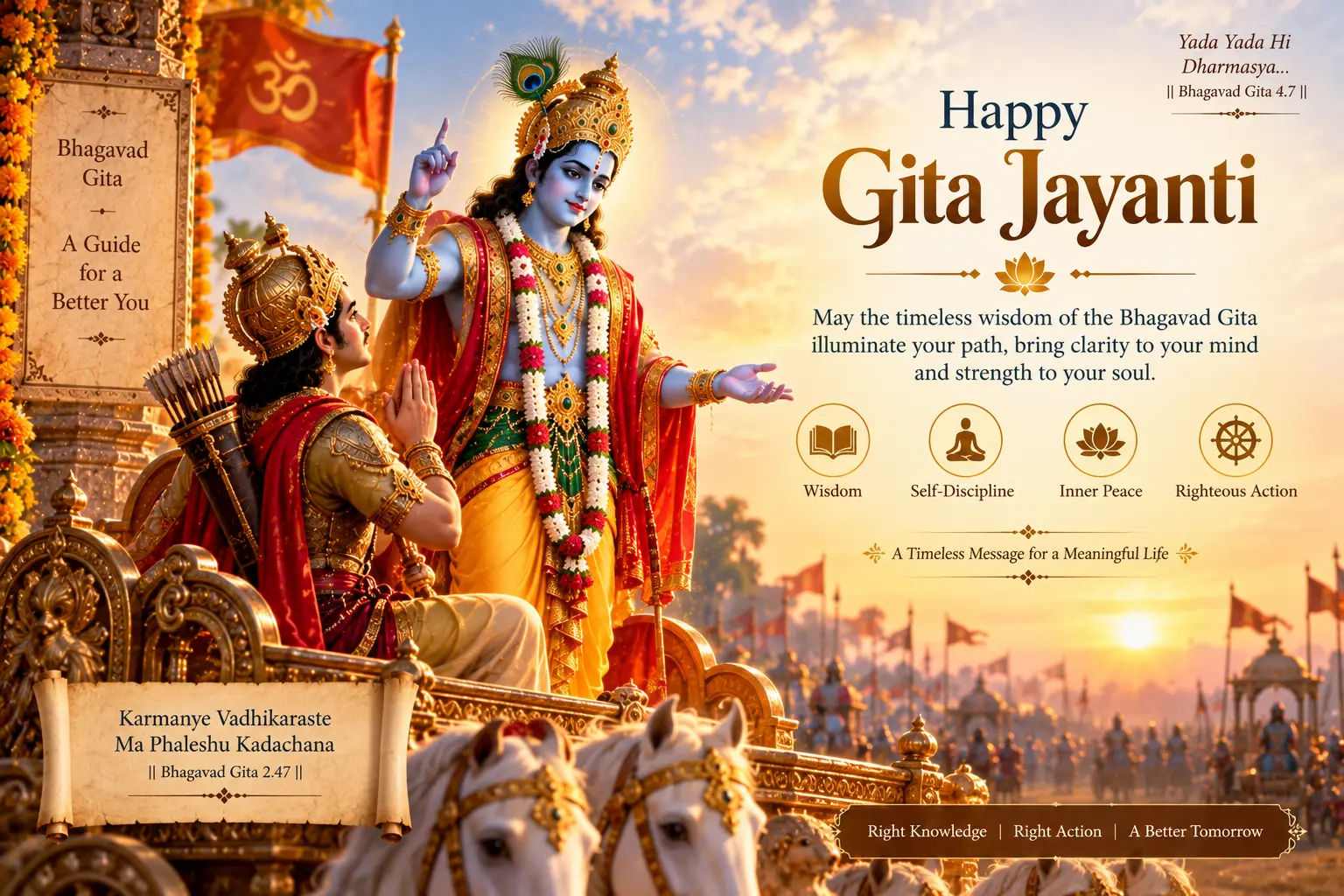
Gita Jayanti
Gita Jayanti is one of the most intellectually revered and spiritually profound festivals in Sanatana Dharma, celebrating the historic revelation of the Srimad Bhagavad Gita—the timeless song of the Supreme Personality of Godhead, Bhagavan Sri Krishna. Occurring on the auspicious Ekadashi tithi of Shukla Paksha in the holy winter month of Margashirsha (November–December), this sacred observance marks the hallowed occasion at Jyotisar in the ancient land of Kurukshetra where Sri Krishna imparted seven hundred verses of supreme spiritual wisdom to His bewildered friend and disciple, the Pandava prince Arjuna. Unlike conventional Hindu festivals that commemorate the earthly birthday or cosmic descent of deities, Gita Jayanti holds the unique distinction of celebrating the birth of a living philosophical scripture—a scripture that serves as the definitive manual for human existence, duty, self-realization, and devotion across all ages.