




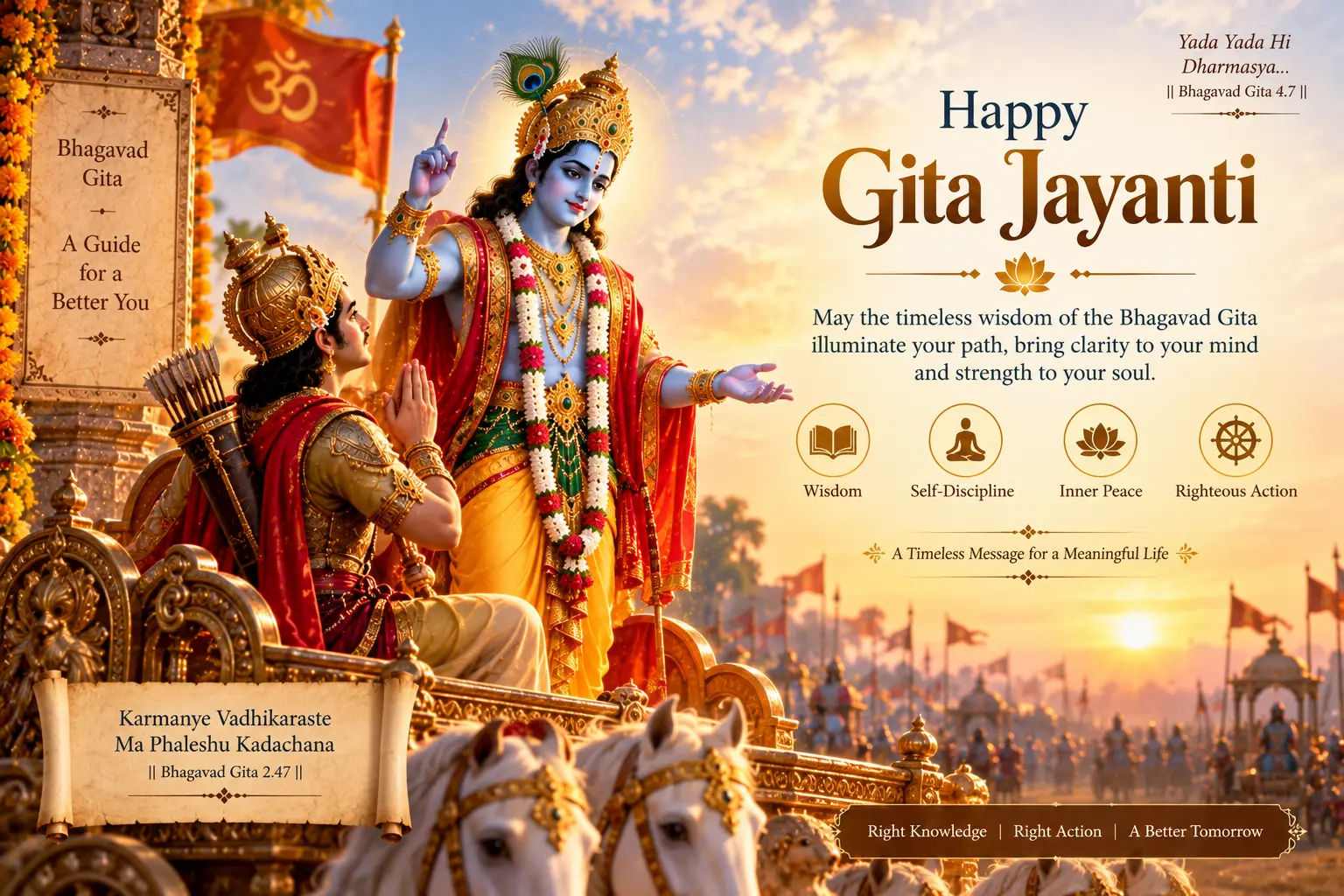
Gita Jayanti is one of the most intellectually revered and spiritually profound festivals in Sanatana Dharma, celebrating the historic revelation of the Srimad Bhagavad Gita—the timeless song of the Supreme Personality of Godhead, Bhagavan Sri Krishna. Occurring on the auspicious Ekadashi tithi of Shukla Paksha in the holy winter month of Margashirsha (November–December), this sacred observance marks the hallowed occasion at Jyotisar in the ancient land of Kurukshetra where Sri Krishna imparted seven hundred verses of supreme spiritual wisdom to His bewildered friend and disciple, the Pandava prince Arjuna. Unlike conventional Hindu festivals that commemorate the earthly birthday or cosmic descent of deities, Gita Jayanti holds the unique distinction of celebrating the birth of a living philosophical scripture—a scripture that serves as the definitive manual for human existence, duty, self-realization, and devotion across all ages.
Gita Jayanti 2026: Date, Puja Timings, Rituals & Stories
Gita Jayanti Timings & Panchang
Important festival dates and auspicious timings
07:09 am
05:28 pm
Sunday, 20 Dec 2026
10:09 pm – 08:14 pm
Gita Jayanti
On the brink of the catastrophic Mahabharata war, amidst the thunderous clamor of conch shells and clashing legions, Arjuna stood overwhelmed by grief, attachment, and ethical paralysis upon witnessing his revered preceptors, grandsires, cousins, and lifelong companions assembled for mutual destruction. Overcome by despondency (Vishada), Arjuna laid down his Gandiva bow and surrendered unconditionally to Sri Krishna as a disciple seeking ultimate truth. Standing between the two opposing armies, Lord Krishna delivered the eighteen chapters of the Bhagavad Gita, systematically unraveling the deepest mysteries of the eternal soul (Atman), the mechanics of cosmic nature (Prakriti), the illusion of mortal birth and death (Samsara), the path of selfless duty (Karma Yoga), the attainment of experiential knowledge (Jnana Yoga), the meditative transcendence of mind (Raja Yoga), and the ultimate summit of unalloyed surrender (Bhakti Yoga).
Across the sacred geography of India and among millions of seekers worldwide, Gita Jayanti is observed with solemn scriptural recitation (Gita Parayana), philosophical seminars, scholarly discourses, deep meditation, distribution of the Gita text, and sacred fire rituals (Gita Havan). At Jyotisar in Kurukshetra, Haryana—beneath the ancient banyan tree that witnessed the celestial dialogue—pilgrims, acharyas, and ascetics assemble for the grand International Gita Mahotsav, chanting all seven hundred shlokas simultaneously. The vibrations of the Gita purify the atmosphere, inspiring householders and ascetics alike to awaken to their higher spiritual purpose and live with fearless equanimity.
Why is Gita Jayanti Celebrated?
Gita Jayanti is celebrated to commemorate the precise historical and cosmic moment when Bhagavan Sri Krishna revealed the eternal spiritual wisdom of the Bhagavad Gita to Arjuna on the battlefield of Kurukshetra. It represents the divine descent of eternal Vedic knowledge (Veda Vani) in an accessible, concentrated form, spoken directly from the lotus mouth of the Supreme Lord Himself.
The festival marks the transformation of human despondency (Arjuna Vishada) into supreme spiritual enlightenment and righteous action. In our everyday lives, every human being encounters situations resembling Kurukshetra—crises of conscience, ethical dilemmas, fear of loss, emotional attachment, and paralysis of will. Celebrating Gita Jayanti reaffirms the eternal message that by surrendering our personal ego to divine wisdom, we can overcome every inner battle and fulfill our life's higher calling.
It honors the synthesis of all yogic paths—Karma Yoga, Jnana Yoga, Dhyana Yoga, and Bhakti Yoga. Rather than advocating escape from worldly responsibilities, the Bhagavad Gita teaches the sublime art of Nishkama Karma—selfless action performed without attachment to results. Celebrating this day inspires seekers to integrate practical excellence in the world with uninterrupted contemplation of the Divine.
The festival coincides with Mokshada Ekadashi, magnifying its salvific efficacy. Puranic scriptures affirm that reading, chanting, listening to, and reflecting upon even a single chapter, single verse, or single quarter of a verse of the Bhagavad Gita on this day bestows spiritual merit equal to bathing in the Ganga and performing thousands of Vedic sacrifices.
Finally, Gita Jayanti serves as a worldwide revival of scriptural study (Swadhyaya). It is celebrated by distributing copies of the Bhagavad Gita to seekers, conducting youth seminars, organizing recitation competitions, and renewing our collective commitment to live according to moral integrity, compassion, and divine love.
- Commemorating the historic revelation of the Bhagavad Gita by Lord Sri Krishna to Arjuna at Jyotisar in Kurukshetra.
- Awakening humanity from the stupor of illusion (Maya) and grief through the timeless science of self-realization.
The Historical and Cosmic Revelation of the Bhagavad Gita: From Kurukshetra to Eternity
The Crisis of Kurukshetra and the Despondency of Arjuna
The epic narrative of the Mahabharata culminates in the colossal war between the righteous Pandavas and the deceitful Kauravas on the sacred plains of Kurukshetra (Dharmakshetra). As millions of warriors assembled under the banners of kings from every corner of Bharatavarsha, Prince Arjuna, armed with his celestial bow Gandiva, rode out between the opposing armies on a grand chariot drawn by four white horses, with Lord Sri Krishna Himself holding the reins as Parthasarathi (the charioteer of Partha).
Arjuna requested Sri Krishna to place his chariot precisely between the two armies so he could behold those who stood ready for combat. Looking across the front lines, Arjuna saw his beloved grandsire Bhishma, who had raised him on his lap; his revered martial guru Dronacharya, who had shaped his archery; his teacher Kripacharya; his uncles, brothers, sons, and lifelong friends. Suddenly, a wave of intense pity, deep grief, and profound existential confusion seized Arjuna's heart. Trembling violently, with his throat dry, his skin burning, and tears blinding his vision, Arjuna declared that he could see no good in slaughtering his own kinsmen for the sake of royal luxuries or an earthly kingdom.
Overwhelmed by compassion and misguided sentiment, Arjuna cast away his divine bow and arrows and sat down in the chariot, weeping. In that historic moment of total despondency (Arjuna Vishada Yoga), Arjuna made the pivotal spiritual leap: he acknowledged his confusion, recognized that his empirical knowledge was powerless to cure his grief, and surrendered completely to Sri Krishna, praying: 'I am Your disciple, surrendered unto You. Please instruct me in that which is definitively best for my eternal welfare.'
The Eternal Song: Sri Krishna's Systematic Instruction
Hearing Arjuna's anguished plea, Lord Sri Krishna smiled gently and began His immortal discourse, recorded across eighteen chapters and seven hundred shlokas in the Bhishma Parva of the Mahabharata. The Lord immediately dismantled Arjuna's sorrow at its root by exposing the fundamental fallacy of confusing the immortal self (Atman) with the mortal physical body (Deha). 'You mourn for those who are not worthy of grief, yet you speak words of wisdom,' Sri Krishna declared. 'The wise lament neither for the living nor for the dead. As the soul passes through childhood, youth, and old age in this body, so it similarly passes into another body at death. The soul is never born, nor does it ever die; weapons cannot cleave it, fire cannot burn it, water cannot wet it, and wind cannot dry it.'
Metaphysical Wisdom: The Universal Manual for Psychological Harmony and Spiritual Liberation
Kurukshetra as the Eternal Battlefield of the Human Mind
In the allegorical interpretation expounded by traditional acharyas and enlightened commentators, Kurukshetra is not merely an ancient field in Haryana; it is the arena of the human heart and mind. The human body is the Dharmakshetra—the field of righteousness where karmic seeds are sown and harvested. Within every individual soul, two forces battle continuously: the Kauravas, representing the innumerable tendencies of lust, greed, anger, pride, envy, and ignorance born of darkness (Tamas and Rajas); and the Pandavas, representing the noble virtues of truth, righteousness, devotion, detachment, and discriminative wisdom born of purity (Sattva).
Arjuna represents the individual soul (Jivatman) caught in the web of delusion (Moha), paralyzed by conflicting duties and emotional attachments. Sri Krishna represents the Paramatman—the Indwelling Witness and Supreme Guide residing in the heart of every living being. When the Jivatman surrenders its personal ego to the Paramatman, spiritual paralysis dissolves, and divine wisdom illuminates the intellect to fight and conquer the inner forces of darkness.
The Philosophy of Nishkama Karma: Action as Yoga
One of the greatest philosophical contributions of the Bhagavad Gita is the doctrine of Nishkama Karma Yoga—the performance of duty without attachment to personal fruits. Conventional philosophy often viewed intense action and spiritual contemplation as mutually exclusive, prescribing world-renouncing asceticism as the sole path to liberation. Sri Krishna radically redefined renunciation (Sannyasa) not as the physical abandonment of action, but as the renunciation of ego-driven motives and anxiety over results.
When a human being works motivated by selfish desires, every action produces karmic bondage (Karma Bandhana), anxiety, and agitation. However, when action is performed with mental poise (Samatvam yoga uchyate) and offered as a sacrifice to the Supreme Lord (Yajnarthat karmano'nyatra loko'yam karma-bandhanah), the very same work becomes an instrument of spiritual purification. Nishkama Karma enables an individual to live fully in the world, managing family, profession, and societal leadership with dynamic efficiency, while remaining internally as untouched by worldly taint as a lotus leaf is by water.
Ritual Protocols: Gita Parayana, Swadhyaya, and Devotional Practices
Complete Gita Parayana (Continuous Scriptural Chanting)
The central ritual observance of Gita Jayanti is Gita Parayana—the complete recitation of all eighteen chapters and seven hundred shlokas of the Bhagavad Gita. In temples, ashrams, and private residences, devotees begin chanting early in the morning before the family altar. If chanting all eighteen chapters in one sitting is impractical for householders, chapters are divided throughout the day, or devotees chant key focal chapters such as Chapter 12 (Bhakti Yoga), Chapter 15 (Purushottama Yoga), or Chapter 18 (Moksha Sannyasa Yoga).
Recitation is preceded by chanting the Gita Dhyana Shlokas (nine invocatory verses praising the Gita as the ambrosial milk drawn from the cows of the Upanishads by the milkman Sri Krishna). Chanting is conducted with clear Sanskrit pronunciation, rhythmic cadence, and deep reverent contemplation of each verse's meaning.
Fasting on Mokshada Ekadashi and Gita Havan
Because Gita Jayanti coincides with Mokshada Ekadashi, observers maintain a strict fast according to their physical capacity. Devotees abstain from all food grains, pulses, beans, onions, and garlic, consuming only pure water, milk, fruits, and root vegetables (Phalahar). This ascetic discipline calms the senses, purifies the digestive system, and directs biological energy toward spiritual contemplation.
In many traditional communities, a sacred fire ritual (Gita Havan) is performed. In this havan, each of the seven hundred shlokas of the Bhagavad Gita is chanted aloud, accompanied by an oblation of pure cow ghee, sacred herbs, and black sesame seeds into the consecrated fire with the utterance of 'Svaha'. The sacred smoke purifies the surrounding environment and elevates the consciousness of all participants.
Gita Dan (Distribution of Scriptures) and Swadhyaya Satsang
A foundational practice on Gita Jayanti is Gita Dan—gifting authentic editions of the Bhagavad Gita to students, seekers, friends, and community members. In Chapter 18, verses 68 and 69, Sri Krishna declares that whoever imparts this supreme secret wisdom to His devotees performs the highest service of devotion, and no one in the world is dearer to Him.
Gita Jayanti Puja Vidhi (Step by Step)
- 1
Brahma Muhurta Snanam and Sankalpa
Awaken during the auspicious Brahma Muhurta (approximately one and a half hours before sunrise). Cleanse the body thoroughly with pure water, ideally invoking sacred rivers (Ganga, Yamuna, Godavari, Saraswati, Narmada, Sindhu, Kaveri). Wear clean, fresh, unstitched yellow or white garments. Face east or north before the family altar and take the solemn Sankalpa (vow) of observing Gita Jayanti and Mokshada Ekadashi vrat, pledging devotion, scriptural study, and truthful conduct for the pleasure of Bhagavan Sri Krishna.
- 2
Altar Cleansing and Sanctification (Bhumi Shuddhi)
Thoroughly clean the puja altar and room. Sprinkle consecrated water mixed with Ganga jal and Tulasi leaves while chanting the Pavamana Sukta or the purification mantra: 'Om Apavitrah Pavitro Va Sarvavastham Gato'pi Va, Yah Smaret Pundarikaksham Sa Bahyabhyantarah Shuchih'. Spread a fresh, clean silk cloth (preferably yellow) over the wooden puja chauki (dais).
- 3
Sthapana of Sri Krishna, Arjuna, and Srimad Bhagavad Gita
Install an idol or consecrated picture of Lord Sri Krishna, ideally as Parthasarathi (driving the chariot of Arjuna) or playing His divine flute. Beside the Lord, place a reverent depiction of Arjuna with folded hands. On a decorated wooden book-stand (Grantha Peetha), place a clean, sacred copy of the Srimad Bhagavad Gita wrapped in a red or yellow silk cloth (Pavitra Vastra).
- 4
Gita Jayanti Puja Samagri List
Idols, Scripture, and Altar Sacred Equipment
- Conch shell (Shankha) and brass ritual ringing bell (Ghanta)
- Pure copper, brass, or silver puja plate, tumblers, and spoon (Panchapatra and Achamani)
- Decorated wooden dais (Chauki or Bajot) and yellow silk altar cloth
- Wooden book-stand (Grantha Peetha or Rehal) for the Bhagavad Gita
- An authentic Sanskrit-vernacular edition of the Srimad Bhagavad Gita
- Idols or framed portraits of Lord Sri Krishna (Parthasarathi) and Arjuna
Sacred Bathing, Tilaka, and Fragrant Offerings
- Ganga jal (holy water) and clean spring water
- Panchamrita ingredients: pure cow milk, fresh curd, cow ghee, honey, and jaggery water
- Pure yellow sandalwood powder and Malayaja Chandana paste
- Kumkum (vermilion), pure camphor (Kapur), and Ashtagandha paste
- Natural herbal incense sticks (Dhoop/Agarbatti) of sandalwood, lotus, or rose
- Pure cow ghee or sesame oil with clean cotton wicks (Vatti) for the lamps
Floral Offerings and Sacred Plants
- Abundant fresh green Tulasi leaves and Tulasi Manjari (blossoms)
Mantras and Prayers for Gita Jayanti
Gita Jayanti Vrat Rules and Fasting Guidelines
Strict Observance of Mokshada Ekadashi Fasting
Because Gita Jayanti coincides precisely with Mokshada Ekadashi, devotees observing the vrata abstain strictly from all cereal grains, pulses, lentils, rice, wheat, corn, onions, and garlic. The fast may be observed as Nirjala (without water, for advanced seekers), Sajala (consuming only water and pure cow milk), or Phalahari (consuming fresh fruits, nuts, and sago). Fasting purifies bodily toxins, stabilizes mental restlessness, and attunes the consciousness to the subtle vibrations of Sri Krishna's teachings.
Disciplined Swadhyaya and Continuous Recitation
The day must be dedicated to Swadhyaya (sacred self-study). Devotees avoid unnecessary idle talk, arguments, political debates, and sensory entertainment. Silence (Mauna) or measured, gentle speech centered entirely on spiritual philosophy is observed. Devotees read the Sanskrit verses with accurate intonation, followed by deep reflection on the commentary (Bhashya) to assimilate the practical application of each teaching into daily conduct.
Practicing Equanimity and Nishkama Bhava
Throughout the festival day, practitioners make a conscious mental effort to practice the core virtue taught by the Gita: Samatvam (equanimity in joy and sorrow, gain and loss, praise and censure). Rather than reacting with irritation to daily disturbances, one practices offering every circumstance to the Divine with a calm, smiling disposition, treating every fellow creature with kindness and seeing Lord Sri Krishna present within every soul.
Sacred Dan (Charity) and Parana Timing
Devotees conclude the vrata by performing noble acts of charity (Dan), particularly Gita Dan (distributing copies of the Bhagavad Gita), Annadan (feeding hungry beings), and Gomata Seva (serving cows). On the subsequent day, Dwadashi tithi, the fast is broken within the prescribed Parana muhurta after morning prayers and offerings to pious brahmanas and seekers, thus completing the sacred two-day spiritual discipline.
Dos and Don'ts of Gita Jayanti
Good Practices (Do's)
- Wake up early during Brahma Muhurta, take a purifying bath, and make a sincere resolve to read and absorb the Bhagavad Gita.
- Recite at least one or more chapters of the Gita with proper Sanskrit pronunciation and deep contemplation of its practical meaning.
- Gift copies of the Srimad Bhagavad Gita to students, colleagues, relatives, and truth-seekers (Gita Dan).
- Observe the sacred fast of Mokshada Ekadashi according to your physical capacity to purify your mind and senses.
- Offer fragrant Tulasi leaves, yellow flowers, and pure cow ghee lamps to Lord Sri Krishna and the sacred scripture.
Gita Jayanti Across Regions
| Region | Local Name |
|---|---|
| Kurukshetra and Haryana | |
| Vrindavan and Mathura (Braj Region) | |
| Tamil Nadu and Karnataka | |
| West Bengal and Odisha | |
| Maharashtra and Gujarat |
Gita Jayanti FAQs
What is the historical and scriptural significance of Gita Jayanti?
Gita Jayanti marks the sacred day when Bhagavan Sri Krishna imparted the 700 verses of the Srimad Bhagavad Gita to Arjuna on the battlefield of Kurukshetra, on Margashirsha Shukla Ekadashi. Unlike other festivals celebrating deity incarnations, Gita Jayanti commemorates the birth of a living philosophical scripture that guides humanity through all ethical, spiritual, and psychological struggles.
Why does Gita Jayanti always coincide with Mokshada Ekadashi?
According to the Mahabharata and Padma Purana, Sri Krishna delivered the Gita on Shukla Paksha Ekadashi of Margashirsha, which is known as Mokshada Ekadashi. This alignment emphasizes that true liberation (Moksha) is achieved through spiritual knowledge, selfless action, and loving surrender to the Supreme Divine.
Which chapters of the Bhagavad Gita are especially recommended to chant on Gita Jayanti?
Upcoming Festivals
View All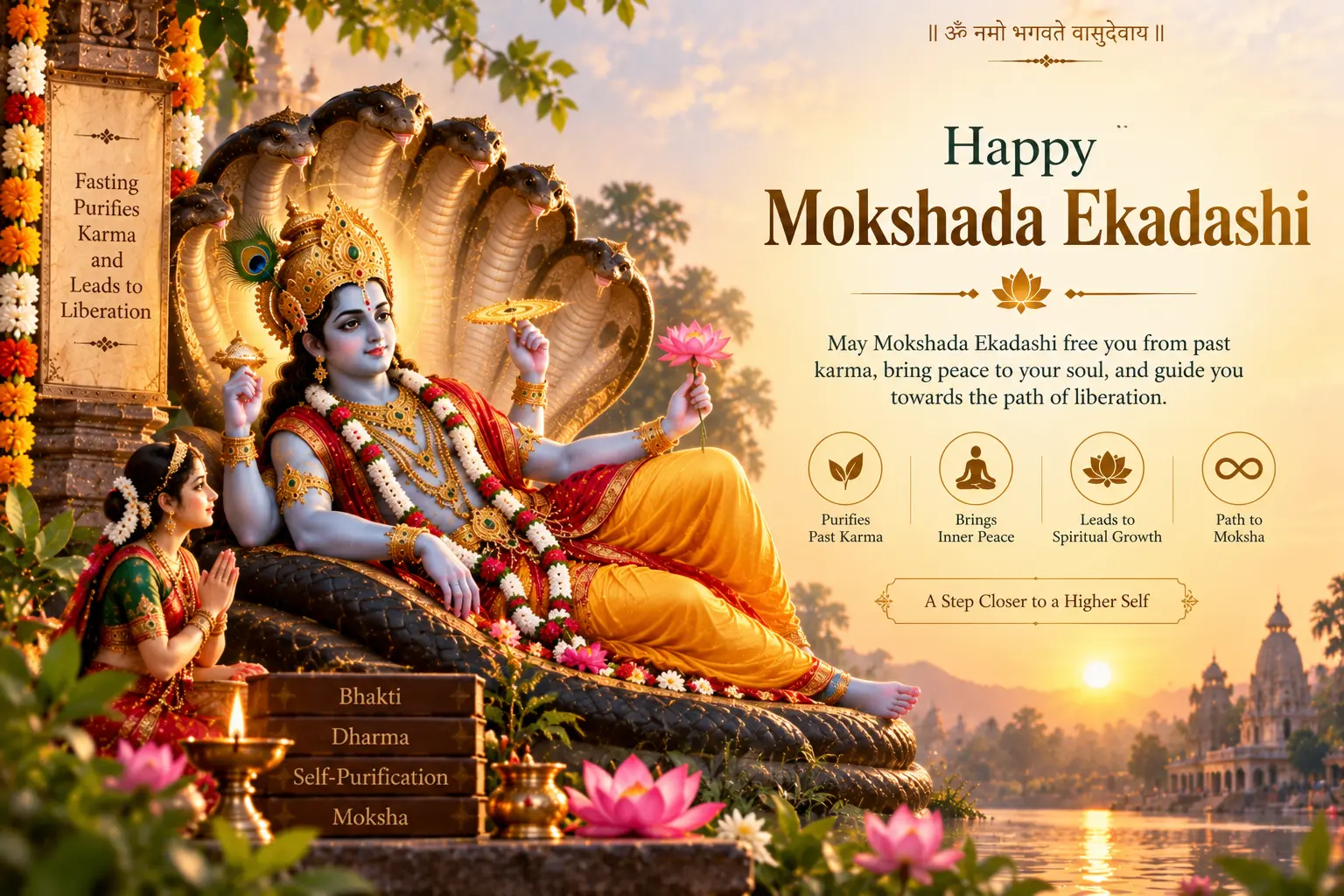
Mokshada Ekadashi
Mokshada Ekadashi, observed on the Shukla Paksha Ekadashi (the eleventh lunar day of the waxing moon) in the sacred winter month of Margashirsha (Agrahayana), is one of the most spiritually venerated and soteriologically potent fasting days in Sanatana Dharma. As its Sanskrit name unequivocally proclaims—'Mokshada', meaning 'the bestower of ultimate liberation (Moksha)'—this holy vrata possesses the extraordinary capacity to dissolve mountains of accumulated karmic transgressions, deliver departed ancestral souls from torment in lower realms (Naraka), and grant unalloyed devotion to Lord Sri Damodara-Krishna. Celebrated with intense ascetic discipline, scriptural recitation, and uninterrupted contemplation across India and Nepal, Mokshada Ekadashi holds supreme significance in both Smarta and Vaishnava traditions as an unshakeable bridge from the ocean of mortal sorrow to the eternal tranquility of Vaikuntha.
Dattatreya Jayanti
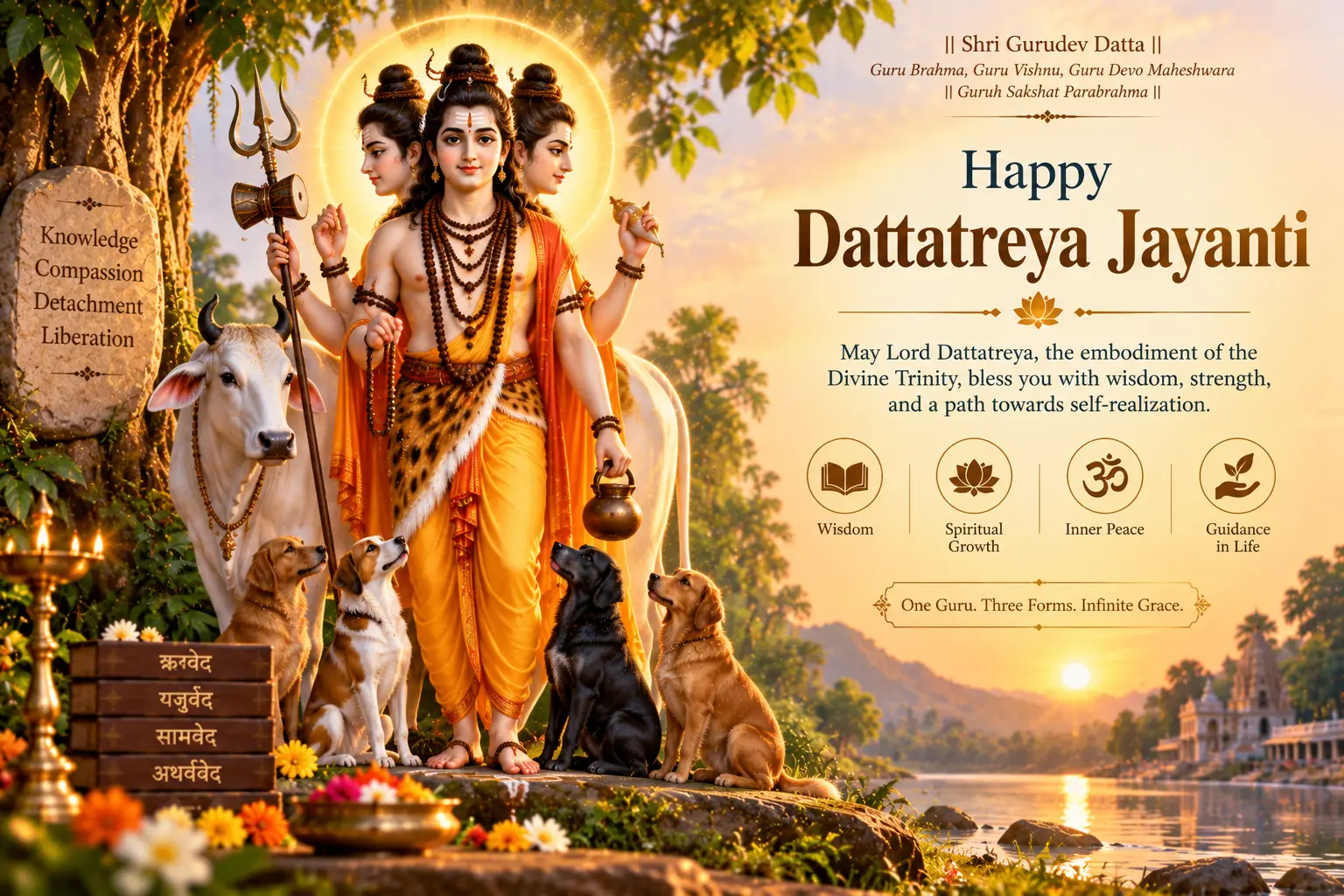
Dattatreya Jayanti, observed with profound esoteric reverence, ascetic contemplation, and devotional splendor across India, celebrates the auspicious divine advent of Lord Sri Dattatreya—the unified, primordial incarnation of the Hindu Supreme Trinity (Brahma, Vishnu, and Shiva). Occurring on the full moon day (Purnima tithi) of the sacred month of Margashirsha (November–December) under the radiant celestial influence of the Mrigashirsha nakshatra, this sacred festival commemorates the transcendental moment when the supreme archetypes of Creation (Brahma), Preservation (Vishnu), and Dissolution (Shiva) merged harmoniously into a singular transcendental form. Revering Dattatreya as the Adi Guru (the Primordial World Teacher), the Avadhuta of supreme renunciation, and the lord of all yogic wisdom, seekers celebrate this holy day to awaken inner discrimination, transcend the duality of earthly existence, and attain direct spiritual illumination.
Margashirsha Purnima
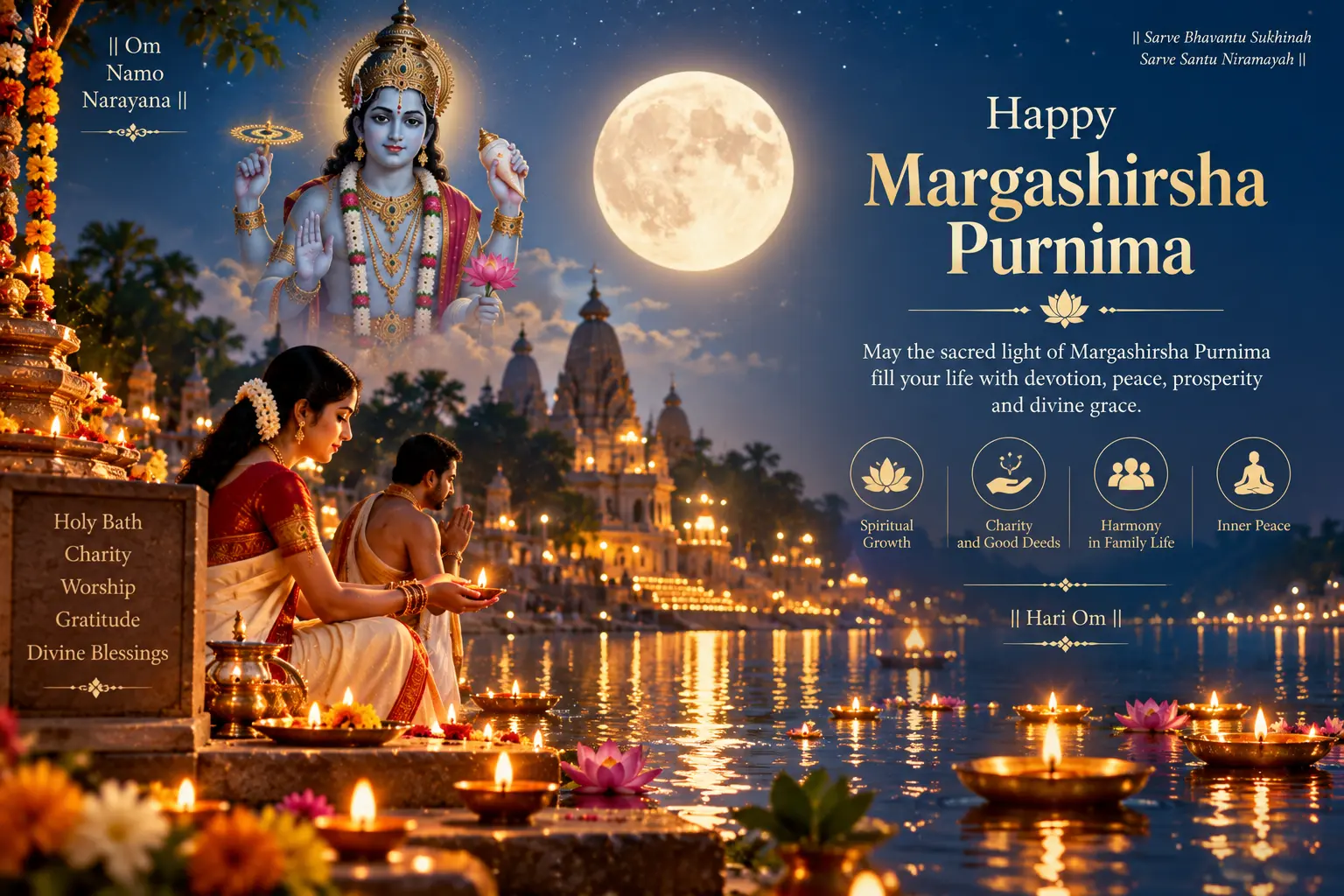
Margashirsha Purnima, celebrated on the full moon day of the sacred month of Margashirsha (Agrahayana), is one of the most spiritually illuminating and astrologically auspicious full moon festivals in Sanatana Dharma. Occurring when the full moon shines in the constellation of Mrigashirsha (the celestial deer's head ruled by the planet Mars and presided over by Soma, the Moon God), this holy tithi marks the supreme spiritual culmination of the month that Lord Sri Krishna Himself declared to be His own transcendental self in the Bhagavad Gita ('Masanang Margashirsho'ham'). Popularly known in various regional cultures as Battisi Purnima, Moksha Purnima, and Korvai Deepam, this sacred day unites the worship of Lord Sri Satyanarayan, the divine advent of Lord Dattatreya, the celestial Cosmic Dance of Lord Nataraja (Arudra Darshan), and ancient river-bathing rites.
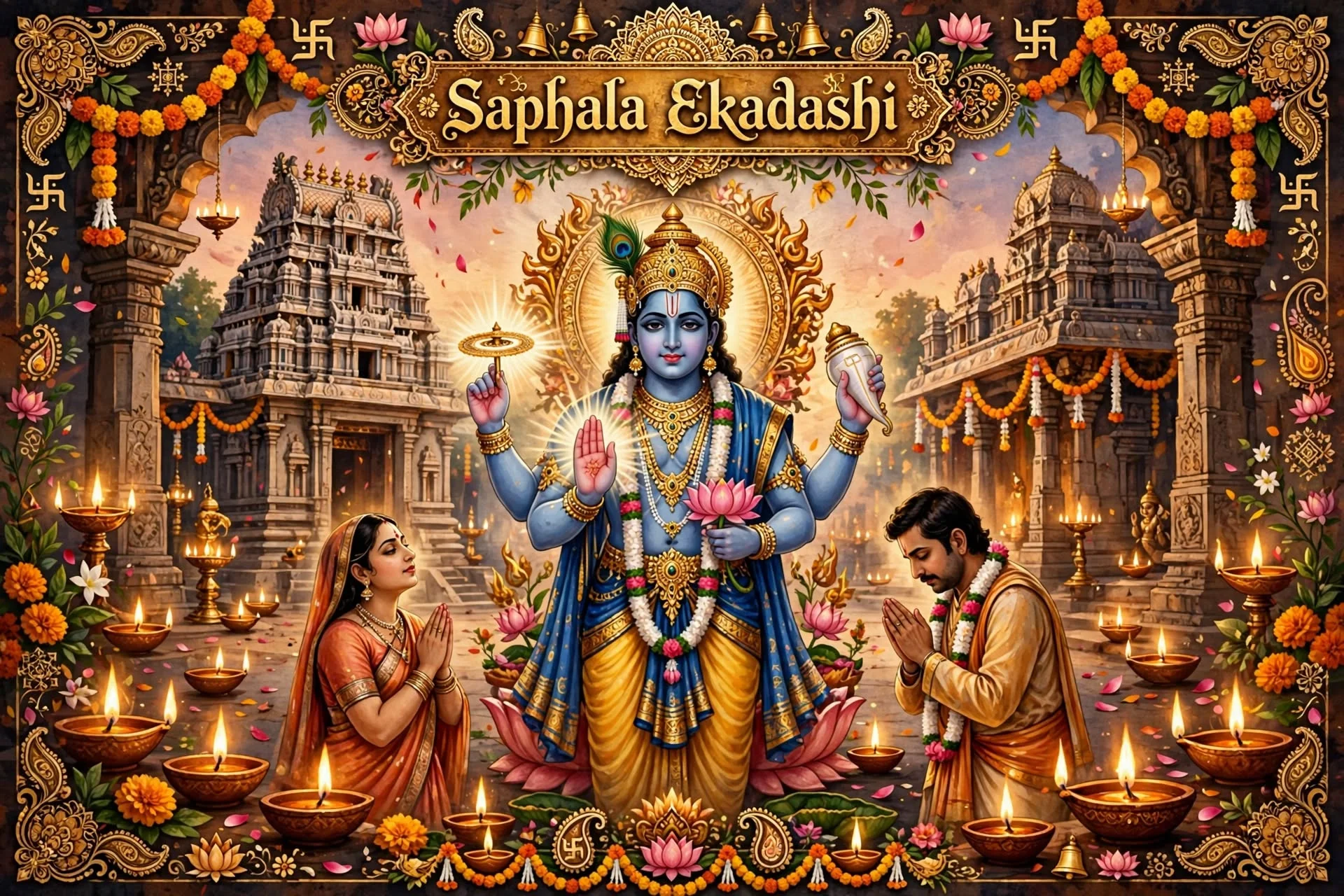
Saphala Ekadashi Vrat
Saphala Ekadashi, also known as Safala Ekadashi, is an important Hindu fasting day dedicated to Lord Vishnu. It is observed on the Ekadashi Tithi of Krishna Paksha in the month of Pausha according to the Purnimanta calendar. In the Amanta calendar, it falls in the Krishna Paksha of Margashirsha.
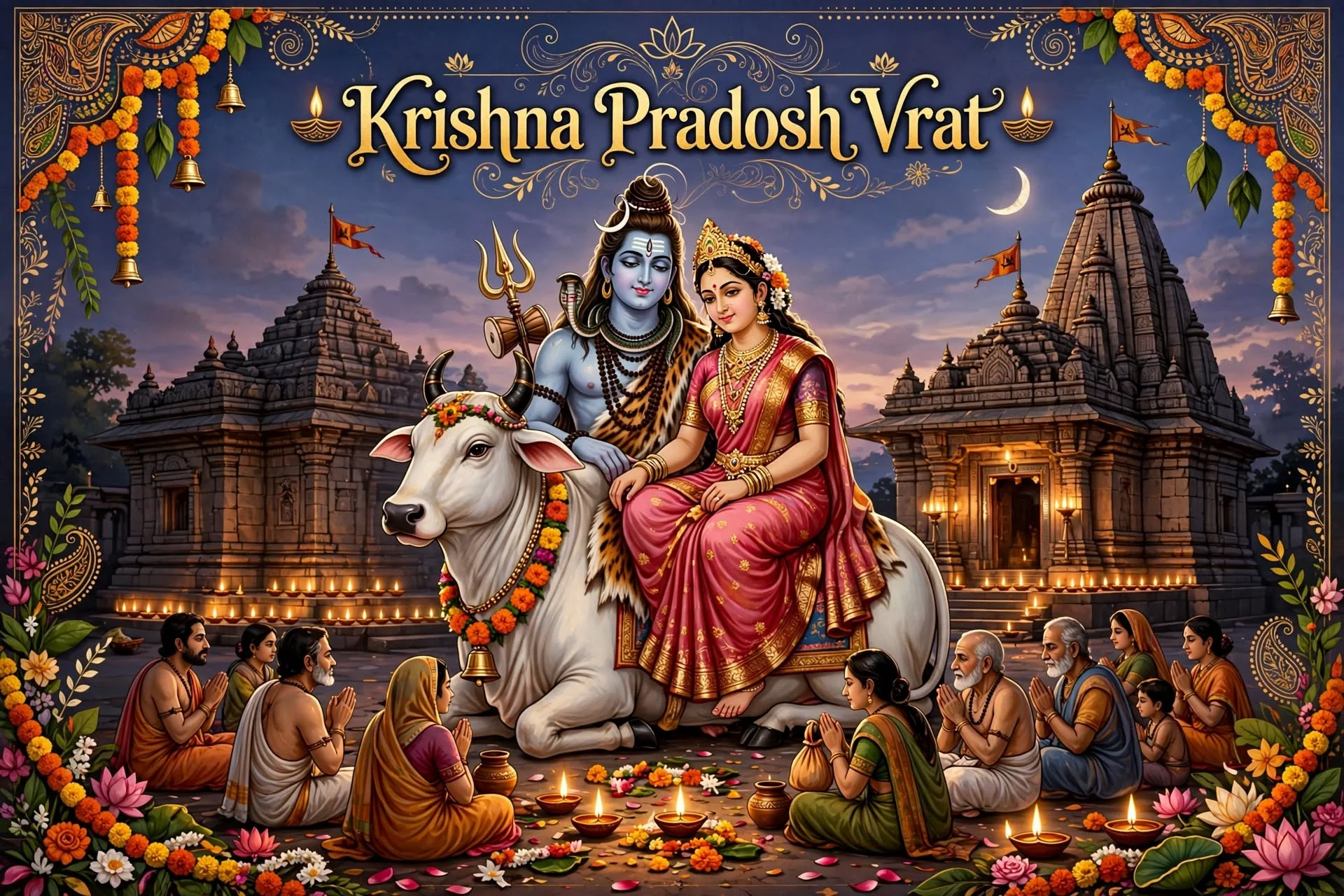
Krishna Pradosh Vrat
Masik Shivaratri is a monthly Hindu observance dedicated to Lord Shiva. It is observed on the Chaturdashi Tithi of Krishna Paksha, the fourteenth lunar day during the waning phase of the Moon. Devotees worship Lord Shiva with faith, observe a fast and perform night-time prayers to seek spiritual strength, peace and divine blessings.
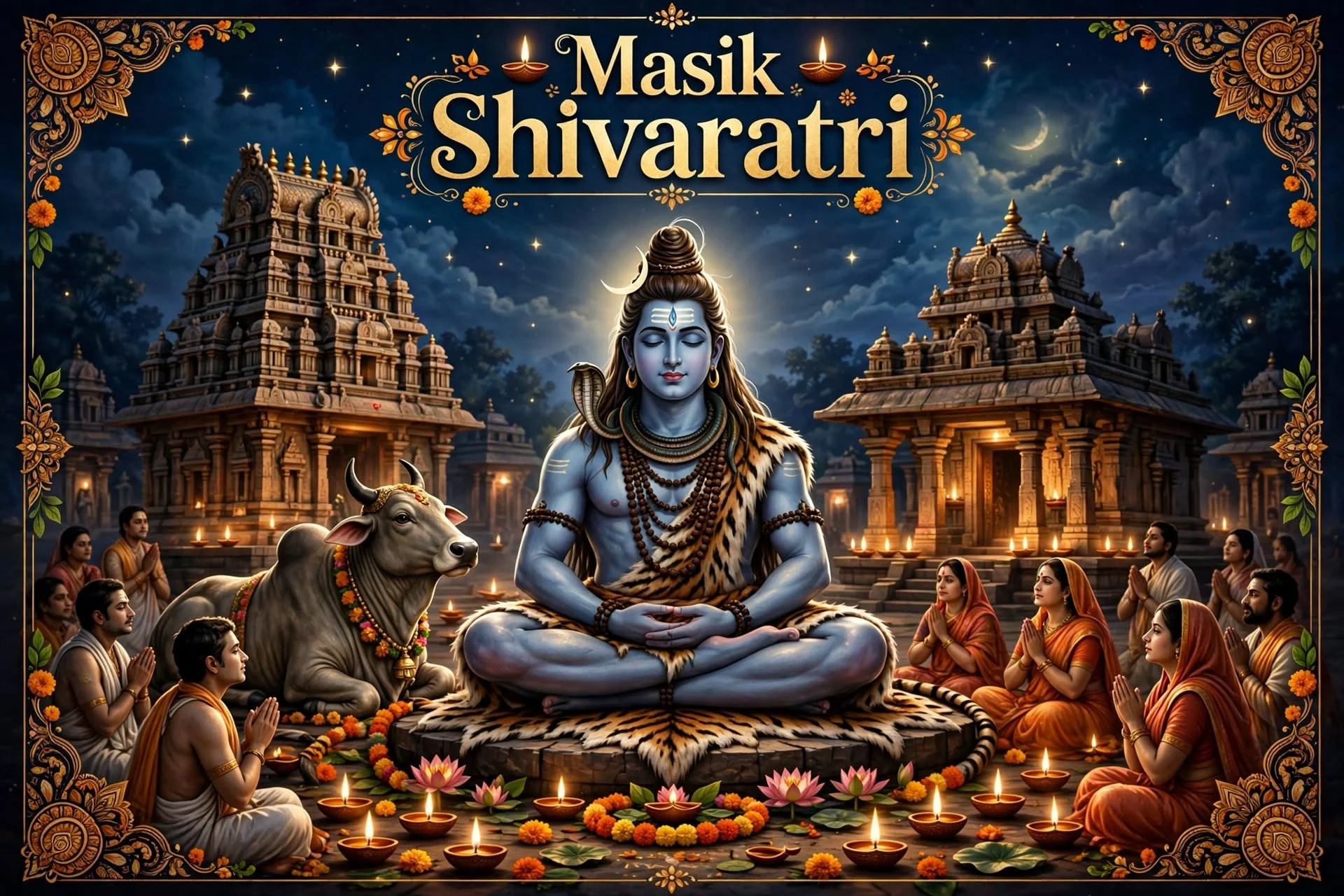
Masik Shivaratri
Masik Shivaratri, also known as Monthly Shivaratri or Masa Shivaratri, is a sacred Hindu observance dedicated to Lord Shiva. It is observed every lunar month on Krishna Paksha Chaturdashi, the fourteenth lunar day of the waning fortnight. Devotees worship Lord Shiva and Goddess Parvati, observe a vrat, perform Shiva Lingam Abhishek, chant sacred mantras and remain engaged in prayer during the night.
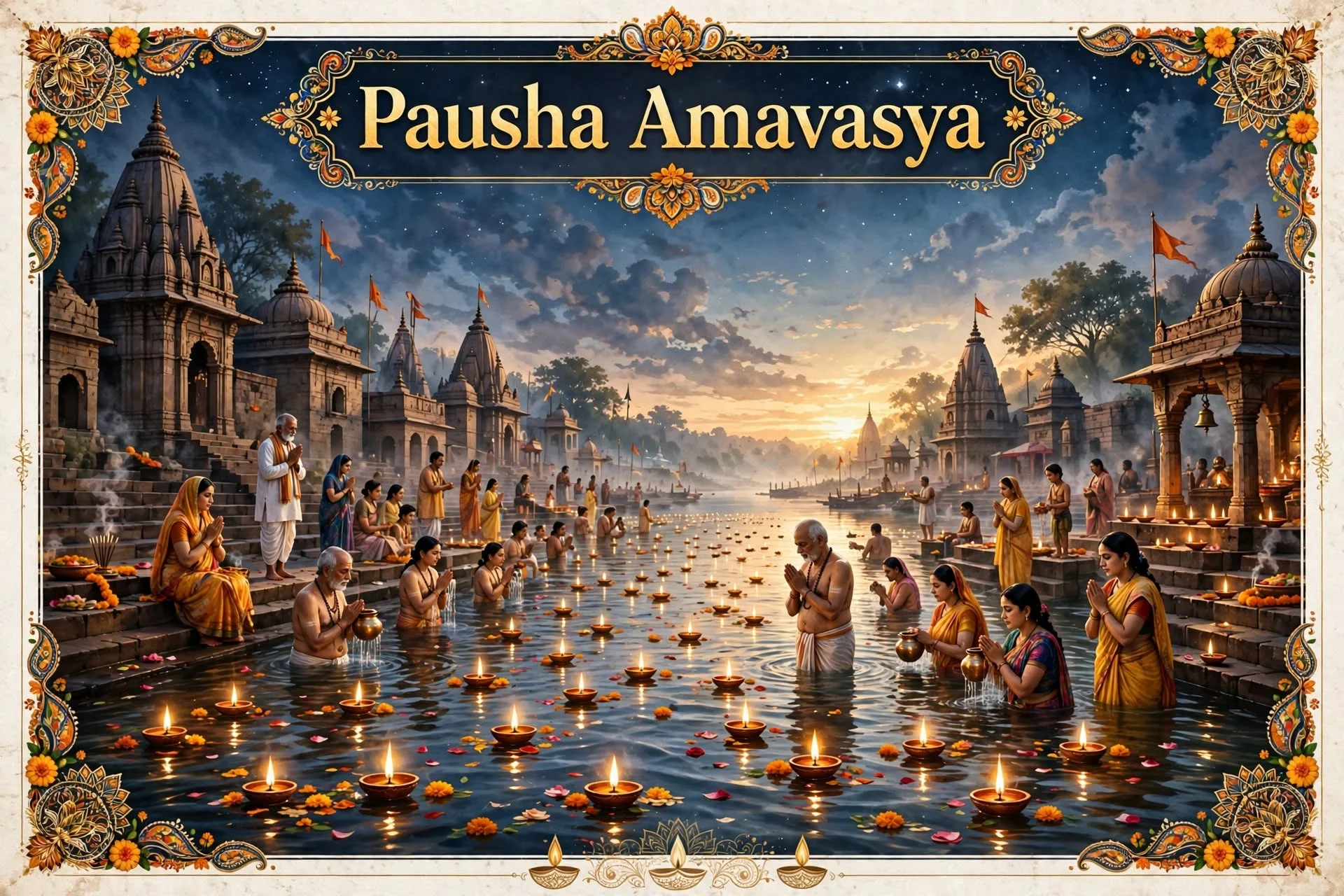
Pausha Amavasya
Pausha Amavasya is an important Hindu observance dedicated to remembering and honouring departed ancestors, known as Pitru. It falls on the Amavasya Tithi, or new-moon day, of the Hindu lunar month of Pausha. Devotees observe this day through sacred bathing, Pitru Tarpan, Shraddha, prayers, charity and acts of service. It is regarded as an appropriate occasion to express gratitude towards ancestors and seek their blessings for the wellbeing of the family.
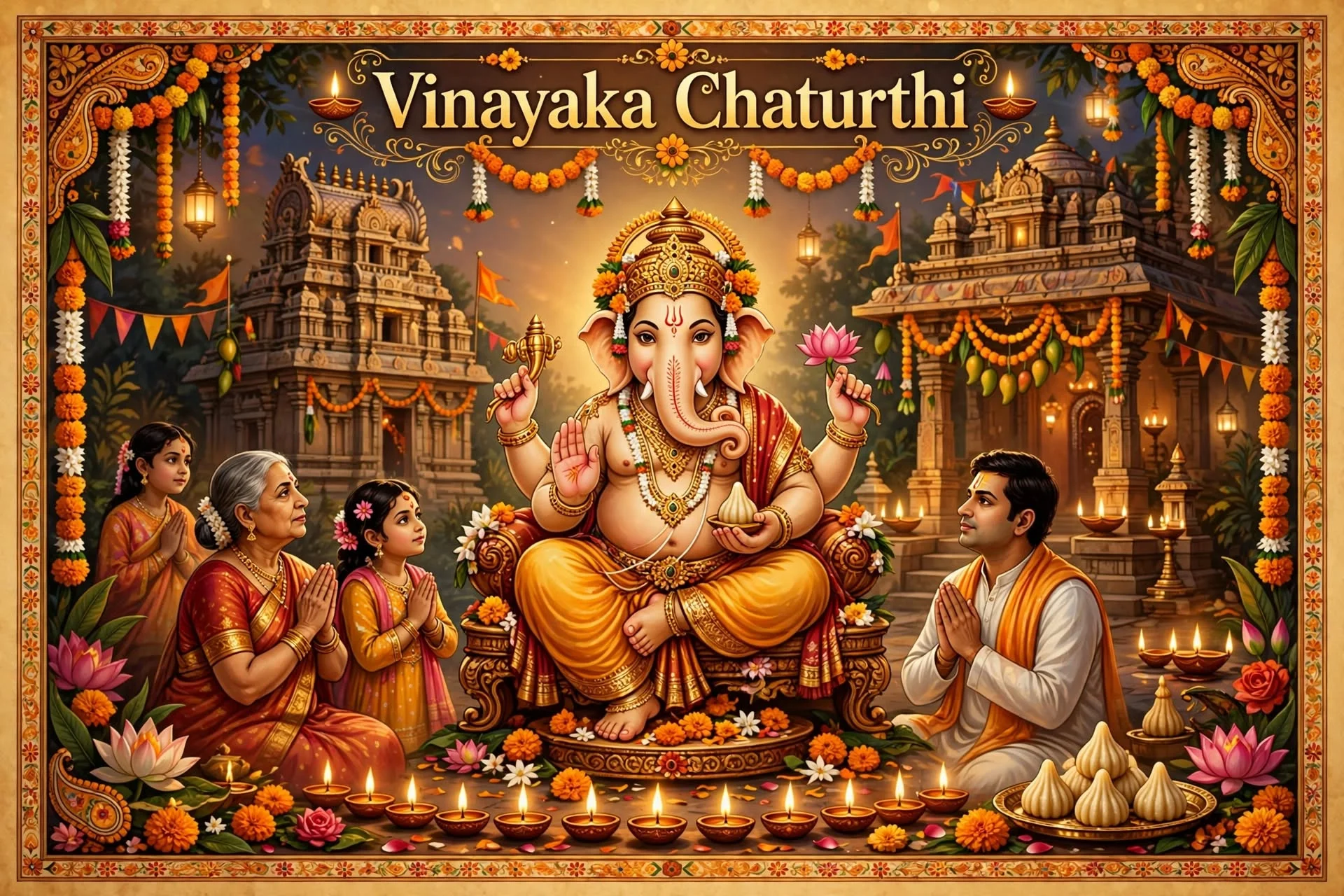
Vinayaka Chaturthi
Vinayaka Chaturthi is a Hindu religious observance dedicated to Lord Ganesha, the remover of obstacles, the deity of wisdom, knowledge and auspicious beginnings. It is observed on Shukla Paksha Chaturthi, the fourth lunar day of the waxing fortnight, in each Hindu lunar month. Devotees worship Lord Ganesha through prayers, fasting, mantra chanting, offerings and meditation to seek his blessings for success, prosperity, wisdom and the removal of difficulties.