




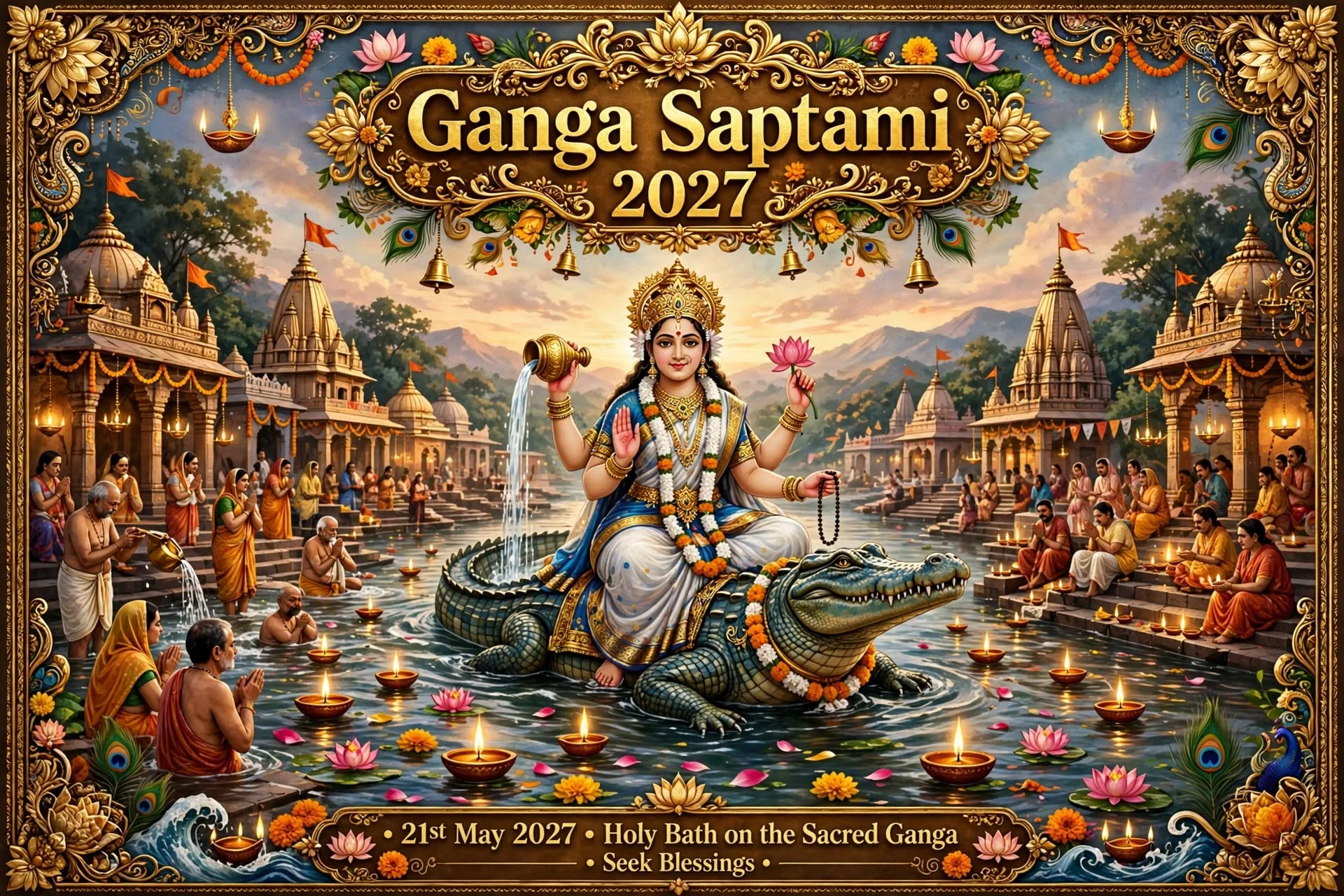
Ganga Saptami, also revered as Ganga Pujan or Ganga Jayanti, is a sacred festival celebrated on the Shukla Paksha Saptami (seventh lunar day) of the holy month of Vaishakha. While Ganga Dussehra (in the subsequent month of Jyeshtha) commemorates the original descent of the heavenly river from the celestial realm onto Lord Shiva's matted locks and subsequently to the earth, Ganga Saptami specifically celebrates the rebirth or re-emergence of Mother Ganga from the ear of the revered Sage Jahnu, earning her the illustrious title "Jahnavi".
Ganga Saptami 2027: Date, Puja Timings, Rituals & Stories
Ganga Saptami Timings & Panchang
Important festival dates and auspicious timings
Usha Arghya (Sunrise)
05:33 am
Sandhya Arghya (Sunset)
07:03 pm
Start Date
Wednesday, 12 May 2027
Puja Muhurat
01:24 am – 11:13 pm
Ganga Saptami
According to Vedic and Pauranic traditions, when the torrential river followed King Bhagiratha's chariot towards the ocean, her tumultuous currents inadvertently submerged the sacred sacrificial altar and hermitage of Maharshi Jahnu. Incensed by this disturbance during his deep meditation, the sage miraculously consumed the entire river in one sip using his yogic powers. Upon the desperate pleas of Bhagiratha and the celestial gods, Sage Jahnu relented and released Ganga through his right ear on Vaishakha Shukla Saptami, adopting her as his spiritual daughter.
Pilgrims and devotees assemble in immense numbers along sacred riverbanks, especially at Haridwar, Rishikesh, Prayagraj, and Varanasi, to take ritual dawn dips, float earthen lamps (Deepa Dana) upon the holy waters, and recite the Ganga Stotram composed by Adi Shankaracharya to wash away lifetime karmas and mental impurities.
Why is Ganga Saptami Celebrated?
Ganga Saptami is celebrated to commemorate the rebirth of the river of divine grace (Maa Ganga) and to express eternal gratitude to the life-giving, purifying waters that sustain the cultural and spiritual heartbeat of India. It marks the day when divine water was liberated after being absorbed by yogic penance, symbolizing that even divine forces respect the authority of supreme spiritual discipline.
It is also celebrated to invoke physical vitality, purification of the mind from sorrow and guilt, and liberation from cyclic rebirth (Moksha).
- Celebrates the re-emergence of River Ganga as Jahnavi from the ear of Sage Jahnu.
- Provides spiritual purification and dissolves negative karmas through holy river snana and prayer.
- Honors the perseverance of King Bhagiratha in bringing heavenly grace to purify mortal ancestors.
- Promotes ecological reverence, clean water stewardship, and devotion to sacred rivers.
The Legend of Sage Jahnu and the Re-birth of Ganga as Jahnavi
Bhagiratha's Tapasya and Ganga's Torrent
As chronicled in the Balakanda of the Valmiki Ramayana and the Kashi Khanda of the Skanda Purana, King Bhagiratha undertook centuries of unmatched penance to bring the celestial river Mandakini down to earth to liberate the sixty thousand charred sons of King Sagara. Lord Shiva contained the ferocious force of the descending river within His matted hair, gently releasing her into seven streams.
Guided by Bhagiratha's blowing of the conch shell, Ganga surged forward across plains and mountains. However, overcome by youthful pride in her boundless speed and volume, her crashing waves swept through the quiet hermitage of the venerable Sage Jahnu, scattering his sacred fire altars, kusha mats, and sacrificial vessels.
Sage Jahnu's Feat and Divine Re-emergence
Displaying extraordinary yogic mastery, Sage Jahnu opened his mouth and effortlessly swallowed the entire river in a single sip, leaving the dry riverbed empty and halting Bhagiratha's mission in despair. Bhagiratha, accompanied by Indra and the assembled devas, fell at the feet of the sage, offering exalted hymns and explaining the noble purpose of the river's journey.
Mollified by their sincere devotion and recognizing the cosmic destiny of the river, Sage Jahnu released Ganga through his ear on the seventh day of the bright fortnight of Vaishakha. Since she was reborn from his body, Jahnu embraced her as his daughter, and she became celebrated throughout the three worlds as Jahnavi.
Source: Valmiki Ramayana, Balakanda, Sarga 43 & Skanda Purana, Kashi Khanda
Water as Consciousness and the Reconciliation of Power with Wisdom
Reconciling Dynamic Energy with Spiritual Stillness
Ganga represents the dynamic, flowing torrent of divine life-force (Shakti), while Sage Jahnu embodies the quiet, immovable mountain of meditative awareness (Shiva Tattva). When uncontrolled dynamism clashes with inner stillness, conflict arises. The miracle of Ganga Saptami illustrates how raw dynamic power, when disciplined and channeled through the wisdom of meditation, becomes a blessing for the entire cosmos.
The Metaphor of Continual Purification
Mother Ganga is known as "Patita Pavani"—the elevator of the fallen. Symbolically, her waters remind the human soul that no matter how burdened by worldly mistakes or karmic residues, sincere immersion in the current of divine contemplation restores original purity and luminosity.
Ritual Traditions and Riverbank Observances
Brahma Muhurta Snana and Surya Tarpan
Devotees assemble along the banks of the Ganga or local water bodies at dawn. Stepping into the holy waters, they chant Vedic mantras, take three or seven dips facing the rising sun, and offer water oblations to the Sun God, Sage Jahnu, King Bhagiratha, and Lord Shiva.
Evening Maha Aarti and Deepa Danam
At dusk, thousands of brass multi-tiered lamps are lit along the river ghats of Haridwar, Rishikesh, and Varanasi. Devotees release small leaf boats (Donas) carrying lit oil lamps, fragrant marigolds, and incense onto the sparkling waters, accompanied by resonant temple bells and conch blowing.
Ganga Saptami Puja Vidhi (Step by Step)
- 1
Pratah Snana
Take a sacred bath in the river Ganga or bathe at home with water consecrated by adding Gangajal while reciting "Gange Cha Yamune Chaiva".
- 2
Sankalpa
Hold pure river water, flowers, and unbroken akshata in hand, making a solemn pledge to observe Ganga Saptami with devotion and purity.
- 3
Altar Preparation
Place an image of Mother Ganga seated upon her crocodile vahana (Makara) or a copper Kalash filled with pure Ganga water on a clean wooden seat.
- 4
Avahana and Dhyana
Invoke the presence of Goddess Ganga, Sage Jahnu, and King Bhagiratha with folded hands and reverent Sanskrit verses.
- 5
Shodashopachara Snana
Offer ceremonial drops of milk, honey, rose water, and gangajal to the deity or Kalash while chanting sacred hymns.
Ganga Saptami Puja Samagri List
River and Altar Puja Materials
Sacred materials assembled for riverbank or home altar worship.
- Ganga water in copper Kalash
- Idol or portrait of Goddess Ganga
- Red and white silk chunri
- Malayagiri chandan and pure sindoor
- Unbroken rice grains (Akshata)
- Fresh flower garlands and lotus blossoms
Deepa Danam and Lighting Articles
Items required for the traditional floating lamp ceremony.
- Earthen clay lamps (Diyas)
- Pure cow ghee or sesame oil
- Cotton wicks and matchbox
- Biodegradable leaf plates (Donas)
- Camphor for aarti
- Natural dhoop sticks
Prasadam and Consecrated Foods
Sattvic food offerings acceptable for Mother Ganga.
- White milk sweets (Mishri, Peda, Kheer)
- Fresh seasonal fruits (Melons, Mangoes)
Mantras and Prayers for Ganga Saptami
Ganga Saptami Vrat Rules and Fasting Guidelines
Sattvic Conduct and Fasting Guidelines
Devotees observing the Ganga Saptami vrat maintain absolute purity of speech, dietary simplicity, and devotion.
- Observe a daytime fast partaking only of fruits, milk, or pure water
- Abstain from grains, cereals, salt, and non-sattvic foods until evening aarti
- Dedicate the day to chanting the Ganga Sahasranama or reading the Ramayana
Environmental and Spiritual Ethics
The observance requires strict ecological consciousness regarding water bodies.
- Never use chemical soaps, detergents, or throw non-biodegradable trash into rivers
- Float only natural earthen lamps with flower petals that dissolve harmlessly
- Feed fish and aquatic life with flour balls (Aata golis) with reverence
Dos and Don'ts of Ganga Saptami
Good Practices (Do's)
- Take a holy bath early in the morning while chanting sacred river mantras.
- Offer pure water, milk, and flowers to River Ganga or at home in a Kalash.
- Recite the Ganga Stotram with sincere devotion and contemplative focus.
- Float biodegradable earthen lamps with flower petals during the evening twilight.
- Keep water bodies, riverbanks, and surroundings impeccably clean.
Ganga Saptami Across Regions
| Region | Local Name |
|---|---|
| Uttarakhand (Haridwar, Rishikesh, Devprayag) | Ganga Janmotsav / Ganga Jayanti |
| Uttar Pradesh & Bihar (Varanasi, Prayagraj, Patna) | Ganga Saptami Pujan |
| West Bengal (Kolkata, Gangasagar) | Jahnavi Saptami |
Ganga Saptami FAQs
What is the distinction between Ganga Saptami and Ganga Dussehra?
Ganga Saptami (Vaishakha Shukla Saptami) marks the rebirth of Ganga from the ear of Sage Jahnu as Jahnavi, whereas Ganga Dussehra (Jyeshtha Shukla Dashami) commemorates her initial descent from the heavens to earth.
Why is River Ganga addressed as Jahnavi?
After Sage Jahnu swallowed the river for flooding his hermitage, he released her through his ear upon Bhagiratha's prayers, adopting her as his daughter. Hence, she is celebrated as Jahnavi (daughter of Jahnu).
How can a devotee observe Ganga Saptami if they cannot travel to the river?
One can add a few drops of stored Gangajal into home bathwater, face the north or east direction, and chant the sacred snana mantra ("Gange Cha Yamune Chaiva..."). Mental devotion is fully honored in Vedic thought.
Upcoming Festivals
View All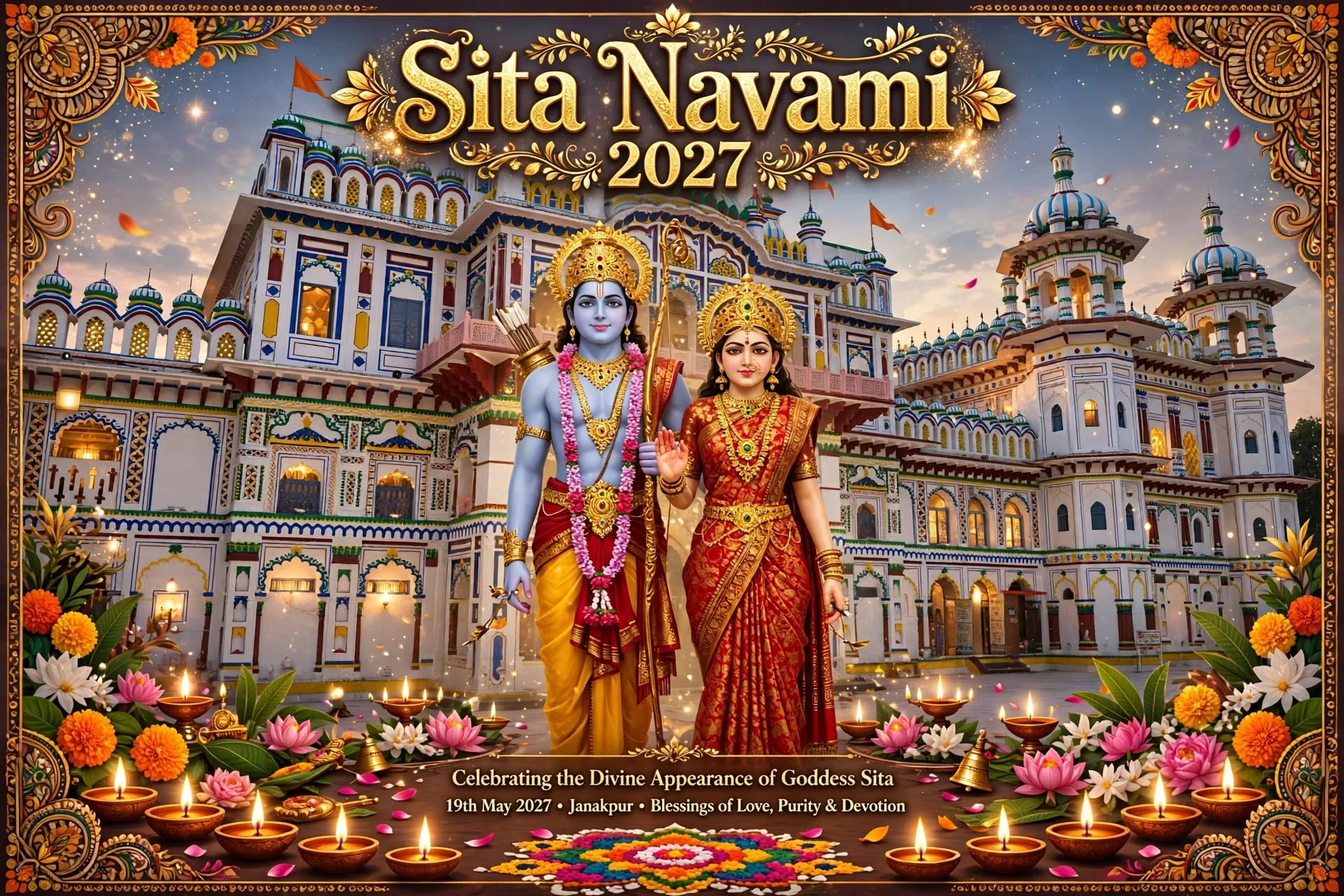
Friday, May 14, 2027
Sita Navami
Sita Navami, widely celebrated as Janaki Jayanti, marks the sacred appearance anniversary of Goddess Sita, the divine consort of Lord Rama and the supreme embodiment of devotion, sacrifice, moral fortitude, and dharmic grace. Falling on the Shukla Paksha Navami (ninth lunar day) of the holy month of Vaishakha, this auspicious tithi occurs exactly one month after Rama Navami (Chaitra Shukla Navami), symbolizing the cosmic unity and balance of Sri Rama and Mata Sita.
View Festival Guide
Saturday, May 15, 2027
Vrishabha Sankranti
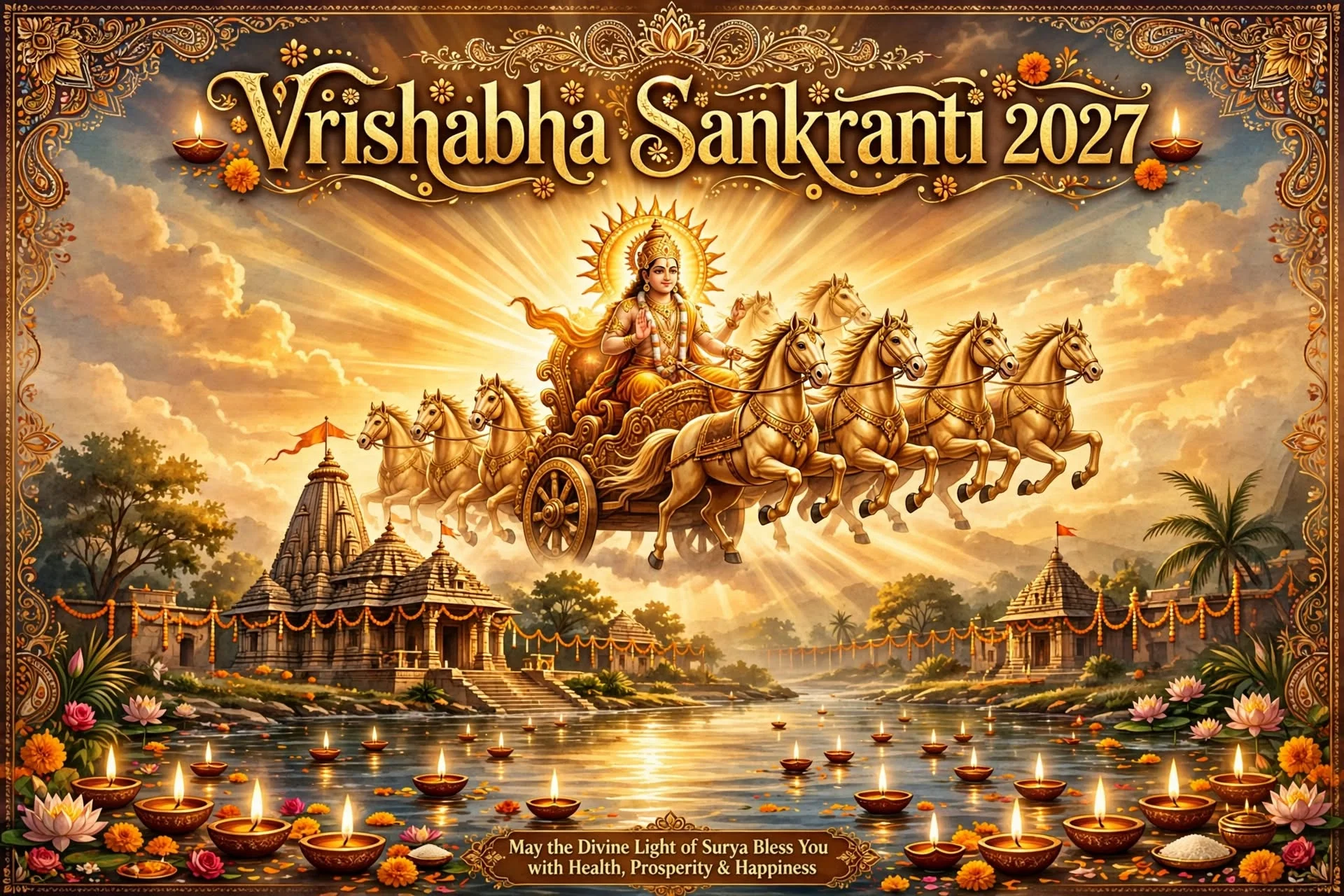
Vrishabha Sankranti, also known as Vrishabha Sankramanam, marks the astronomical transition of the Sun (Surya) from Mesha Rashi (Aries) into Vrishabha Rashi (Taurus) in the sidereal zodiac. This solar ingress marks the beginning of the Vrishabha solar month and is traditionally observed around the middle of May. The Sanskrit word 'Vrishabha' means bull and represents the second sign of the zodiac, associated in Hindu astrological tradition with stability, nourishment, fertility, patience, and material sustenance.
View Festival Guide
Sunday, May 16, 2027
Mohini Ekadashi
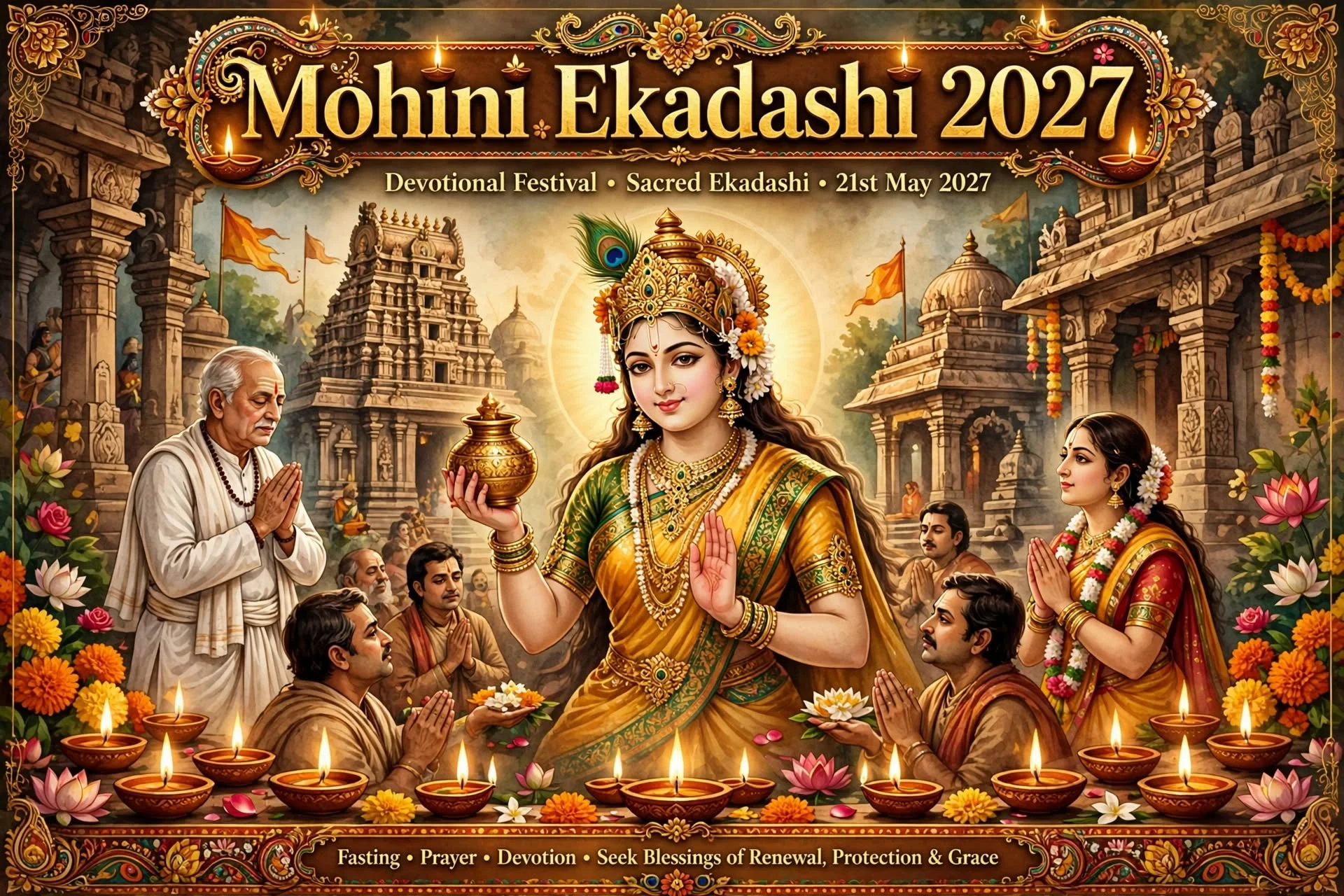
Mohini Ekadashi is an extraordinarily celebrated and sacred fasting observance occurring during the Shukla Paksha (waxing lunar phase) of the auspicious Hindu month of Vaishakha. This holy tithi commemorates the divine manifestation of Lord Vishnu's only female incarnation—the mesmerizing, enchantingly beautiful enchantress Mohini. Manifesting during the cosmic churning of the celestial ocean (Samudra Manthan), Mohini Avatar protected cosmic balance by distributing the nectar of immortality (Amrita) to the benevolent devas while outwitting the aggressive asuras.
View Festival Guide
Monday, May 17, 2027
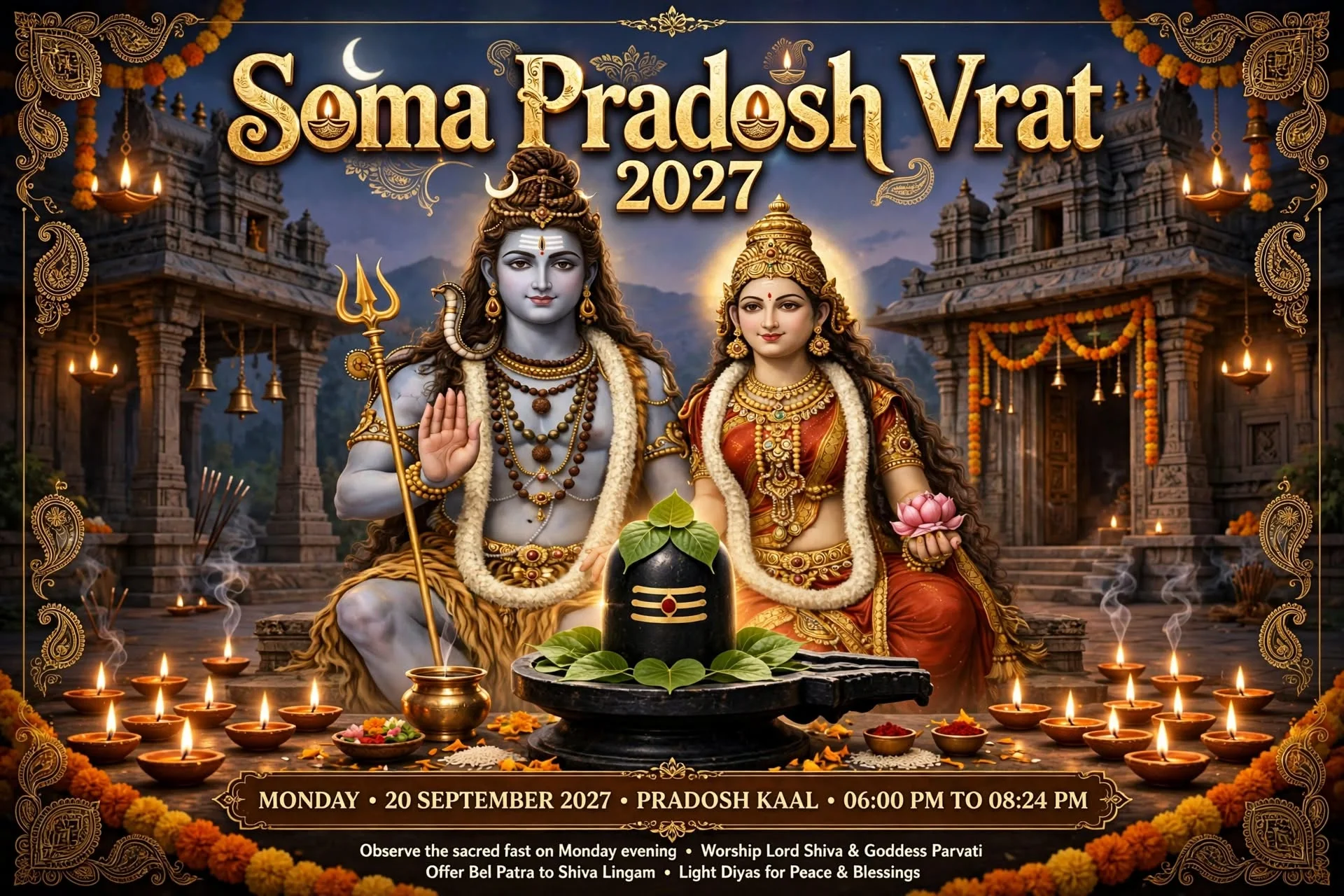
Soma Pradosh Vrat
Soma Pradosh Vrat, also known as Som Pradosh Vrat or Soma Trayodashi, is a Hindu fasting and worship observance dedicated primarily to Lord Shiva. It is observed when Trayodashi, the thirteenth lunar day of either Shukla Paksha or Krishna Paksha, coincides with Monday. Monday is traditionally associated with Lord Shiva, which gives this Pradosh observance its name.
View Festival Guide
Tuesday, May 18, 2027
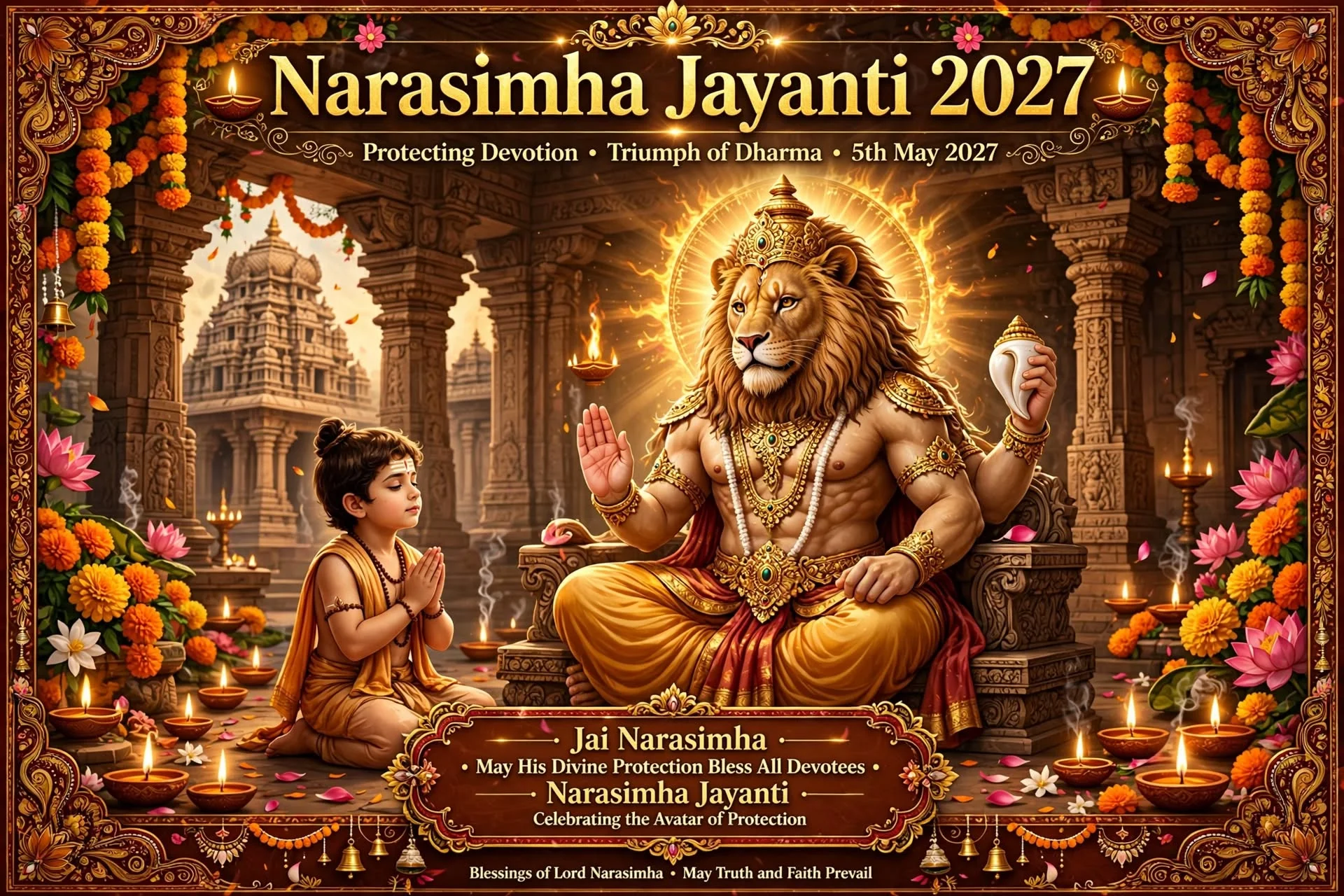
Narasimha Jayanti
Narasimha Jayanti marks the ferocious yet intensely protective divine manifestation of Lord Narasimha—the fourth incarnation (Avatar) of Lord Vishnu—who descended in an extraordinary half-man, half-lion form to vanquish the despotic demon king Hiranyakashipu and protect His unswerving young devotee Bhakta Prahlada. Celebrated on the Shukla Paksha Chaturdashi (fourteenth lunar day) of the holy month of Vaishakha, this festival represents the triumph of innocent devotion over tyrannical power and the omnipresence of God across creation.
View Festival Guide
Wednesday, May 19, 2027
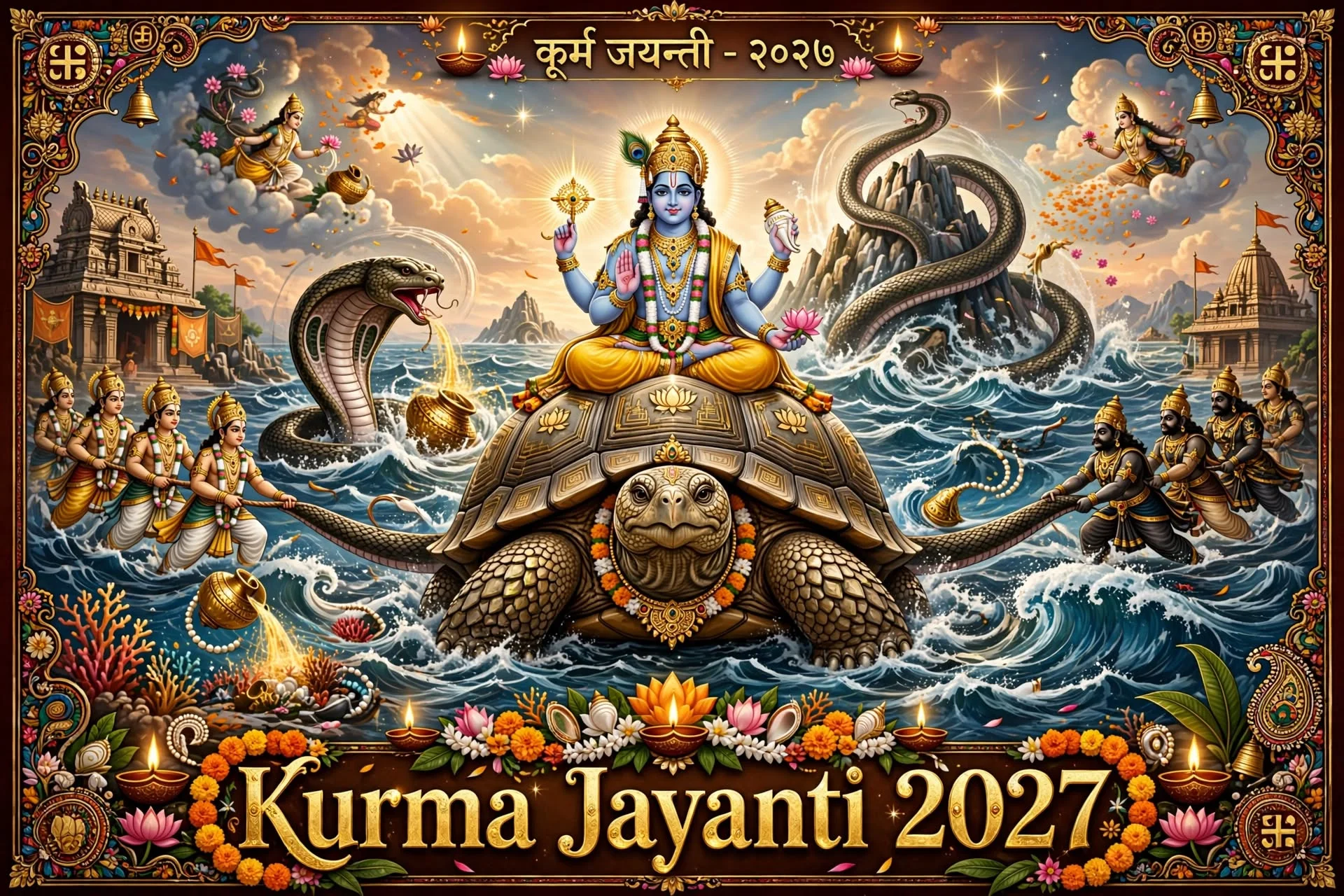
Kurma Jayanti
Kurma Jayanti marks the divine appearance anniversary of Bhagavan Kurma, the second divine incarnation (Avatar) of Lord Vishnu, manifesting in the form of a gigantic tortoise during the Satya Yuga on the auspicious tithi of Vaishakha Shukla Purnima (the full moon day of Vaishakha). Manifesting during the monumental cosmic churning of the celestial ocean (Samudra Manthan), Lord Kurma provided His massive, unyielding shell as the bedrock pivot to support the sinking Mount Mandara, saving the cosmic endeavor and enabling the extraction of the nectar of immortality (Amrita) and Goddess Mahalakshmi.
View Festival Guide
Thursday, May 20, 2027
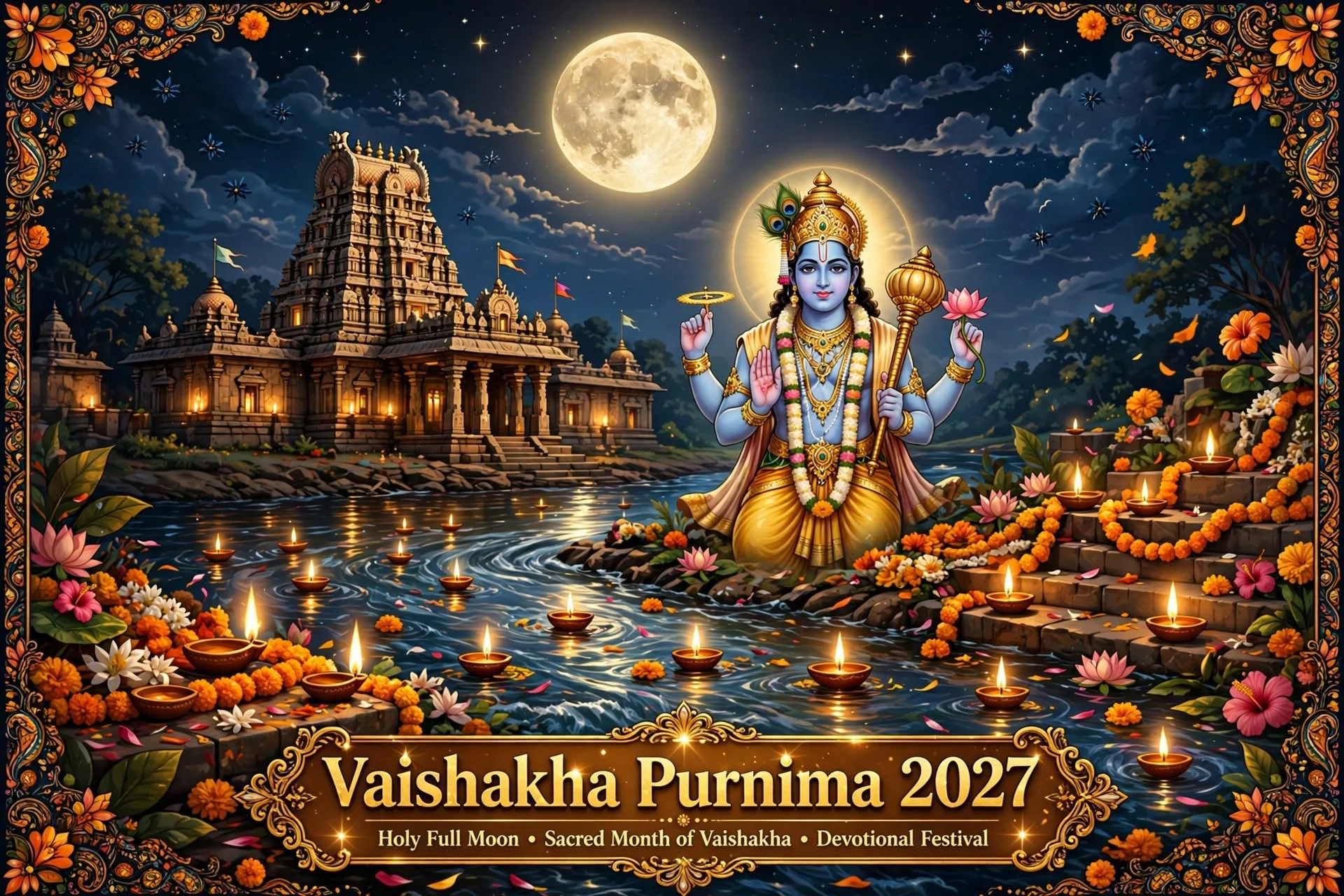
Vaishakha Purnima
Vaishakha Purnima is the sacred full-moon day occurring on the Purnima Tithi of Shukla Paksha in the Hindu lunar month of Vaishakha. It is one of the spiritually significant Purnima observances in the Hindu calendar and is associated with sacred bathing, charity, worship of Lord Vishnu, remembrance of ancestors, and spiritual discipline. The word Purnima refers to the full-moon phase, symbolizing completeness, illumination, and the culmination of the lunar fortnight. Vaishakha is traditionally regarded as a particularly meritorious month for religious observances, making its concluding full moon an important occasion for devotees.
View Festival Guide
Thursday, May 20, 2027
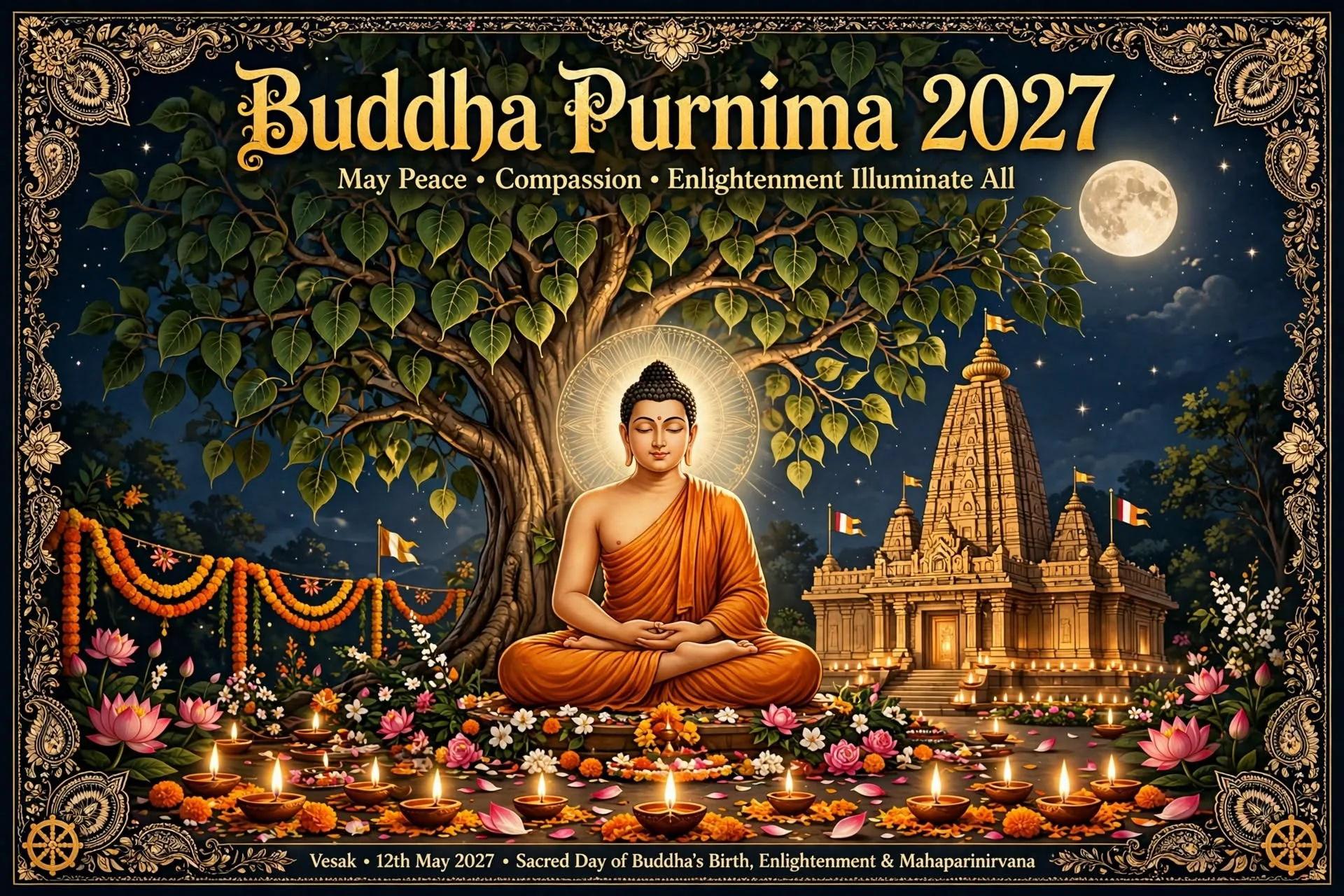
Buddha Purnima
Buddha Purnima, internationally celebrated as Buddha Jayanti or Vesak, is one of the most sublime and universally revered spiritual festivals, falling on the sacred full moon day (Purnima) of the holy month of Vaishakha. This momentous tithi commemorates the thrice-blessed milestone (Thrice-Holy Vesak) in the life of Gautama Buddha: his miraculous birth as Prince Siddhartha in Lumbini, his supreme enlightenment (Bodhi) beneath the Bodhi tree in Bodh Gaya, and his ultimate transition into final liberation (Mahaparinirvana) in Kushinagar.
View Festival Guide